
Vex and Engineering Design for Launch Activities Stephanie


- Slides: 30
“Vex and Engineering Design for Launch Activities”
Stephanie Racine, M. Ed. PLTW Master Teacher PLTW Launch Lead Teacher Mother of two beautiful girls, wife, 22 yr veteran teacher, Star Wars fanatic, Lego master builder and overall fan of anything from the 1980’s. Currently working as a computer science teacher at Ponaganset Middle School in Foster, RI. Email: sracine@fgschools. com Instagram: @stemracine Twitter: @scienceracine
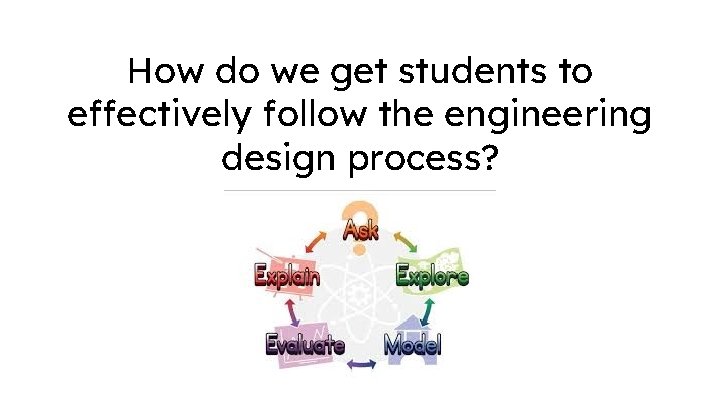
How do we get students to effectively follow the engineering design process?
DEFINE: What was the problem you are trying to solve?
RESEARCH & DOCUMENT: How had this problem been solved in the past? What skills or knowledge will you need to design a model?
SKETCH: Create a sketch of your solution that includes labels, information about how it works and possible materials to create a prototype. DECISION MATRIX: Decide as a team which idea meets the criteria and constraints.
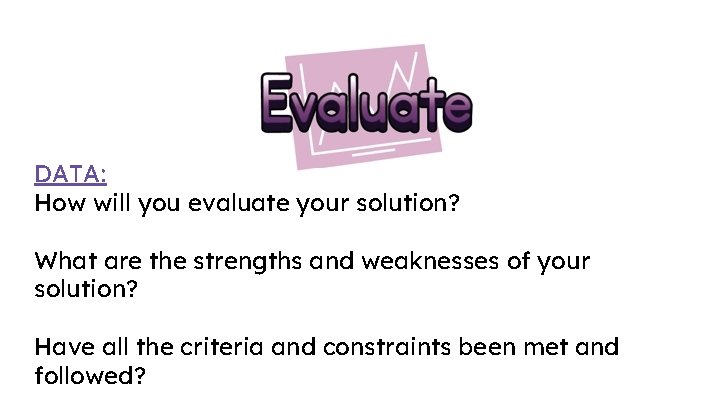
DATA: How will you evaluate your solution? What are the strengths and weaknesses of your solution? Have all the criteria and constraints been met and followed?
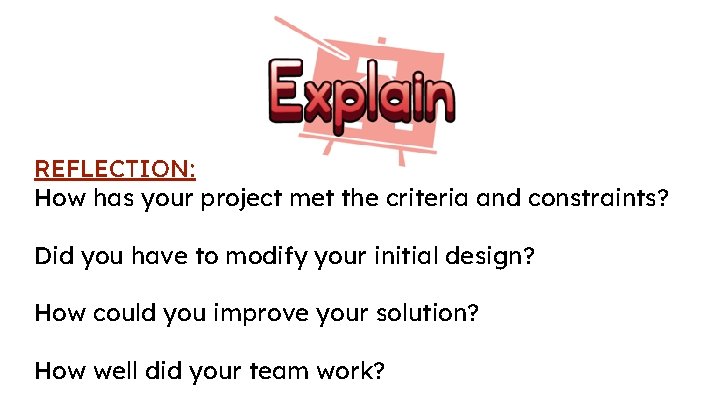
REFLECTION: How has your project met the criteria and constraints? Did you have to modify your initial design? How could you improve your solution? How well did your team work?
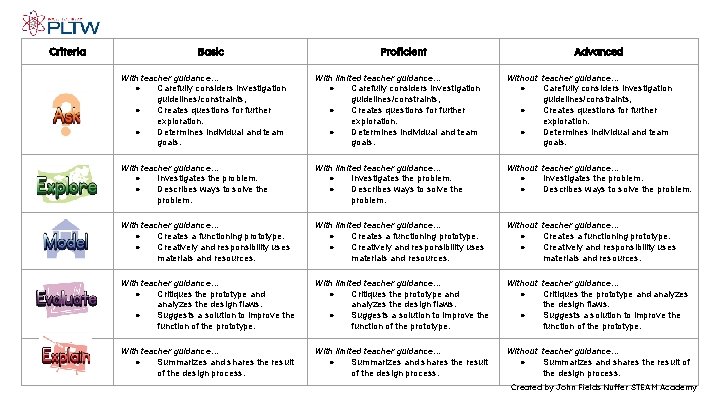
Criteria Basic Proficient Advanced With teacher guidance… ● Carefully considers investigation guidelines/constraints, ● Creates questions for further exploration. ● Determines individual and team goals. With limited teacher guidance… ● Carefully considers investigation guidelines/constraints, ● Creates questions for further exploration. ● Determines individual and team goals. Without teacher guidance… ● Carefully considers investigation guidelines/constraints, ● Creates questions for further exploration. ● Determines individual and team goals. With teacher guidance… ● Investigates the problem. ● Describes ways to solve the problem. With limited teacher guidance… ● Investigates the problem. ● Describes ways to solve the problem. Without teacher guidance… ● Investigates the problem. ● Describes ways to solve the problem. With teacher guidance… ● Creates a functioning prototype. ● Creatively and responsibility uses materials and resources. With limited teacher guidance… ● Creates a functioning prototype. ● Creatively and responsibility uses materials and resources. Without teacher guidance… ● Creates a functioning prototype. ● Creatively and responsibility uses materials and resources. With teacher guidance… ● Critiques the prototype and analyzes the design flaws. ● Suggests a solution to improve the function of the prototype. With limited teacher guidance… ● Critiques the prototype and analyzes the design flaws. ● Suggests a solution to improve the function of the prototype. Without teacher guidance… ● Critiques the prototype and analyzes the design flaws. ● Suggests a solution to improve the function of the prototype. With teacher guidance… ● Summarizes and shares the result of the design process. With limited teacher guidance… ● Summarizes and shares the result of the design process. Without teacher guidance… ● Summarizes and shares the result of the design process. Created by John Fields Nuffer STEAM Academy
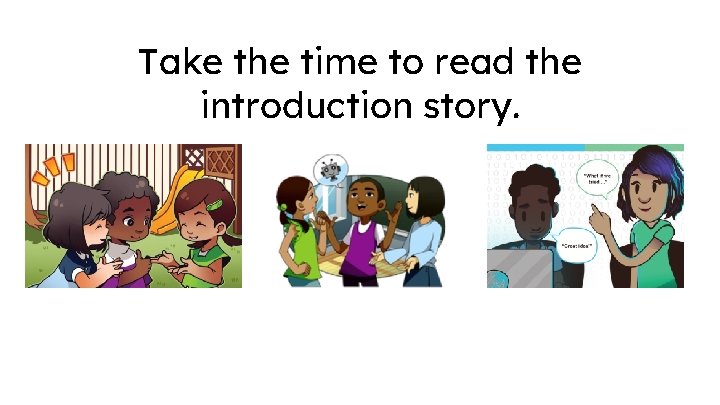
Take the time to read the introduction story.
5 th Grade Robotics & Animation Example of one lesson with all the steps of the design process.
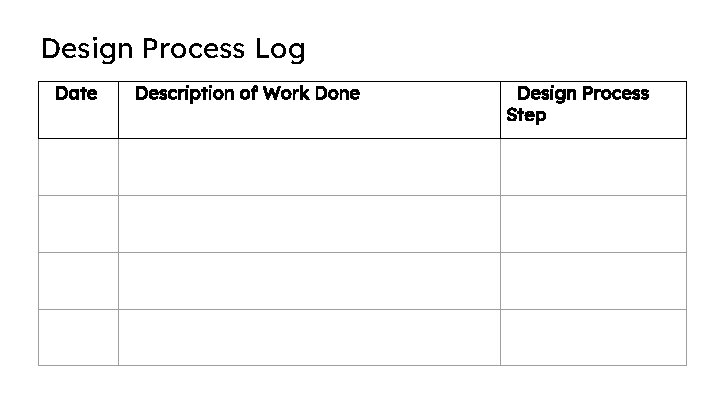
Design Process Log Date Description of Work Done Design Process Step
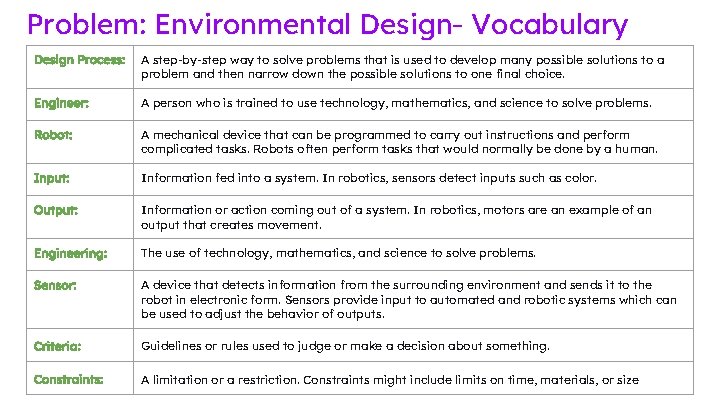
Problem: Environmental Design- Vocabulary Design Process: A step-by-step way to solve problems that is used to develop many possible solutions to a problem and then narrow down the possible solutions to one final choice. Engineer: A person who is trained to use technology, mathematics, and science to solve problems. Robot: A mechanical device that can be programmed to carry out instructions and perform complicated tasks. Robots often perform tasks that would normally be done by a human. Input: Information fed into a system. In robotics, sensors detect inputs such as color. Output: Information or action coming out of a system. In robotics, motors are an example of an output that creates movement. Engineering: The use of technology, mathematics, and science to solve problems. Sensor: A device that detects information from the surrounding environment and sends it to the robot in electronic form. Sensors provide input to automated and robotic systems which can be used to adjust the behavior of outputs. Criteria: Guidelines or rules used to judge or make a decision about something. Constraints: A limitation or a restriction. Constraints might include limits on time, materials, or size
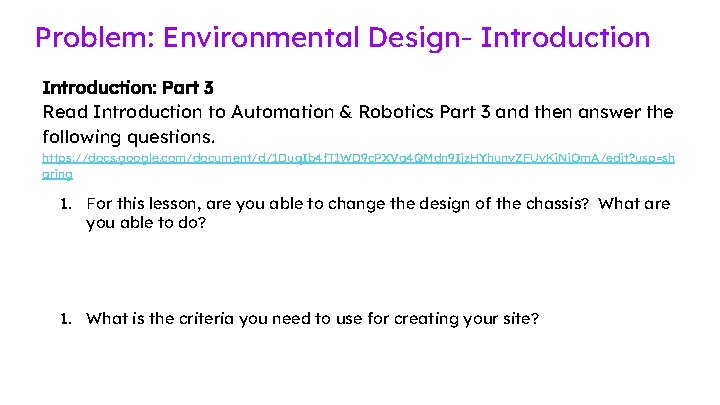
Problem: Environmental Design- Introduction: Part 3 Read Introduction to Automation & Robotics Part 3 and then answer the following questions. https: //docs. google. com/document/d/1 Duq. Ib 4 f. T 1 WD 9 c. PXVa 4 QMdn 9 Ijz. HYhunv. ZFUv. Ki. Ni. Om. A/edit? usp=sh aring 1. For this lesson, are you able to change the design of the chassis? What are you able to do? 1. What is the criteria you need to use for creating your site?
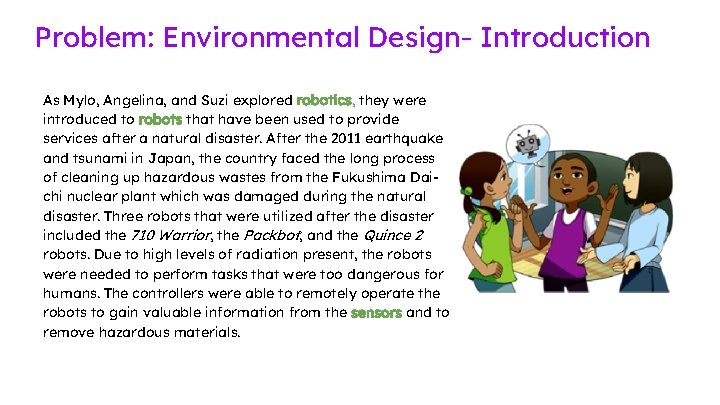
Problem: Environmental Design- Introduction As Mylo, Angelina, and Suzi explored robotics, they were introduced to robots that have been used to provide services after a natural disaster. After the 2011 earthquake and tsunami in Japan, the country faced the long process of cleaning up hazardous wastes from the Fukushima Daichi nuclear plant which was damaged during the natural disaster. Three robots that were utilized after the disaster included the 710 Warrior, the Packbot, and the Quince 2 robots. Due to high levels of radiation present, the robots were needed to perform tasks that were too dangerous for humans. The controllers were able to remotely operate the robots to gain valuable information from the sensors and to remove hazardous materials.
Problem: Environmental Design- Introduction Continued In this design problem, you will work with a group to design, model, and test a robot that can remove hazardous materials (represented by blocks) from a disaster site. Your group will also design the layout of the site to include a water site and a hazardous materials collection zone. The site dimensions should not exceed a five by five feet area that is made from available materials. For this problem your robot should be able to remove a minimum of five “hazardous materials” within a two minute time period while protecting the water. The robot chassis built in your Project will provide the base of your robot. You may add parts to the robot, but you may not remove any parts of the original design. You are also required to use a minimum of one sensor in your solution to the problem.
Problem: Environmental Design- Procedure 1. As part of a team, you will design and evaluate a robot that can remove hazardous materials from a site that you create using the following design criteria and constraints: a. You may add to the original chassis design but may not remove any original parts. b. The robot will be operated remotely using the controller. c. The site must be no larger than 5 ft. by 5 ft. in size. You may use masking tape to create the site boundaries, or you may create a “site” on butcher paper, poster board, construction paper, or other available materials. d. A water area must be included in your site but must also be avoided by the hazardous materials. The water area should take up approximately 1/3 of the area of the site. e. A hazardous waste collection zone must be included. The hazardous waste collection zone must be located on the opposite side from the entry to the site. f. A minimum of 5 hazardous materials (represented by wooden blocks) must be removed from the site within a two minute time period.
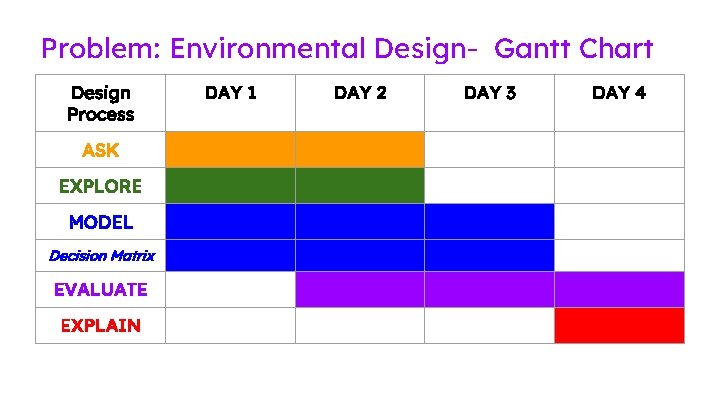
Problem: Environmental Design- Gantt Chart Design Process ASK EXPLORE MODEL Decision Matrix EVALUATE EXPLAIN DAY 1 DAY 2 DAY 3 DAY 4
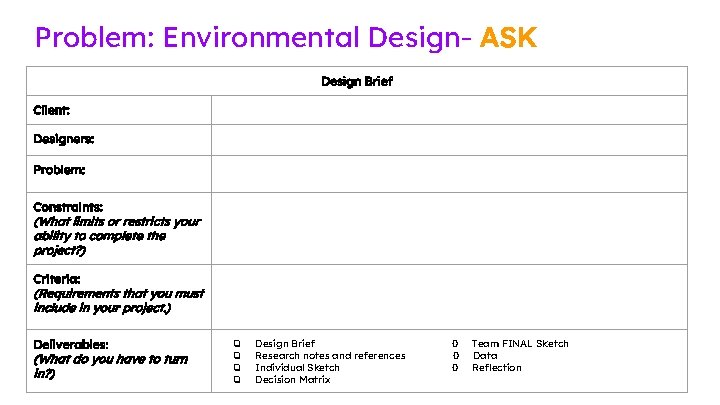
Problem: Environmental Design- ASK Design Brief Client: Designers: Problem: Constraints: (What limits or restricts your ability to complete the project? ) Criteria: (Requirements that you must include in your project. ) Deliverables: (What do you have to turn in? ) ❏ ❏ Design Brief Research notes and references Individual Sketch Decision Matrix 0 0 0 Team FINAL Sketch Data Reflection
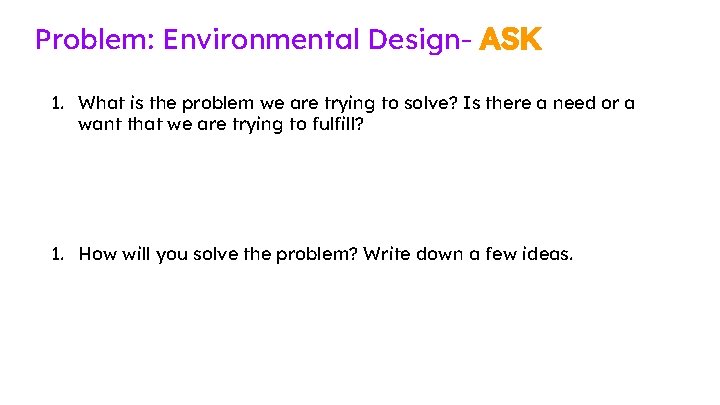
Problem: Environmental Design- ASK 1. What is the problem we are trying to solve? Is there a need or a want that we are trying to fulfill? 1. How will you solve the problem? Write down a few ideas.
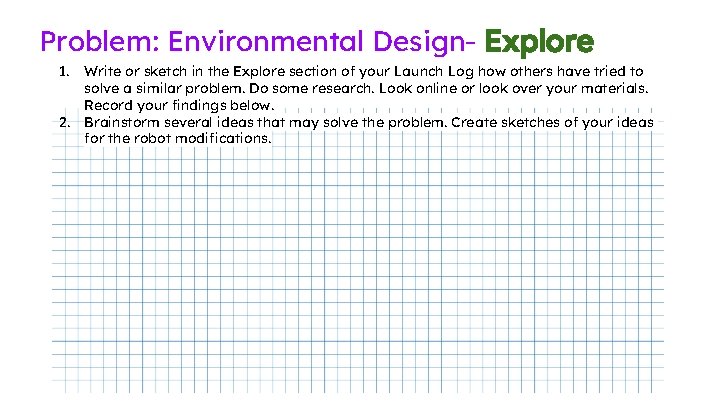
Problem: Environmental Design- Explore 1. 2. Write or sketch in the Explore section of your Launch Log how others have tried to solve a similar problem. Do some research. Look online or look over your materials. Record your findings below. Brainstorm several ideas that may solve the problem. Create sketches of your ideas for the robot modifications.
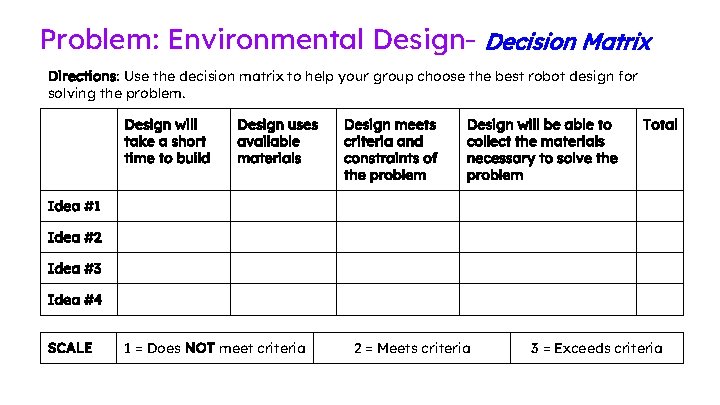
Problem: Environmental Design- Decision Matrix Now that all of the team members have completed a detailed robot design, the team must decide which designs most closely match the original criteria for the Environmental Design Problem. Up to this point, your team has been working hard on your design, and you most likely think that it is the best design in the class. If a vote were taken, everyone would probably vote for their own idea! Deciding which design is the best is not an easy task even for professional engineers. A decision matrix is a tool that a team or individual can use to look at each design objectively and compare the design to the original criteria. Components of each design are rated to see how they solved the original requirements or criteria. Numbers are used to rate or score each component, which can then be added up and averaged to get a final score.
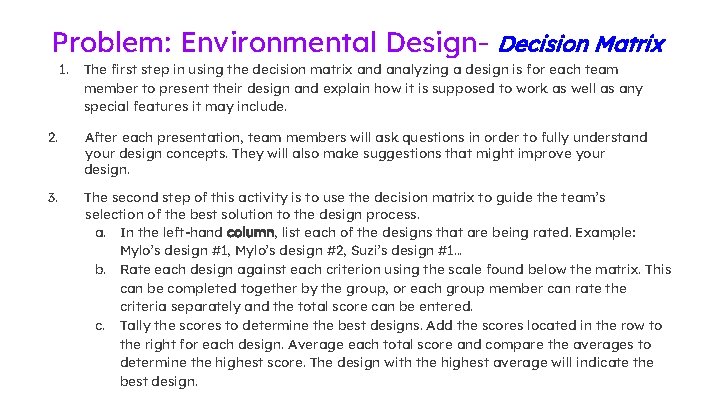
Problem: Environmental Design- Decision Matrix 1. The first step in using the decision matrix and analyzing a design is for each team member to present their design and explain how it is supposed to work as well as any special features it may include. 2. After each presentation, team members will ask questions in order to fully understand your design concepts. They will also make suggestions that might improve your design. 3. The second step of this activity is to use the decision matrix to guide the team’s selection of the best solution to the design process. a. In the left-hand column, list each of the designs that are being rated. Example: Mylo’s design #1, Mylo’s design #2, Suzi’s design #1… b. Rate each design against each criterion using the scale found below the matrix. This can be completed together by the group, or each group member can rate the criteria separately and the total score can be entered. c. Tally the scores to determine the best designs. Add the scores located in the row to the right for each design. Average each total score and compare the averages to determine the highest score. The design with the highest average will indicate the best design.
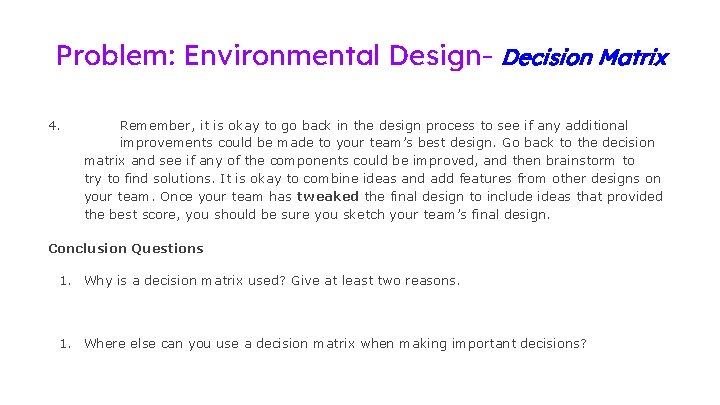
Problem: Environmental Design- Decision Matrix 4. Remember, it is okay to go back in the design process to see if any additional improvements could be made to your team’s best design. Go back to the decision matrix and see if any of the components could be improved, and then brainstorm to try to find solutions. It is okay to combine ideas and add features from other designs on your team. Once your team has tweaked the final design to include ideas that provided the best score, you should be sure you sketch your team’s final design. Conclusion Questions 1. Why is a decision matrix used? Give at least two reasons. 1. Where else can you use a decision matrix when making important decisions?
Problem: Environmental Design- Decision Matrix Directions: Use the decision matrix to help your group choose the best robot design for solving the problem. Design will take a short time to build Design uses available materials Design meets criteria and constraints of the problem Design will be able to collect the materials necessary to solve the problem Total Idea #1 Idea #2 Idea #3 Idea #4 SCALE 1 = Does NOT meet criteria 2 = Meets criteria 3 = Exceeds criteria
Problem: Environmental Design- Model Sketch the final design agreed upon by the Decision Matrix. Label your sketch with materials and other details, then build your prototype.
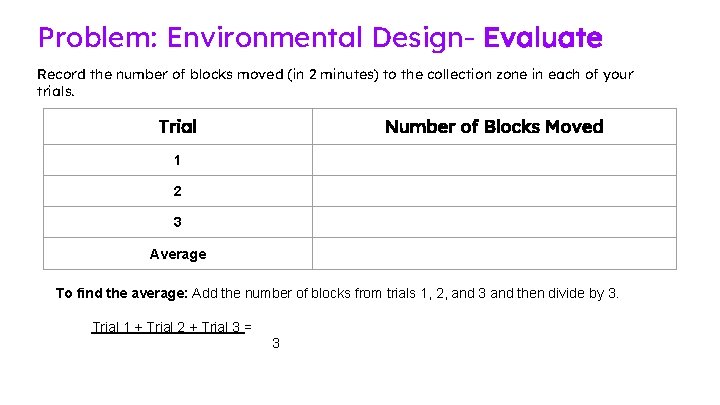
Problem: Environmental Design- Evaluate Record the number of blocks moved (in 2 minutes) to the collection zone in each of your trials. Trial Number of Blocks Moved 1 2 3 Average To find the average: Add the number of blocks from trials 1, 2, and 3 and then divide by 3. Trial 1 + Trial 2 + Trial 3 = 3
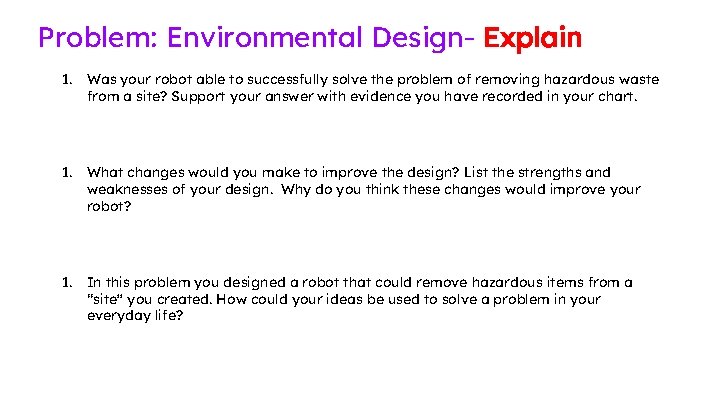
Problem: Environmental Design- Explain 1. Was your robot able to successfully solve the problem of removing hazardous waste from a site? Support your answer with evidence you have recorded in your chart. 1. What changes would you make to improve the design? List the strengths and weaknesses of your design. Why do you think these changes would improve your robot? 1. In this problem you designed a robot that could remove hazardous items from a “site” you created. How could your ideas be used to solve a problem in your everyday life?
Discuss Amongst Yourselves How would you modify and adapt your lessons to follow the design process? What are some challenges? How can we help you overcome them?