
VETERINARY PARASITOLOGY THIRD YEAR STAGE 2018 2019 PROF

- Slides: 20
VETERINARY PARASITOLOGY THIRD YEAR STAGE 2018 -2019 PROF. DR. GAHZI Y. AL-EMARAH PARASITOLOGEST Department of Veterinary Microbiology and Parasitology College of Veterinary Medicine University of Basrah
NEMATODA Chabretia ovina General Characteristics - Occur in the colon. - The host; sheep , goat , cattle and number of the ruminants throughout the world. - The males are 13 -14 mm long and the females 17 -20 mm long. The anterior end is curved slightly ventral and large buccal capsule opens anteroventrally. - There are leaf-crown and a shallow ventral cervical groove.
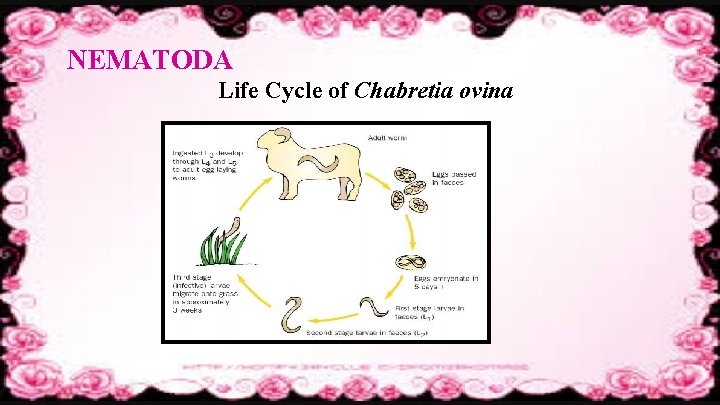
NEMATODA Chabretia ovina General Characteristics - The male bursa is well developed and the spicules are 1. 31. 7 mm long. - The eggs measure 90 -105 by 50 -55 Mm. Life Cycle - Infection occurs per os by larvae relatively long tail. - L 3 undergo an extensive histotropic phase in the wall of the small intestine prior to the third ecdyses 7 -8 days after infection.
NEMATODA Chabretia ovina Life Cycle - Up to 26 days reach the colon. - L 4 develop mainly in the lumen of the caecum. - The fourth ecdyses occurs on average about 24 days after infection. - P. P is 49 days.
NEMATODA Life Cycle of Chabretia ovina
NEMATODA Chabretia ovina Pathogenicity and Pathogenesis 1 - The granular layer which is digested by the secretion of the oesophageal glands of the worm. 2 - Worms suck blood. 3 - An increased activity of goblet cells and infiltration with lymphocytes and eosinophils.
NEMATODA Chabretia ovina Clinical Signs 1 - Diarrhoea with much blood and mucus. 2 - Lose condition and become anaemic and die. Diagnosis - Clinical signs. - Faecal culture. - Serological exam. Treatment Rx and benzimidazoles.
NEMATODA FAMILY: ANCYLOSTOMATOIDEA General Characteristics - The buccal capsule bears on its ventral margin 1 -4 pairs of teeth. - The dorsal gutter dose not project into the cavity of the buccal cavity to form a dorsal cone.
NEMATODA Ancylostoma caninum General Characteristics - Occure in the small intestine. - The host; dog, fox , wolf and other wild carnivores. rarely in man. - It’s cosmopolitan in distribution, being common in tropical and sub tropical zones in north Amerce , Australia and Asia. - The male is 10 -12 mm long and the female 14 -16 mm long.
NEMATODA Ancylostoma caninum General Characteristics - The worms are fairly rigid and gray or reddish in colour, depending on the presence of the blood in the alimentary canal. - The anterior end is bent dorsal and the oral aperture is the directed anterodorsally. - The buccal capsule is deep.
NEMATODA Ancylostoma caninum General Characteristics -There are bears three teeth on either side of the buccal capsule (in the depth of the capsule there is a pair of triangular dorsal teeth a pair of centrolateral teeth). -The male bursa is well developed and the spicules are 0. 80. 95 mm long. - The vulva is situated near the junction of the second and last thirds the body. .
NEMATODA Ancylostoma caninum General Characteristics - The eggs measure 56 -75 by 34 -47 Mm and contain about eight cells when passed in the faeces.
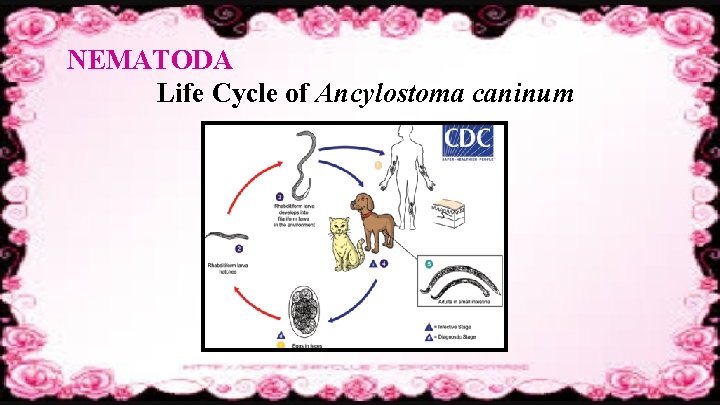
NEMATODA Ancylostoma caninum Life Cycle Adult female produce 16000 eggs per day. The pre-infection stages are none resistant to desiccation , so that they are found only in moist surrounding. -The optimal temperature for development is between 23 and 30ºc. A variety of developmental pathways may occur following infection.
NEMATODA Ancylostoma caninum Life Cycle 1 - Oral infection May be the larvae are placed in the mouth a preparation will penetrate the buccal and pharyngeal epithelia and undergo migration as skin penetration. 2 - Skin penetration Leads to migration to the lungs and by tracheal migration to the intestine (somatic migration). 3 - Prenatal infection
NEMATODA Ancylostoma caninum Life Cycle 4 - Colostral or lactogenic infection - The larvae after enter the host reach blood vessels or lymphatic vessel and are carried by these via the venous system or thoracic duct to the heart and lungs - larvae pass into the alveoli and migrate up the bronchioles , bronchi and trachea and are then swallowed and mature in the small intestine. - P. P is 17 days.
NEMATODA Life Cycle of Ancylostoma caninum
NEMATODA Ancylostoma caninum Pathogenicity and Pathogenesis 1 - Anaemia 2 - Worms suck blood due to poor source of iron in blood and milk. 3 - An increased activity of goblet cells and infiltration with lymphocytes and eosinophils. 4 - The animals are more able to cope with the blood lose, which could be at a rate of as much as one –quarter of the total circulating erythrocyte volume.
NEMATODA Ancylostoma caninum Clinical Signs 1 - Diarrhoea with much blood and mucus. 2 - The dog lose condition and become anaemic and die. 3 - Oedema , general weakness and emaciation 4 - The coat becomes harsh and dry. 5 - The chief clinical signs is anaemia. Diagnosis - Clinical signs. - Faecal culture.
NEMATODA Ancylostoma caninum Diagnosis - Serological exam. Treatment Rx, Tetrachloroethylene, Bephenium compounds and Mebendazole.
THANK YOU