
VETERINARY ANATOMY UNIT 6 TopicIII STUDY ABOUT FEMUR
VETERINARY ANATOMY, UNIT- 6, Topic-III- STUDY ABOUT FEMUR -ALONG WITH ITS Musculatures ox, horse, sheep, goat, pig, dog&fowl Instructor- DR. SANJAY KUMAR BHARTI HOD, VETERINARY ANATOMY
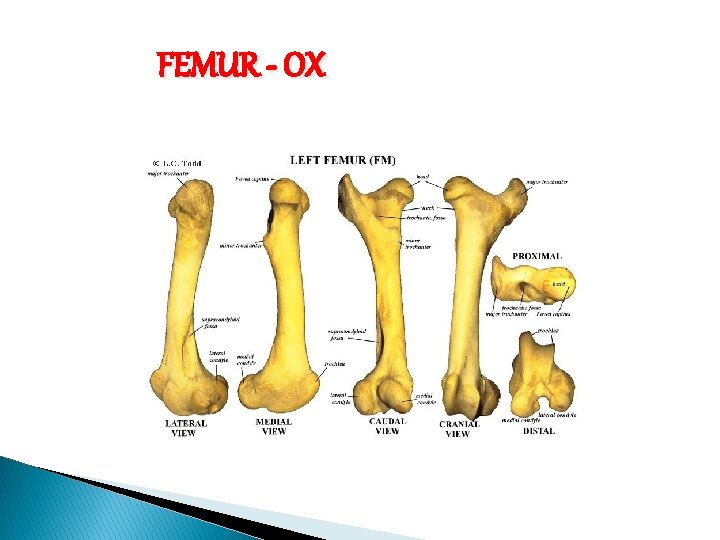
STUDY ABOUT FEMUR -ALONG WITH ITS Musculatures ox, horse, sheep, goat, pig, dog&fowl (Ox) 1. The femur, the most massive and longest bones. 2. Extends obliquely downward and forward in direction. 3. Proximally it head articulates with acetabulum and forms joint that is known as hip joint. 4. Distally it articulates with proximal ends of tibia, fibula and dorsal surface of patella and forms joint that is known as stifle joints For description, It consists of a shaft and two extremities.
FEMUR - Thigh Bone-Cont…… �Shaft: �The shaft posses four surfaces. �The anterior, medial and lateral surfaces are continuous, convex from side to side and are covered in life by the quadriceps femoris. �The posterior face is narrow in the middle where it is rough for the adductor. Below this is an oblique vascular impression running downward and outward marking the course of the femoral vessels.

FEMUR - Thigh Bone-Cont…… The medial border of posterior surface presents in its upper third the trochanter minor, which is for quadratus femoris and iliopsoas. Extending from this trochanter obliquely and joining the trochanter major is trochanteric ridge, which forms the posterolateral boundary of the trochanteric fossa, trochanteric ridge is for the gluteus medius and trochanteric fossa for gemellus, obturator externus and obturator internus. � The distal third of this border carries above the medial condyle the medial supra condyloid crest for the medial head of the gastrocnemius. The rest of this border below the trochanter minor is for the pectineus. � The lateral border presents in its distal third the supracondyloid fossa, which is bounded laterally by the lateral supra-condyloid crest. The fossa for the superficial flexor of the digit and the crest for the lateral head of the gastrocnemius. �
Femur- Proximal extremity Ø It composed of the head, neck and the trochanter major. Ø The head is medial and articulates with the acetabulum. The small non-articular sulcus, fovea capitis, on the middle of the head is for the round ligament of the hip joint. Ø The trochanter major or greater trochanter is massive and is for the gluteus medius. The lateral face is convex. Below its base are two rough tubercles -the upper one for the middle gluteus and the lower one for the deep gluteus.
Femur- Distal extremity Ø The distal extremity is condyles behind. Ø The trochlea articulates with patella. The medial ridge of the trochlea is more prominent. Ø The condyles are separated by the intercondyloid fossa and articulate with the condyles of the tibia through the medium of the interarticular cartilages or menisci. The medial condyle presents an eminence on its medial aspect for the medial ligament. The lateral condyle presents two depressions on its lateral aspect, the upper one for the lateral ligament of the stifle and the lower one for the popliteus. Between the lateral condyle and the lateral ridge of the trochlea is, the extensor fossa for the complex muscle. The inter-condyloid fossa lodges the spine of the tibia. Its anterior part is for the posterior crucial ligament. At its posterior part close to the medial condyle is a depression for the coronary ligament of the lateral meniscus and close to the lateral condyle is another depression for the anterior cruciate ligament. Ø Ø large and comprises of trochlea in front and two
FEMUR - OX
Goat and Sheep- Fumer � A distinct line separates the lateral and posterior surfaces. � The trochanter major is little higher than the head. � Trochlear ridges are slightly oblique.
Horse-FEMUR � � � � It is more massive and longest bone of body. The posterior face bears in its proximal third a rough eminence for the biceps femoris. Fovea Capatis is deeper and notched. The trochanter minor is in the form of a rough ridge. The lateral border bears the trochanter tertius that is also known as Third Trochanter in its proximal third for the superficial gluteus. The supracondyloid fossa and the lateral supra condyloid crest is better developed. The trochanteric ridge is vertical and extends from the proximal third to the great trochanter. The great trochanter is made up of a convexity a summit and a crest. The crest is below and lateral to the convexity
PIG-FEMUR � The shaft is wide and relatively massive. � A ridge extends from the trochanter major to the lateral supracondyloid crest and there is no supracondyloid fossa. � The third trochanter is absent.
DOG-FEMUR � � � � The shaft is proportionately large and strongly curved with the convexity forward. The supra condyloid fossa is absent. The trochanteric fossa is rounded and deep. The ridges of the trochlea are sagittal and equal. The inter condyloid fossa is wide. On the posterior aspect of the distal extremity immediately above each condyle is a small facet for a sesamoid-the fabella. The fabellae are two small rounded sesamoid bones, located one each on the condyles of the femur on the posterior aspect. They are developed in the tendons of origin of the gastrocnemius muscle.
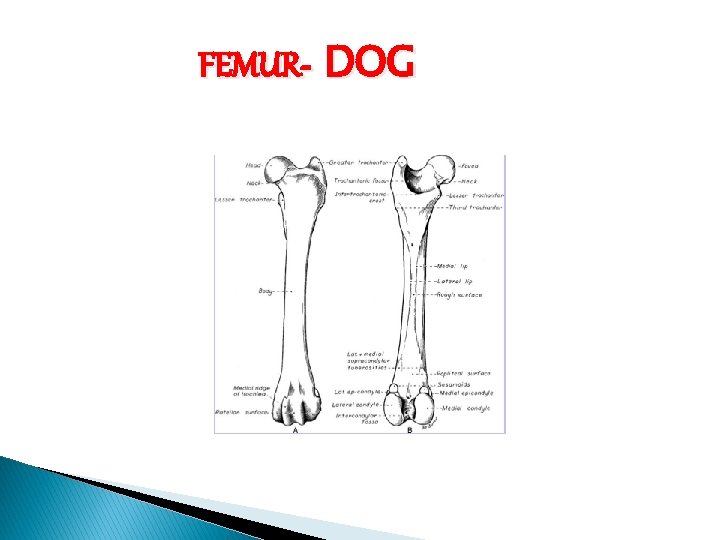
FEMUR- DOG
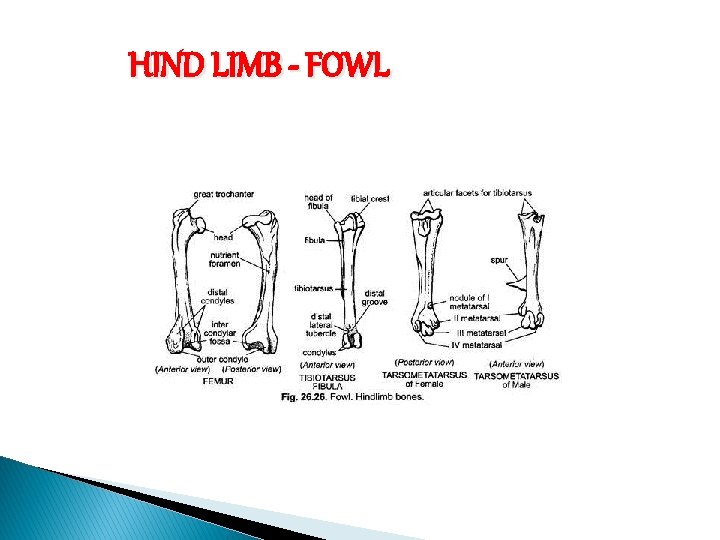
FOWL-FEMUR � The head is prominent but smaller than the acetabulum and the articular surface extends on the trochanter and articulates with the acetabulum and the facet on its rim. � The lateral condyle presents on its lateral aspect a groove for the head of fibula.
HIND LIMB - FOWL
- Slides: 14