
Veterans Benefits Applications for the Medical Community Presenter
Veterans Benefits Applications for the Medical Community Presenter – Andy Balafas Representative and Veterans Liaison, Vitas Healthcare 630 815 9563; Andrew. balafas@vitas. com Guest contributor: Jake Zimmerman Superintendent, Veterans Assistance Commission of Kane County Accredited Veterans Service Officer Certified Veterans Advocate
Goal To provide information to members of the medical community about benefits and resources that could help them in caring for and supporting Veterans patients and their families.
Objectives § Identify basic eligibility requirements for pertinent federal benefits for Veterans, their family members, and their survivors § Discuss the general buckets which describe the eight VA medical priority groups § Explain VA disability compensation, pension, and survivor compensation. § Explain VA burial benefits. § Discuss how and who to coordinate with at the VA medical facilities to help your Veteran patients.
General Eligibility for Most VA Benefits § Requires discharge from active military service under other than dishonorable conditions. § Active service means full-time service, other than active duty for training, as a member of the Army, Navy, Air Force, Marine Corps, Coast Guard, and the United States Space Force. § “Active duty for training” is not the same as “active military service”.
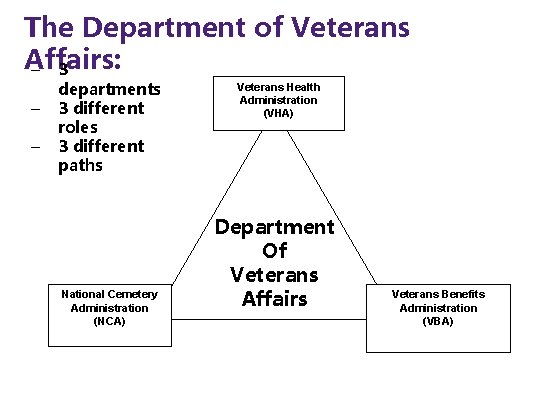
The Department of Veterans Affairs: – 3 – – departments 3 different roles 3 different paths National Cemetery Administration (NCA) Veterans Health Administration (VHA) Department Of Veterans Affairs Veterans Benefits Administration (VBA)
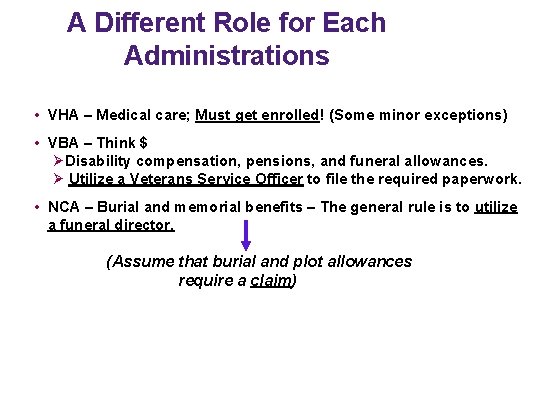
A Different Role for Each Administrations • VHA – Medical care; Must get enrolled! (Some minor exceptions) • VBA – Think $ ØDisability compensation, pensions, and funeral allowances. Ø Utilize a Veterans Service Officer to file the required paperwork. • NCA – Burial and memorial benefits – The general rule is to utilize a funeral director. (Assume that burial and plot allowances require a claim)
The Role of the Service Officer is Very Important! • • To get questions answered To submit claims Can enroll for VA medical care Follow-up as patient’s designated agent Do not charge for services
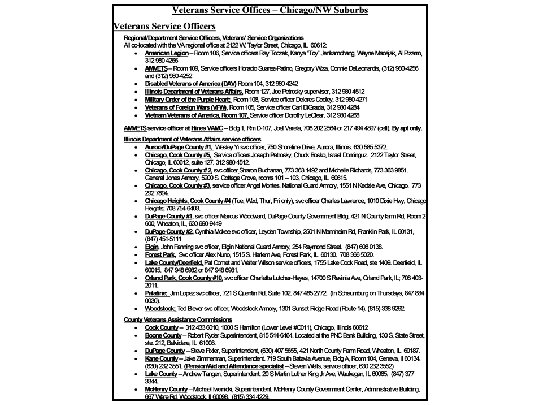
Service Officer Availability has been affected by the pandemic: County VAC vs Veterans service organizations vs IDVA
Service Officer vs Accredited VA claims agent:
Service Connection: An illness or injury that affects body or mind: § Caused by military service. § Already existed but was aggravated by military service.
Discharges 1. Honorable – Administrative 2. General – Administrative 3. Other Than Honorable (OTH) – Most severe type of administrative discharge 4. Bad conduct – A punitive discharge, usually implies a general court martial 5. Dishonorable – A punitive discharge, usually implies a court martial
Defined War Periods • World War II (December 7, 1941 – December 31, 1946) • Korean conflict (June 27, 1950 – January 31, 1955) • Vietnam era (February 28, 1961 – May 7, 1975 for veterans who served in the Republic of Vietnam during that period; otherwise August 5, 1964 – May 7, 1975) • Gulf War (August 2, 1990 – through a future date to be set by law or Presidential Proclamation)
Separation Papers • Must have to get benefits from the VA • “Discharge papers”; “Report of separation”; “DD 214’; Pre-1950 discharges are various WD/AGO Forms • Replacing - Application must be made by the Veteran or surviving next of kin: • Mail-in forms • On-line at www. archives. gov • Veterans Service Officers • 1973 fire at the National personnel Records Center
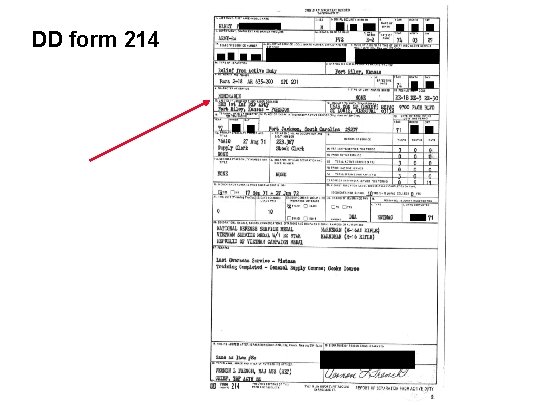
DD form 214
Other Documents which may be needed: • If Veteran is unable to make decisions - Power of attorney (The VA is picky about the medical POA). • If getting spousal related benefits - Marriage certificate. • For burial/memorial or survivor benefits – Corresponding death certificate. • VA Pension and VA medical enrollment – Annual family income, savings (bank accounts, 401 Ks, IRAs, stocks, etc. ) unreimbursed medical expenses. • Government IDs and SSNs
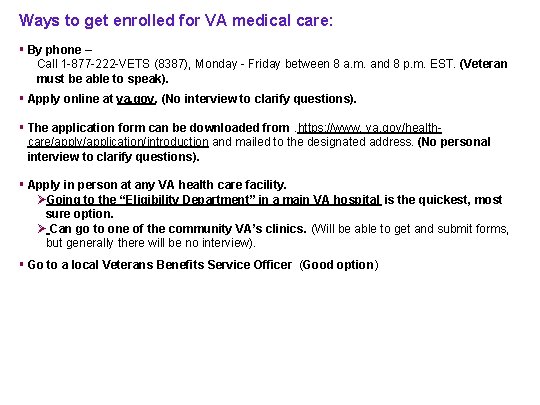
Ways to get enrolled for VA medical care: § By phone – Call 1 -877 -222 -VETS (8387), Monday - Friday between 8 a. m. and 8 p. m. EST. (Veteran must be able to speak). § Apply online at va. gov. (No interview to clarify questions). § The application form can be downloaded from. https: //www. va. gov/healthcare/apply/application/introduction and mailed to the designated address. (No personal interview to clarify questions). § Apply in person at any VA health care facility. ØGoing to the “Eligibility Department” in a main VA hospital is the quickest, most sure option. Ø Can go to one of the community VA’s clinics. (Will be able to get and submit forms, but generally there will be no interview). § Go to a local Veterans Benefits Service Officer (Good option)
During enrollment: § Enrollment isn’t complete until the Veteran has attended an initial “vesting” visit with a VA physician. (It is usually done by the assigned VA PCP at the Veteran’s chosen VA primary care location) §Hospice appropriate Veterans are exceptions and do not need an initial vesting visit.
Health Care Benefits • During enrollment, each veteran is assigned to a priority group −There are 8 priority groups • The VA must do this because it does not have unlimited funding and resources
Medical Benefits for Veterans General “buckets” for the 8 Priority groups. • Medical/psychological issues caused or aggravated by military service. • Former POW’s and Purple Heart recipients. • When and where they served. • Income (Priority Groups 7 & 8, differs by county) • Catastrophic disability (Priority Group 4).
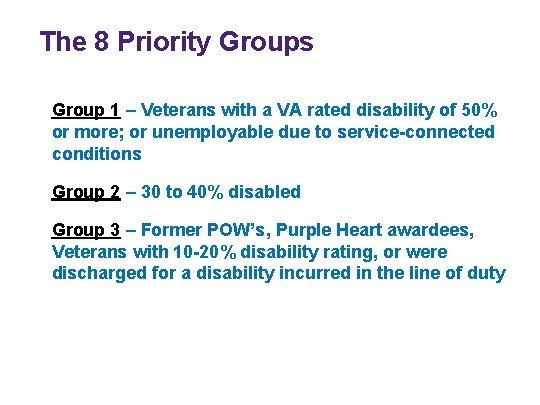
The 8 Priority Groups Group 1 – Veterans with a VA rated disability of 50% or more; or unemployable due to service-connected conditions Group 2 – 30 to 40% disabled Group 3 – Former POW’s, Purple Heart awardees, Veterans with 10 -20% disability rating, or were discharged for a disability incurred in the line of duty
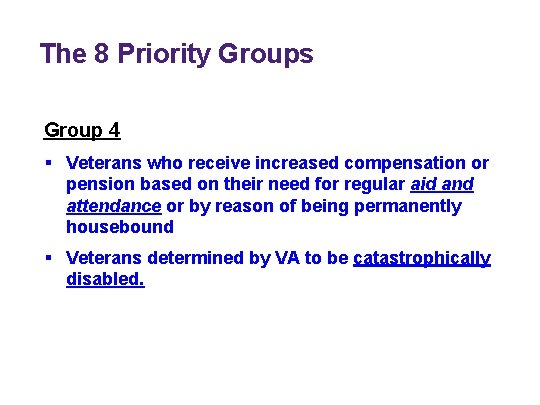
The 8 Priority Groups Group 4 § Veterans who receive increased compensation or pension based on their need for regular aid and attendance or by reason of being permanently housebound § Veterans determined by VA to be catastrophically disabled.
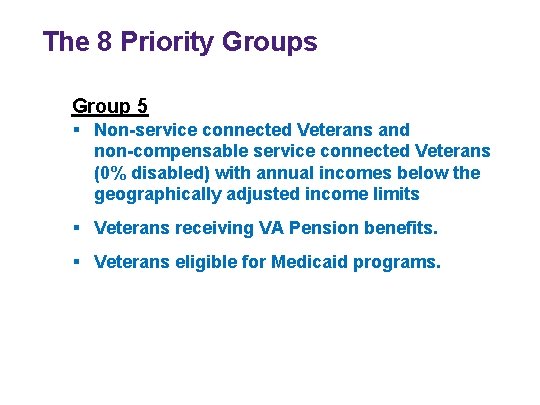
The 8 Priority Groups Group 5 § Non-service connected Veterans and non-compensable service connected Veterans (0% disabled) with annual incomes below the geographically adjusted income limits § Veterans receiving VA Pension benefits. § Veterans eligible for Medicaid programs.
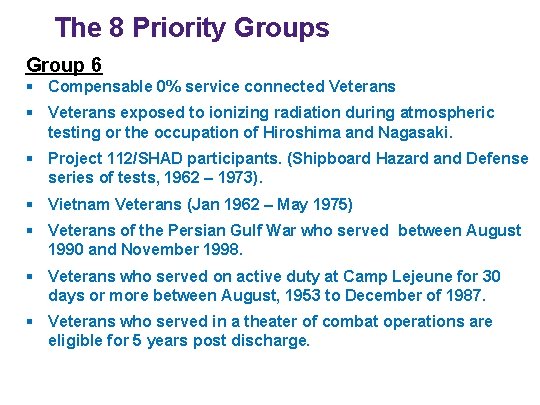
The 8 Priority Groups Group 6 § Compensable 0% service connected Veterans § Veterans exposed to ionizing radiation during atmospheric testing or the occupation of Hiroshima and Nagasaki. § Project 112/SHAD participants. (Shipboard Hazard and Defense series of tests, 1962 – 1973). § Vietnam Veterans (Jan 1962 – May 1975) § Veterans of the Persian Gulf War who served between August 1990 and November 1998. § Veterans who served on active duty at Camp Lejeune for 30 days or more between August, 1953 to December of 1987. § Veterans who served in a theater of combat operations are eligible for 5 years post discharge.
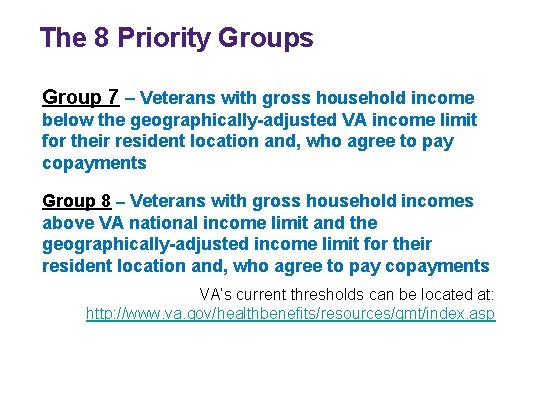
The 8 Priority Groups Group 7 – Veterans with gross household income below the geographically-adjusted VA income limit for their resident location and, who agree to pay copayments Group 8 – Veterans with gross household incomes above VA national income limit and the geographically-adjusted income limit for their resident location and, who agree to pay copayments VA’s current thresholds can be located at: http: //www. va. gov/healthbenefits/resources/gmt/index. asp
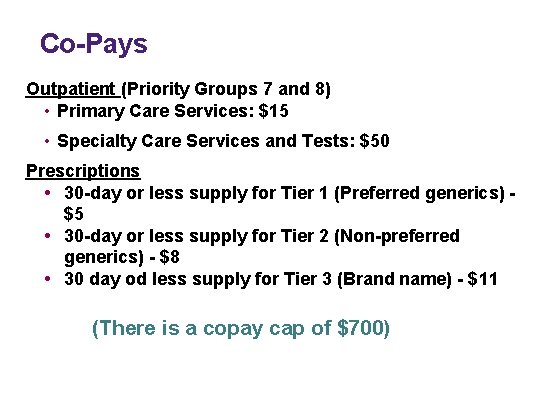
Co-Pays Outpatient (Priority Groups 7 and 8) • Primary Care Services: $15 • Specialty Care Services and Tests: $50 Prescriptions • 30 -day or less supply for Tier 1 (Preferred generics) $5 • 30 -day or less supply for Tier 2 (Non-preferred generics) - $8 • 30 day od less supply for Tier 3 (Brand name) - $11 (There is a copay cap of $700)
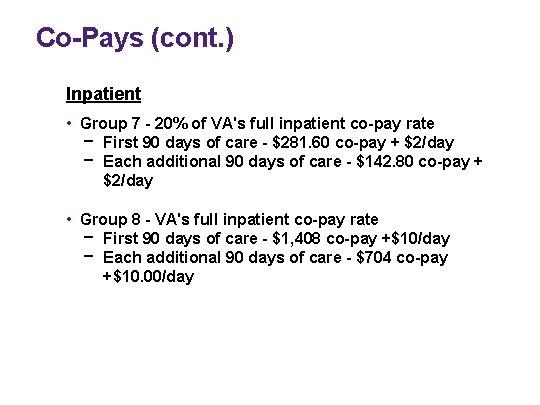
Co-Pays (cont. ) Inpatient • Group 7 - 20% of VA's full inpatient co-pay rate − First 90 days of care - $281. 60 co-pay + $2/day − Each additional 90 days of care - $142. 80 co-pay + $2/day • Group 8 - VA's full inpatient co-pay rate − First 90 days of care - $1, 408 co-pay +$10/day − Each additional 90 days of care - $704 co-pay +$10. 00/day
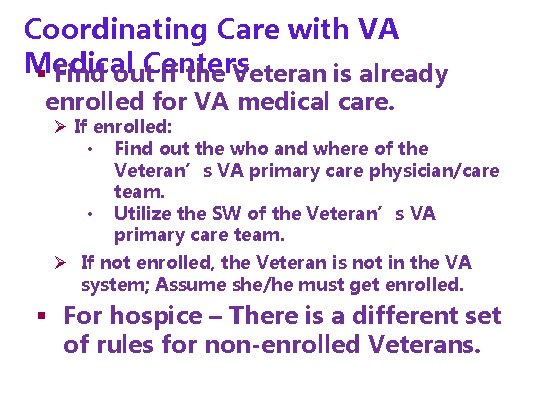
Coordinating Care with VA Medical § Find out. Centers if the Veteran is already enrolled for VA medical care. Ø If enrolled: • Find out the who and where of the Veteran’s VA primary care physician/care team. • Utilize the SW of the Veteran’s VA primary care team. Ø If not enrolled, the Veteran is not in the VA system; Assume she/he must get enrolled. § For hospice – There is a different set of rules for non-enrolled Veterans.
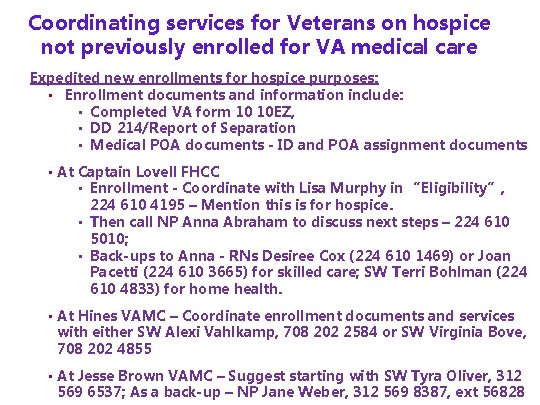
Coordinating services for Veterans on hospice not previously enrolled for VA medical care Expedited new enrollments for hospice purposes: • Enrollment documents and information include: • Completed VA form 10 10 EZ, • DD 214/Report of Separation • Medical POA documents - ID and POA assignment documents • At Captain Lovell FHCC • Enrollment - Coordinate with Lisa Murphy in “Eligibility”, 224 610 4195 – Mention this is for hospice. • Then call NP Anna Abraham to discuss next steps – 224 610 5010; • Back-ups to Anna - RNs Desiree Cox (224 610 1469) or Joan Pacetti (224 610 3665) for skilled care; SW Terri Bohlman (224 610 4833) for home health. • At Hines VAMC – Coordinate enrollment documents and services with either SW Alexi Vahlkamp, 708 202 2584 or SW Virginia Bove, 708 202 4855 • At Jesse Brown VAMC – Suggest starting with SW Tyra Oliver, 312 569 6537; As a back-up – NP Jane Weber, 312 569 8387, ext 56828

Skilled Nursing, Home Health In-home Respite
Long-term Skilled Services The VA provides institution based services (nursing home level of care) to Veterans through three programs: § VA owned and operated Community Living Centers (CLC) § The community nursing home program. § State Veterans’ Homes owned and operated by the states
Long-term Skilled Services: The VA is obligated to pay the full cost of nursing home services for enrolled Veterans: • At CLCs and VA contracted nursing homes: Ø If the Veteran needs nursing home care for a service‑connected disability, or Ø If the Veteran has a 70 percent or greater service-connected disability rating or Ø If the VA agrees that the Veteran is hospice appropriate. • At state Veterans homes: - These are run by each state; The states have their own eligibility rules and agreements with the VA.
Home Health Aid Program § Veteran must be enrolled for VA medical care. § Unskilled assistance from community-based home health providers for at home assistance. § Generally for Veterans needing help with at least 3 ADLs § To assist with ADLs § Can be for temporary needs § Available for home and ALF/LTC facility hospice patients (Not SNF) (Varies, 9 – 15 hrs/wk).
In-home Respite §Veteran must be enrolled for VA medical care. §Unskilled assistance from community-based home health providers for at home assistance. § 6 hrs/day for up to 30 days/year §Generally can be used concurrently with VA approved home-health hours
What monetary assistance does the VA provide? • Disability Compensation • VA Pension • Dependency and Indemnity • Certain Allowances
VA Disability Compensation • For VA recognized service connection • Requires filing a claim • Varies with the degree of disability and the number of dependents. • Basic awards (2021): Ø 10% - $144 up to Ø 100% - $3, 146
Presumptive Service Conditions The VA presumes that certain disabilities were caused by military service because of the unique circumstances of a specific Veteran’s military service. Common “unique circumstances”: • Veterans who develop ALS • Former POWs • Service in Vietnam/Southeast Asia during the Vietnam War • Exposure to radiation (“Atomic Veterans”) • Gulf War Veterans • Service in Camp Lejeune for 30 days (1953 – 1987) 30
Implications for: • • Service connected disability claims Qualification for VA medical care Surviving dependent compensation Increased funeral allowances (as you will see).
Think about your Vietnam Veterans: • Vietnam era (February 28, 1961 – May 7, 1975 for Veterans who served in the Republic of Vietnam during that period: • 1973 – Last combat troops out of Vietnam…… • A 19 – 40 year old in 1975 would be …. . 65 – 86 yo in 2021. • Some of the presumptive conditions for Agent Orange exposure include (There are now 17): o o o o Respiratory cancers Prostate cancer Type 2 diabetes Parkinsons/Parkinsonism Ischemic heart disease Hodgkin’s disease Non-Hodgkin’s lymphoma Some soft-tissue sarcomas
“Aid and Attendance” This is actually “VA Pension” • Service officers don’t use the term “aid and attendance”: Ø“Non-service Connected Pension” Ø“Low-income Pension” • Types Ø Veterans Pension Ø Survivors Pension
VA Pension § Do not confuse with military retirement. § For honorably discharged Veterans with one day of active duty wartime service § For surviving dependents of honorably discharged Veterans with one day of active duty wartime service. §Based on: Low household income and limited household savings/assets.
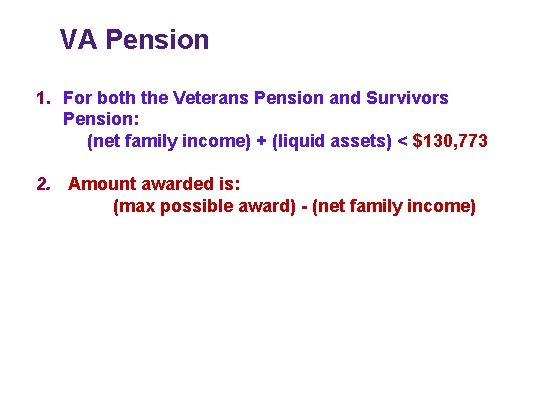
VA Pension 1. For both the Veterans Pension and Survivors Pension: (net family income) + (liquid assets) < $130, 773 2. Amount awarded is: (max possible award) - (net family income)
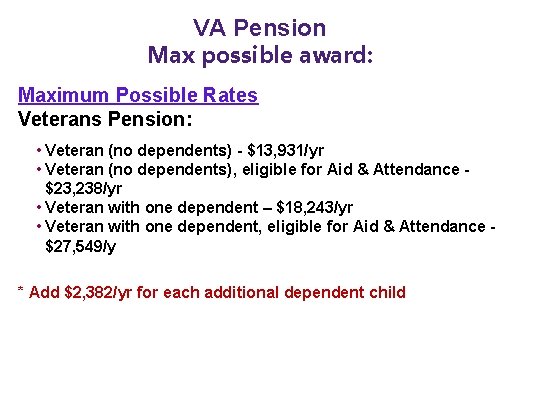
VA Pension Max possible award: Maximum Possible Rates Veterans Pension: • Veteran (no dependents) - $13, 931/yr • Veteran (no dependents), eligible for Aid & Attendance $23, 238/yr • Veteran with one dependent – $18, 243/yr • Veteran with one dependent, eligible for Aid & Attendance $27, 549/y * Add $2, 382/yr for each additional dependent child
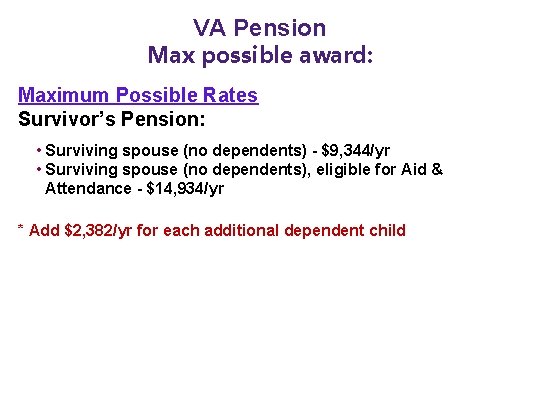
VA Pension Max possible award: Maximum Possible Rates Survivor’s Pension: • Surviving spouse (no dependents) - $9, 344/yr • Surviving spouse (no dependents), eligible for Aid & Attendance - $14, 934/yr * Add $2, 382/yr for each additional dependent child
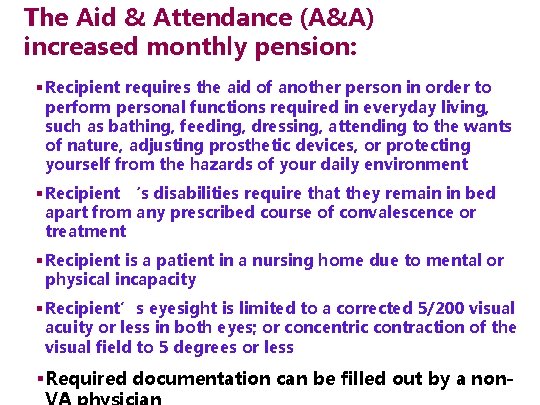
The Aid & Attendance (A&A) increased monthly pension: § Recipient requires the aid of another person in order to perform personal functions required in everyday living, such as bathing, feeding, dressing, attending to the wants of nature, adjusting prosthetic devices, or protecting yourself from the hazards of your daily environment § Recipient ‘s disabilities require that they remain in bed apart from any prescribed course of convalescence or treatment § Recipient is a patient in a nursing home due to mental or physical incapacity § Recipient’s eyesight is limited to a corrected 5/200 visual acuity or less in both eyes; or concentric contraction of the visual field to 5 degrees or less §Required documentation can be filled out by a non-
Pension and Disability Compensation - Veterans can’t get a service connected disability and a VA low-income pension at the same time. - If eligible for both, the higher of the two would be paid.
Beware!!! Veterans Benefits Service Officers Vs Organizations that want to make $ by handling assets Warning: Pension recipients are at risk of financial exploitation. ***This is a warning about dishonest individuals who prey on those who receive pension benefits. There have been reports of scam artists targeting and taking advantage of Veterans/survivors receiving these benefits.
Look Back and Penalty Period § There is a 36 -month look-back period § There is a potential penalty period of up to 5 years for those who transfer assets in an attempt to qualify for pension.
The “DIC” Dependency and Indemnity Compensation § For surviving dependents § Not income based Ø If Veteran’s death was caused by or hastened by a serviceconnected issue. Ø The Veteran had been rated with a 100% service-connected disability. (Unless the rating was awarded very recently). § Basic Monthly rate - $1, 357/mo • Plus $336/mo if surviving spouse is entitled to A&A • Plus $289/mo for each dependent child
DIC Eligibility Surviving Spouse: § Married to a service member who died on active duty, active duty for training, or inactive duty training, or § Was married to the Veteran for a least one year, or § Had a child with the Veteran and cohabitated with the Veteran continuously until the Veteran’s death, or § If separated, was not at fault for the separation and is not currently remarried.

Burial and Memorial Benefits
Burial in VA National Cemeteries • Other than dishonorable discharge • Veterans, spouses, and dependent children • The Veteran does not have to die before a spouse or dependent child
Burial in VA National Cemeteries • Veteran and spouse/dependents • At no cost to the family • Includes gravesite ØOpening and closing of the grave ØHeadstone or marker and perpetual care ØPerpetual care as part of a national shrine ►In general, the family is responsible for all costs up to delivery of the remains to the national cemetery. ►The federal government only pays funeral costs up- front for Veterans that die while on active duty.
Burial in VA National Cemeteries • Includes burial flag and military funeral honors (Veteran only) • Of note on Arlington National Cemetery o Run by the Department of the Army, not the NCA o Has different eligibility rules
Burial in Private Cemeteries • Headstone or marker • Medallions in lieu of headstone or marker • Military funeral honors • Veteran only 50
VA Burial Allowances §The Veteran was discharged under conditions other than dishonorable, and: • The Veteran died because of a service-related disability, or • For non-service connected allowances: • The Veteran was receiving VA pension or compensation, or: • The Veteran died while hospitalized by VA, or under VA contract at a non-VA facility, or • The Veteran died while traveling at VA expense to get VA care, or • The Veteran died while a patient at a VA-approved Veteran state nursing home
Burial Expenses Reimbursement Service Connected - $2, 000 • Non-service connected • Up to $300 burial/funeral allowance and $807 for a plot. • If hospitalized by the VA at the time of death, up to $807 burial/funeral and $807 for a plot. • If death occurred under VA care, costs of transporting the remains may be reimbursed, • No plot allowance if buried in a national cemetery.
Beneficiary Travel (BT) What(Jake types of travel can VA provide or reimburse for? Zimmerman) § VA has authority to provide to eligible persons reimbursement for mileage driven in a private vehicle, and transportation by common carrier/public transportation § In addition, when medically justified by a VA health care provider, special mode of transportation (ambulance, wheelchair van, etc. ) may be approved. Most common reasons to be for eligible for Beneficiary Travel (BT): § Veterans with disabilities rated 30% or more serviceconnected (SC): travel for care relating to any condition § Veterans with disabilities rated less than 30%: travel for care relating to their SC condition(s) § Veterans receiving Department of Veterans Affairs (VA) pension benefits § Veterans traveling in relation to a Compensation and Pension (C&P) examination
A comment: Divorce from a Veteran ends all eligibility for any VA-related benefits for the ex-spouse
Accessing Benefits – quick review 1. Suggested ways to enroll for medical care: • Go to a VA Medical facility • VA Hospital (Most efficient option) • VA Outpatient Clinic (fill and fax) • Through an accredited Veterans benefits service office • By phone at (877) 222 -8387. (Veteran must do the enrollment or be present to give permission to answer questions) 2. To file a claim (disability, pensions, allowances) – Use an accredited Veterans benefits service officer to file a claim. 3. For burial and memorial benefits – See your funeral director (Claims for various allowances should go through a Veterans Benefits Service Officer) 55
For further details: • Federal Benefits for Veterans Dependents and Survivors, US Department of Veterans Affairs 2019 Editions • Health Care Benefits Overview, 2018 Edition, US Department of Veterans Affairs • U. S. Department of Veterans Affairs website at www. va. gov • Accredited Veterans services officers. • Appropriate contacts at VA medical facilities • Official military records - www. archives. gov
References § Federal Benefits for Veterans (2013, 2014, 2015, 2016, and 2017, 2018, and 2019, Editions) Dependents and Survivors, US Department of Veterans Affairs § VA Health Care Benefits Overview, 2018 Edition, US Department of Veterans Affairs § U. S. Department of Veterans Affairs website at www. va. gov § Jake Zimmerman, Superintendent of the Veterans Assistance Commission of Kane County, Geneva, Illinois. § Wells, Steven, Service Officer of the Veterans Assistance Commission of Kane County, Geneva, Illinois. § Thanks to Captain Lovell FHCC Social Worker Terri Bohlman for information on The VA’s Skilled Home Health and Home Health Aid program. § Thanks to Captain Lovell FHCC RN Joan Pacetti for information on the VA’s Skilled Home Health and Home Health Aid program. § Thanks to Hines VAMC Social Worker Alexi Vahlkamp for information on the VA’s hospice and palliative care benefits. § Military records, www. archives. gov
- Slides: 62