
VET Sport and Rec Chapter 1 Organize personal
- Slides: 24
VET Sport and Rec Chapter 1 - Organize personal work priorities and development
Work objectives and goals • • • Budgetary targets Production targets Team and individual learning Team participation Reporting deadlines Sales targets
Work objectives and goals- Budgetary targets • Is the set amount of money to spend on each task or objective. For example refurbishment of a gym, wanting to spend $200, 000 in total, would be the budgetary target.
Work objectives and goals- Production targets • Used in manufacturing. • They are the set number of a product that a company wants to produce within a certain time frame.
Work objectives and goals- Team and individual learning goals • Relate to the ability of a team or individual to learn skills or knowledge. • New skills or knowledge they aim to require by the end of the year. • Goal setting: • Specific • Measurable • Achievable • Realistic • Timely ** Complete activity on pg. 38 - goal setting
Work objectives and goals- Team participation • A work goal for many organisations. • Development of relationships to create an honest and successful environment. • Complete activity T 1. 0 (pg. 20)
Key Performance Indicators (KPI’s) • A Key Performance Indicator (KPI) is a measurable value that demonstrates how effectively a company is achieving key business objectives. Organizations use KPIs to evaluate their success at reaching targets. • Key performance indicators may include: • KPI’s for customer satisfaction • KPI’s for customer effort • Monitoring time taken to answer calls • Operating within reporting protocols • Score tools such as net promoter • Understanding metrics
KPI’s - Understanding Metrics • Metrics are often the most measurable KPI as they are given in numbers. A metric can be a count of something, the number of people who visit the organisations website. Or a ratio, for example, the number of pages visited when on the website e. g. three out of eleven pages. Metrics can be used to measure: • • Frequency Sales Conversion rates Pages per visit
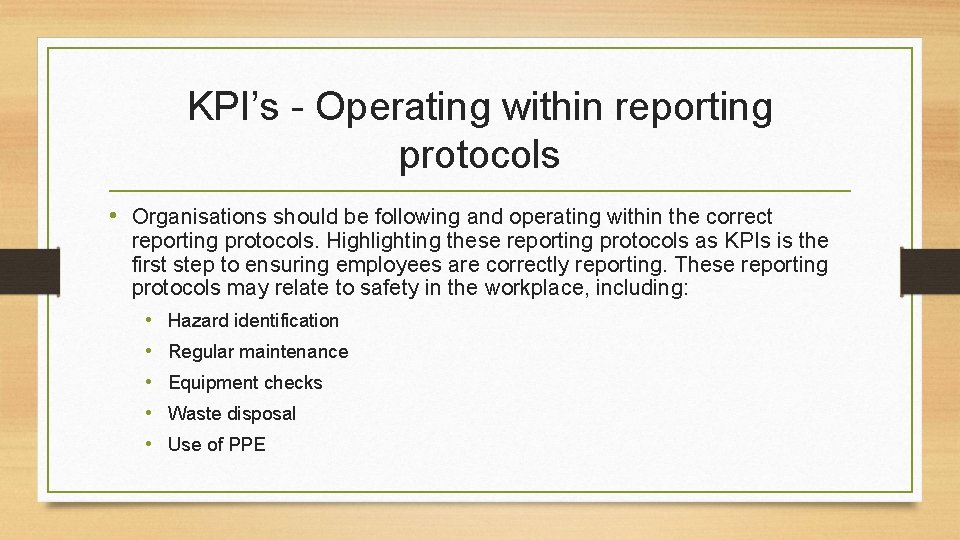
KPI’s - Operating within reporting protocols • Organisations should be following and operating within the correct reporting protocols. Highlighting these reporting protocols as KPIs is the first step to ensuring employees are correctly reporting. These reporting protocols may relate to safety in the workplace, including: • Hazard identification • Regular maintenance • Equipment checks • Waste disposal • Use of PPE
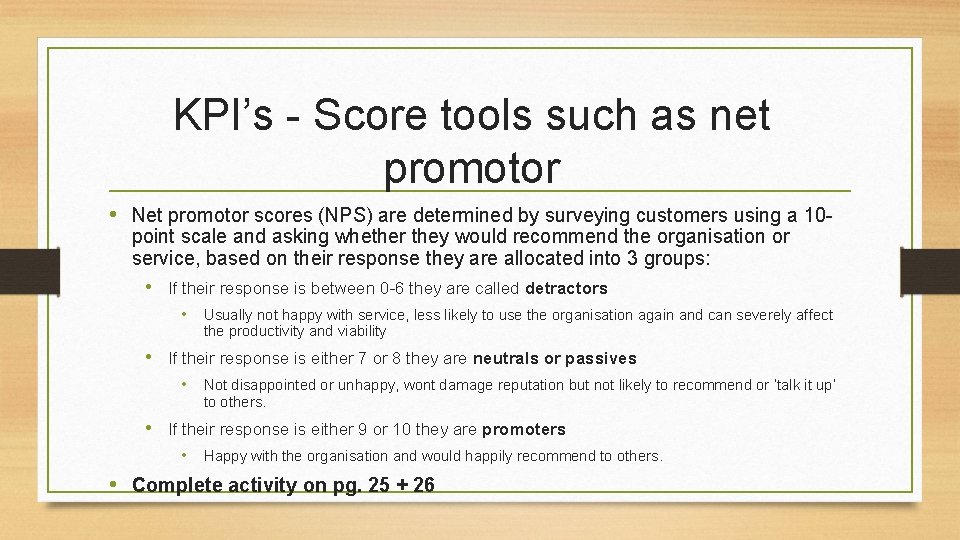
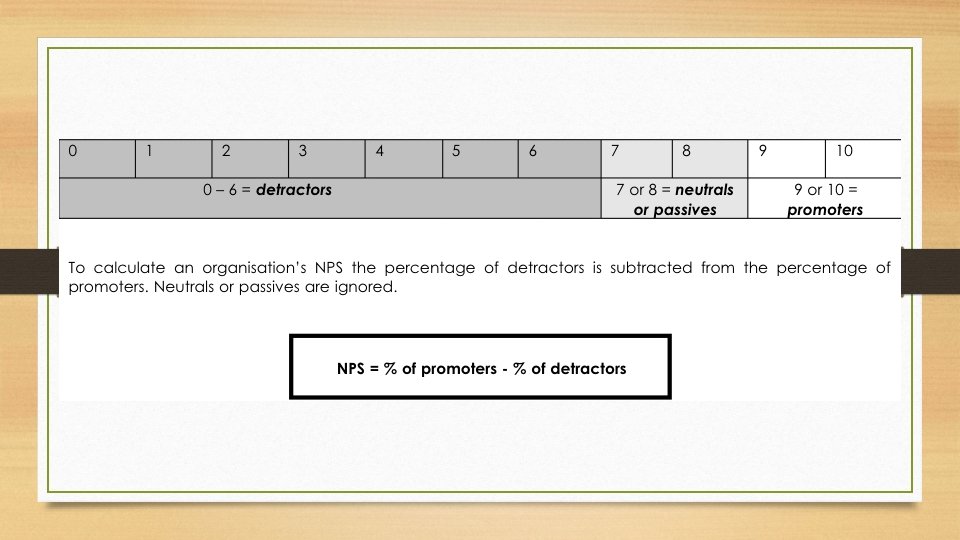
KPI’s - Score tools such as net promotor • Net promotor scores (NPS) are determined by surveying customers using a 10 point scale and asking whether they would recommend the organisation or service, based on their response they are allocated into 3 groups: • If their response is between 0 -6 they are called detractors • Usually not happy with service, less likely to use the organisation again and can severely affect the productivity and viability • If their response is either 7 or 8 they are neutrals or passives • Not disappointed or unhappy, wont damage reputation but not likely to recommend or ‘talk it up’ to others. • If their response is either 9 or 10 they are promoters • Happy with the organisation and would happily recommend to others. • Complete activity on pg. 25 + 26
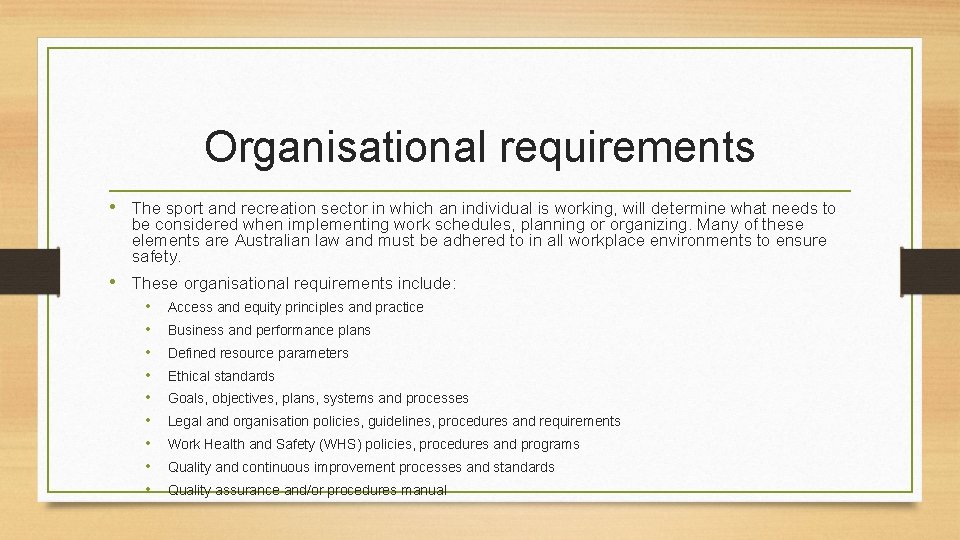
Organisational requirements • The sport and recreation sector in which an individual is working, will determine what needs to be considered when implementing work schedules, planning or organizing. Many of these elements are Australian law and must be adhered to in all workplace environments to ensure safety. • These organisational requirements include: • • • Access and equity principles and practice Business and performance plans Defined resource parameters Ethical standards Goals, objectives, plans, systems and processes Legal and organisation policies, guidelines, procedures and requirements Work Health and Safety (WHS) policies, procedures and programs Quality and continuous improvement processes and standards Quality assurance and/or procedures manual
• Read pg. 27 • Complete activity 1. 3
Business and performance plans • A business plan should include: • • • Executive summary Company description The market Competitors Marketing and sales plan Risks Operational plan Financial plan Exit strategy ** Read page 30 on your own
Organisational requirements- Ethical Standards • Ethical standards are set by society; they are seen as the ‘right thing to do’. • Ethical standards and responsibilities in the sport and recreation industry include: • • • Harassment Sexual harassment Sexual abuse Physical abuse Client/instructor relationships Cheating Inclusive/non-discriminatory practices Bullying Child protection
Organisational requirements- Goals, objectives, plans, systems and processes SMART Goal setting: • Specific - What do I want to achieve and how? • Measurable - How do I know when I’ve achieved the goal? • Attainable - Is my goal achievable? • Realistic - why do you want to reach this goal? What is the objective behind the goal, and will this goal really achieve that? • Timely - When am I going to achieve my goal by? ** Complete activity 1. 11 on page 38
Legal and organisational policies, guidelines and requirements • Equal employment opportunity • Anti-discrimination • Duty of Care ** Read page 38 and 39 and further expand explain these 3 dot points.
Organisational requirements- Quality Assurance and WHS Policies Quality Assurance: • Planned review of policies and procedures within the workplace. • Used to review whether the organisational goals and objectives were achieved. WHS Policies: • • • Safe premises Safe machinery and materials Safe system of work Information, instruction, training and supervision Suitable working environment and facilities
• Read bottom of page 38 -40 • Chapter review questions on page 41.
Factors affecting the achievement of work objectives • • • Budget constraints Competing work demands Environmental factors such as time, weather Resource and material availability Technology/ equipment breakdowns Workplace hazards, risk and controls
Feedback • • • Informal Feedback from supervisors or colleagues Routine organisational methods for monitoring service delivery Customer feedback Reflective/personal feedback ** Read pages 47 -48 and further summarise these key points on feedback.
Personal wellbeing • Cultural • Encompasses the beliefs, identity and behaviours that we value. • Social • Wellbeing relating to our relationships, communication and our ability to interact positively • Spiritual • Wellbeing relating to an individuals ability to feel balanced, whole and centered. • Emotional • How a person feels at work and about their job.
Personal wellbeing- Stress in the workplace • Signs of stress • Resolution strategies • Absence from work • Time off • Alcohol or substance abuse • Sharing load/ job design • Conflict • Training • Poor work performance • Meditation • Counselling ** Complete activity 1. 17 on page 51
Professional development • • • Mentors Internal and external training Performance appraisals Personal Study Formal/informal learning ** Read pages 55 -56 and further summarise these key points Work experience ** Complete chapter review page 57 Workplace skills assessment RCC Quality assurance assessments and recommendations