
Vestibule Prof K Sivapalan Vestibular Apparatus 11292020 Vestibule
Vestibule Prof. K. Sivapalan
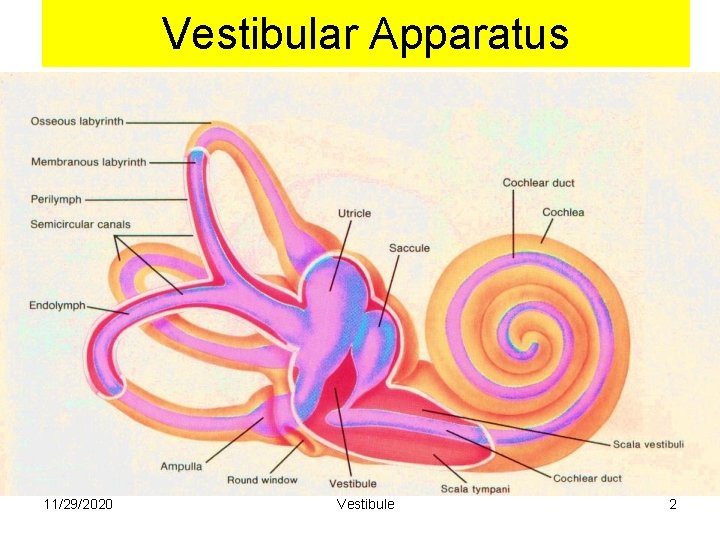
Vestibular Apparatus 11/29/2020 Vestibule 2
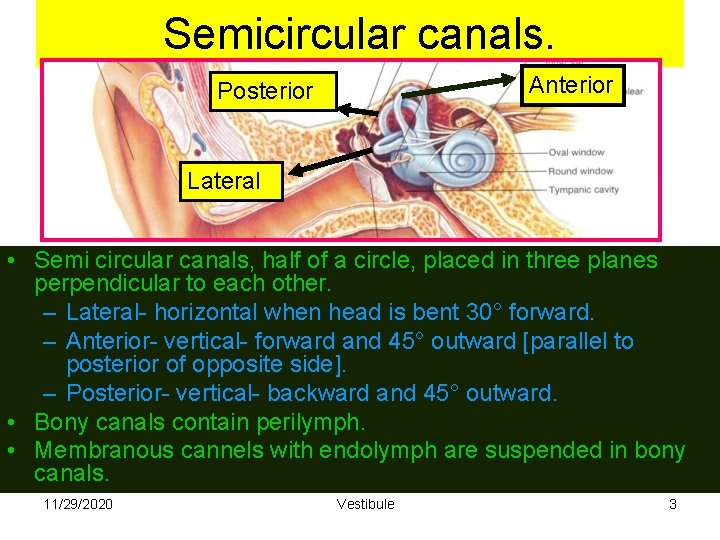
Semicircular canals. Anterior Posterior Lateral • Semi circular canals, half of a circle, placed in three planes perpendicular to each other. – Lateral- horizontal when head is bent 30° forward. – Anterior- vertical- forward and 45° outward [parallel to posterior of opposite side]. – Posterior- vertical- backward and 45° outward. • Bony canals contain perilymph. • Membranous cannels with endolymph are suspended in bony canals. 11/29/2020 Vestibule 3
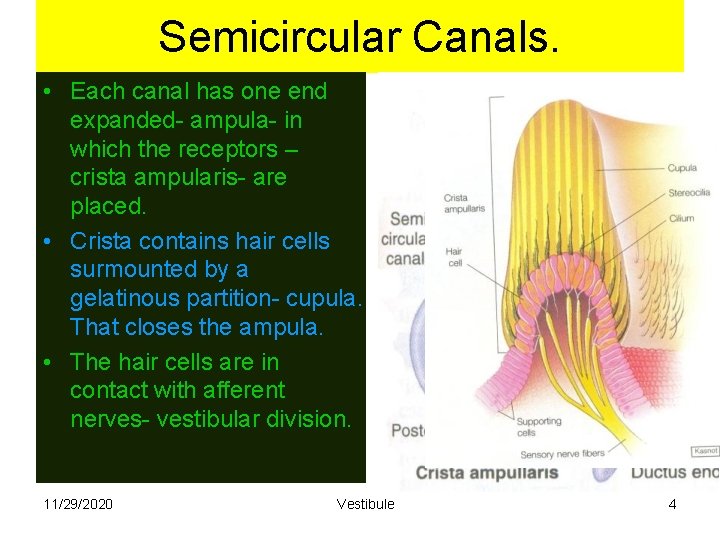
Semicircular Canals. • Each canal has one end expanded- ampula- in which the receptors – crista ampularis- are placed. • Crista contains hair cells surmounted by a gelatinous partition- cupula. That closes the ampula. • The hair cells are in contact with afferent nerves- vestibular division. 11/29/2020 Vestibule 4
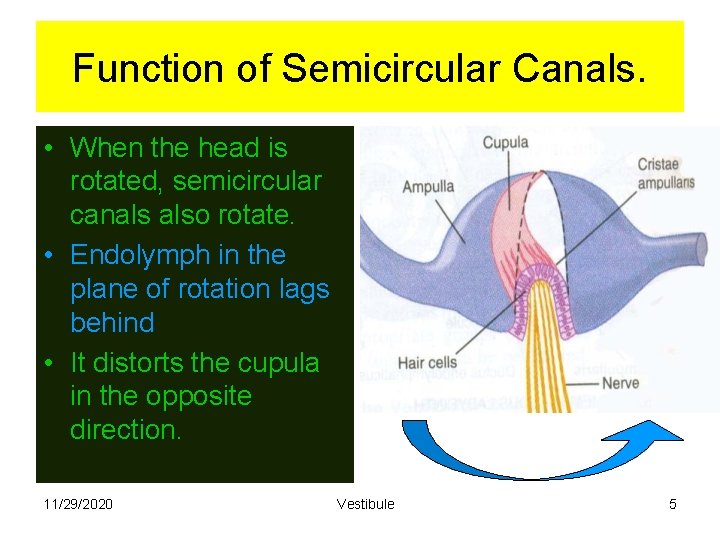
Function of Semicircular Canals. • When the head is rotated, semicircular canals also rotate. • Endolymph in the plane of rotation lags behind • It distorts the cupula in the opposite direction. 11/29/2020 Vestibule 5
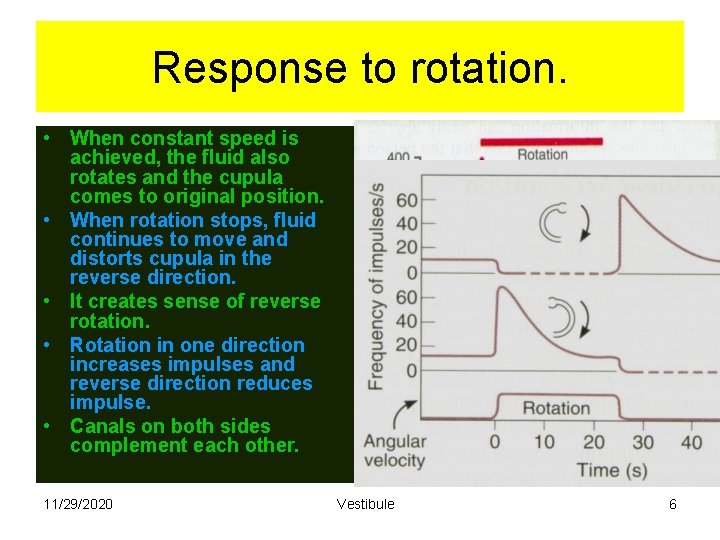
Response to rotation. • When constant speed is achieved, the fluid also rotates and the cupula comes to original position. • When rotation stops, fluid continues to move and distorts cupula in the reverse direction. • It creates sense of reverse rotation. • Rotation in one direction increases impulses and reverse direction reduces impulse. • Canals on both sides complement each other. 11/29/2020 Vestibule 6
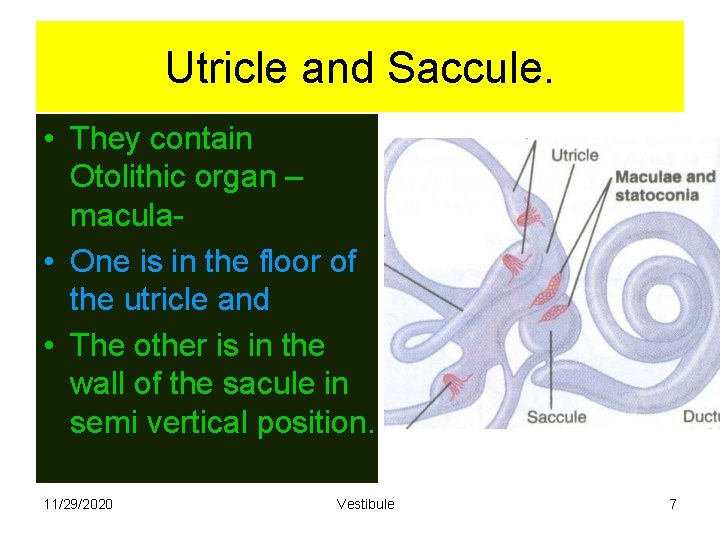
Utricle and Saccule. • They contain Otolithic organ – macula • One is in the floor of the utricle and • The other is in the wall of the sacule in semi vertical position. 11/29/2020 Vestibule 7
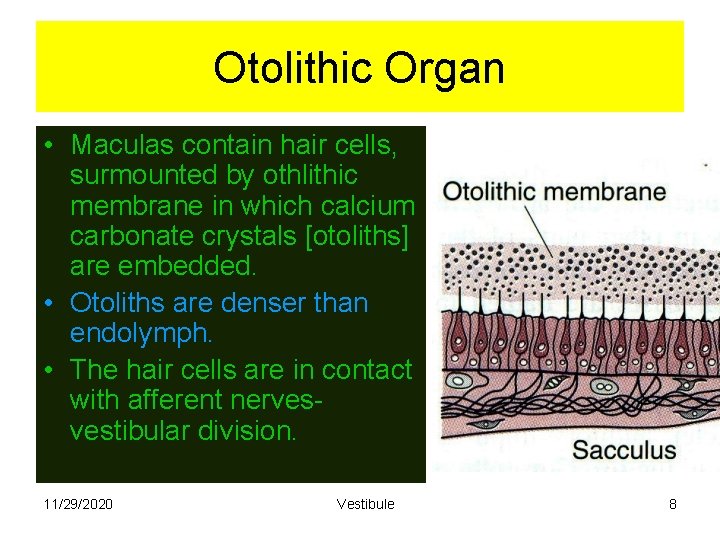
Otolithic Organ • Maculas contain hair cells, surmounted by othlithic membrane in which calcium carbonate crystals [otoliths] are embedded. • Otoliths are denser than endolymph. • The hair cells are in contact with afferent nervesvestibular division. 11/29/2020 Vestibule 8
Response to Linear Acceleration. • Utricle responds to horizontal and saccule to vertical acceleration. • On linear acceleration, otoliths lag behind and distort the otolith membrane and bend the hair cells. • There is distortion without acceleration due to gravitational force. This is responsible for righting reflexes. 11/29/2020 Vestibule 9
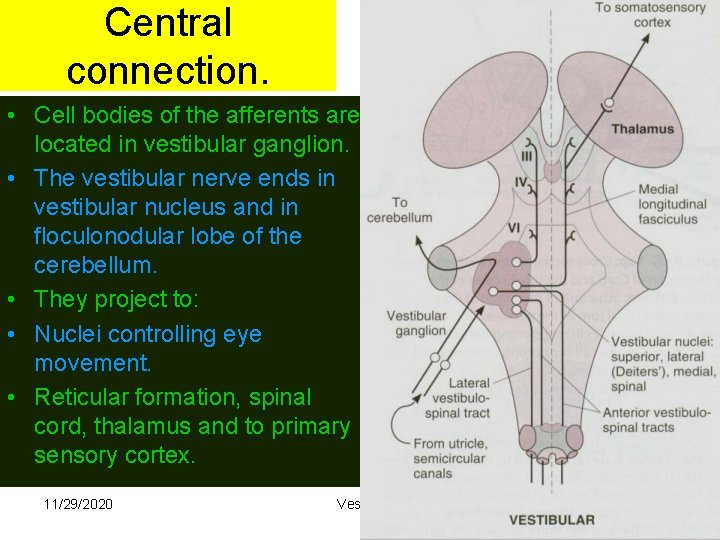
Central connection. • Cell bodies of the afferents are located in vestibular ganglion. • The vestibular nerve ends in vestibular nucleus and in floculonodular lobe of the cerebellum. • They project to: • Nuclei controlling eye movement. • Reticular formation, spinal cord, thalamus and to primary sensory cortex. 11/29/2020 Vestibule 10
Nystagmus. • When head is rotated, eyes remain fixed on an object- it moves slowly in the direction opposite to the rotation. • Suddenly it eyes snap back to a new point of fixation. • The slow component is from labyrinths. • The quick component is from center in brain stem. • Post rotatory nystagmus in opposite direction. 11/29/2020 Vestibule 11
Abnormal function of Vestibule. • Vertigo- sense of rotation when no rotation - inflammation of labyrinths. • Motion sickness: • Nausea, blood pressure changes, sweating, pallor, and vomiting. • Excessive stimulation of labyrinths. • Also mismatch of visual and other sensations. 11/29/2020 Vestibule 12
- Slides: 12