
VES 4 US Extracellular vesicles from a natural
- Slides: 14
VES 4 US Extracellular vesicles from a natural source for tailormade nanomaterials This project has received funding from the European Union’s Horizon 2020 research and innovation programme under grant agreement No 801338
VES 4 US - Index 1. Objective 2. State of the art 3. Impacts 4. Limitations 5. Solutions 6. Results 7. Workpackages 8. Consortium
VES 4 US project in a click VES 4 US Extracellular vesicles from a natural source for tailor-made nanomaterials Starting: 1/09/2018 End: 31/08/2021 EC Contribution: 2, 946, 303. 75€ 6 partners 6 countries ves 4 us. eu @ves 4 us
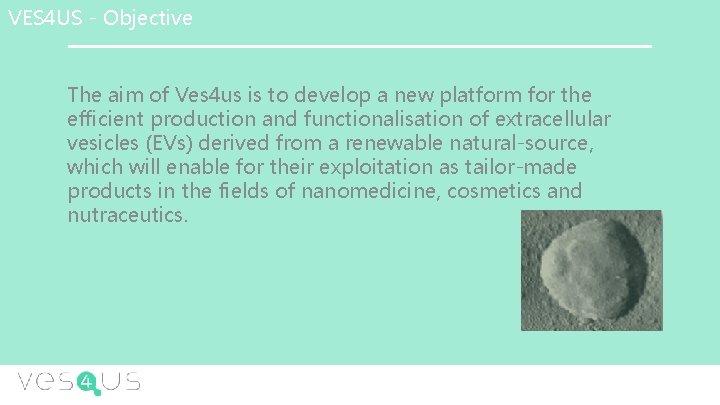
VES 4 US - Objective The aim of Ves 4 us is to develop a new platform for the efficient production and functionalisation of extracellular vesicles (EVs) derived from a renewable natural-source, which will enable for their exploitation as tailor-made products in the fields of nanomedicine, cosmetics and nutraceutics.
VES 4 US – State of the art INNOVATION: VES 4 US aims at creating a fundamentally new bioprocessing approach to generate and functionalise EVs from a renewable biological source using state-of-the-art technologies that have emerged in recent years as potent signal transducers, and cell-cell communicators. EVs will be loaded with specific cargoes directly in isolated EVs or by the modulation of producer cells. Membrane engineering for targeting purposes is expected to allow generating vesicle carriers with unprecedented abilities for delivery in specific tissues such as, brain, lung, skin, dendritic or tumour cells.
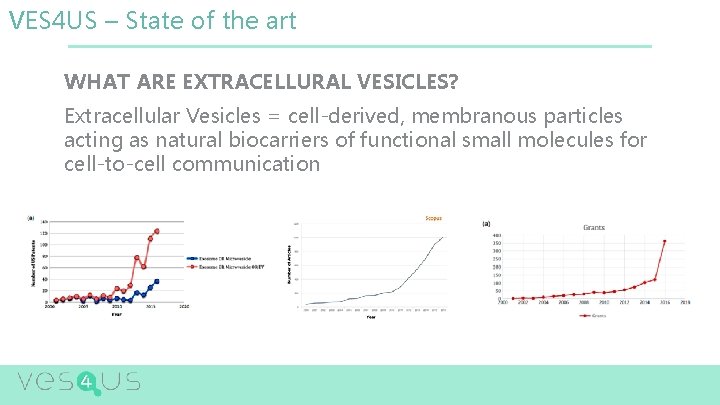
VES 4 US – State of the art WHAT ARE EXTRACELLURAL VESICLES? Extracellular Vesicles = cell-derived, membranous particles acting as natural biocarriers of functional small molecules for cell-to-cell communication
VES 4 US- Impacts Scientific Socioeconomic • EV features: 1) Are well tolerated in the body, 2) Have long circulating halflife, 3) Are internalized by other cells, 4) Carry small molecules and cargoes, 5) Are able to cross the BBB Potential EV application in the sectors of biotechnology, pharmaceutics, cosmetics, and the food industry, assessing also their clinical application possibilities, both diagnostic and therapeutic. • EVs as natural biocarriers of functional small molecules have raised great interest (cell-free therapy? )
VES 4 US – Limitations Problematics addressed 1) Pharmaceutical acceptability, economically viable and sustainable natural source of EVs 2) Replace the established time - and labour-intensive EV isolation procedures 3) Physic-chemical features of EVs to build a knowledge-base for research and industrial applications 4) Generating carriers with abilities for delivery in specific cells or tissues 5) EVs bioactivity
VES 4 US - Solutions Methods and means used 1) A sustainable, renewable and innovative natural source will be used to isolate EVs, (no milk-derived or bacterial-derived EVs) 2) Set-up and optimization of a novel reproducible and scalable retrieval of Evs 3) Conventional chemical-biophysical methods and innovative tools based on microfluidic technology 4) New methods for the engineering of EVs membrane will be optimised based on recently developed strategies applied on EVs and currently applied by partner 5) The biological activity, uptake and toxicology of EVs will be characterised using a series of established and novel in vitro and in vivo assays
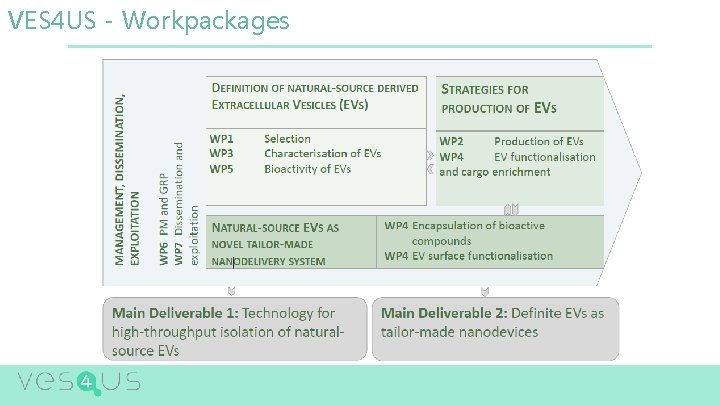
VES 4 US - Workpackages
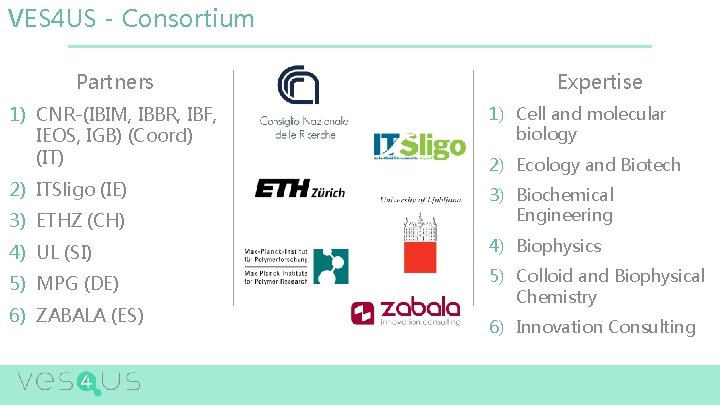
VES 4 US - Consortium Partners Expertise 1) CNR-(IBIM, IBBR, IBF, IEOS, IGB) (Coord) (IT) 1) Cell and molecular biology 2) ITSligo (IE) 3) ETHZ (CH) 3) Biochemical Engineering 4) UL (SI) 4) Biophysics 5) MPG (DE) 5) Colloid and Biophysical Chemistry 6) ZABALA (ES) 2) Ecology and Biotech 6) Innovation Consulting
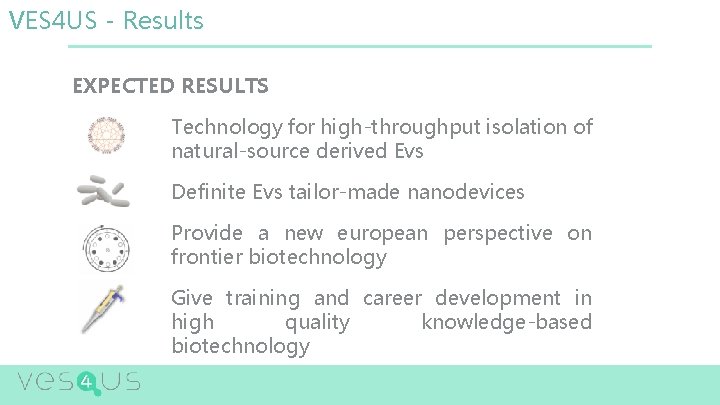
VES 4 US - Results EXPECTED RESULTS Technology for high-throughput isolation of natural-source derived Evs Definite Evs tailor-made nanodevices Provide a new european perspective on frontier biotechnology Give training and career development in high quality knowledge-based biotechnology
This is a VES 4 US presentation
Thank you Find us in: ves 4 us. eu @ves 4 us This project has received funding from the European Union’s Horizon 2020 research and innovation programme under grant agreement No 801338