
VERY SMALL APERTURE TERMINAL VSAT PROGRAM BRIEFING Presenter
VERY SMALL APERTURE TERMINAL (VSAT) PROGRAM BRIEFING Presenter: Hal Haislip Enterprise Program Management Office (EPMO), Transition, Release and Support (TRS), Enterprise Commercial Sustainment Management (ECSM) March 5, 2019
Introductions Ø Lino Vera – TAC CO Ø Dan Winterroth – TAC CS Ø Samantha Mc. Intyre - TAC CS Ø Chu Lai – TAC Engineer Ø Hal Haislip – Program Manager Ø Michael Proctor – OIT Service Delivery Ø Frank Joy – OIT Service Delivery Ø Chris Nelson – Communications Engineer / VSAT SME
Agenda Ø Background Ø Ground rules Ø Respond 1 st set of submitted questions Ø Presentation Ø Show equipment Ø Present significant changes to the PWS Ø Lunch Ø Go over new questions
Background and Expectations Current Contract Ø Task Order awarded under GSA’s GWAC Custom SATCOM Solutions Ø Expires 11/30/2019 Ø Draft PWS posted to FBO was basically the current PWS Ø Significant changes have been made and will be presented Ø A final “draft” PWS will be posted to FBO Ground Rules Ø No questions permitted during presentations Ø Write your questions down and provide to Dan or Samantha Ø All questions will be answered and posted to FBO Ø We will schedule any requested one on one meeting via teleconference
VSAT Business Requirements Ø Must work 100% of the time, regardless of existing infrastructure. Ø Must be completely independent of any other VA system. Ø Must be simple to use, with the ability to allow for complexity as necessary. Ø Must be secure. Ø Must be fault tolerant. Ø Must provide sufficient communications to meet mission objectives Ø The VSAT program must support: Veteran outreach, rural/underserved Veteran healthcare, telemedicine, direct patient care, Disaster Preparedness, Emergency Response, National Public Health, Continuation of Operations (COOP), and Continuation of Government (COG) missions.
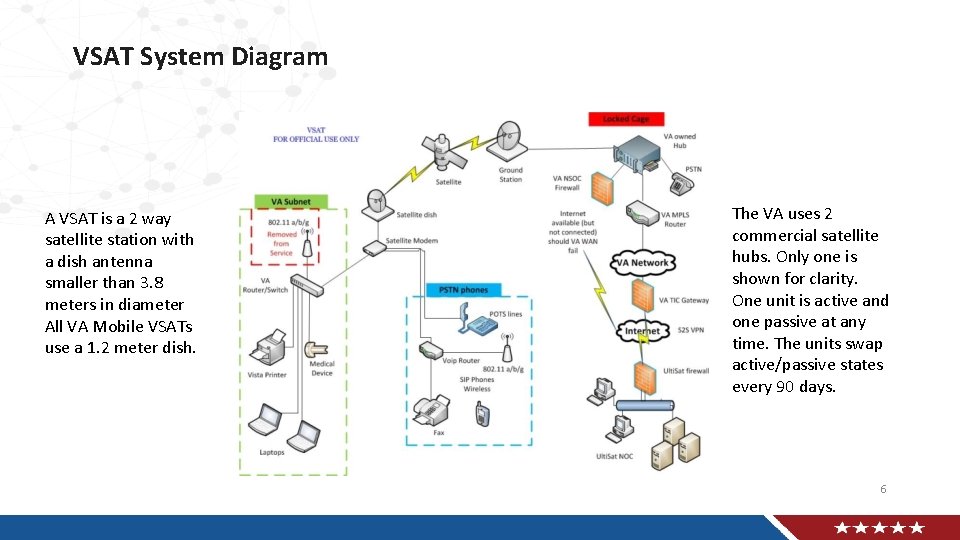
VSAT System Diagram A VSAT is a 2 way satellite station with a dish antenna smaller than 3. 8 meters in diameter All VA Mobile VSATs use a 1. 2 meter dish. The VA uses 2 commercial satellite hubs. Only one is shown for clarity. One unit is active and one passive at any time. The units swap active/passive states every 90 days. 6
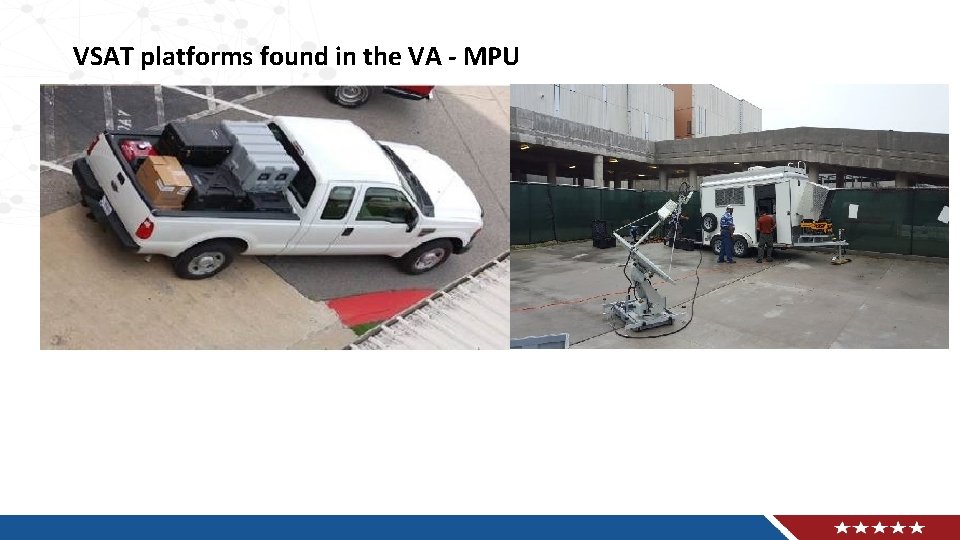
VSAT platforms found in the VA - MPU
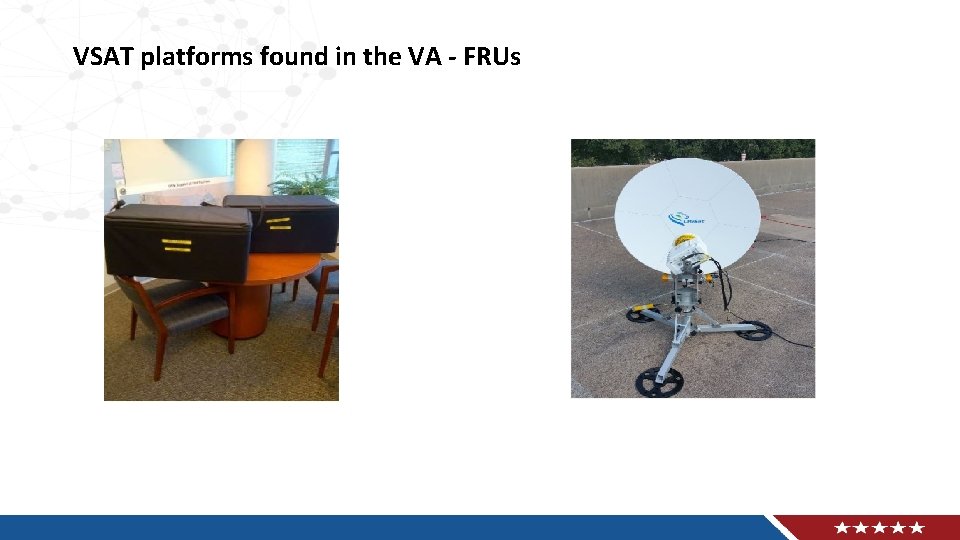
VSAT platforms found in the VA - FRUs
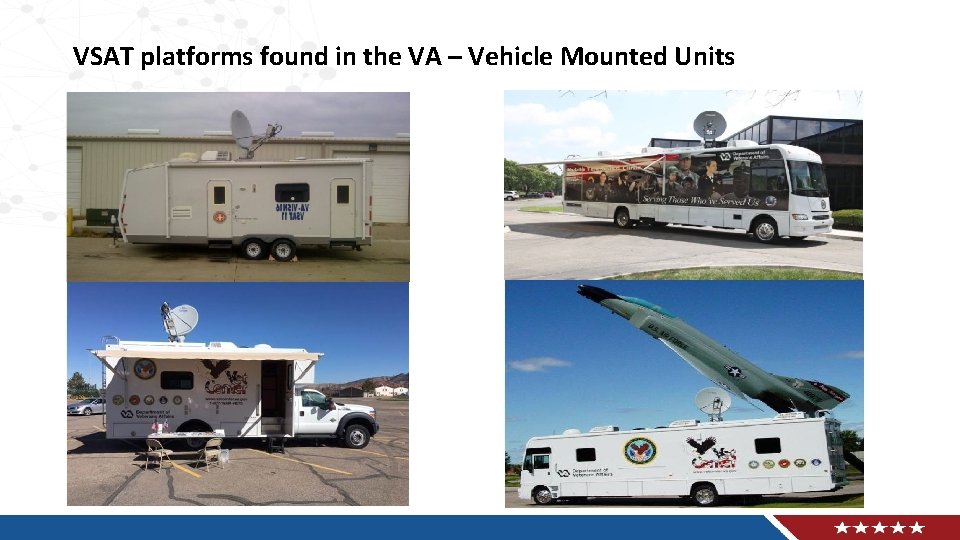
VSAT platforms found in the VA – Vehicle Mounted Units
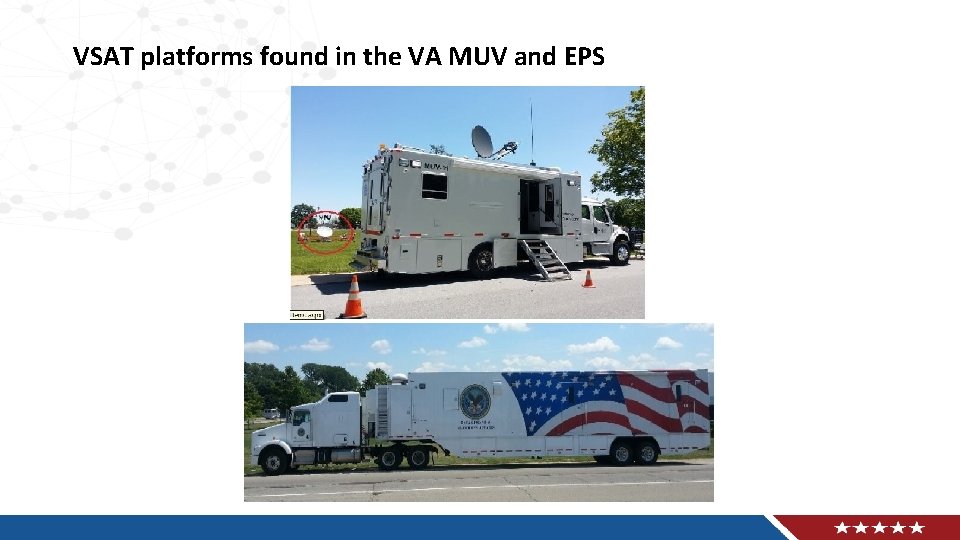
VSAT platforms found in the VA MUV and EPS
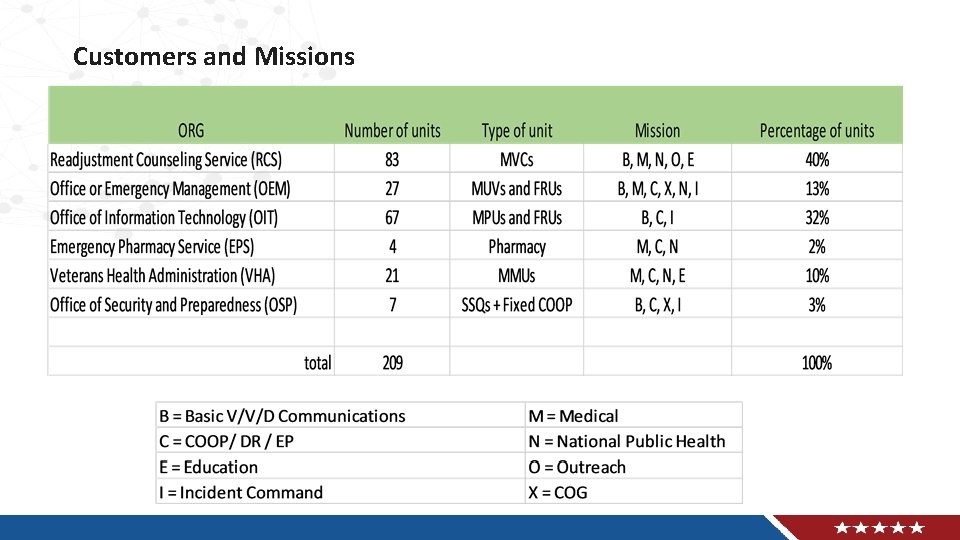
Customers and Missions Cont. 1 Ø Mobile Vet Centers (MVC’s) spend at least three days a week on the road providing assistance to Veterans at events such as fairs, health events, races, and other public events. They have been deployed to military installations to provide free “phone home” service in areas without phone service. Many localized disasters are responded to by MVCs. These units provide counseling and mental health assistance to Veterans in need of these services. These units can be equipped with providers and equipment doubling as a MMU, per agreement between the Readjustment Counseling Service (RCS) and Veterans Health Administration (VHA). Ø Mobile Medical Units (MMU’s) are deployed at least three days a week per VHA policy. The MMUs are basically a small out patient clinic (OPC) on wheels. However some are specialized for services such as: mammograms, Ear’s, Nose and Throat (ENT), dermatology, and outpatient surgery. Ø Emergency Pharmacy Service (EPS) units are pharmacies on wheels. These units deploy with security due to the value of what they carry. Typically they only deploy during major disasters.
Customers and Missions Cont. 2 Ø OI&T Operates a mixture of Man Portable Units (MPUs) and First Responder Units (FRU’s). While FRU’s are not “auto-deploy” they are much lighter and have a more powerful modem. The MPUs and FRUs are the most versatile of the VSAT units. They both fit in the bed of a pickup truck and can be transported almost anywhere. For this reason, they are usually the units deployed to a disaster site. Some units have operated continuously for over 90 days (example: Puerto Rico 2017 -2018). Ø The Office of Emergency Management Operates FRUs and Multi-Use Vehicles (MUVs). MUVs, are vehicles that can be reconfigured for multiple missions. They are equipped with VSAT, Plum Cases, HF radios, and two generators. The MUVs main drawback is they are large and need commercial drivers licenses to move. Ø OSP operates two fixed COOP VSATs that are up and functional 100% of the time. These units are monitored 24/7/365.
Customers and Missions Cont. 3 Ø The OSP “Go- Kit” consists of VSATs, routers, switches, WAPs, Fiber optic and copper cables, Video Units, and Voice over Internet Protocol (VOIP) phones, all loaded in a VA owned trailer. It contains everything necessary to implement a Command Control Center for the Department. As part of the Federal Continuity Directives (FCD) 1 and 2, we use the National Veterans Small Business Expo (NVSBE) events to exercise the Departments ability to reconstitute National Essential Functions. The VA is concerned with National Essential Functions (NEFs) 6 and 8 as defined in FCD-2 dated June 13, 2017. Ø NEF 6: Provides rapid and effective response to and recovery from the domestic consequences of an attack or other incident. Ø NEF 8: Provides for Federal Government services that address the national health, safety, and welfare needs of the United States.
Customers and Missions
History (Where we came from) Ø First VA VSAT, was designed around 2002 -2003. This was called a Man Portable Unit (MPU). Ø First use, of a VA VSAT was in 2004, used to provide communications in Key West, Florida after hurricane Frances. Ø The same VSAT was used in 2005 to provide communications to Biloxi VAMC after hurricane Katrina. Ø In 2006, VISN 8 and 16 procured the first production units for Disaster Response (DR) and Emergency Preparedness (EP). Ø In 2007 to 2009 additional VSAT’s were purchased by individual VISN’s on an ad-hoc basis.
History Cont. Ø By the end of 2013 there were 138 VSAT’s, either the MPU type, or a slightly different model, mounted on various types of vehicles. Instead of being called MPU’s, they were named after the mission they were to perform. Ø In 2015 an additional type of VSAT unit was introduced into inventory, known as the First Responder Unit (FRU). Ø The FRU was designed specifically for the Offices of Emergency Preparedness (OEM) and Office of Security and Preparedness (OSP). Ø Many Area Emergency Managers (AEM) didn’t want the FRUs, therefore, some are now operated by OIT. Ø VSATs have been deployed to all significant disaster events in the US since 2010.
Lessons Learned Ø Originally the VSAT system used a shared service, where a transponder was shared with other satellite based customers. A shared service was chosen due to less cost. Ø In 2007 and again in 2009, Florida had several wild fires due to drought conditions. These fires brought Federal response, which resulted in all VA transponder services being preempted by Federal Emergency Management Agency (FEMA). All VA VSAT’s lost service. Ø Due to the lessons learned the VA contracted for a dedicated transponder that greatly reduced the likely hood of being preempted. This is a requirement in the PWS. Ø The MPUs are heavy and time consuming to setup. Therefore, they are the least tested units in the inventory. We still require Auto deploy/ point systems. Ø Many VSAT equipped vehicle drivers do not take in to account bridge heights and other low hanging structures. Eleven hits to date. The VA will be responsible for replacing units destroyed in this manner.
Current Operations Ø Currently, there are 209 VSATs in inventory. This will be 226 by time of award. Ø For redundancy purposes, there are two teleports; one in the Western U. S. , and one in the Eastern U. S. This is a requirement in the PWS. Ø The VSAT system has a dedicated 36 Mega Hertz(MHz) transponder, on a satellite over the Western U. S. This or more is a requirement in the PWS. Ø VSATs reside in 49 States, Puerto Rico, and the U. S. Virgin Islands. To date, Alaska has declined all offers for VSAT units. Ø The VA manages only 9% of the VSAT components. VSAT is a managed service in most respects. The Vendor needs to take over the remaining 9% as described in the PWS Ø All satellite links are encrypted via Federal Information Processing Standard (FIPS) 140 -2 certified encryption. Encryption occurs in the satellite modem and hubs. This is a requirement in the PWS.
Current Operations Cont. 1 Ø VSATs report their GPS coordinates when online. Ø There is a VSAT portal and VSAT live location Geographic Information System (GIS) website. This is a requirement in the PWS. Ø Should the VA network fail, the VSAT network can be redirected to the Internet (or another network) and still provide voice, video, and data services to another Government entity such as Homeland Security, Health and Human Services, or Do. D. This is a requirement in the PWS. Ø The vast majority of VSAT team member are Veterans that volunteer to be on the teams. Ø Mobile Vet Centers (MVC’s), Multi-Use Vehicles (MUVs), Mobile Medical Units (MMU’s), and Emergency Pharmacy Service (EPS) units rely on local IT staff for laptop and printer support. Ø On average, MVCs, MUVs, MMUs and EPS units receive less than 15 minutes of OIT support per unit, per year.
Current Operations Cont. 2 Ø The hub and modem technology is currently over 15 years old. Ø Some VSATs are 14 years old. Ø Due to the age of the equipment reliability has become an issue. Ø Cisco routers are currently at End-of-Life, and approaching End-of-Support. Ø For normal operations VSATs are configured to operate with a 1 Mb up and 2 Mb down. Ø During emergency operations a limited number can be configured to operate up to 3 Mb up and 5 Mb down.
Current Operations Cont. 3 Ø Help Desk, Technical Support, and Maintenance are provided by a contractor under a firm fixed price contract. This is a requirement in the PWS. Ø VSAT teams receive on-site training every year and are asked to deploy (for testing) units every 30 days. This is a requirement in the PWS. Ø Daily VSAT operations are delegated to the assigned organizational unit, until they receive a tasking order from the VA Integrated Operations Center (IOC). They are then tasked to perform specific missions by the Department. No changes are planned. Ø The VA IOC provides tasks orders, then after consulting/coordination with the VSAT PM, Disaster Response-Continuation of Operations (DR-COOP) assigns the specific assets to deploy. No changes are planned.
Q&A Office of Information and Technology 22
- Slides: 22