
Very Low Level Waste Lisa Edwards EPRI Senior
- Slides: 13
Very Low Level Waste Lisa Edwards EPRI Senior Program Manager LLW Forum March, 2015 © 2015 Electric Power Research Institute, Inc. All rights reserved.
2 Reports – Publically Available § Report ID 1024844 § Investigates international and US application of the concept of VLLW § Compares international disposal requirements for VLLW to RCRA landfill requirements in the US 2 § Report ID 3002000587 § Provides generic technical basis for defining VLLW in the US § Compares results to international definitions of VLLW © 2015 Electric Power Research Institute, Inc. All rights reserved.
Key take-Aways from Report 1024844 § VLLW is part of IAEA waste categories § Successfully used in France, Spain, and Sweden § Concept is applied in US – 20. 2002 exemption process – Agreement states § RCRA subtitle C disposal facilities compare favorably to disposal requirements for VLLW used abroad § Significant industry O&M and decommissioning savings can be realized with RCRA VLLW disposal path § Could play an important role in addressing disposal needs associated with radiological dispersal devices (RDD) 3 © 2015 Electric Power Research Institute, Inc. All rights reserved.
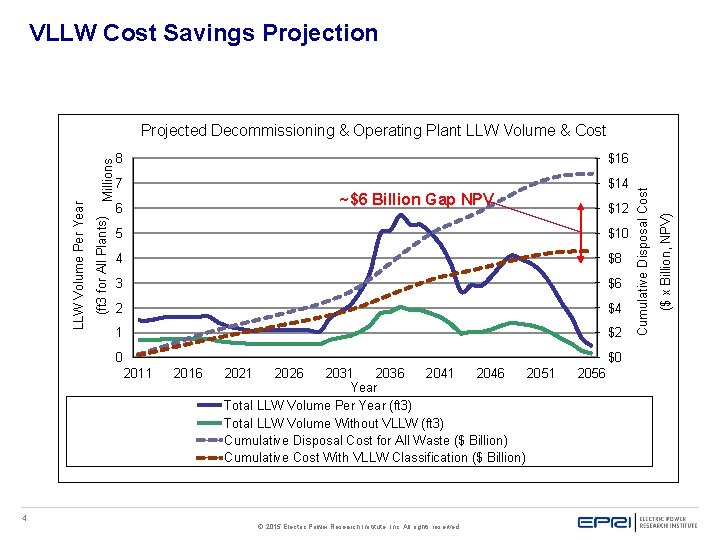
VLLW Cost Savings Projection $16 7 $14 ~$6 Billion Gap NPV 6 5 $10 4 $8 3 $6 2 $4 1 $2 0 $0 2011 4 $12 2016 2021 2026 2031 2036 2041 2046 2051 Year Total LLW Volume Per Year (ft 3) Total LLW Volume Without VLLW (ft 3) Cumulative Disposal Cost for All Waste ($ Billion) Cumulative Cost With VLLW Classification ($ Billion) © 2015 Electric Power Research Institute, Inc. All rights reserved. 2056 ($ x Billion, NPV) 8 Cumulative Disposal Cost Millions (ft 3 for All Plants) LLW Volume Per Year Projected Decommissioning & Operating Plant LLW Volume & Cost
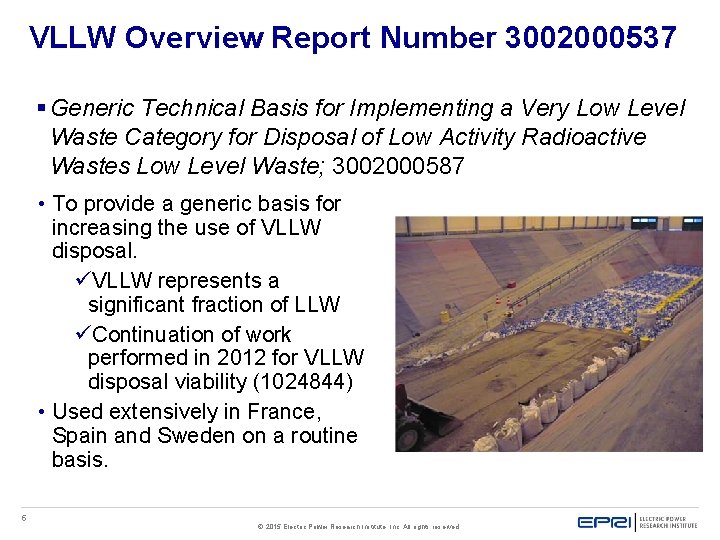
VLLW Overview Report Number 3002000537 § Generic Technical Basis for Implementing a Very Low Level Waste Category for Disposal of Low Activity Radioactive Wastes Low Level Waste; 3002000587 • To provide a generic basis for increasing the use of VLLW disposal. üVLLW represents a significant fraction of LLW üContinuation of work performed in 2012 for VLLW disposal viability (1024844) • Used extensively in France, Spain and Sweden on a routine basis. 5 © 2015 Electric Power Research Institute, Inc. All rights reserved.
Key Takeaways 3002000587 Generic Very Low Level Waste Basis (VLLW) § VLLW can be safely disposed in properly designed generic hazardous waste disposal facilities. – Provides a generic approach based on reasonable yet conservative assumptions for disposal of VLLW. – Global applicability for lined, monitored, and capped hazardous waste disposal facilities. – Substantial cost savings to utilities, preservation of limited LLW disposal resources, LLW disposal relief afforded to universities and hospitals. – A pathway for generic disposal of VLLW is of benefit to public. 6 © 2015 Electric Power Research Institute, Inc. All rights reserved.
Generic VLLW Analysis Methodology § Using reasonable yet conservative assumptions for disposal of VLLW in lined, monitored, and capped hazardous waste disposal facilities § Establish parameters based on global guidance and experience and sound scientific reasoning. § The challenges: – Some requirements vary by country – What performance objective (dose limits) should apply? § Some factors are relatively constant such as minimum hazardous waste disposal facility design requirements for lining, capping, monitoring, etc. conforming to: – Annex 1 of EU council directive 1999/31/EC – US EPA RCRA subtitle C 7 © 2015 Electric Power Research Institute, Inc. All rights reserved.
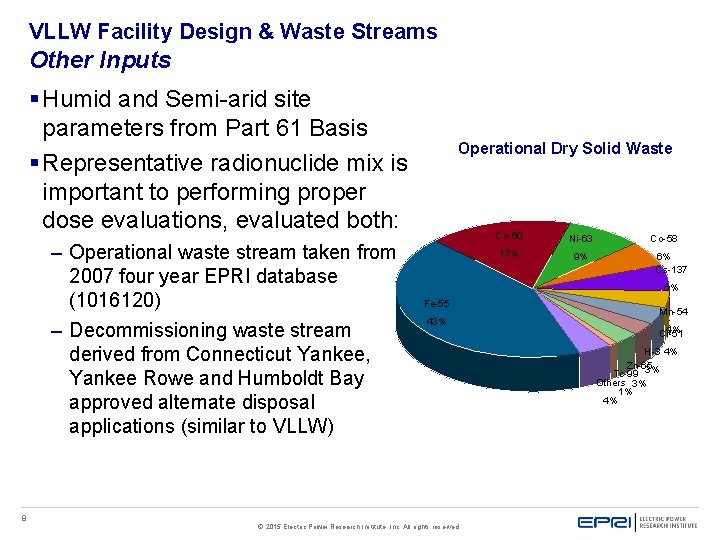
VLLW Facility Design & Waste Streams Other Inputs § Humid and Semi-arid site parameters from Part 61 Basis § Representative radionuclide mix is important to performing proper dose evaluations, evaluated both: – Operational waste stream taken from 2007 four year EPRI database (1016120) – Decommissioning waste stream derived from Connecticut Yankee, Yankee Rowe and Humboldt Bay approved alternate disposal applications (similar to VLLW) 8 Operational Dry Solid Waste Co-60 Ni-63 17% 9% Co-58 6% Cs-137 6% Fe-55 43% © 2015 Electric Power Research Institute, Inc. All rights reserved. Mn-54 4% Cr-51 H-3 4% Zn-65 Tc-99 3% Others 3% 1% 4%
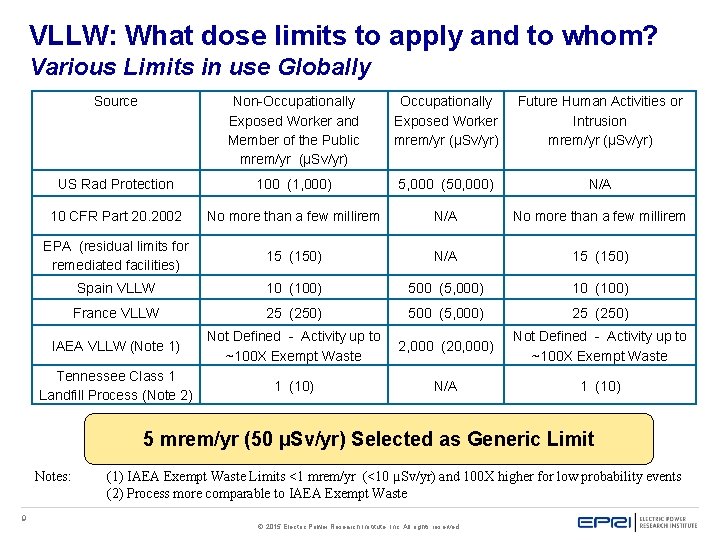
VLLW: What dose limits to apply and to whom? Various Limits in use Globally Source Non-Occupationally Exposed Worker and Member of the Public mrem/yr (µSv/yr) Occupationally Exposed Worker mrem/yr (µSv/yr) Future Human Activities or Intrusion mrem/yr (µSv/yr) US Rad Protection 100 (1, 000) 5, 000 (50, 000) N/A 10 CFR Part 20. 2002 No more than a few millirem N/A No more than a few millirem EPA (residual limits for remediated facilities) 15 (150) N/A 15 (150) Spain VLLW 10 (100) 500 (5, 000) 10 (100) France VLLW 25 (250) 500 (5, 000) 25 (250) IAEA VLLW (Note 1) Not Defined - Activity up to ~100 X Exempt Waste 2, 000 (20, 000) Not Defined - Activity up to ~100 X Exempt Waste Tennessee Class 1 Landfill Process (Note 2) 1 (10) N/A 1 (10) 5 mrem/yr (50 µSv/yr) Selected as Generic Limit Notes: 9 (1) IAEA Exempt Waste Limits <1 mrem/yr (<10 µSv/yr) and 100 X higher for low probability events (2) Process more comparable to IAEA Exempt Waste © 2015 Electric Power Research Institute, Inc. All rights reserved.
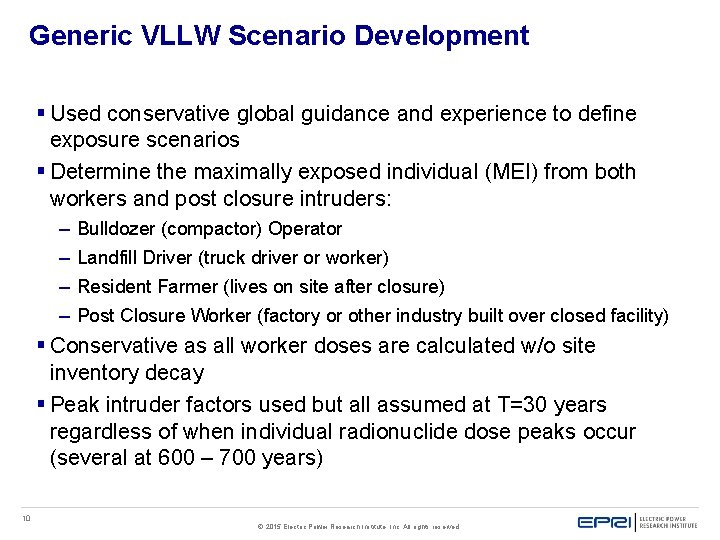
Generic VLLW Scenario Development § Used conservative global guidance and experience to define exposure scenarios § Determine the maximally exposed individual (MEI) from both workers and post closure intruders: – – Bulldozer (compactor) Operator Landfill Driver (truck driver or worker) Resident Farmer (lives on site after closure) Post Closure Worker (factory or other industry built over closed facility) § Conservative as all worker doses are calculated w/o site inventory decay § Peak intruder factors used but all assumed at T=30 years regardless of when individual radionuclide dose peaks occur (several at 600 – 700 years) 10 © 2015 Electric Power Research Institute, Inc. All rights reserved.
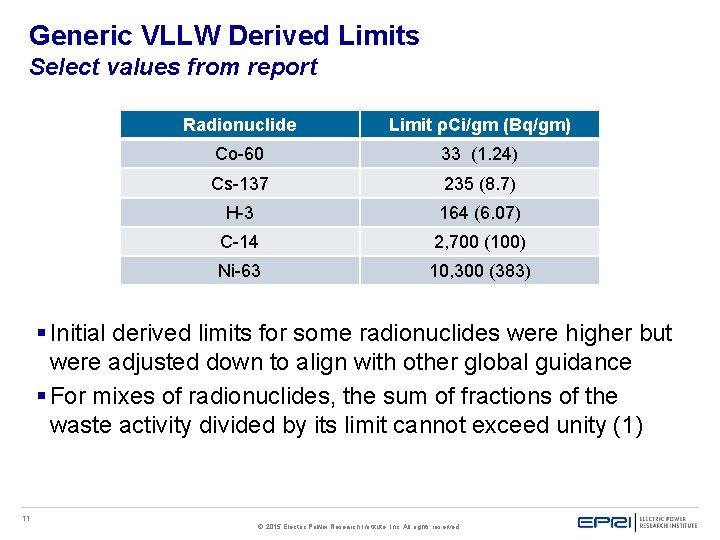
Generic VLLW Derived Limits Select values from report Radionuclide Limit ρCi/gm (Bq/gm) Co-60 33 (1. 24) Cs-137 235 (8. 7) H-3 164 (6. 07) C-14 2, 700 (100) Ni-63 10, 300 (383) § Initial derived limits for some radionuclides were higher but were adjusted down to align with other global guidance § For mixes of radionuclides, the sum of fractions of the waste activity divided by its limit cannot exceed unity (1) 11 © 2015 Electric Power Research Institute, Inc. All rights reserved.
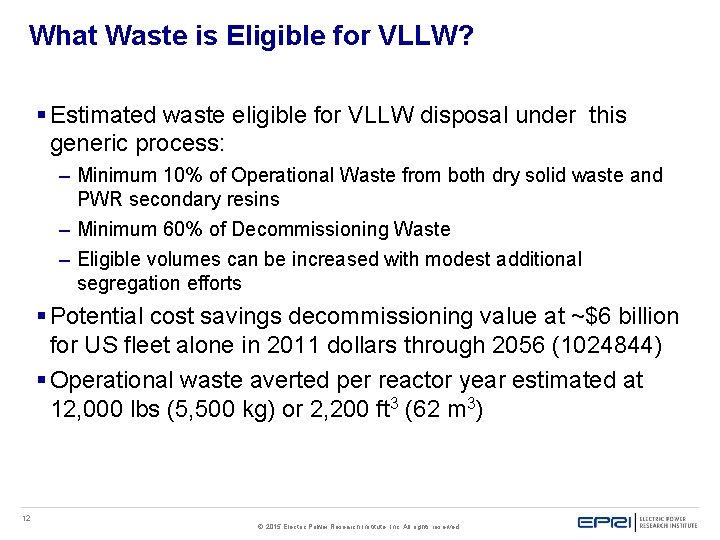
What Waste is Eligible for VLLW? § Estimated waste eligible for VLLW disposal under this generic process: – Minimum 10% of Operational Waste from both dry solid waste and PWR secondary resins – Minimum 60% of Decommissioning Waste – Eligible volumes can be increased with modest additional segregation efforts § Potential cost savings decommissioning value at ~$6 billion for US fleet alone in 2011 dollars through 2056 (1024844) § Operational waste averted per reactor year estimated at 12, 000 lbs (5, 500 kg) or 2, 200 ft 3 (62 m 3) 12 © 2015 Electric Power Research Institute, Inc. All rights reserved.
Together…Shaping the Future of Electricity 13 © 2015 Electric Power Research Institute, Inc. All rights reserved.