
Very Long Chain Fatty Acid Synthesis Inhibition VLCFA
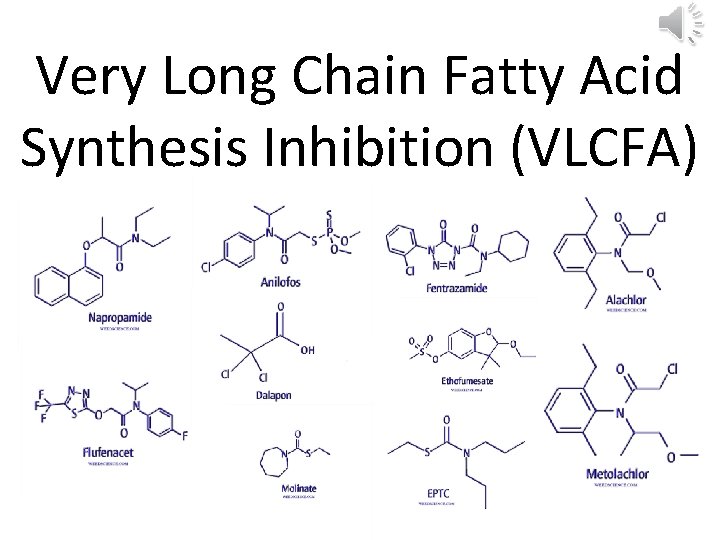
Very Long Chain Fatty Acid Synthesis Inhibition (VLCFA)
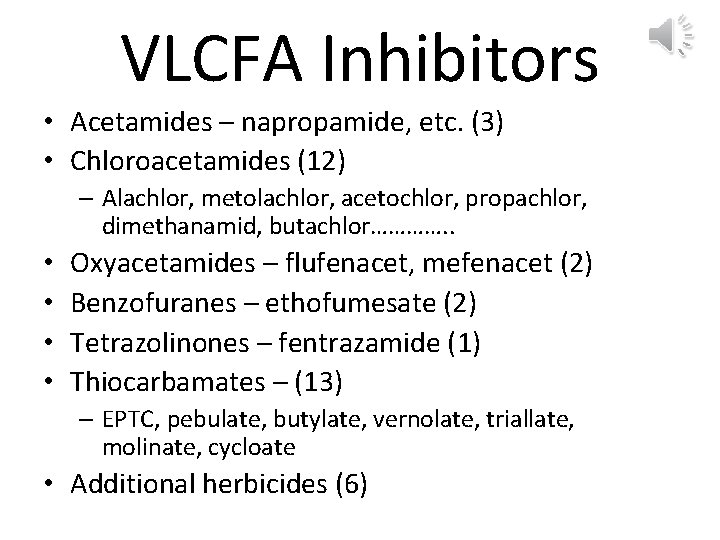
VLCFA Inhibitors • Acetamides – napropamide, etc. (3) • Chloroacetamides (12) – Alachlor, metolachlor, acetochlor, propachlor, dimethanamid, butachlor…………. . • • Oxyacetamides – flufenacet, mefenacet (2) Benzofuranes – ethofumesate (2) Tetrazolinones – fentrazamide (1) Thiocarbamates – (13) – EPTC, pebulate, butylate, vernolate, triallate, molinate, cycloate • Additional herbicides (6)
VLCFA Inhibitors • Active only on seedling shoots and roots • Pre-emergence and pre-plant incorporated • Essentially non-mobile in soil, but some movement is possible with certain chloroacetamides • Very low water solubility restricts apoplastic movement, coupled with immediate activity
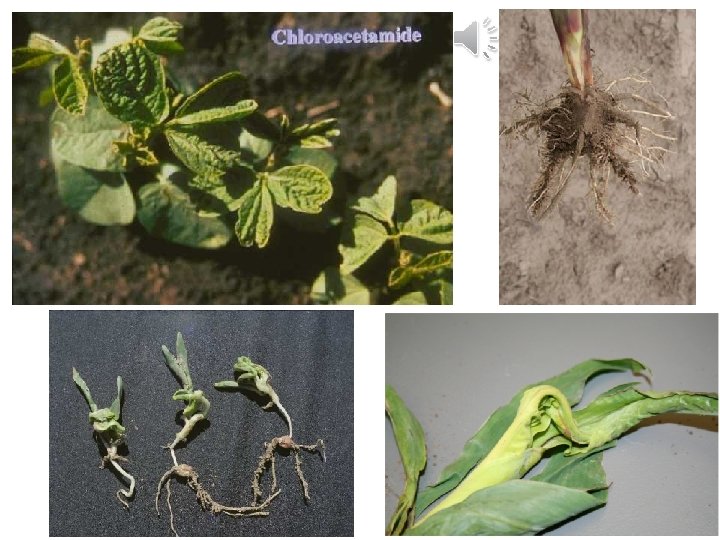
Mode of Action • Absorption of herbicide into seedling roots and shoot tissue – Some movement via soil water uptake – Most likely most uptake by roots growing and direct contact • Most affected plants don’t emerge from soil • Symptoms a result of damage to growth areas, manifesting as the plant grows
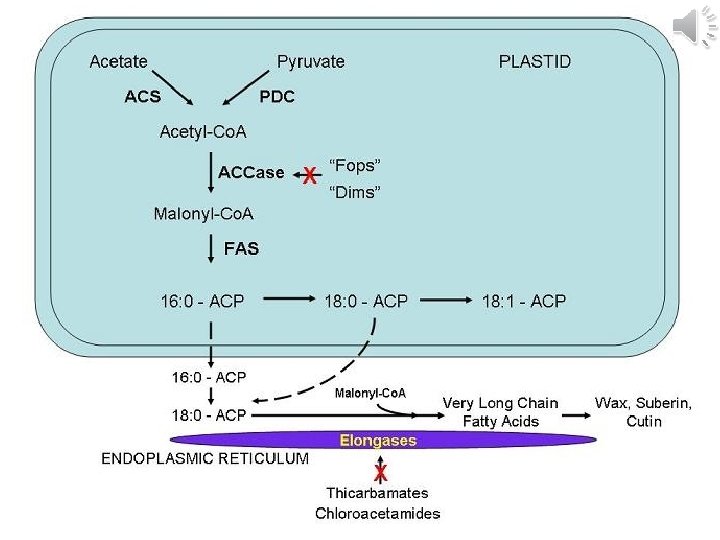
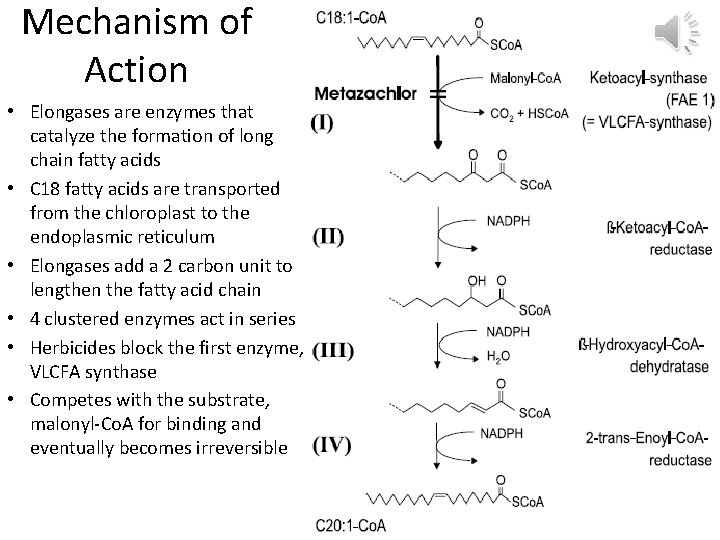
Mechanism of Action • Elongases are enzymes that catalyze the formation of long chain fatty acids • C 18 fatty acids are transported from the chloroplast to the endoplasmic reticulum • Elongases add a 2 carbon unit to lengthen the fatty acid chain • 4 clustered enzymes act in series • Herbicides block the first enzyme, VLCFA synthase • Competes with the substrate, malonyl-Co. A for binding and eventually becomes irreversible
Mode/Mechanism of Action • Elongation step is blocked, pointing to elongases as the critical step • Most evidence points to VLCFA synthase as the target enzyme for all in this classification • Thiocarbamates must be metabolized to an active form by sulfoxidase enzymes
Selectivity • Primarily placement of the herbicide within the top layer of soil – Contacts small seeded weeds such as pigweeds, Florida pusley, and most grasses – Crop plants are planted below the treated zone, thus limiting uptake of the herbicide • Chloroacetamides – some crops have ability to metabolize herbicides via glutathione conjugation (corn)
Safeners and Extenders for Thiocarbamates • Dichlormid – enhances sulfate metabolism which increases glutathione activity – may act as a competitive inhibitor for uptake for EPTC • Dietholate – microbial inhibitor used with EPTC and butylate – called ‘extenders’

Safeners for Chloroacetamides • Benoxacor Ø applied in conjunction with metolachlor (20: 1 ratio) Ø enhances the rate of S-metolachlor detoxification in corn and potatoes Ø activity includes removal of chlorine, subsequent glutathione conjugation and hydrolysis to an alcohol metabolite that is conjugated by glucose • Dichlormid Ø specifically used with acetochlor (chloroacetamide) Ø induces the synthesis of glutathione S-transferease isozymes which metabolize the herbicide
Safeners for Chloroacetamides Fenclorim Ø used in conjunction with pretilachlor (chloroacetamide) to enhance GST activity in rice Ø applied as a seed treatment Ø pretilachlor and fenclorim not labeled for use in US Fluxofenim - Concep III Ø used as a safener for chloroacetamide herbicides in sorghum (primarily Smetolachlor) but will work for most chloroacetamides Ø used as a seed treatment for sorghum safening - 0. 4 g-ai/kg of seed Ø absorbed through seed coat of germinating sorghum seeds Ø elevates glutathione S-transferase activity which increases herbicide metabolism Fluorazole – Screen - no longer in use Ø similar activity and use as Concep III
S-Metolachlor • • Enantiomers Only S form active Original had both New formulation only S
Resistance Mechanisms • Very slow to develop…… > 30 years (triallate) • Inability to metabolize herbicide to active form – Called “loss of function” mutants – Thiocarbamates • Chloroacetamides – Enhanced metabolism in barnyardgrass and rigid ryegrass
- Slides: 14