
Vertical Scaling in ValueAdded Models for Student Learning
- Slides: 30
Vertical Scaling in Value-Added Models for Student Learning Derek Briggs Jonathan Weeks Ed Wiley University of Colorado, Boulder Presentation at the annual meeting of the National Conference on Value. Added Modeling. April 22 -24, 2008. Madison, WI. 1
Overview • Value-added models require some form of longitudinal data. • Implicit assumption that test scores have a consistent interpretation over time. • There are multiple technical decisions to make when creating a vertical score scale. • Do these decisions have a sizeable impact on – student growth projections? – value-added school residuals? 2
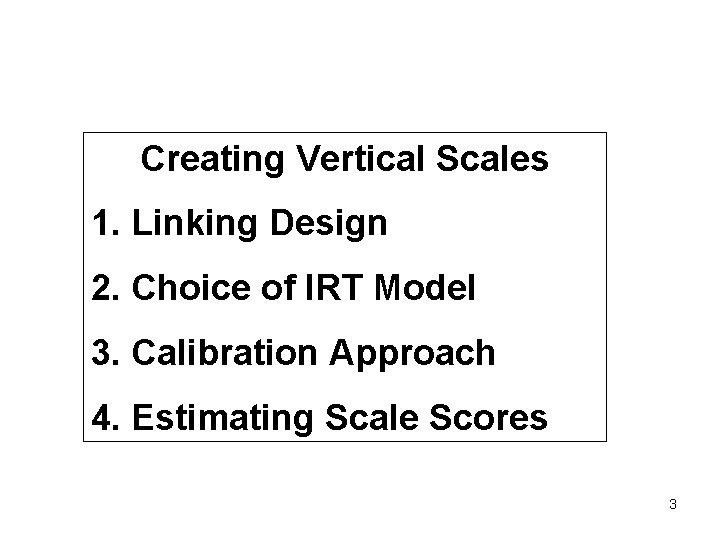
Creating Vertical Scales 1. Linking Design 2. Choice of IRT Model 3. Calibration Approach 4. Estimating Scale Scores 3
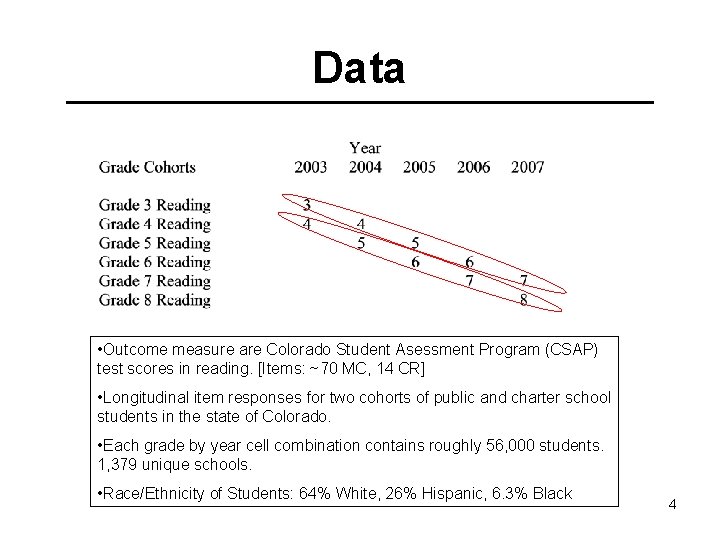
Data • Outcome measure are Colorado Student Asessment Program (CSAP) test scores in reading. [Items: ~70 MC, 14 CR] • Longitudinal item responses for two cohorts of public and charter school students in the state of Colorado. • Each grade by year cell combination contains roughly 56, 000 students. 1, 379 unique schools. • Race/Ethnicity of Students: 64% White, 26% Hispanic, 6. 3% Black 4
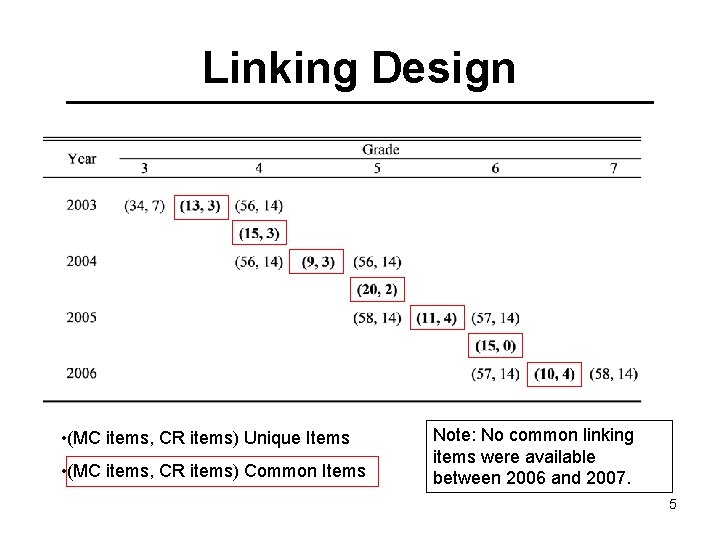
Linking Design • (MC items, CR items) Unique Items • (MC items, CR items) Common Items Note: No common linking items were available between 2006 and 2007. 5
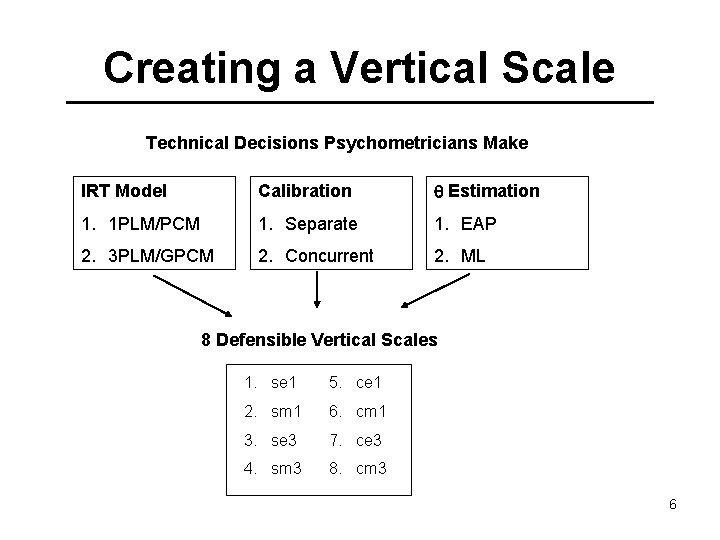
Creating a Vertical Scale Technical Decisions Psychometricians Make IRT Model Calibration Estimation 1. 1 PLM/PCM 1. Separate 1. EAP 2. 3 PLM/GPCM 2. Concurrent 2. ML 8 Defensible Vertical Scales 1. se 1 5. ce 1 2. sm 1 6. cm 1 3. se 3 7. ce 3 4. sm 3 8. cm 3 6
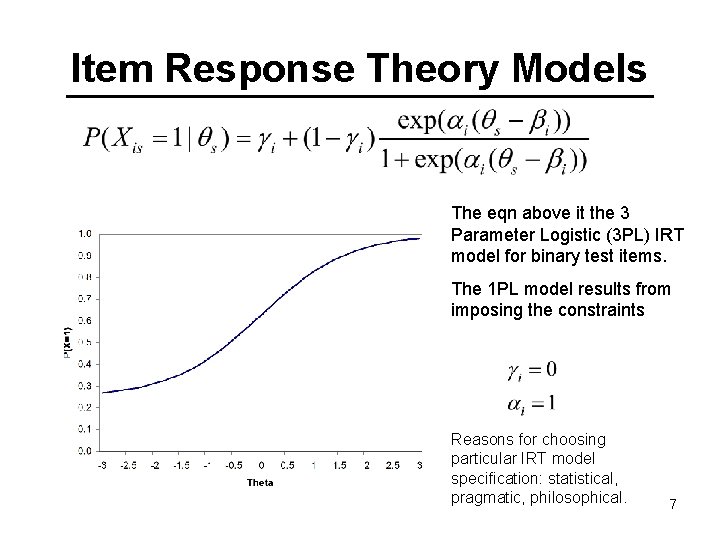
Item Response Theory Models The eqn above it the 3 Parameter Logistic (3 PL) IRT model for binary test items. The 1 PL model results from imposing the constraints Reasons for choosing particular IRT model specification: statistical, pragmatic, philosophical. 7
IRT Assumptions and Properties Assumptions • Unidimensionality: The test only measures one latent construct. • Local Independence: Conditional on this latent construct, item responses are independent. Properties • Scale Indeterminacy: The scale of a test is only identified up to a linear transformation. • Parameter Invariance: If the model fits, item & person parameters should be the same regardless of the group of persons & items used to estimate them. 8
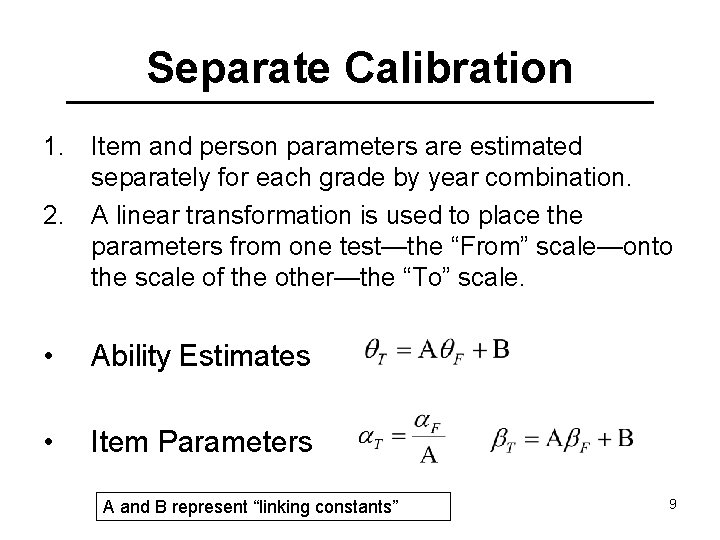
Separate Calibration 1. Item and person parameters are estimated separately for each grade by year combination. 2. A linear transformation is used to place the parameters from one test—the “From” scale—onto the scale of the other—the “To” scale. • Ability Estimates • Item Parameters A and B represent “linking constants” 9
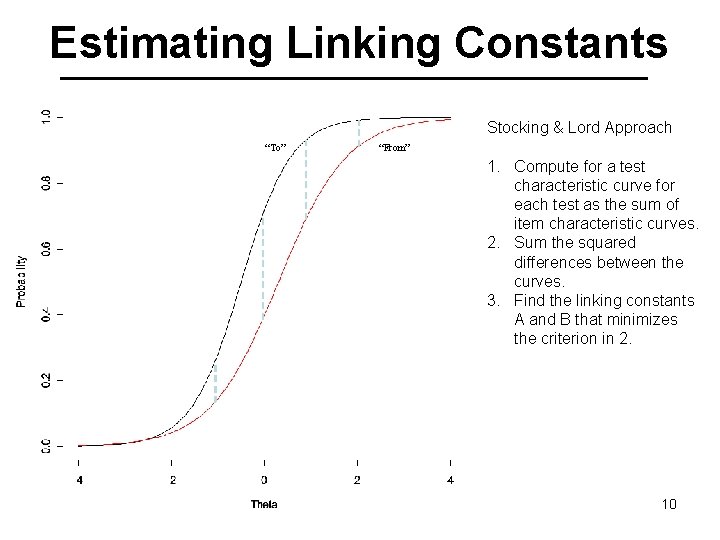
Estimating Linking Constants Stocking & Lord Approach “To” “From” 1. Compute for a test characteristic curve for each test as the sum of item characteristic curves. 2. Sum the squared differences between the curves. 3. Find the linking constants A and B that minimizes the criterion in 2. 10
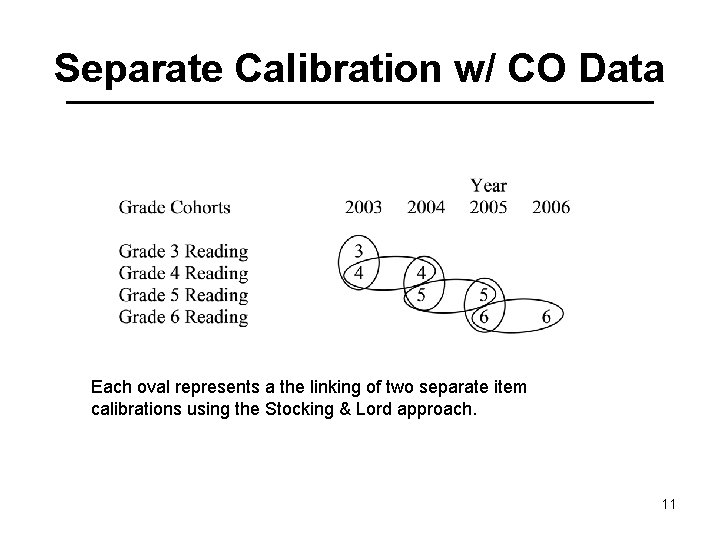
Separate Calibration w/ CO Data Each oval represents a the linking of two separate item calibrations using the Stocking & Lord approach. 11
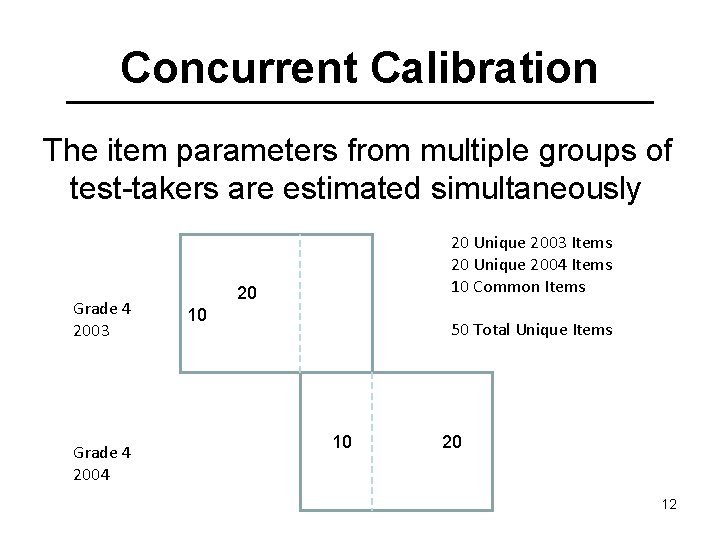
Concurrent Calibration The item parameters from multiple groups of test-takers are estimated simultaneously Grade 4 2003 Grade 4 2004 20 Unique 2003 Items 20 Unique 2004 Items 10 Common Items 20 10 50 Total Unique Items 10 20 12
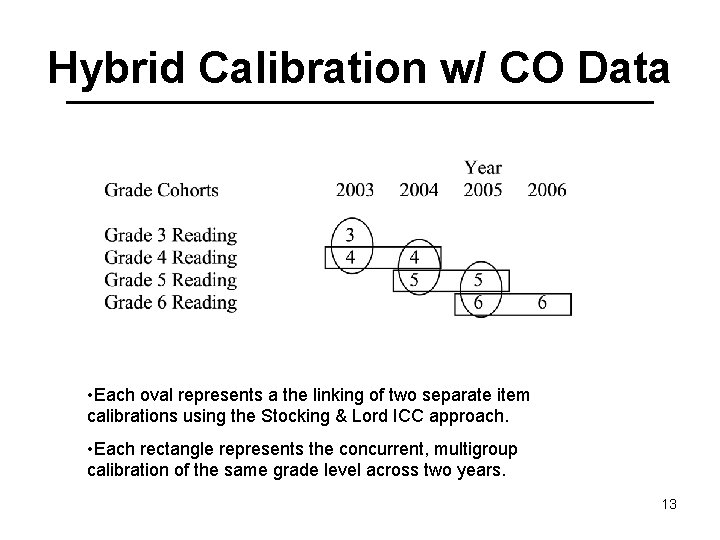
Hybrid Calibration w/ CO Data • Each oval represents a the linking of two separate item calibrations using the Stocking & Lord ICC approach. • Each rectangle represents the concurrent, multigroup calibration of the same grade level across two years. 13
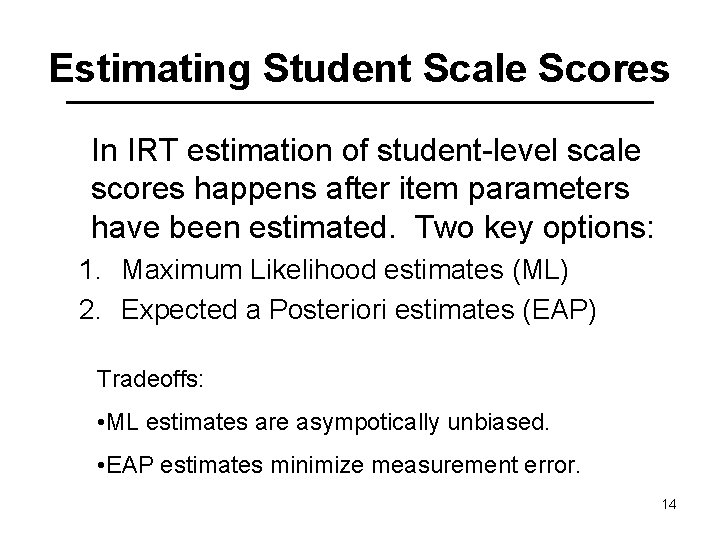
Estimating Student Scale Scores In IRT estimation of student-level scale scores happens after item parameters have been estimated. Two key options: 1. Maximum Likelihood estimates (ML) 2. Expected a Posteriori estimates (EAP) Tradeoffs: • ML estimates are asympotically unbiased. • EAP estimates minimize measurement error. 14
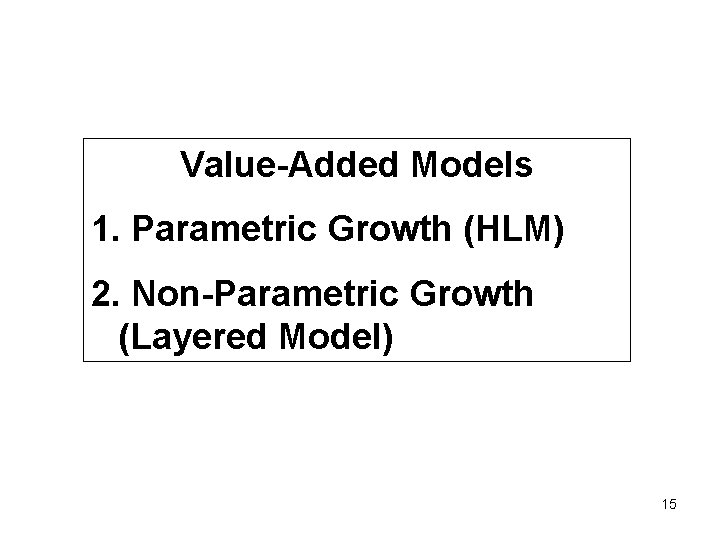
Value-Added Models 1. Parametric Growth (HLM) 2. Non-Parametric Growth (Layered Model) 15
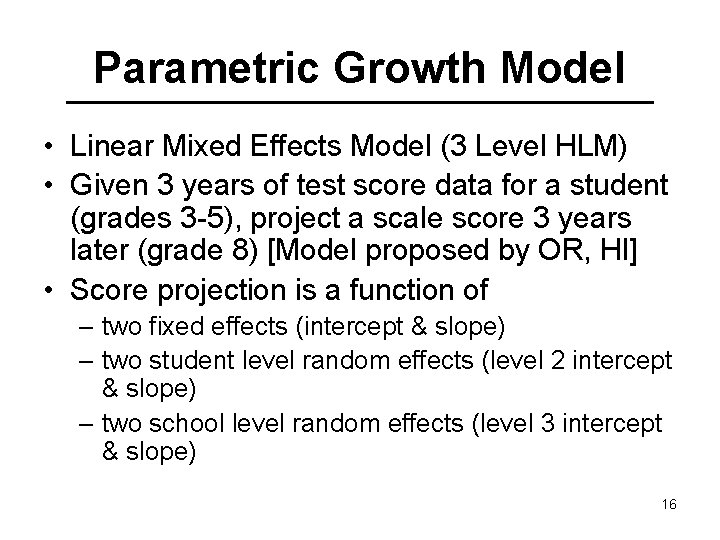
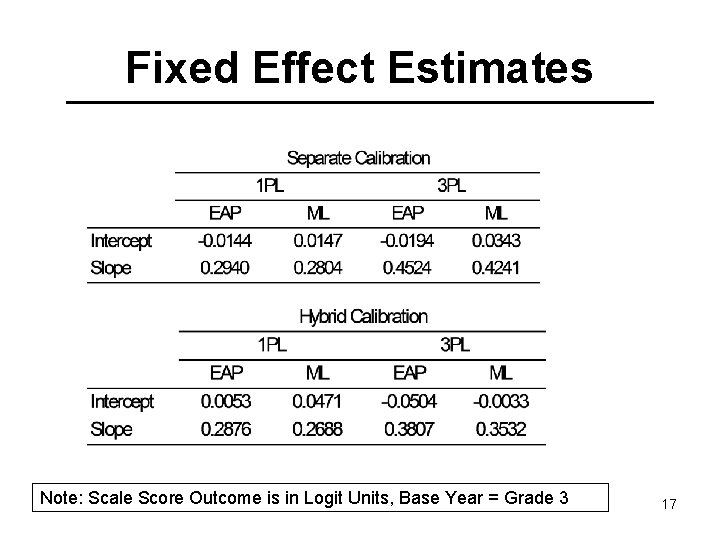
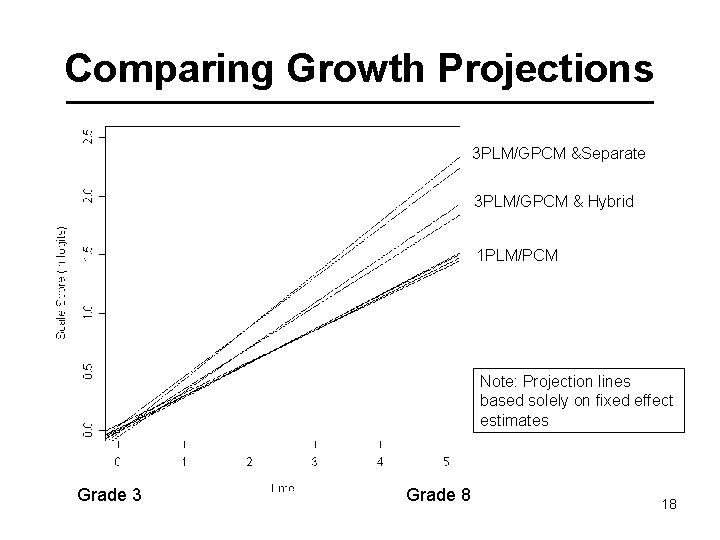
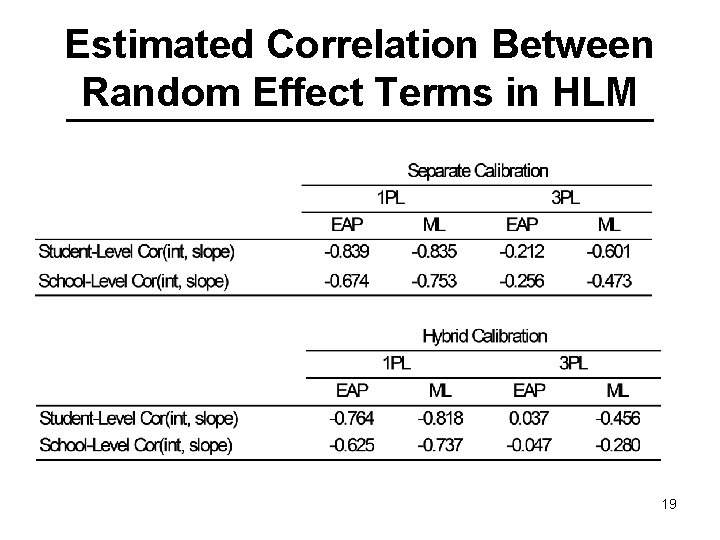
Parametric Growth Model • Linear Mixed Effects Model (3 Level HLM) • Given 3 years of test score data for a student (grades 3 -5), project a scale score 3 years later (grade 8) [Model proposed by OR, HI] • Score projection is a function of – two fixed effects (intercept & slope) – two student level random effects (level 2 intercept & slope) – two school level random effects (level 3 intercept & slope) 16
Fixed Effect Estimates Note: Scale Score Outcome is in Logit Units, Base Year = Grade 3 17
Comparing Growth Projections 3 PLM/GPCM &Separate 3 PLM/GPCM & Hybrid 1 PLM/PCM Note: Projection lines based solely on fixed effect estimates Grade 3 Grade 8 18
Estimated Correlation Between Random Effect Terms in HLM 19
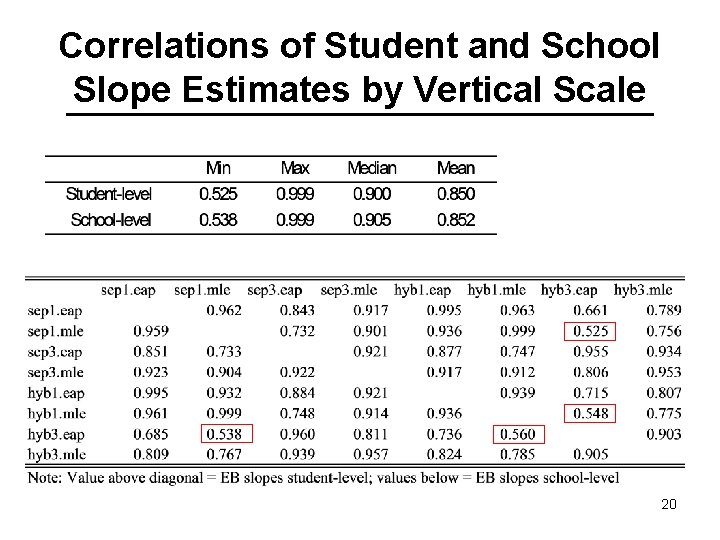
Correlations of Student and School Slope Estimates by Vertical Scale 20
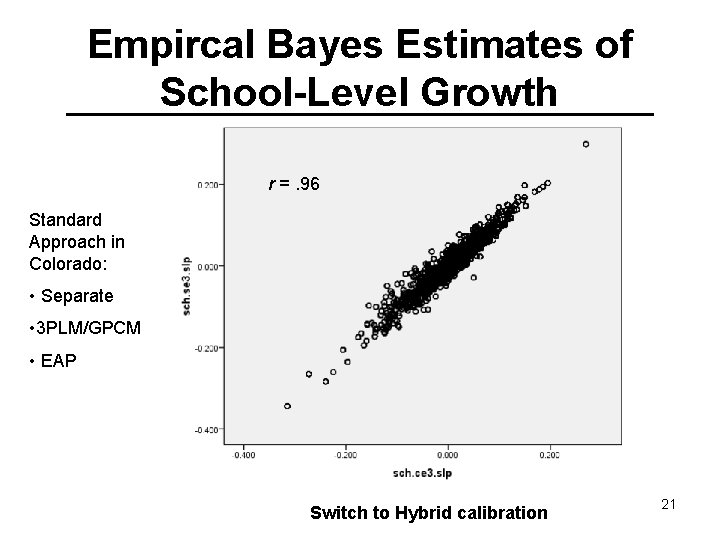
Empircal Bayes Estimates of School-Level Growth r =. 96 Standard Approach in Colorado: • Separate • 3 PLM/GPCM • EAP Switch to Hybrid calibration 21
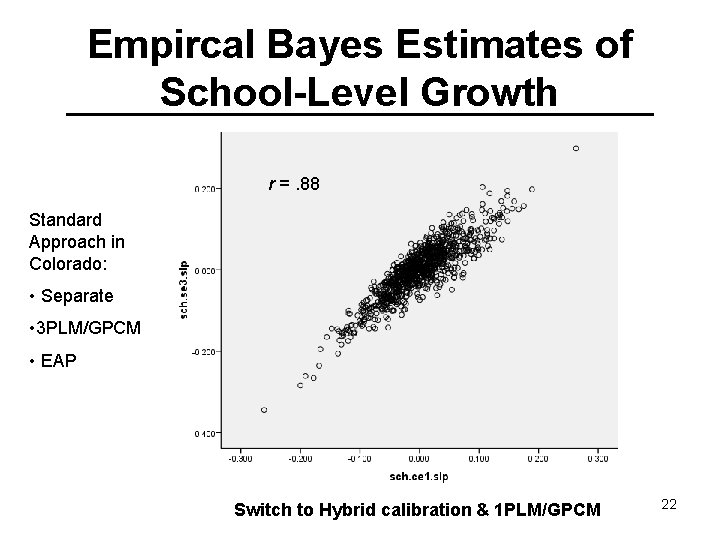
Empircal Bayes Estimates of School-Level Growth r =. 88 Standard Approach in Colorado: • Separate • 3 PLM/GPCM • EAP Switch to Hybrid calibration & 1 PLM/GPCM 22
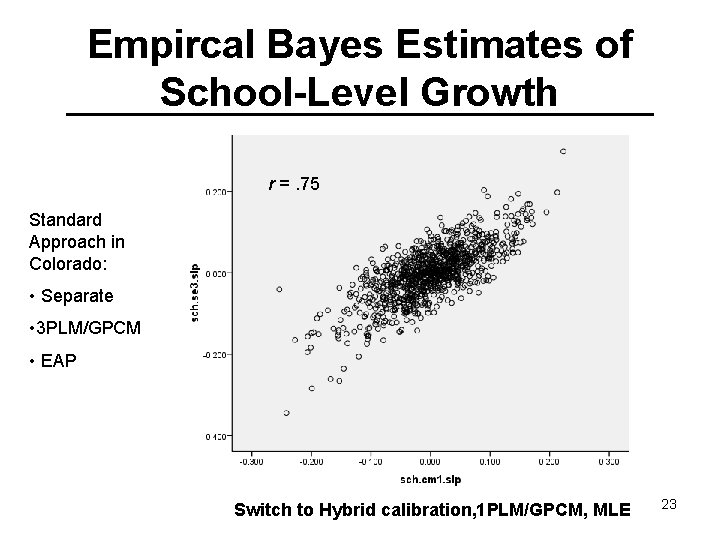
Empircal Bayes Estimates of School-Level Growth r =. 75 Standard Approach in Colorado: • Separate • 3 PLM/GPCM • EAP Switch to Hybrid calibration, 1 PLM/GPCM, MLE 23
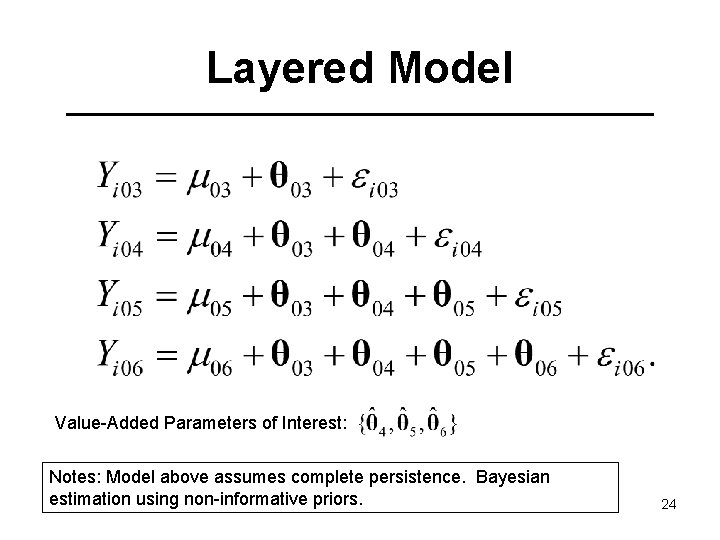
Layered Model Value-Added Parameters of Interest: Notes: Model above assumes complete persistence. Bayesian estimation using non-informative priors. 24
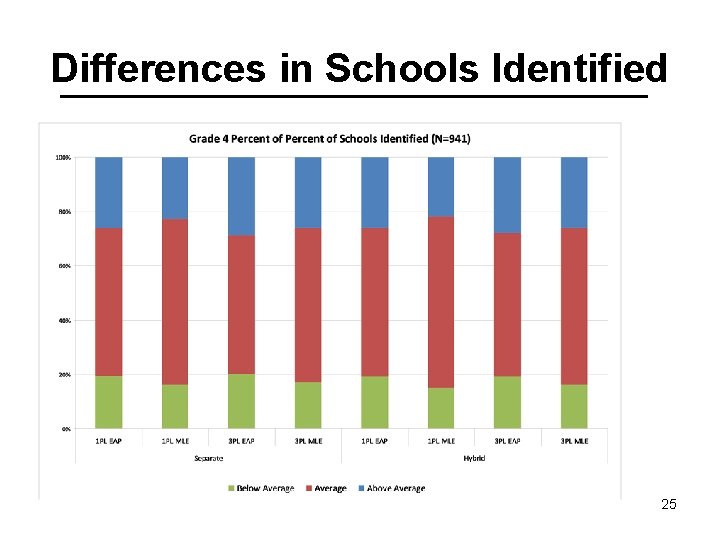
Differences in Schools Identified 25
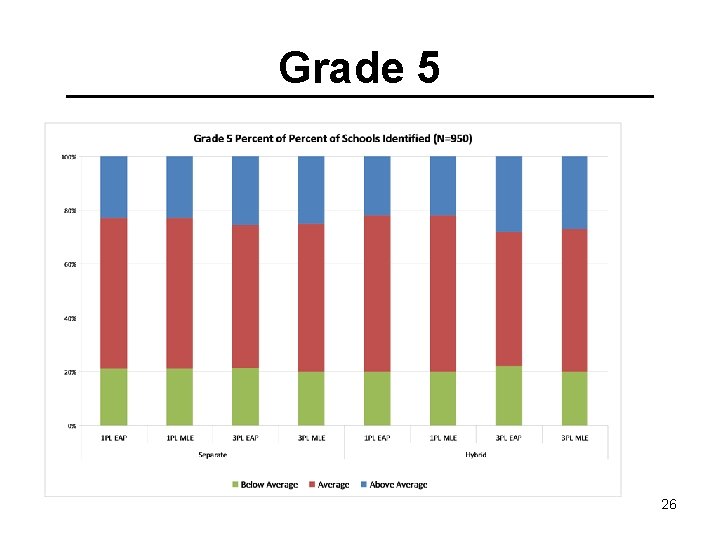
Grade 5 26
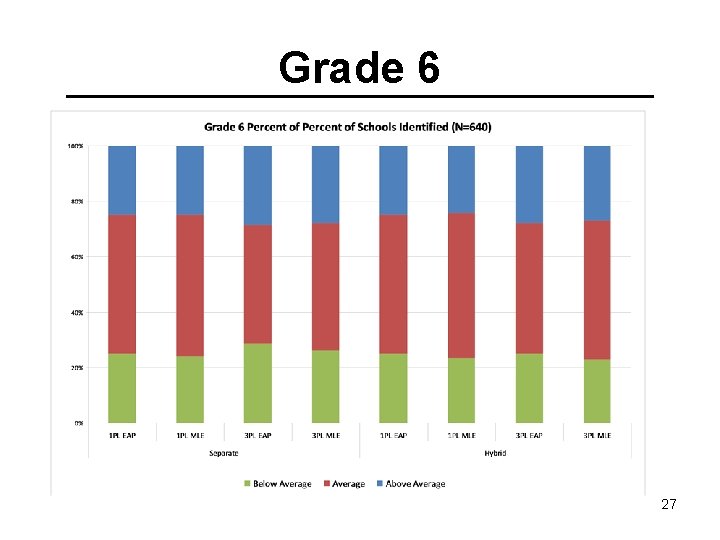
Grade 6 27
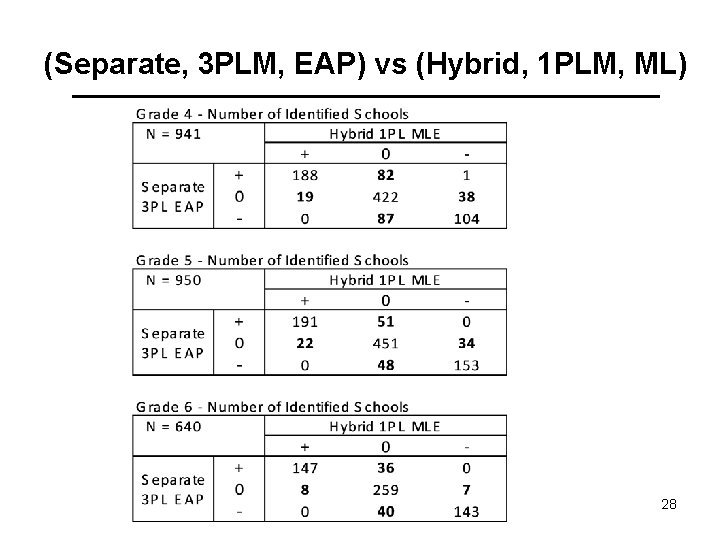
(Separate, 3 PLM, EAP) vs (Hybrid, 1 PLM, ML) 28
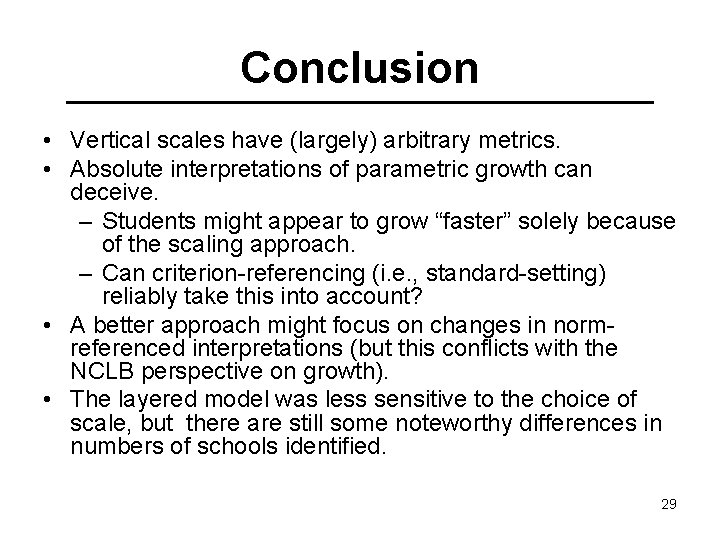
Conclusion • Vertical scales have (largely) arbitrary metrics. • Absolute interpretations of parametric growth can deceive. – Students might appear to grow “faster” solely because of the scaling approach. – Can criterion-referencing (i. e. , standard-setting) reliably take this into account? • A better approach might focus on changes in normreferenced interpretations (but this conflicts with the NCLB perspective on growth). • The layered model was less sensitive to the choice of scale, but there are still some noteworthy differences in numbers of schools identified. 29
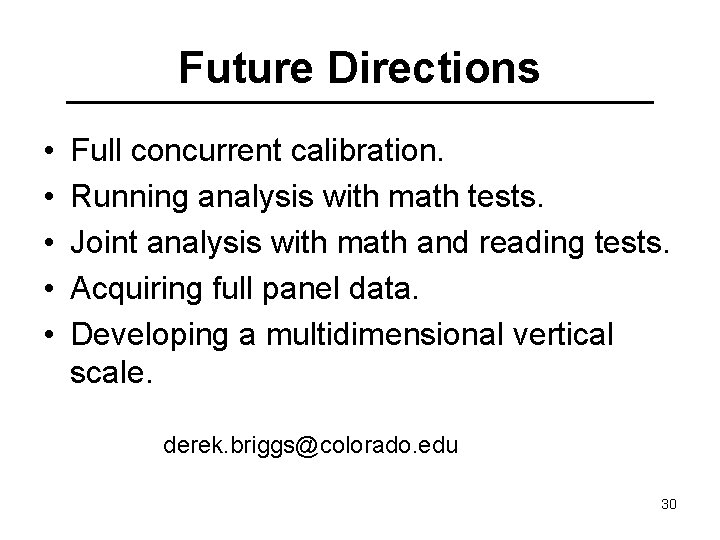
Future Directions • • • Full concurrent calibration. Running analysis with math tests. Joint analysis with math and reading tests. Acquiring full panel data. Developing a multidimensional vertical scale. derek. briggs@colorado. edu 30