
VERTICAL MOTION STABILITY Introduction Very slow upward motions

VERTICAL MOTION & STABILITY
• Introduction – Very slow upward motions play a key role in the production of clouds and precipitation, and therefore, in the creation of flight hazards, such as poor visibilities, low ceilings, and icing. – Gentle downward motions dissipate clouds and contribute to fair weather. • Section A Vertical Motions • Section B Stability • Section C Stability and Vertical Motions

• Section A: Vertical Motions when an air parcel moves from one location to another, it typically has a horizontal component (wind) and a vertical component (vertical motion) – Causes air may move upward or downward for a number of reasons • the most frequent causes are convergence and divergence, orography, fronts and convection

• Convergence / Divergence – Convergence corresponds to a net inflow of air into a given area • it may occur when wind speed slows down in the direction of flow and/or when opposing airstreams meet; figure 5 -2 – Divergence the net outflow from a given area • winds may diverge when the wind speed increases in the direction of the flow and/or when an air stream spreads out in the downstream direction; figure 5 -2
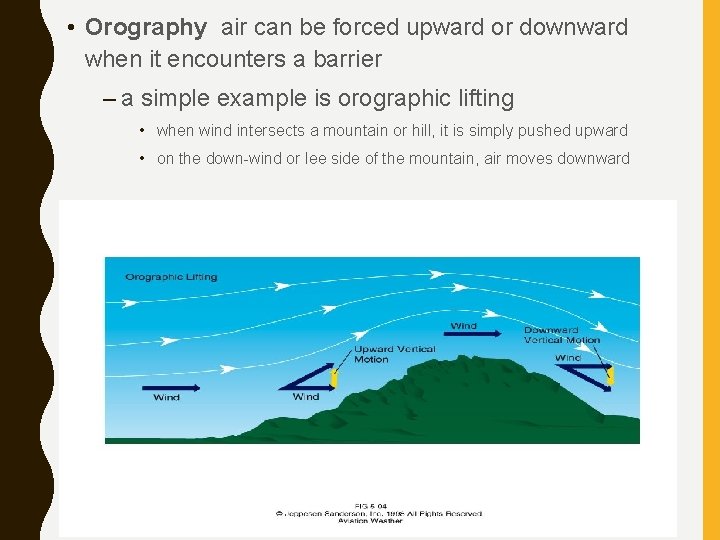
• Orography air can be forced upward or downward when it encounters a barrier – a simple example is orographic lifting • when wind intersects a mountain or hill, it is simply pushed upward • on the down-wind or lee side of the mountain, air moves downward
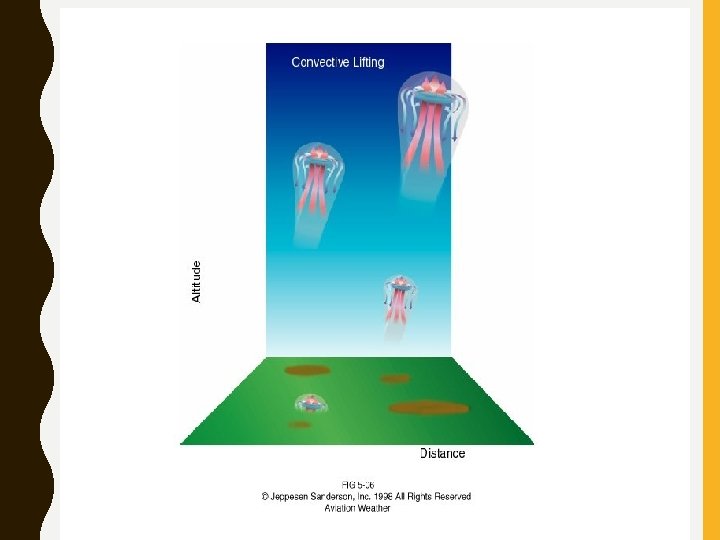
• Fronts when the atmosphere itself creates an obstacle to the wind, a barrier effect similar to a mountain can be produced – when a cold air mass is next to a warm air mass, a narrow, sloping boundary is created between the two called a front • Frontal lifting if either air mass moves toward the other, the warm air moves upward over the cold, dense air mass in a process called frontal lifting or in some special cases overrunning Convection Convective lifting as bubbles of warm air rise in the convective lifting process, the surrounding air sinks; figure 5 -6 and occurs under unstable atmospheric conditions
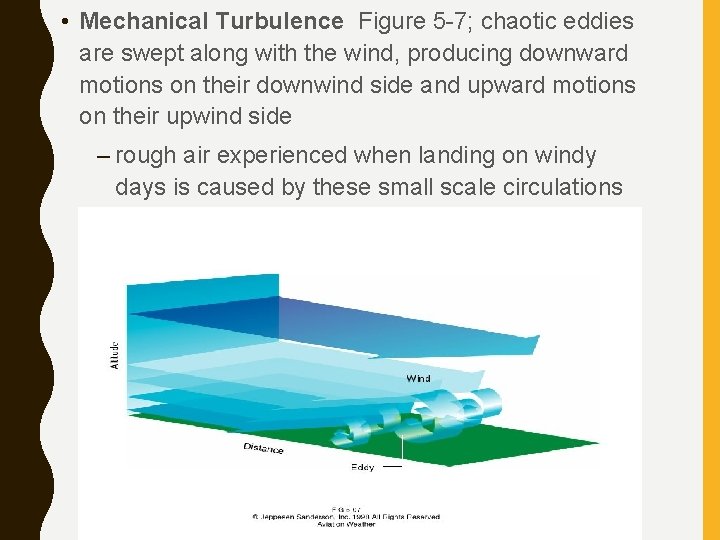
• Mechanical Turbulence Figure 5 -7; chaotic eddies are swept along with the wind, producing downward motions on their downwind side and upward motions on their upwind side – rough air experienced when landing on windy days is caused by these small scale circulations
• Gravity Wave Motions under certain circumstances, air may be disturbed by small scale wave motions – that is, parcels of air may be caused to oscillate vertically; – such oscillations that move away from the source of the disturbance are called atmospheric gravity waves because the earth’s gravity plays an important role in producing them – a mountain wave is one type of gravity wave
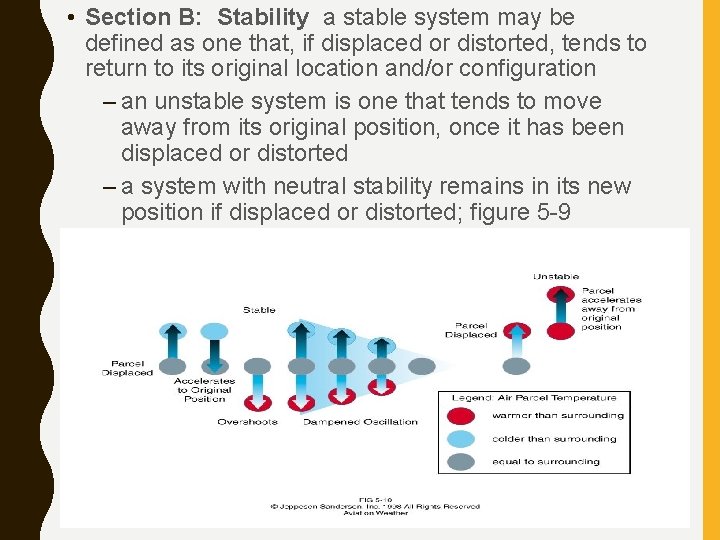
• Section B: Stability a stable system may be defined as one that, if displaced or distorted, tends to return to its original location and/or configuration – an unstable system is one that tends to move away from its original position, once it has been displaced or distorted – a system with neutral stability remains in its new position if displaced or distorted; figure 5 -9
• Atmospheric Stability a condition that makes it difficult for air parcels to move upward or downward – atmospheric instability is a condition that promotes vertical motions Buoyancy the property of an object that allows it to float on the surface of a liquid, or ascend through and remain freely suspend in a compressible fluid such as the atmosphere
– Archimedes’ Principle when an object is placed in a fluid (liquid or gas), it will be subjected to a positive (upward) or negative (downward) force depending on whether the object weighs more or less than the fluid it displaces • can be thought of as the bowling ball / balsa wood-in-the-bucket-ofwater concept;
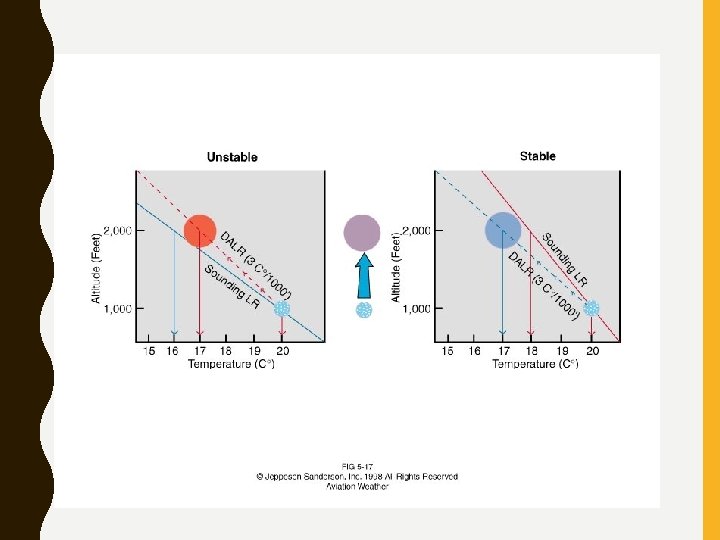
– Positively buoyant if a parcel of air is displaced upward and becomes warmer than its surroundings, it is positively buoyant • it will accelerate upward (away from its original position); it is unstable – Negatively buoyant if a parcel of air is displaced upward and is colder than its surroundings, it is negatively buoyant • it will be accelerated downward (back to its original position); it is stable
• Determining Atmospheric Stability there are three basic concepts that help determine stability – the dry adiabatic process, atmospheric soundings and lapse rates • Dry adiabatic process cooling by expansion and warming by compression • Adiabatic cooling pressure always decreases with height – adiabatic cooling will always accompany upward motion • Adiabatic heating adiabatic heating will always accompany downward motion – the rate of temperature change associated with a dry adiabatic process is a constant: 3 degrees Celsius per 1, 000 feet (5. 4 degrees Fahrenheit per 1, 000 feet)
• Soundings a measurement of meteorological conditions between the ground and some higher level in the atmosphere • Radiosondes the most common meteorological soundings are made via freely rising, unmanned, instrumented balloons called radiosondes or rawinsondes
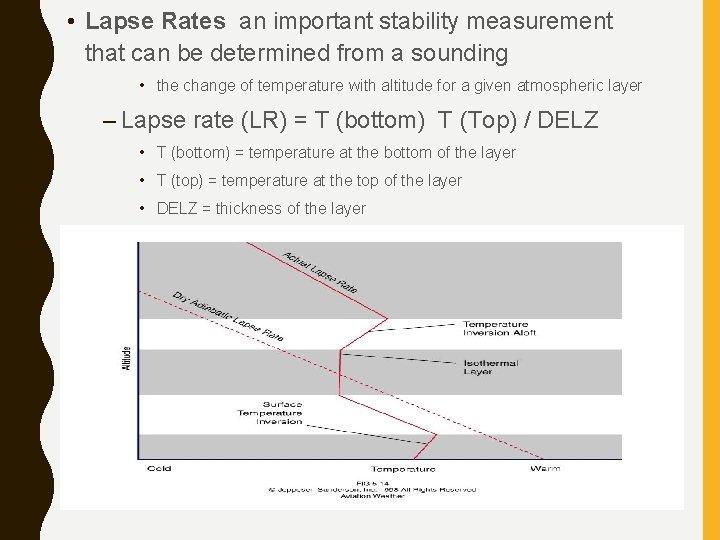
• Lapse Rates an important stability measurement that can be determined from a sounding • the change of temperature with altitude for a given atmospheric layer – Lapse rate (LR) = T (bottom) T (Top) / DELZ • T (bottom) = temperature at the bottom of the layer • T (top) = temperature at the top of the layer • DELZ = thickness of the layer
• Dry adiabatic lapse rate (DALR) the rate at which the temperature of a dry parcel of air decreases as it ascends is also a useful reference in stability determinations – equal to 3 degrees C per 1, 000 feet; figure 5 -14
• Isothermal layer no change in temperature with height (LR = 0) • Inversion layers temperature increases with height (LR < 0) • Surface-based inversions often form at night and may be the source of wind shear problems
• Stability Evaluation • Stability criteria; figure 5 -17 – select the layer in the sounding in which you are interested – within the layer, compare the actual LR and DALR – determine which of the following stability criteria are satisfied • LR > DALR absolutely unstable • LR = DALR neutral • LR < DALR stable
• Section C: Stability and Vertical Motions – ***A stable air mass is more likely to have smoother air than an unstable air mass – ***The formation of either predominantly stratiform or predominately cumuliform clouds depends upon the stability of the air being lifted
– ***Conditions favorable for the formation of a surface-based temperature inversion are clear, cool nights with calm or light winds – ***The stability of an air mass is decreased by heating it from below
- Slides: 22