
Vertical and Horizontal Strategies for Systemwide Quality Improvement

- Slides: 32
Vertical and Horizontal Strategies for System-wide Quality Improvement –What have we learned? Keynote Presentation to the i. Net Chile First National Conference Santiago, Friday 28 th October 2005 Professor David Hopkins HSBC Chair of International Leadership
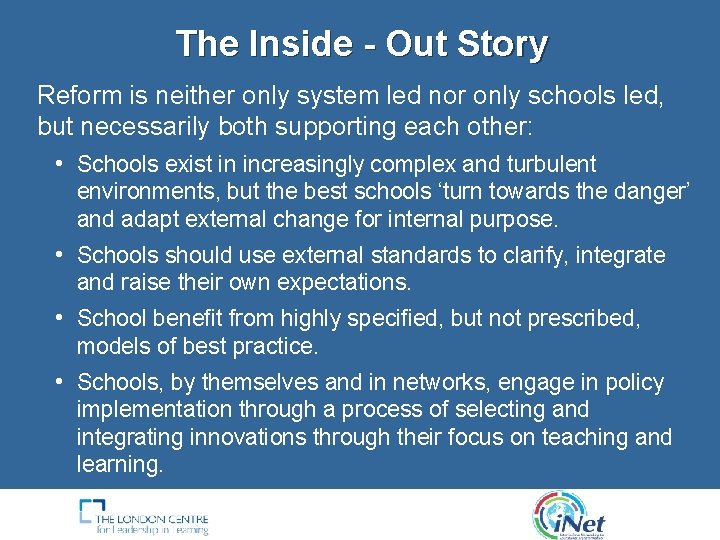
The Inside - Out Story Reform is neither only system led nor only schools led, but necessarily both supporting each other: • Schools exist in increasingly complex and turbulent environments, but the best schools ‘turn towards the danger’ and adapt external change for internal purpose. • Schools should use external standards to clarify, integrate and raise their own expectations. • School benefit from highly specified, but not prescribed, models of best practice. • Schools, by themselves and in networks, engage in policy implementation through a process of selecting and integrating innovations through their focus on teaching and learning.
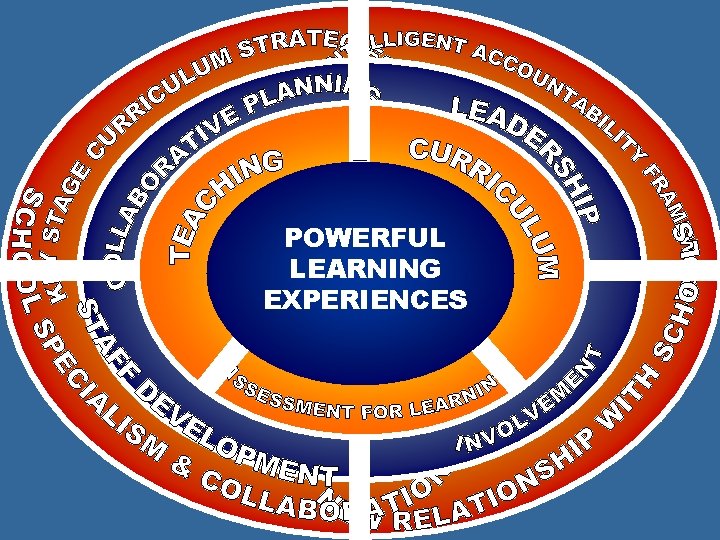
POWERFUL LEARNING EXPERIENCES
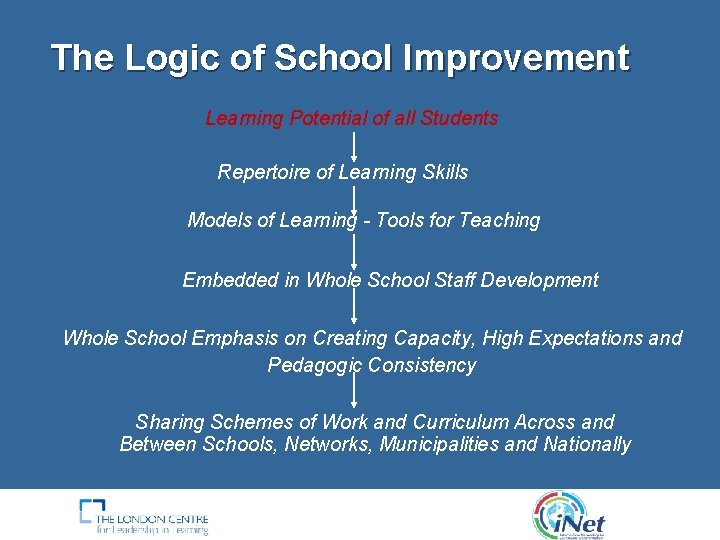
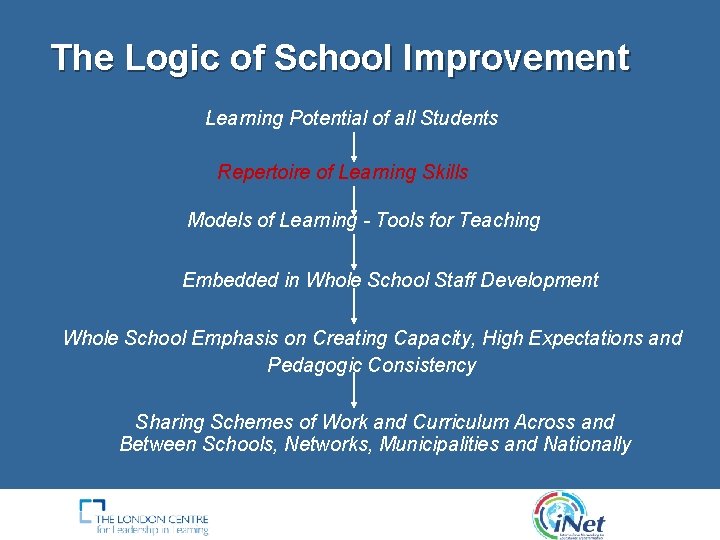
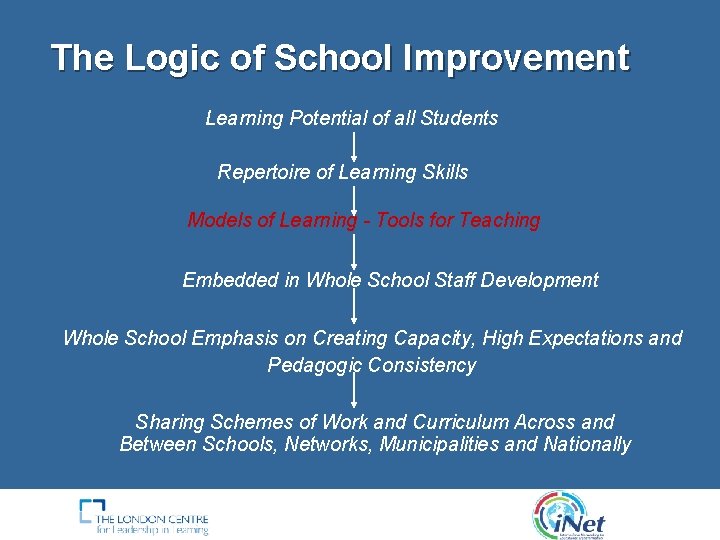
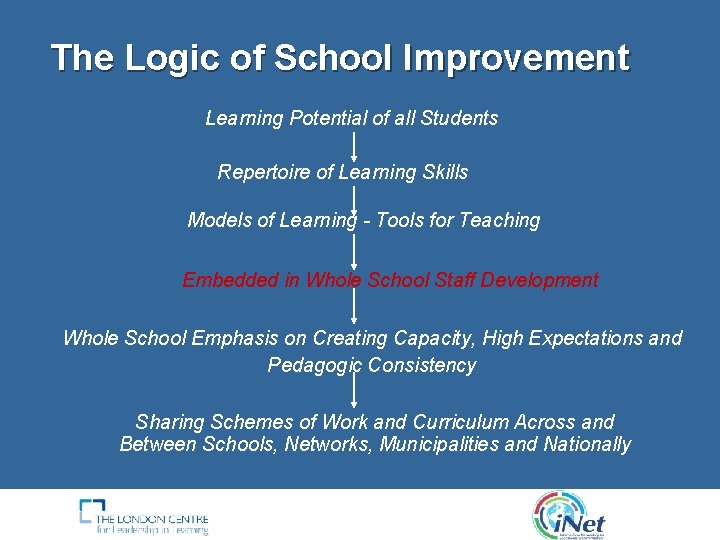
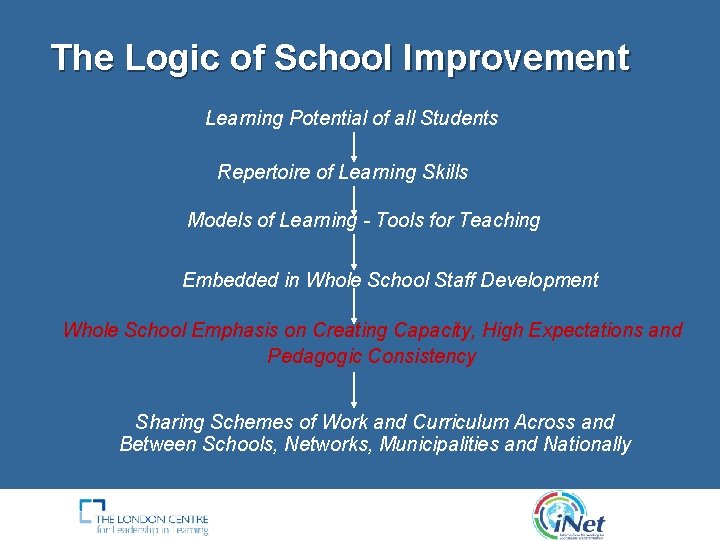
The Logic of School Improvement Learning Potential of all Students Repertoire of Learning Skills Models of Learning - Tools for Teaching Embedded in Whole School Staff Development Whole School Emphasis on Creating Capacity, High Expectations and Pedagogic Consistency Sharing Schemes of Work and Curriculum Across and Between Schools, Networks, Municipalities and Nationally
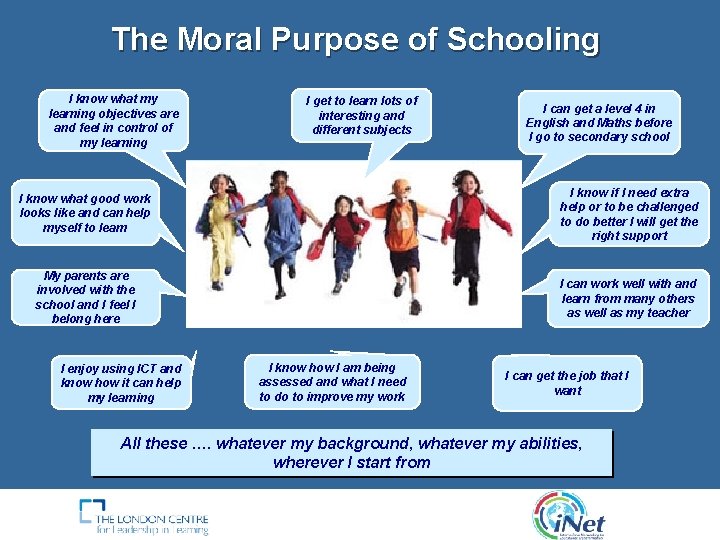
The Moral Purpose of Schooling I know what my learning objectives are and feel in control of my learning I get to learn lots of interesting and different subjects I can get a level 4 in English and Maths before I go to secondary school I know what good work looks like and can help myself to learn I know if I need extra help or to be challenged to do better I will get the right support My parents are involved with the school and I feel I belong here I can work well with and learn from many others as well as my teacher I enjoy using ICT and know how it can help my learning I know how I am being assessed and what I need to do to improve my work I can get the job that I want All these …. whatever my background, whatever my abilities, wherever I start from
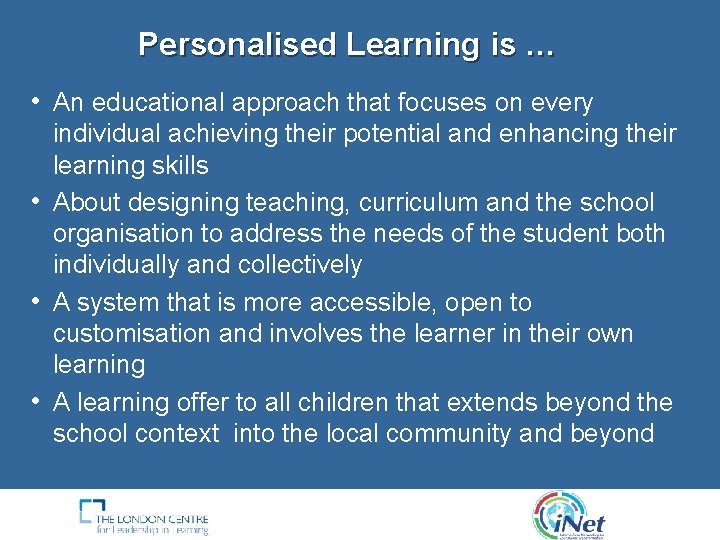
Personalised Learning is … • An educational approach that focuses on every individual achieving their potential and enhancing their learning skills • About designing teaching, curriculum and the school organisation to address the needs of the student both individually and collectively • A system that is more accessible, open to customisation and involves the learner in their own learning • A learning offer to all children that extends beyond the school context into the local community and beyond
The Logic of School Improvement Learning Potential of all Students Repertoire of Learning Skills Models of Learning - Tools for Teaching Embedded in Whole School Staff Development Whole School Emphasis on Creating Capacity, High Expectations and Pedagogic Consistency Sharing Schemes of Work and Curriculum Across and Between Schools, Networks, Municipalities and Nationally
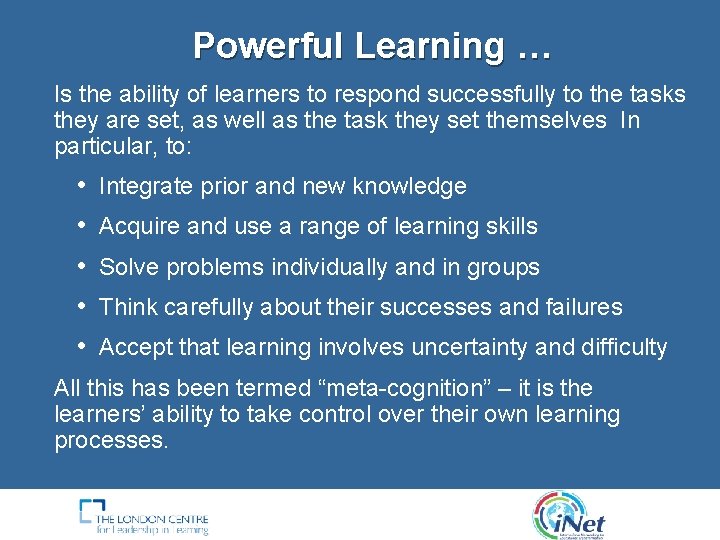
Powerful Learning … Is the ability of learners to respond successfully to the tasks they are set, as well as the task they set themselves In particular, to: • • • Integrate prior and new knowledge Acquire and use a range of learning skills Solve problems individually and in groups Think carefully about their successes and failures Accept that learning involves uncertainty and difficulty All this has been termed “meta-cognition” – it is the learners’ ability to take control over their own learning processes.
Getting to the heart of the matter … Learning experiences are composed of content, process and social climate. As teachers we create for and with our children opportunities to explore and build important areas of knowledge, develop powerful tools for learning, and live in humanising social conditions.
The Logic of School Improvement Learning Potential of all Students Repertoire of Learning Skills Models of Learning - Tools for Teaching Embedded in Whole School Staff Development Whole School Emphasis on Creating Capacity, High Expectations and Pedagogic Consistency Sharing Schemes of Work and Curriculum Across and Between Schools, Networks, Municipalities and Nationally
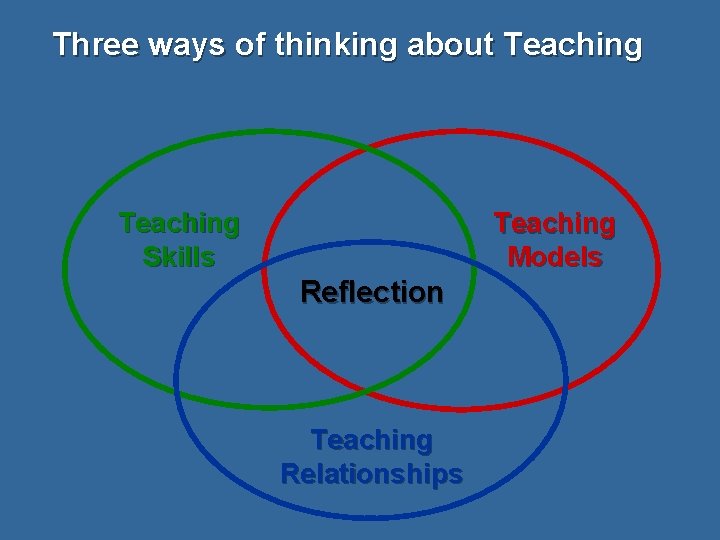
Three ways of thinking about Teaching Skills Teaching Models Reflection Teaching Relationships
Models of Learning - Tools for Teaching In our teacher’s toolbox are the range of models of learning and teaching that simultaneously define curriculum content, the learning strategies, and the arrangements for social interaction that create personalised learning for all our students. For example, in powerful classrooms students learn models for: • Extracting information and ideas from lectures and presentations • • Memorising information Building hypotheses and theories Using metaphors to think creatively Working effectively with other to initiate and carry out co-operative tasks.
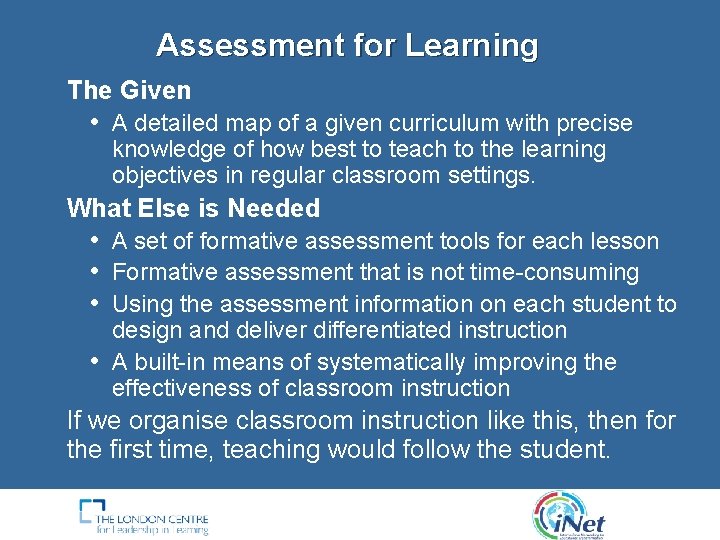
Assessment for Learning The Given • A detailed map of a given curriculum with precise knowledge of how best to teach to the learning objectives in regular classroom settings. What Else is Needed • A set of formative assessment tools for each lesson • Formative assessment that is not time-consuming • Using the assessment information on each student to design and deliver differentiated instruction • A built-in means of systematically improving the effectiveness of classroom instruction If we organise classroom instruction like this, then for the first time, teaching would follow the student.
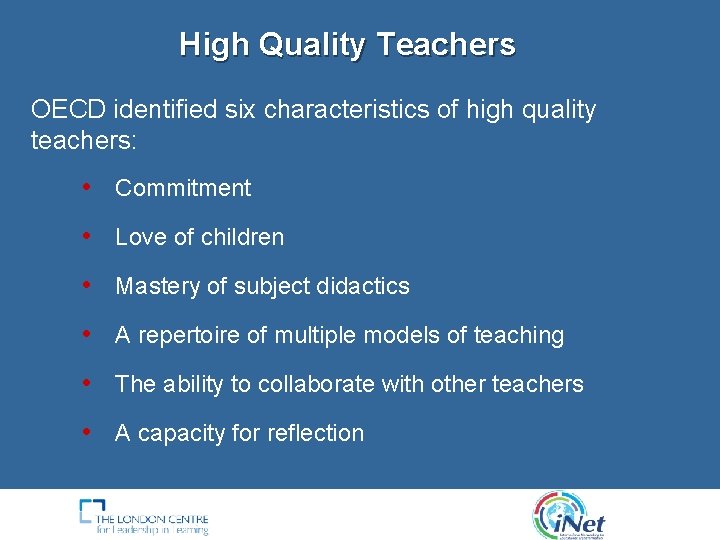
High Quality Teachers OECD identified six characteristics of high quality teachers: • Commitment • Love of children • Mastery of subject didactics • A repertoire of multiple models of teaching • The ability to collaborate with other teachers • A capacity for reflection
The Logic of School Improvement Learning Potential of all Students Repertoire of Learning Skills Models of Learning - Tools for Teaching Embedded in Whole School Staff Development Whole School Emphasis on Creating Capacity, High Expectations and Pedagogic Consistency Sharing Schemes of Work and Curriculum Across and Between Schools, Networks, Municipalities and Nationally
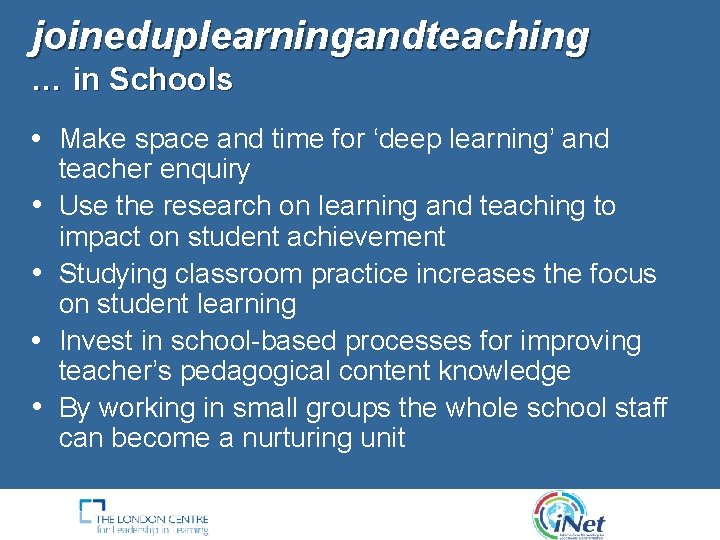
joineduplearningandteaching … in Schools • Make space and time for ‘deep learning’ and • • teacher enquiry Use the research on learning and teaching to impact on student achievement Studying classroom practice increases the focus on student learning Invest in school-based processes for improving teacher’s pedagogical content knowledge By working in small groups the whole school staff can become a nurturing unit
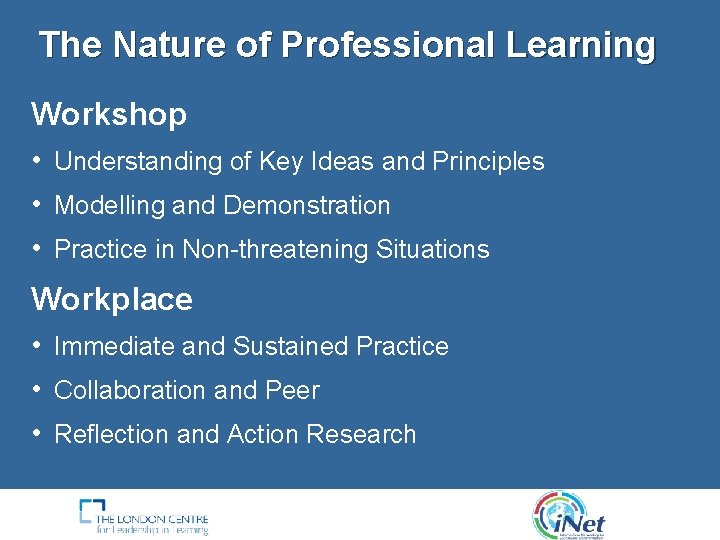
The Nature of Professional Learning Workshop • Understanding of Key Ideas and Principles • Modelling and Demonstration • Practice in Non-threatening Situations Workplace • Immediate and Sustained Practice • Collaboration and Peer • Reflection and Action Research
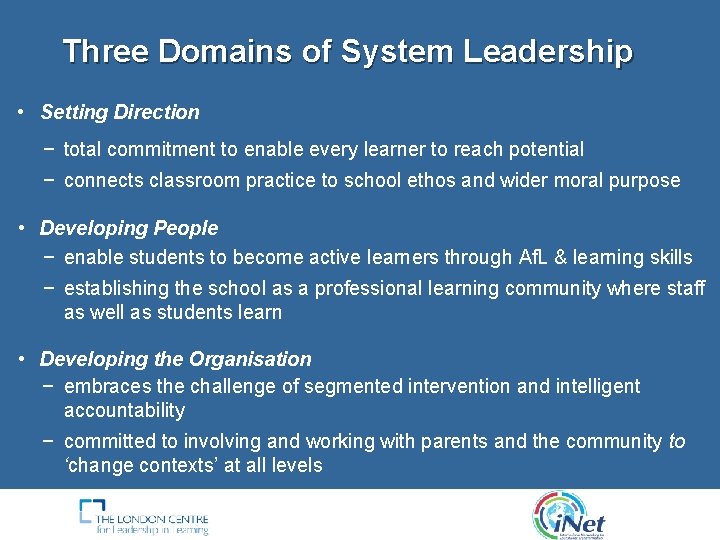
Three Domains of System Leadership • Setting Direction − total commitment to enable every learner to reach potential − connects classroom practice to school ethos and wider moral purpose • Developing People − enable students to become active learners through Af. L & learning skills − establishing the school as a professional learning community where staff as well as students learn • Developing the Organisation − embraces the challenge of segmented intervention and intelligent accountability − committed to involving and working with parents and the community to ‘change contexts’ at all levels
The Logic of School Improvement Learning Potential of all Students Repertoire of Learning Skills Models of Learning - Tools for Teaching Embedded in Whole School Staff Development Whole School Emphasis on Creating Capacity, High Expectations and Pedagogic Consistency Sharing Schemes of Work and Curriculum Across and Between Schools, Networks, Municipalities and Nationally
A Framework for School Improvement Francoise please add
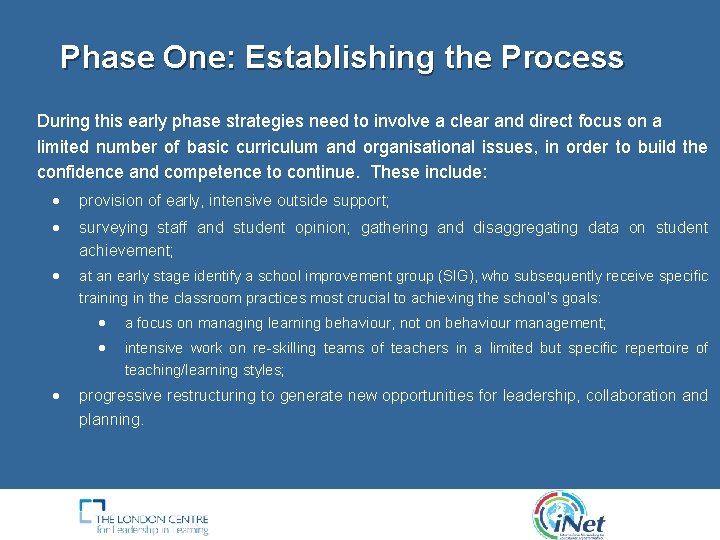
Phase One: Establishing the Process During this early phase strategies need to involve a clear and direct focus on a limited number of basic curriculum and organisational issues, in order to build the confidence and competence to continue. These include: · · provision of early, intensive outside support; · at an early stage identify a school improvement group (SIG), who subsequently receive specific training in the classroom practices most crucial to achieving the school’s goals: surveying staff and student opinion; gathering and disaggregating data on student achievement; · · · a focus on managing learning behaviour, not on behaviour management; intensive work on re-skilling teams of teachers in a limited but specific repertoire of teaching/learning styles; progressive restructuring to generate new opportunities for leadership, collaboration and planning.
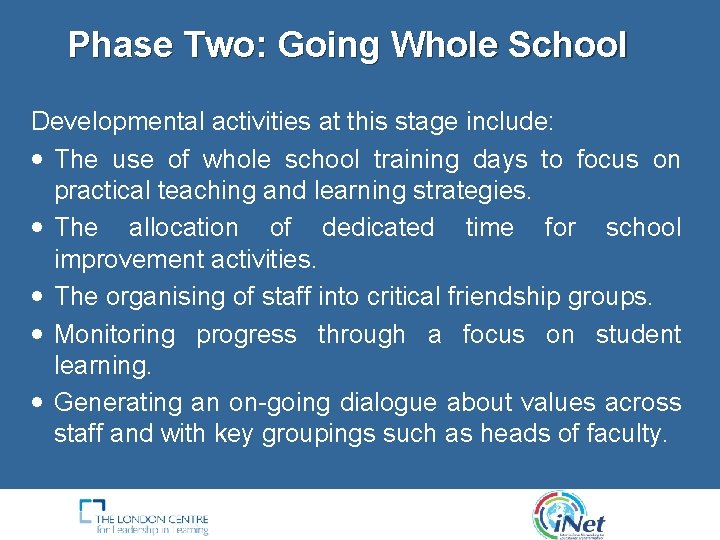
Phase Two: Going Whole School Developmental activities at this stage include: · The use of whole school training days to focus on practical teaching and learning strategies. · The allocation of dedicated time for school improvement activities. · The organising of staff into critical friendship groups. · Monitoring progress through a focus on student learning. · Generating an on-going dialogue about values across staff and with key groupings such as heads of faculty.
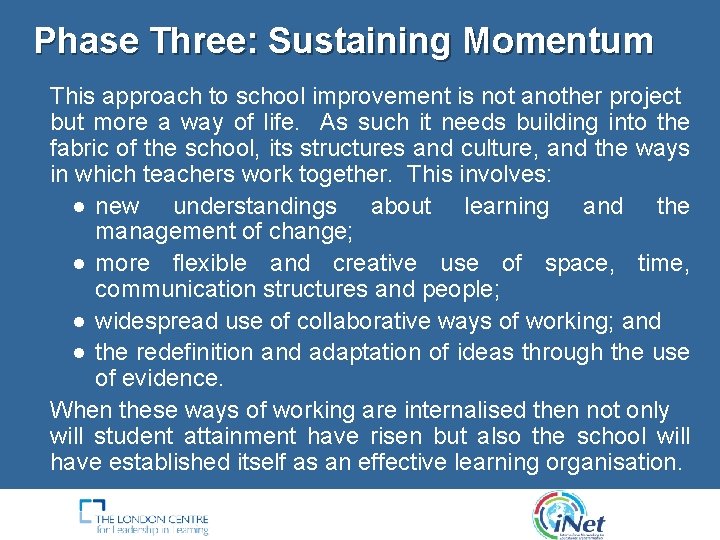
Phase Three: Sustaining Momentum This approach to school improvement is not another project but more a way of life. As such it needs building into the fabric of the school, its structures and culture, and the ways in which teachers work together. This involves: · new understandings about learning and the management of change; · more flexible and creative use of space, time, communication structures and people; · widespread use of collaborative ways of working; and · the redefinition and adaptation of ideas through the use of evidence. When these ways of working are internalised then not only will student attainment have risen but also the school will have established itself as an effective learning organisation.
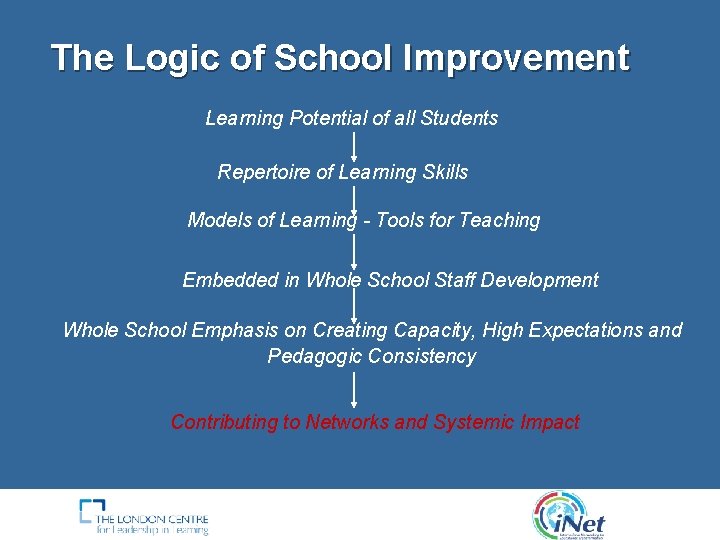
The Logic of School Improvement Learning Potential of all Students Repertoire of Learning Skills Models of Learning - Tools for Teaching Embedded in Whole School Staff Development Whole School Emphasis on Creating Capacity, High Expectations and Pedagogic Consistency Contributing to Networks and Systemic Impact
The Potential Role of Networks can support educational reform by: • Providing a focal point for the dissemination of research, good practice and knowledge creation and transfer. • Keeping the focus on core purposes of schooling in particular creating a discourse on teaching and learning. • Enhancing the skill of teachers. • Researching, developing and evaluating a range of curriculum, teaching, organisational and leadership models. • Building capacity for continuous improvement. • Acting as a link between centralised & decentralised policy.
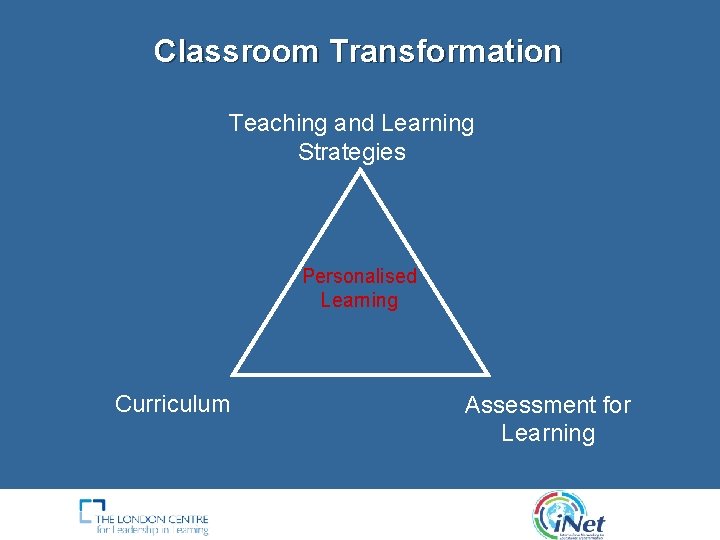
Classroom Transformation Teaching and Learning Strategies Personalised Learning Curriculum Assessment for Learning
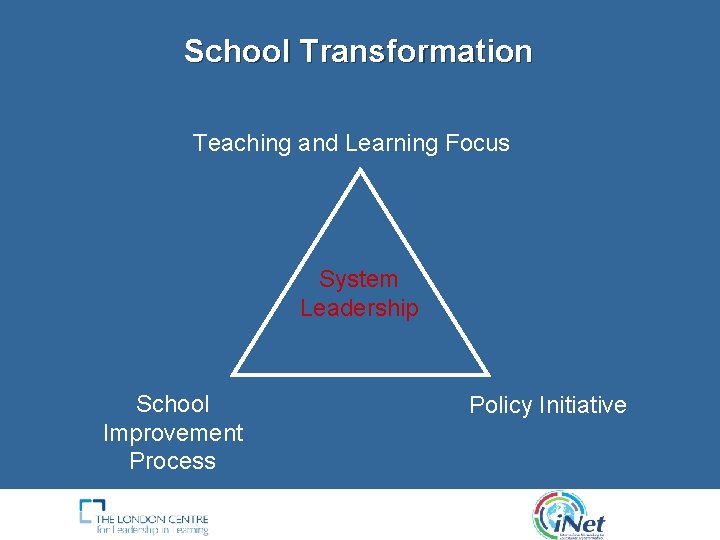
School Transformation Teaching and Learning Focus System Leadership School Improvement Process Policy Initiative
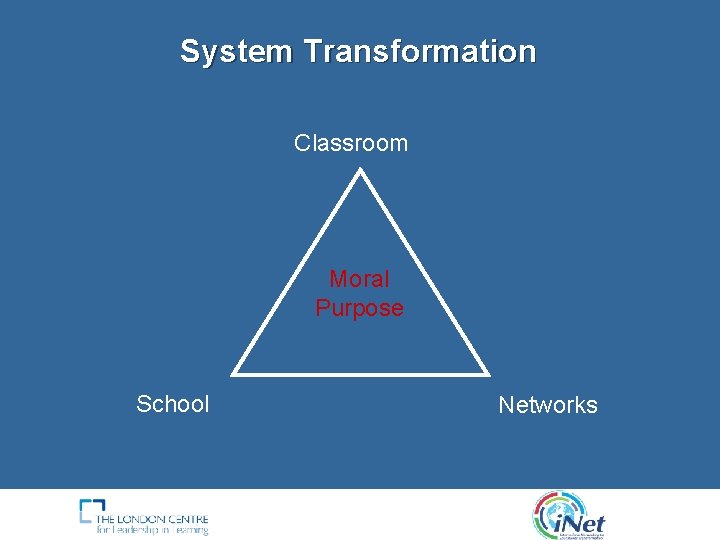
System Transformation Classroom Moral Purpose School Networks
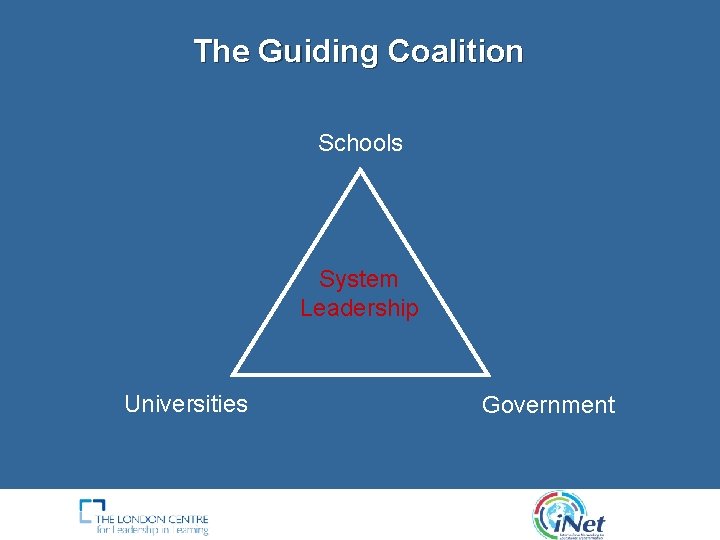
The Guiding Coalition Schools System Leadership Universities Government
We travel as pilgrims … Principles represent the expectations of the way i. Net schools pursue school improvement and transformation, and serve as an aide-memoire to all those involved. They create synergy together they are greater than the sum of their parts. Some examples of principles are: • School improvement is a process that focuses on enhancing the • • quality of students' learning. The school will seek to promote the view that monitoring and evaluation quality is a responsibility which all members of staff share. The school will seek to develop structures and create conditions that encourage collaboration and lead to the empowerment of individuals and groups. The school will see in external pressures for change important opportunities to secure its internal priorities. The vision of the school should be one that embraces all members of the school community as both learners and contributors.
For more information: • Hopkins D (2001) School Improvement For Real, Routledge / Falmer. • Hopkins D (2002) Improving the Quality of Education for All, David Fulton Publishers. • Hopkins D (2002) A Teachers Guide to Classroom Research (3 rd Ed. ), Open University Press. • Hopkins D (2005) Every School a Great School, Specialist Schools and Academies Trust. • Hopkins D and Harris A (2000) Creating the Conditions for Teaching and Learning, David Fulton Publishers. • Joyce B, Calhoun E and Hopkins D (2001) Models of Learning – Tools for Teaching (2 nd Ed. ), Open University Press.
Professor David Hopkins HSBC Chair in International Leadership David Hopkins was recently appointed to the inaugural HSBC Chair in International Leadership, where he supports the work of i. Net, the International arm of the Specialist Schools Trust and the Leadership Centre at the Institute of Education, University of London. Between 2002 and 2005 he served three Secretary of States as the Chief Adviser on School Standards at the Department for Education and Skills. Previously, he was Chair of the Leicester City Partnership Board and Professor and Dean of the Faculty of Education at the University of Nottingham. Before that again he was a Tutor at the University of Cambridge Institute of Education, a Secondary School teacher and Outward Bound Instructor. David is also an International Mountain Guide who still climbs regularly in the Alps and Himalayas. Before becoming a civil servant he outlined his views on teaching quality, school improvement and large scale reform in Hopkins D. (2001) School Improvement for Real, London: Routledge / Falmer.