
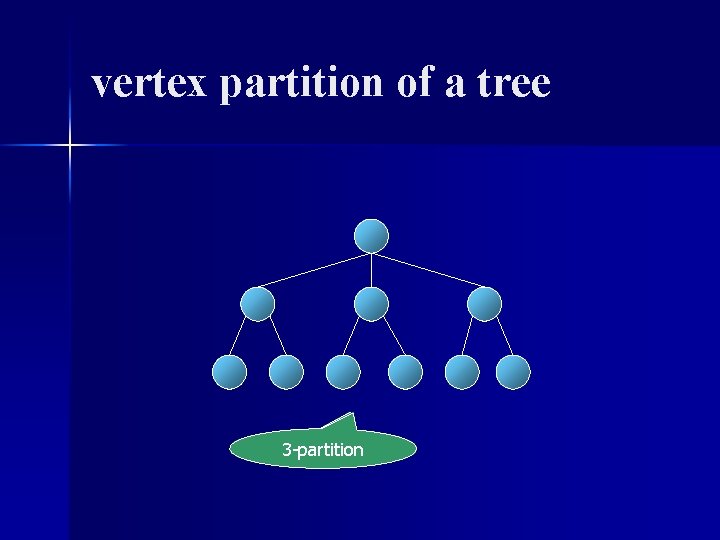
vertex partition of a tree 3 partition 2


- Slides: 17
vertex partition of a tree 3 -partition 2 -partition
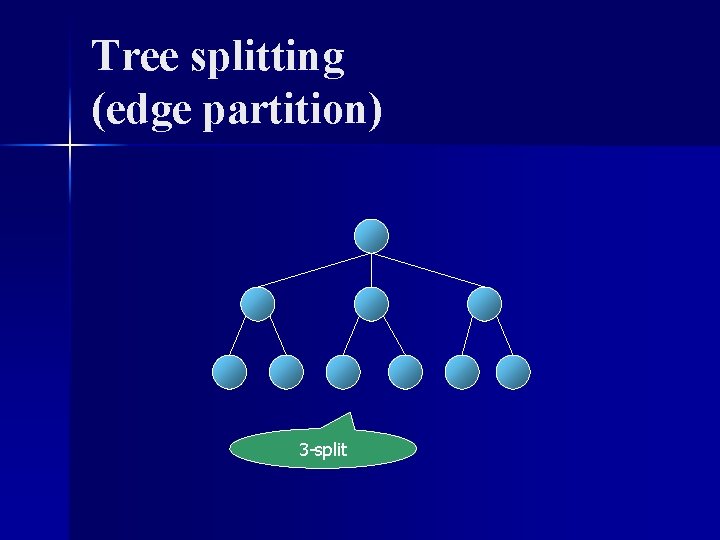
Tree splitting (edge partition) 3 -split 2 -split
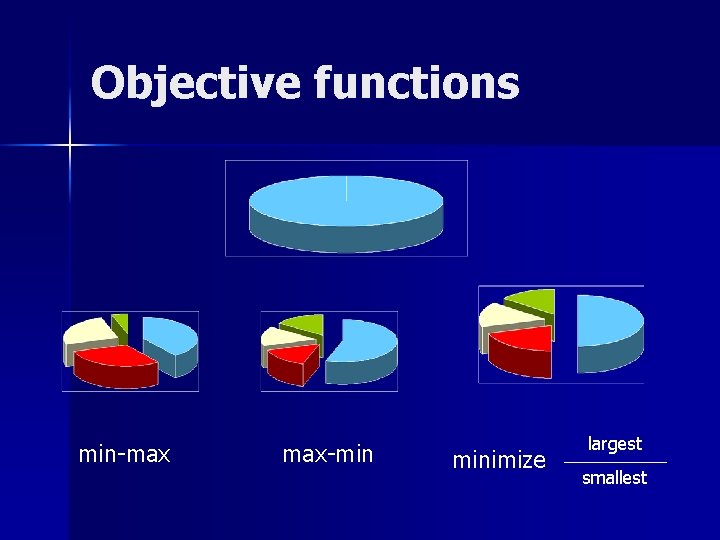
Objective functions min-max max-min minimize largest smallest
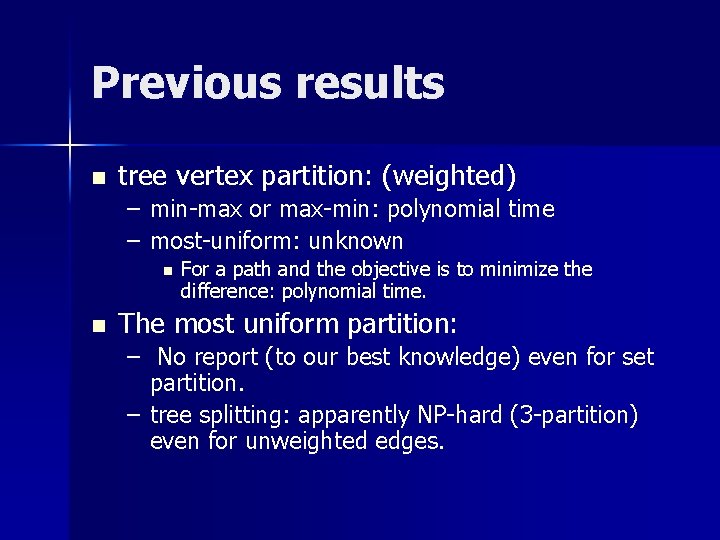
Previous results n tree vertex partition: (weighted) – min-max or max-min: polynomial time – most-uniform: unknown n n For a path and the objective is to minimize the difference: polynomial time. The most uniform partition: – No report (to our best knowledge) even for set partition. – tree splitting: apparently NP-hard (3 -partition) even for unweighted edges.
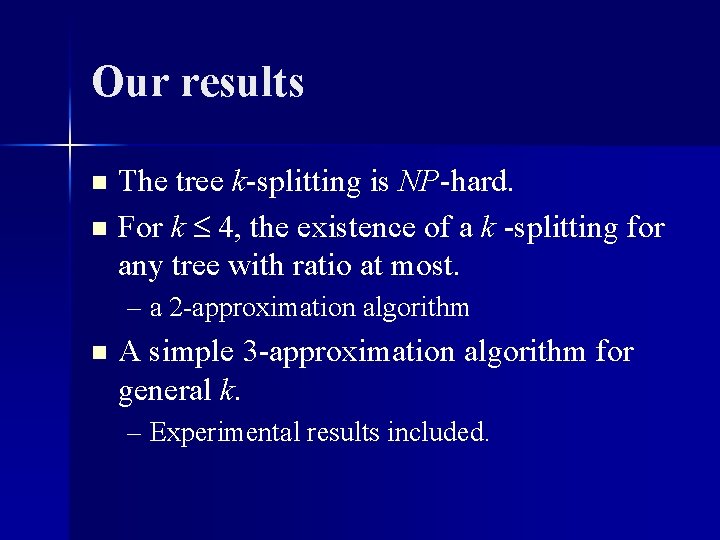
Our results The tree k-splitting is NP-hard. n For k 4, the existence of a k -splitting for any tree with ratio at most. n – a 2 -approximation algorithm n A simple 3 -approximation algorithm for general k. – Experimental results included.
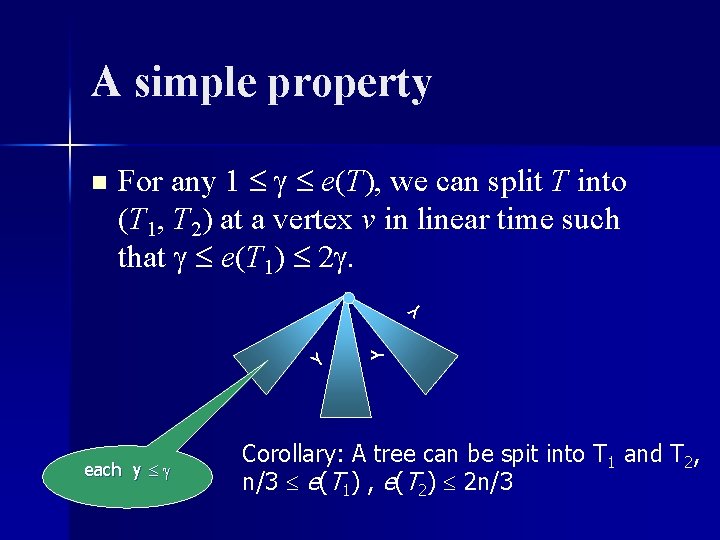
A simple property n For any 1 e(T), we can split T into (T 1, T 2) at a vertex v in linear time such that e(T 1) 2. each y Y Y Y Corollary: A tree can be spit into T 1 and T 2, n/3 e(T 1) , e(T 2) 2 n/3
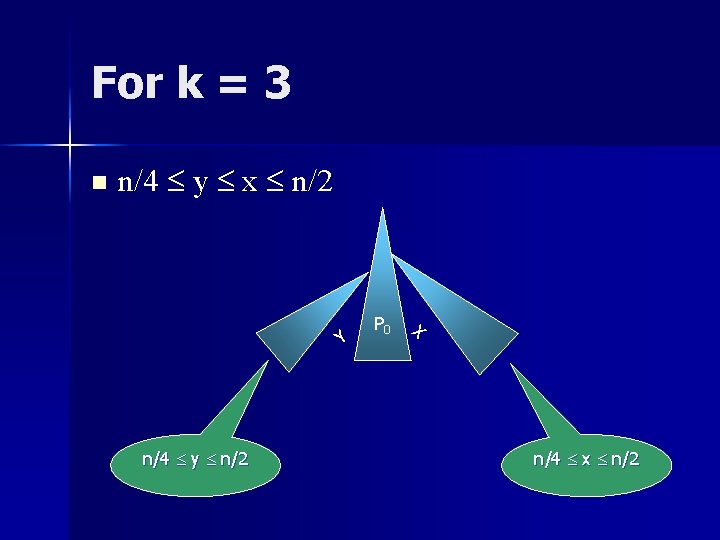
For k = 3 n n/4 y x n/2 Y n/4 y n/2 P 0 X n/4 x n/2
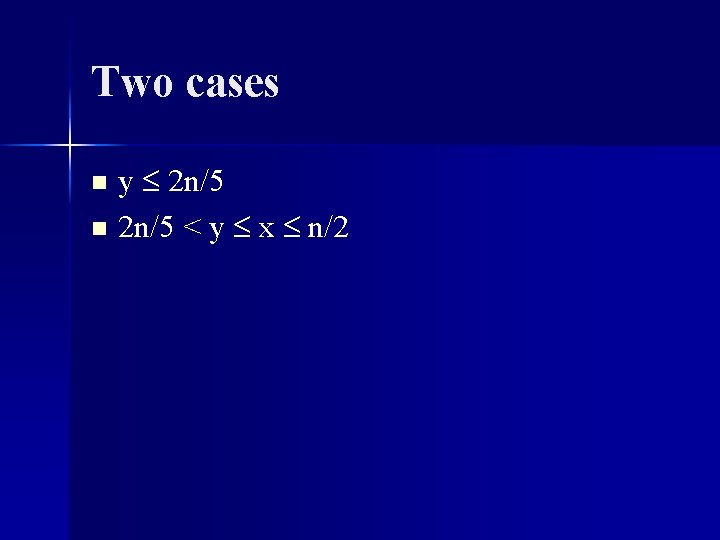
Two cases n n y 2 n/5 < y x n/2
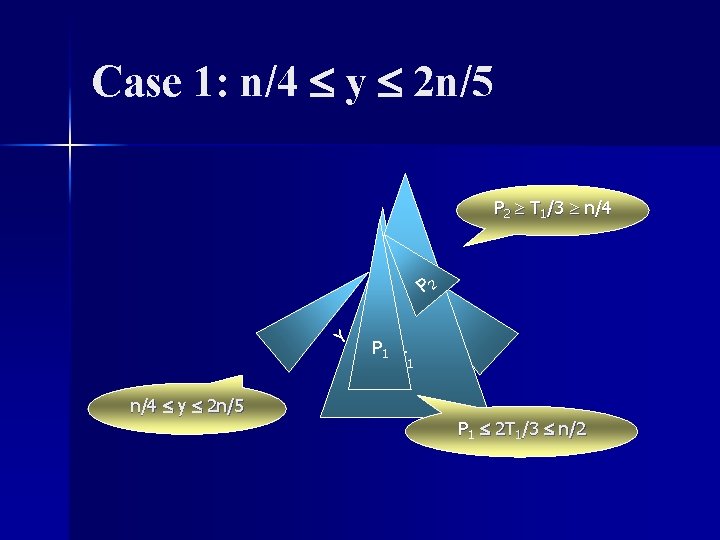
Case 1: n/4 y 2 n/5 P 2 T 1/3 n/4 P 2 Y n/4 y 2 n/5 P 0 P 1 X T 1 P 1 2 T 1/3 n/2
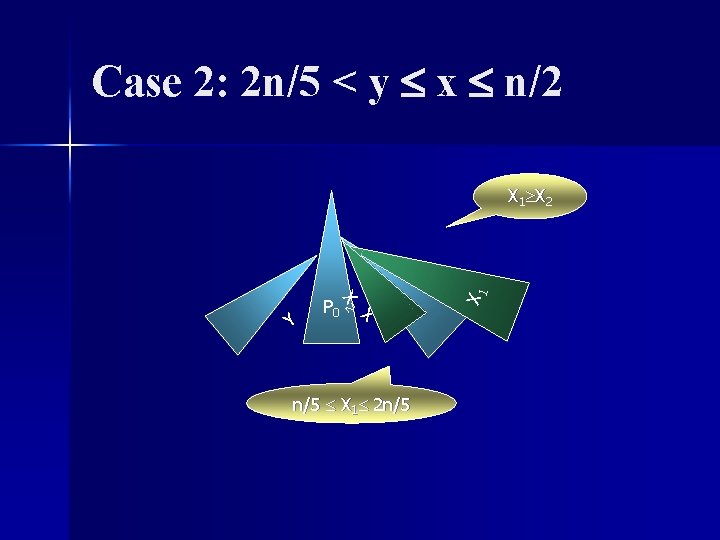
Case 2: 2 n/5 < y x n/2 X 2 Y P 0 X n/5 X 1 2 n/5 X 1 X 2
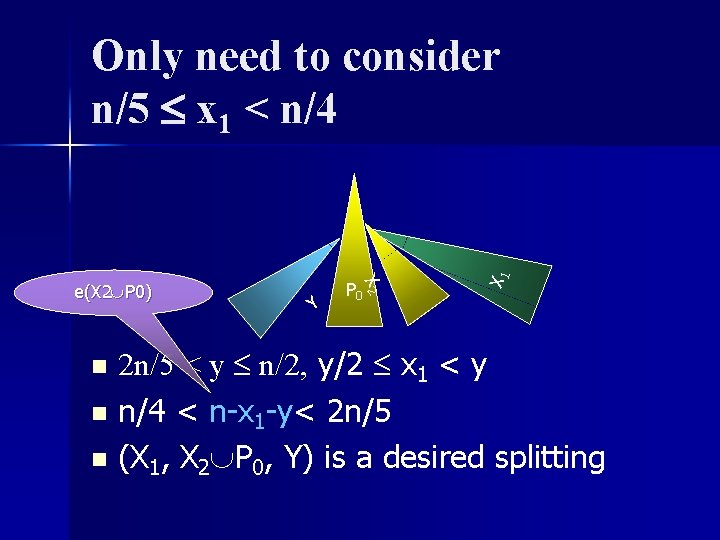
Y P 0 X 2 e(X 2 P 0) X 1 Only need to consider n/5 x 1 < n/4 2 n/5 < y n/2, y/2 x 1 < y n n/4 < n-x 1 -y< 2 n/5 n (X 1, X 2 P 0, Y) is a desired splitting n
For k=4 n It can be prove in a similar way, but the cases are more complicated.
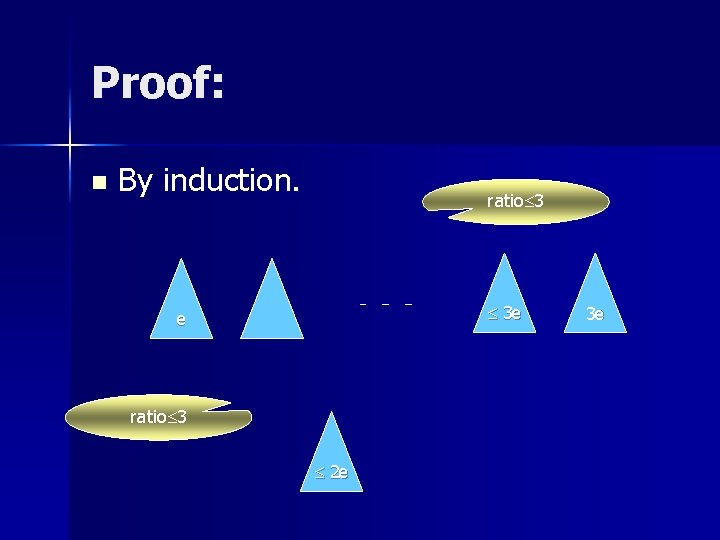
A simple algorithm n There is a simple algorithm to split a tree with ratio at most 3. n Method: always split the maximum part of the previous splitting.
Proof: n By induction. ratio 3 3 e e ratio 3 2 e 3 e 2 e e
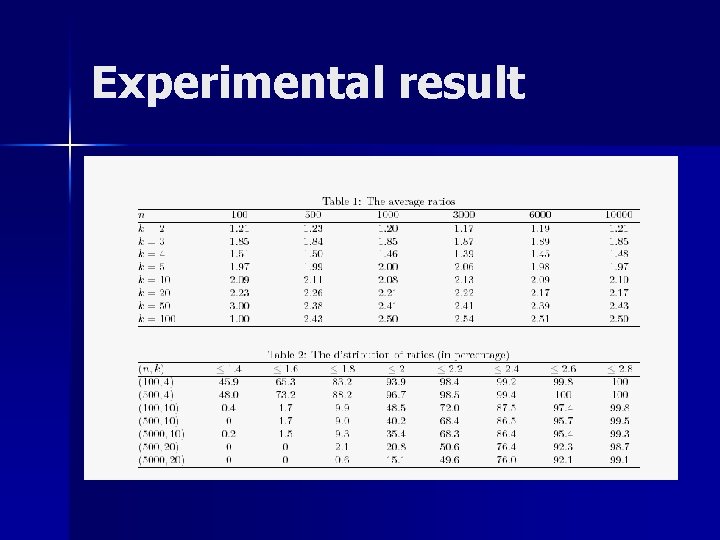
Experimental result
Thank you