
Vertex Finding in Ali Vertexer Tracks E Bruna

Vertex Finding in Ali. Vertexer. Tracks E. Bruna (TO), E. Crescio (TO), A. Dainese (LNL), M. Masera (TO), F. Prino (TO) 1
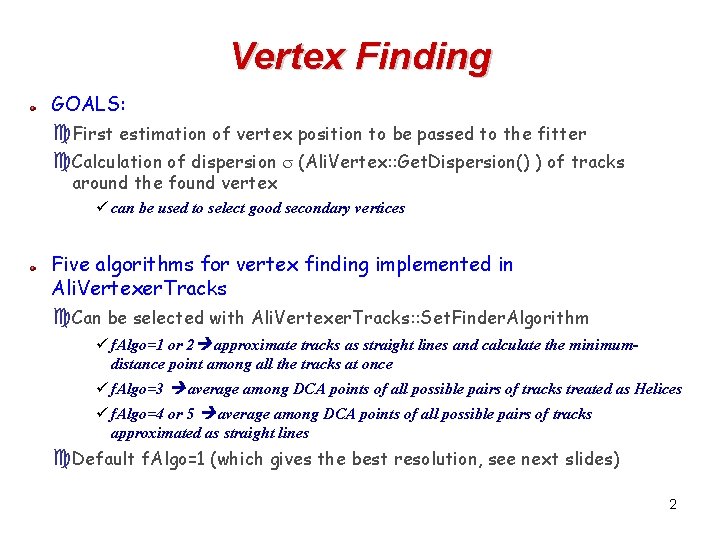
Vertex Finding GOALS: c. First estimation of vertex position to be passed to the fitter c. Calculation of dispersion s (Ali. Vertex: : Get. Dispersion() ) of tracks around the found vertex ü can be used to select good secondary vertices Five algorithms for vertex finding implemented in Ali. Vertexer. Tracks c. Can be selected with Ali. Vertexer. Tracks: : Set. Finder. Algorithm ü f. Algo=1 or 2 approximate tracks as straight lines and calculate the minimumdistance point among all the tracks at once ü f. Algo=3 average among DCA points of all possible pairs of tracks treated as Helices ü f. Algo=4 or 5 average among DCA points of all possible pairs of tracks approximated as straight lines c. Default f. Algo=1 (which gives the best resolution, see next slides) 2
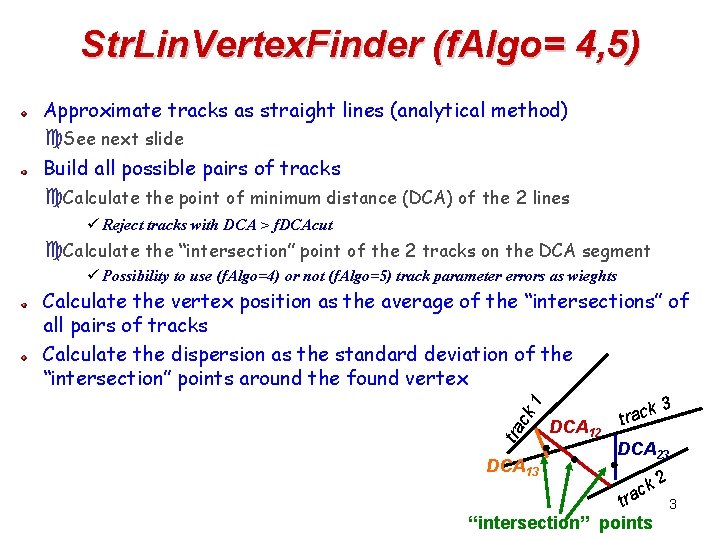
Str. Lin. Vertex. Finder (f. Algo= 4, 5) Approximate tracks as straight lines (analytical method) c. See next slide Build all possible pairs of tracks c. Calculate the point of minimum distance (DCA) of the 2 lines ü Reject tracks with DCA > f. DCAcut c. Calculate the “intersection” point of the 2 tracks on the DCA segment ü Possibility to use (f. Algo=4) or not (f. Algo=5) track parameter errors as wieghts tra ck 1 Calculate the vertex position as the average of the “intersections” of all pairs of tracks Calculate the dispersion as the standard deviation of the “intersection” points around the found vertex DCA 13 DCA 12 k trac 3 DCA 23 k rac t “intersection” points 2 3
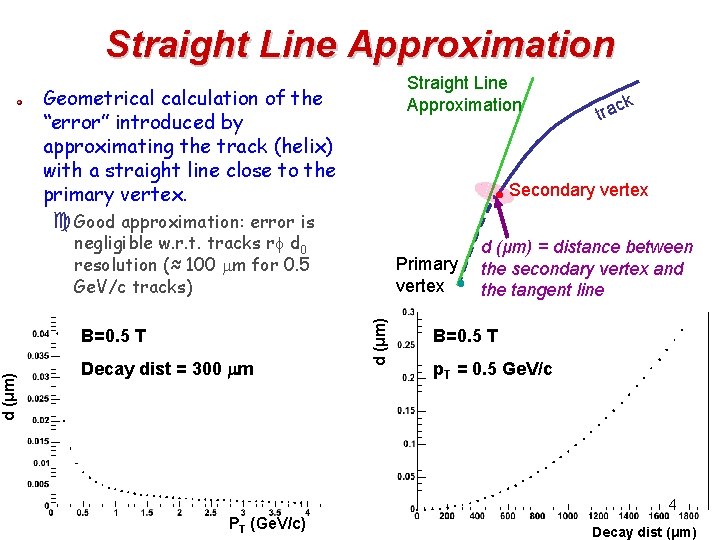
d (μm) Straight Line Approximation Geometrical calculation of the “error” introduced by approximating the track (helix) with a straight line close to the primary vertex. k trac Secondary vertex c Good approximation: error is negligible w. r. t. tracks rf d 0 resolution (≈ 100 mm for 0. 5 Ge. V/c tracks) Decay dist = 300 mm d (μm) B=0. 5 T Primary vertex d (μm) = distance between the secondary vertex and the tangent line B=0. 5 T p. T = 0. 5 Ge. V/c 4 PT (Ge. V/c) Decay dist (μm)

Helix. Vertex. Finder (f. Algo=3) Same algorithm (based on DCA of track pairs) as Str. Lin. Vertex. Finder c. Tracks treated as helices ü DCA calculation no more analytical, but based on minimization – Sometimes does not converge (“Get. DCA stopped at not a minimum” error) ü Reject tracks with DCA > f. DCAcut c. Tracks propagated to the DCA points c“Intersection” points calculated from DCA track points after propagation ü Possible improvement on vertex precision and accuracy Track DCA distribution from 10000 pp events 1 track DCA 12 DCA 13 k trac 3 DCA 23 k 2 c tra “intersection” points 5
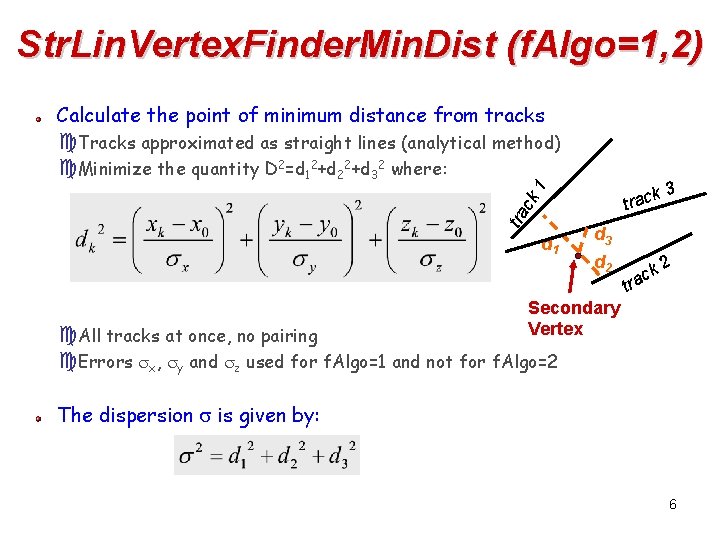
Str. Lin. Vertex. Finder. Min. Dist (f. Algo=1, 2) Calculate the point of minimum distance from tracks tra ck 1 c. Tracks approximated as straight lines (analytical method) c. Minimize the quantity D 2=d 12+d 22+d 32 where: d 1 k trac 3 k rac 2 d 3 d 2 t Secondary Vertex c. All tracks at once, no pairing c. Errors sx, sy and sz used for f. Algo=1 and not for f. Algo=2 The dispersion s is given by: 6
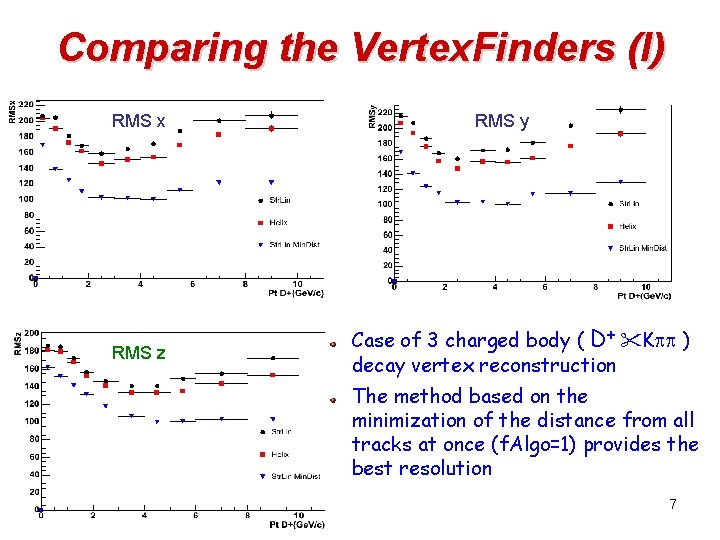
Comparing the Vertex. Finders (I) RMS x RMS z RMS y Case of 3 charged body ( D+ Kpp ) decay vertex reconstruction The method based on the minimization of the distance from all tracks at once (f. Algo=1) provides the best resolution 7
Comparing the Vertex. Finders (II) Different finder algorithms maintained because of different features that can be exploited Str. Lin. Vertex. Finder (f. Algo=4, 5) and Helix. Vertex. Finder (f. Algo=3) c. Possibility of track selection based on DCA c. Useful for rejection of displaced secondary tracks (mainly from strange particles) in primary vertex calculation when no information on the (x, y) beam position in the LHC fill is available Str. Lin. Vertex. Finder. Min. Dist (f. Algo=1) c. Better resolution better vertex determination c. Better calculation of track dispersion, useful for secondary vertex selection (see next slides) 8
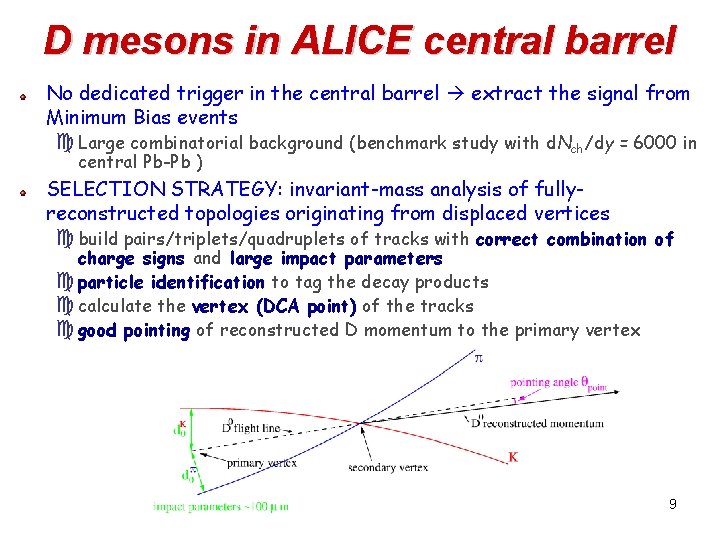
D mesons in ALICE central barrel No dedicated trigger in the central barrel extract the signal from Minimum Bias events c Large combinatorial background (benchmark study with d. Nch/dy = 6000 in central Pb-Pb ) SELECTION STRATEGY: invariant-mass analysis of fullyreconstructed topologies originating from displaced vertices c build pairs/triplets/quadruplets of tracks with correct combination of charge signs and large impact parameters c particle identification to tag the decay products c calculate the vertex (DCA point) of the tracks c good pointing of reconstructed D momentum to the primary vertex 9
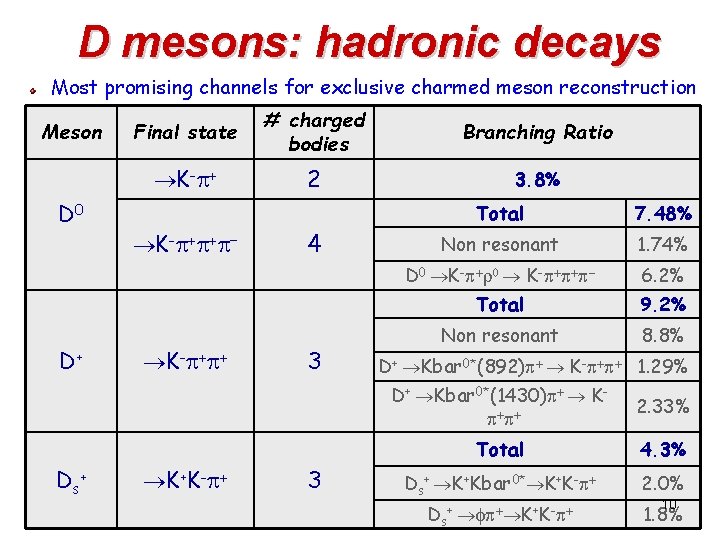
D mesons: hadronic decays Most promising channels for exclusive charmed meson reconstruction Meson Final state # charged bodies Branching Ratio K-p+ 2 3. 8% D 0 K-p+p+p- D+ Ds+ K-p+p+ K+K-p+ 4 3 3 Total 7. 48% Non resonant 1. 74% D 0 K-p+r 0 K-p+p+p. Total 6. 2% 9. 2% Non resonant 8. 8% D+ Kbar 0*(892)p+ K-p+p+ 1. 29% D+ Kbar 0*(1430)p+ K 2. 33% p +p + Total 4. 3% Ds+ K+Kbar 0* K+K-p+ 2. 0% Ds+ fp+ K+K-p+ 1. 8% 10
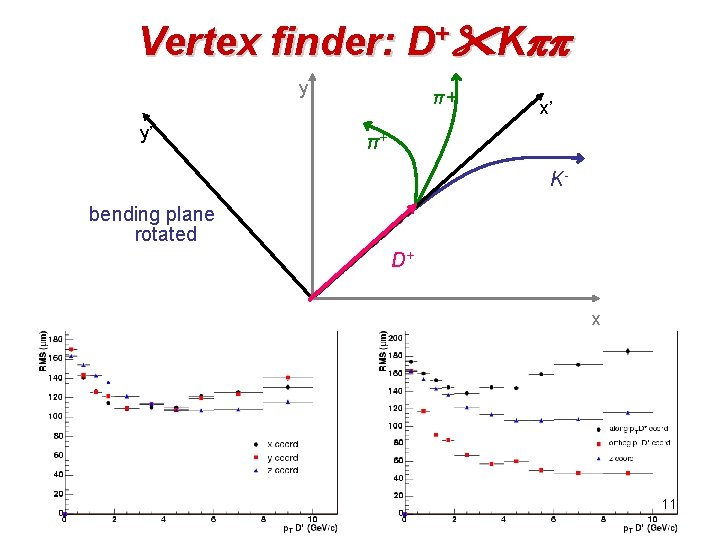
Vertex finder: D+ Kpp y y’ π+ x’ π+ K- bending plane rotated D+ x 11
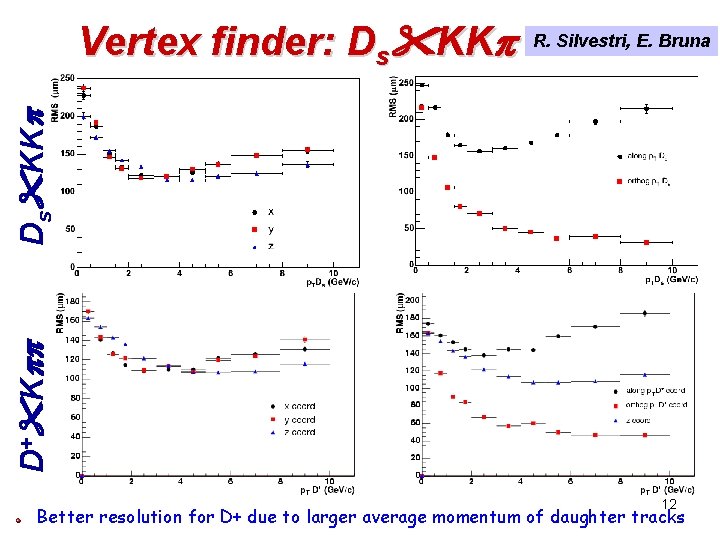
R. Silvestri, E. Bruna D+ Kpp Ds KKp Vertex finder: Ds KKp 12 Better resolution for D+ due to larger average momentum of daughter tracks
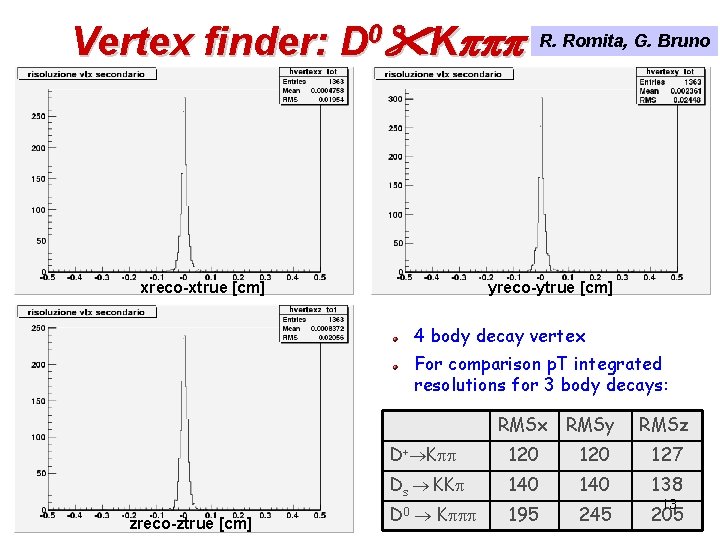
Vertex finder: D 0 Kppp xreco-xtrue [cm] R. Romita, G. Bruno yreco-ytrue [cm] 4 body decay vertex For comparison p. T integrated resolutions for 3 body decays: RMSx RMSy zreco-ztrue [cm] RMSz D+ Kpp 120 127 Ds KKp 140 138 D 0 Kppp 195 245 205 13
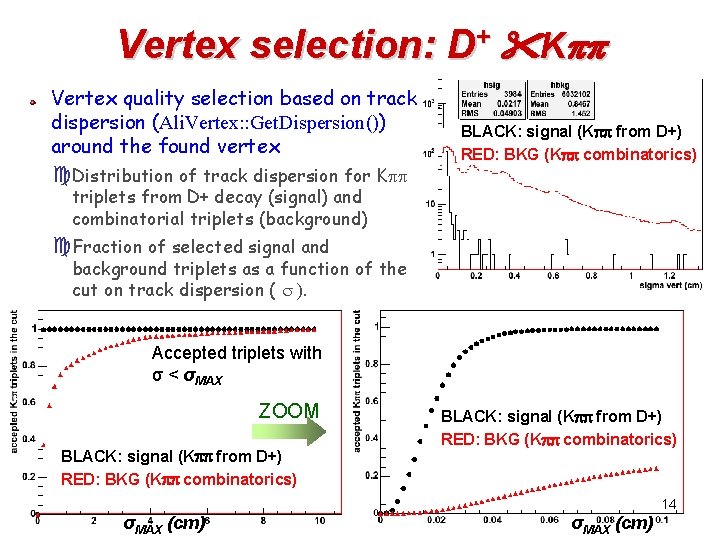
Vertex selection: D+ Kpp Vertex quality selection based on track dispersion (Ali. Vertex: : Get. Dispersion()) around the found vertex c. Distribution of track dispersion for Kpp BLACK: signal (Kpp from D+) RED: BKG (Kpp combinatorics) triplets from D+ decay (signal) and combinatorial triplets (background) c. Fraction of selected signal and background triplets as a function of the cut on track dispersion ( s ). Accepted triplets with σ < σMAX ZOOM BLACK: signal (Kpp from D+) RED: BKG (Kpp combinatorics) 14 σMAX (cm)
Decay vertices in Ali. Vertexer. Tracks: : Vertex. For. Selected. Tracks is the method for secondary vertex determination c Arguments (NEW version presently under test): 1. TObj. Array (or TTree) of Ali. ESDtracks 2. Bool_t opt. Use. Fitter: if k. FALSE the fitting step is not performed and the vertex given by the finder is used 3. Bool_t opt. Propagate: if k. TRUE after the fitter tracks are propagated to the found vertex. c Track selection: ü Prepare. Tracks = just propagate tracks to the x, y of the primary vertex ü No rejection of tracks based on impact parameter (assume that user macro already did the selection) 15
Summary on heavy flavour vertices Ali. Vertexer. Tracks used for D+ Kpp reconstruction in Pb. Pb and pp c. Vertex position is obtained with a resolution ~ 100 mm c. A “quality” parameter (the dispersion) is calculated and is used for vertex selection c. See Elena Bruna’s Ph. D thesis for more details Ongoing studies on: c. D 0 Kppp c. Ds KKp c. B J/Y e+e- (G. Bruno) c. Next step: include kinematical constraint for the resonant decay chains (e. g. Ds KK 0* KKp or Ds fp KKp) Need (especially in pp) to remove the candidate secondary tracks from the primary vertex determination c. See Andrea’s talk about the fitter 16
- Slides: 16