
Vertex 2002 p CT Hartmut F W Sadrozinski
- Slides: 21
Vertex 2002 p. CT: Hartmut F. -W. Sadrozinski , SCIPP Studies in Proton Computed Tomography L. R. Johnson, B. Keeney, G. Ross, H. F. -W. Sadrozinski, A. Seiden, D. C. Williams, L. Zhang Santa Cruz Institute for Particle Physics, UC Santa Cruz, CA 95064 V. Bashkirov, R. W. M. Schulte, K. Shahnazi Loma Linda University Medical Center, Loma Linda, CA 92354 • Proton Energy Loss in Matter • Proton Tomography / Proton Transmission Radiography • Proton Transmission Radiography Data • Proton Transmission Radiography MC Study
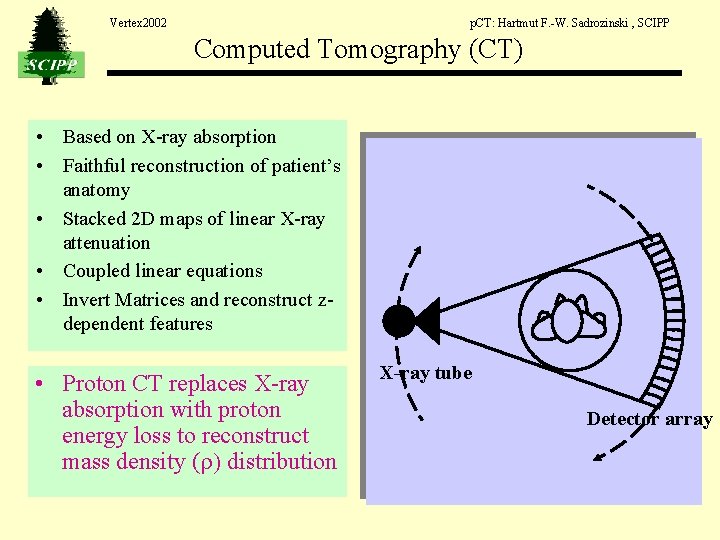
Vertex 2002 p. CT: Hartmut F. -W. Sadrozinski , SCIPP Computed Tomography (CT) • Based on X-ray absorption • Faithful reconstruction of patient’s anatomy • Stacked 2 D maps of linear X-ray attenuation • Coupled linear equations • Invert Matrices and reconstruct zdependent features • Proton CT replaces X-ray absorption with proton energy loss to reconstruct mass density (r) distribution X-ray tube Detector array
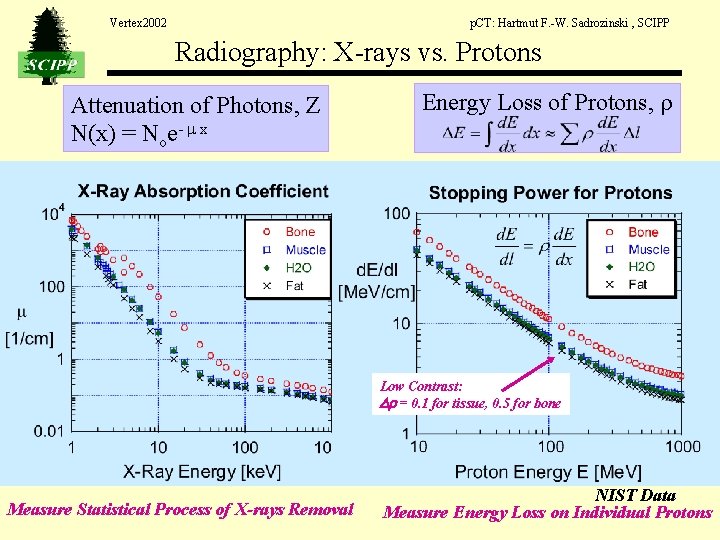
Vertex 2002 p. CT: Hartmut F. -W. Sadrozinski , SCIPP Radiography: X-rays vs. Protons Attenuation of Photons, Z N(x) = Noe- m x Energy Loss of Protons, r Low Contrast: Dr = 0. 1 for tissue, 0. 5 for bone Measure Statistical Process of X-rays Removal NIST Data Measure Energy Loss on Individual Protons
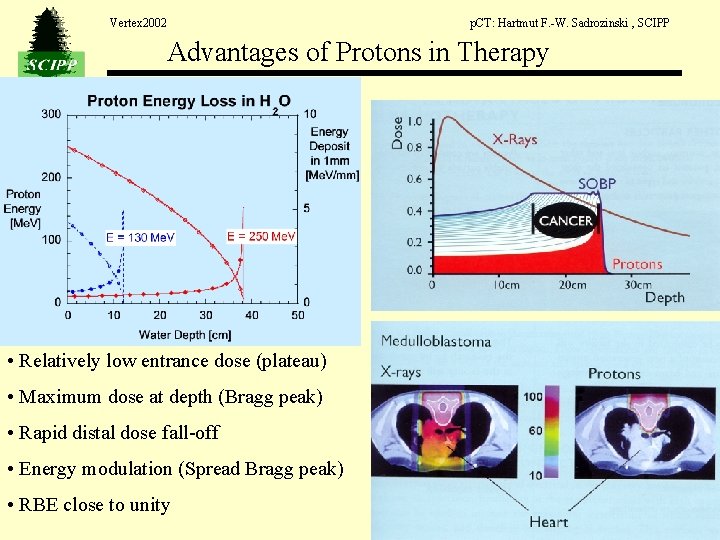
Vertex 2002 p. CT: Hartmut F. -W. Sadrozinski , SCIPP Advantages of Protons in Therapy • Relatively low entrance dose (plateau) • Maximum dose at depth (Bragg peak) • Rapid distal dose fall-off • Energy modulation (Spread Bragg peak) • RBE close to unity NIST Data
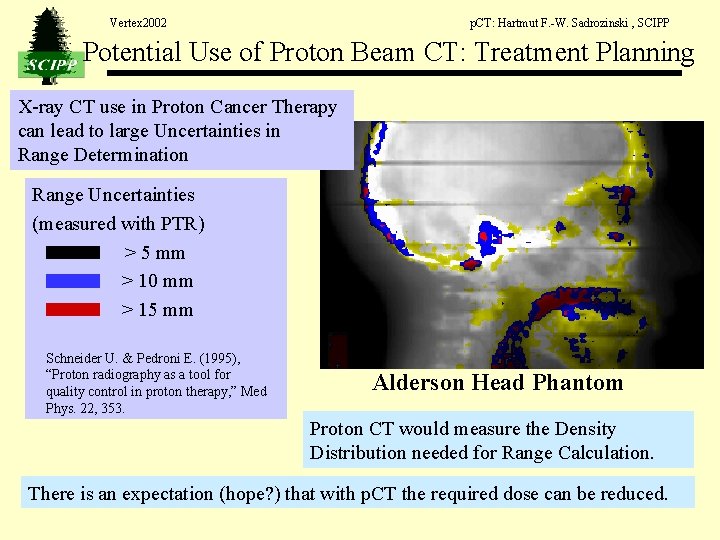
Vertex 2002 p. CT: Hartmut F. -W. Sadrozinski , SCIPP Potential Use of Proton Beam CT: Treatment Planning X-ray CT use in Proton Cancer Therapy can lead to large Uncertainties in Range Determination Range Uncertainties (measured with PTR) > 5 mm > 10 mm > 15 mm Schneider U. & Pedroni E. (1995), “Proton radiography as a tool for quality control in proton therapy, ” Med Phys. 22, 353. Alderson Head Phantom Proton CT would measure the Density Distribution needed for Range Calculation. There is an expectation (hope? ) that with p. CT the required dose can be reduced.
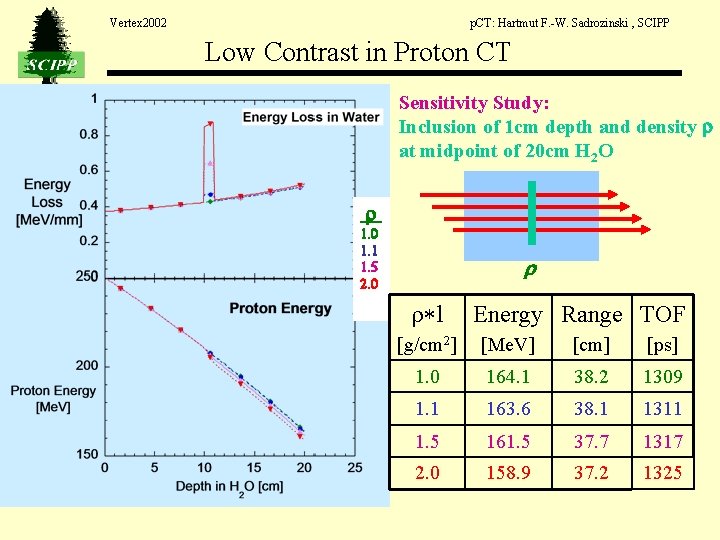
Vertex 2002 p. CT: Hartmut F. -W. Sadrozinski , SCIPP Low Contrast in Proton CT Sensitivity Study: Inclusion of 1 cm depth and density r at midpoint of 20 cm H 2 O r 1. 0 1. 1 1. 5 2. 0 r r*l Energy Range TOF [g/cm 2] [Me. V] [cm] [ps] 1. 0 164. 1 38. 2 1309 1. 1 163. 6 38. 1 1311 1. 5 161. 5 37. 7 1317 2. 0 158. 9 37. 2 1325
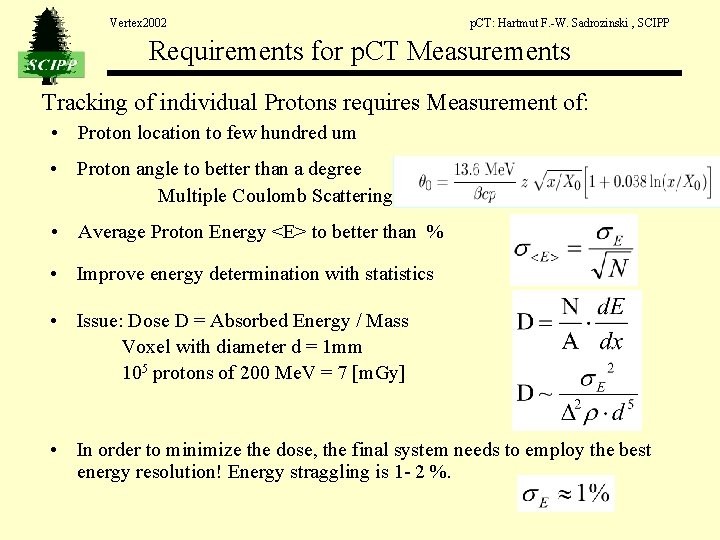
Vertex 2002 p. CT: Hartmut F. -W. Sadrozinski , SCIPP Requirements for p. CT Measurements Tracking of individual Protons requires Measurement of: • Proton location to few hundred um • Proton angle to better than a degree Multiple Coulomb Scattering • Average Proton Energy <E> to better than % • Improve energy determination with statistics • Issue: Dose D = Absorbed Energy / Mass Voxel with diameter d = 1 mm 105 protons of 200 Me. V = 7 [m. Gy] • In order to minimize the dose, the final system needs to employ the best energy resolution! Energy straggling is 1 - 2 %.
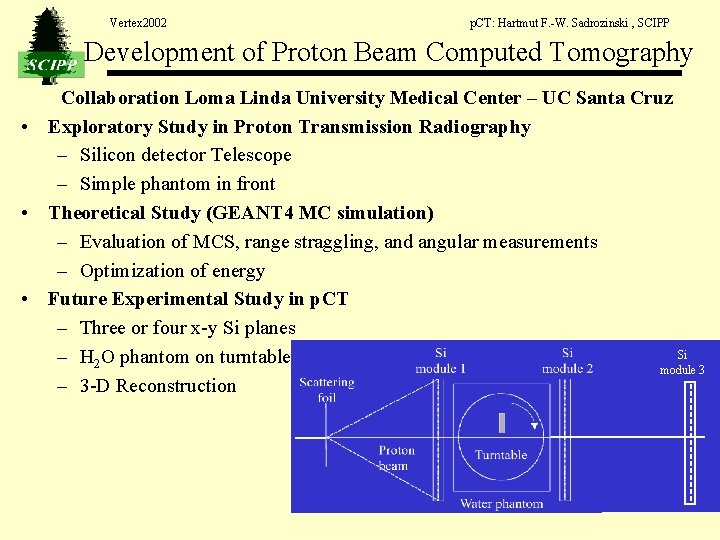
Vertex 2002 p. CT: Hartmut F. -W. Sadrozinski , SCIPP Development of Proton Beam Computed Tomography Collaboration Loma Linda University Medical Center – UC Santa Cruz • Exploratory Study in Proton Transmission Radiography – Silicon detector Telescope – Simple phantom in front • Theoretical Study (GEANT 4 MC simulation) – Evaluation of MCS, range straggling, and angular measurements – Optimization of energy • Future Experimental Study in p. CT – Three or four x-y Si planes Si – H 2 O phantom on turntable module 3 – 3 -D Reconstruction
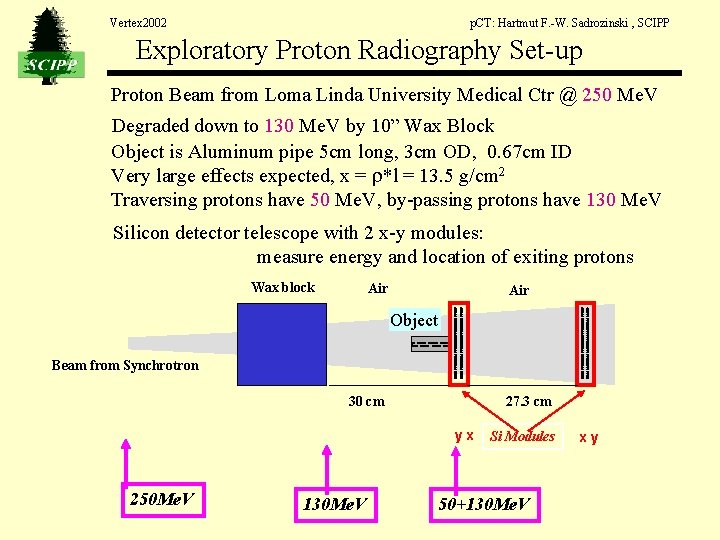
Vertex 2002 p. CT: Hartmut F. -W. Sadrozinski , SCIPP Exploratory Proton Radiography Set-up Proton Beam from Loma Linda University Medical Ctr @ 250 Me. V Degraded down to 130 Me. V by 10” Wax Block Object is Aluminum pipe 5 cm long, 3 cm OD, 0. 67 cm ID Very large effects expected, x = r*l = 13. 5 g/cm 2 Traversing protons have 50 Me. V, by-passing protons have 130 Me. V Silicon detector telescope with 2 x-y modules: measure energy and location of exiting protons Wax block Air Object Beam from Synchrotron 30 cm 27. 3 cm yx 250 Me. V 130 Me. V Si Modules 50+130 Me. V xy
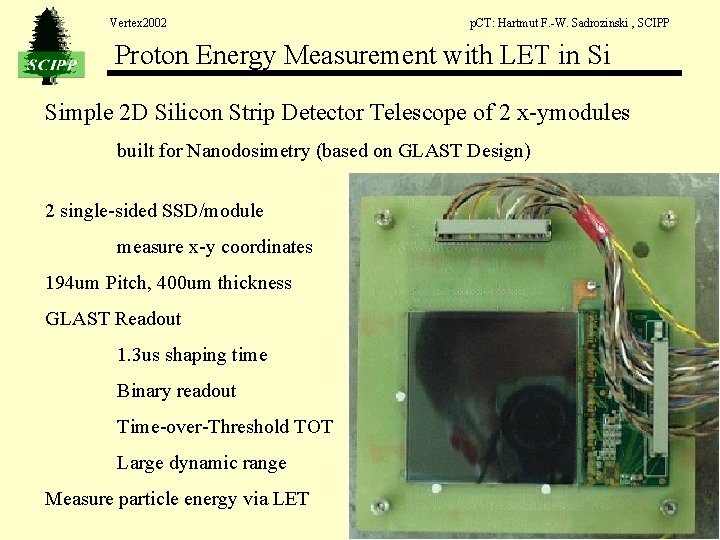
Vertex 2002 p. CT: Hartmut F. -W. Sadrozinski , SCIPP Proton Energy Measurement with LET in Si Simple 2 D Silicon Strip Detector Telescope of 2 x-ymodules built for Nanodosimetry (based on GLAST Design) 2 single-sided SSD/module measure x-y coordinates 194 um Pitch, 400 um thickness GLAST Readout 1. 3 us shaping time Binary readout Time-over-Threshold TOT Large dynamic range Measure particle energy via LET
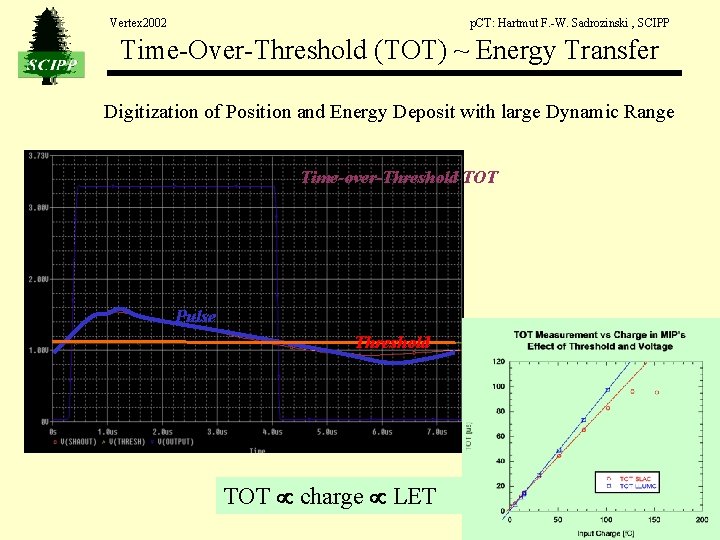
Vertex 2002 p. CT: Hartmut F. -W. Sadrozinski , SCIPP Time-Over-Threshold (TOT) ~ Energy Transfer Digitization of Position and Energy Deposit with large Dynamic Range Time-over-Threshold TOT Pulse Threshold TOT charge LET
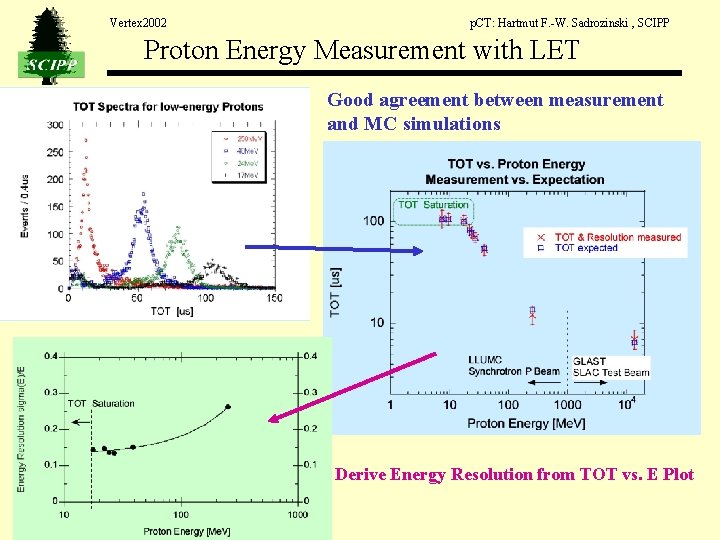
Vertex 2002 p. CT: Hartmut F. -W. Sadrozinski , SCIPP Proton Energy Measurement with LET Good agreement between measurement and MC simulations Derive Energy Resolution from TOT vs. E Plot
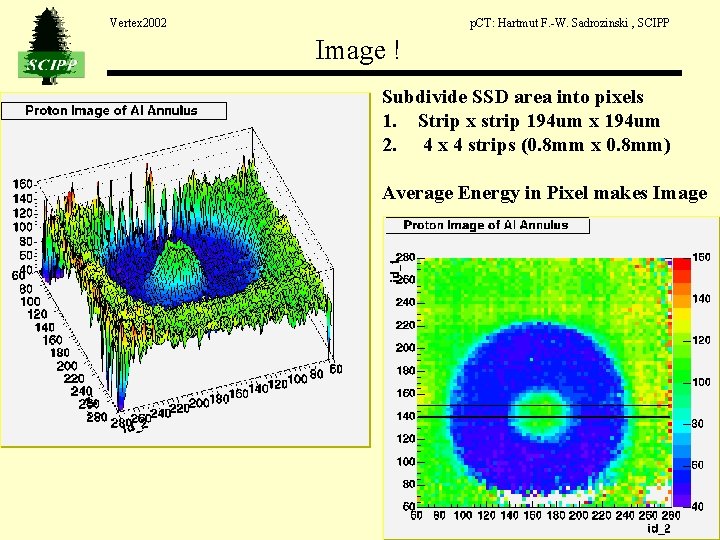
Vertex 2002 p. CT: Hartmut F. -W. Sadrozinski , SCIPP Image ! Subdivide SSD area into pixels 1. Strip x strip 194 um x 194 um 2. 4 x 4 strips (0. 8 mm x 0. 8 mm) Average Energy in Pixel makes Image
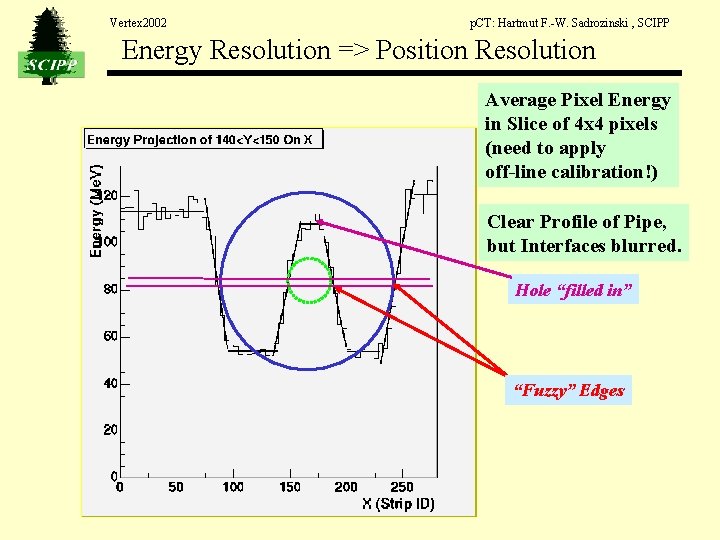
Vertex 2002 p. CT: Hartmut F. -W. Sadrozinski , SCIPP Energy Resolution => Position Resolution Average Pixel Energy in Slice of 4 x 4 pixels (need to apply off-line calibration!) Clear Profile of Pipe, but Interfaces blurred. Hole “filled in” “Fuzzy” Edges
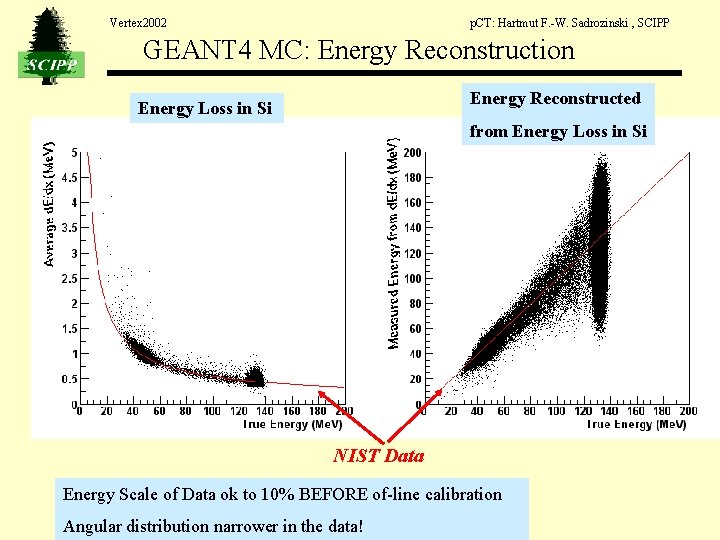
Vertex 2002 p. CT: Hartmut F. -W. Sadrozinski , SCIPP GEANT 4 MC: Energy Reconstruction Energy Reconstructed Energy Loss in Si from Energy Loss in Si NIST Data Energy Scale of Data ok to 10% BEFORE of-line calibration Angular distribution narrower in the data!
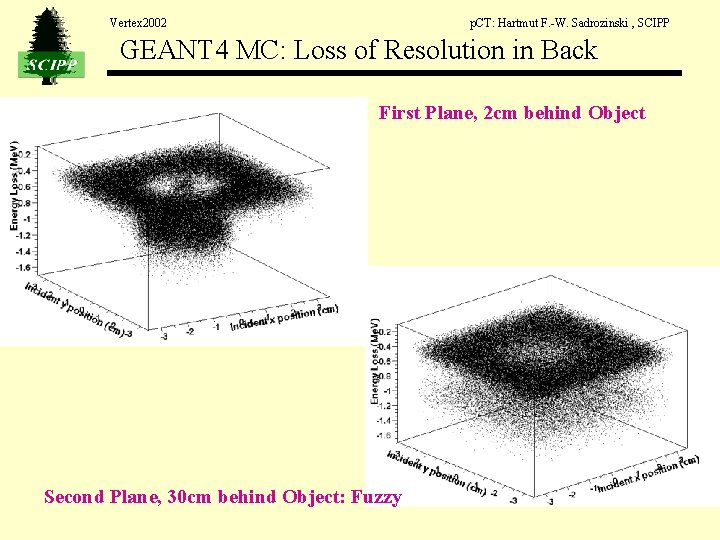
Vertex 2002 p. CT: Hartmut F. -W. Sadrozinski , SCIPP GEANT 4 MC: Loss of Resolution in Back First Plane, 2 cm behind Object Second Plane, 30 cm behind Object: Fuzzy
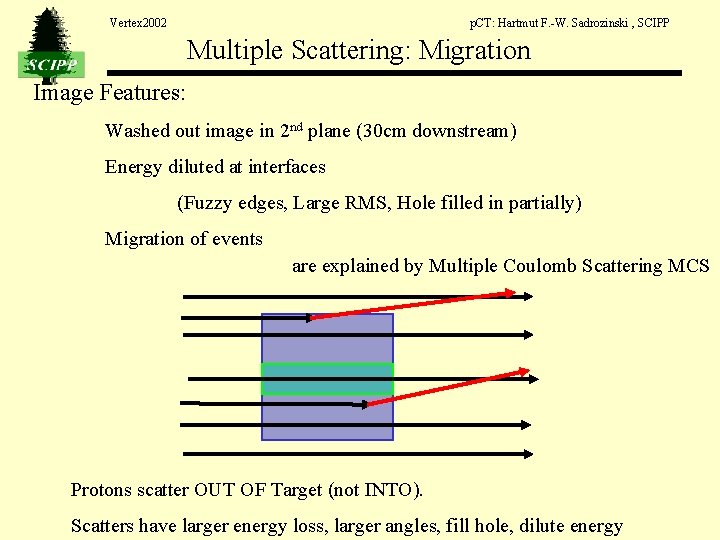
Vertex 2002 p. CT: Hartmut F. -W. Sadrozinski , SCIPP Multiple Scattering: Migration Image Features: Washed out image in 2 nd plane (30 cm downstream) Energy diluted at interfaces (Fuzzy edges, Large RMS, Hole filled in partially) Migration of events are explained by Multiple Coulomb Scattering MCS Protons scatter OUT OF Target (not INTO). Scatters have larger energy loss, larger angles, fill hole, dilute energy
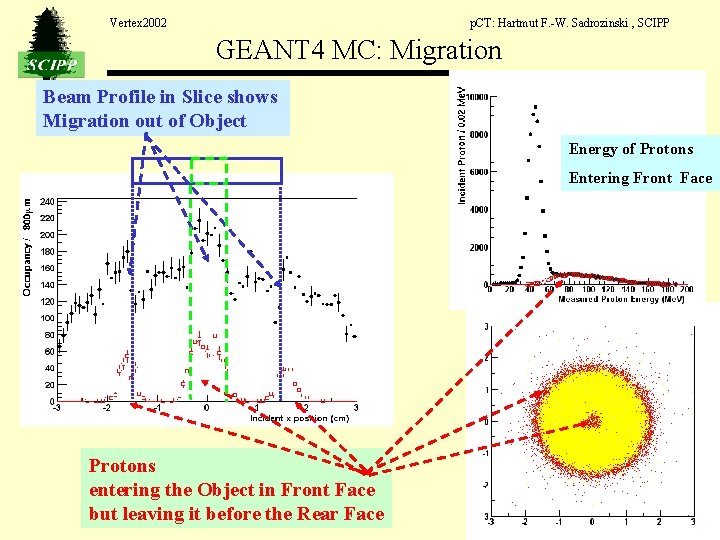
Vertex 2002 p. CT: Hartmut F. -W. Sadrozinski , SCIPP GEANT 4 MC: Migration Beam Profile in Slice shows Migration out of Object Energy of Protons Entering Front Face Protons entering the Object in Front Face but leaving it before the Rear Face
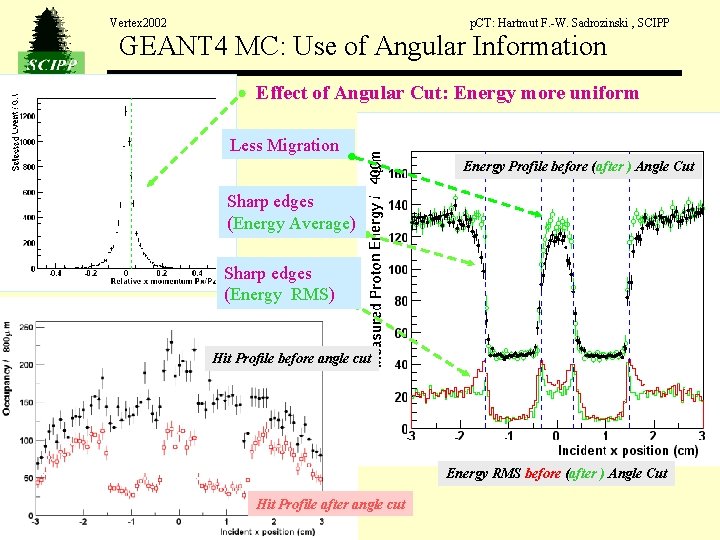
Vertex 2002 p. CT: Hartmut F. -W. Sadrozinski , SCIPP GEANT 4 MC: Use of Angular Information Effect of Angular Cut: Energy more uniform Less Migration Energy Profile before (after ) Angle Cut Sharp edges (Energy Average) Sharp edges (Energy RMS) Hit Profile before angle cut Energy RMS before (after ) Angle Cut Hit Profile after angle cut
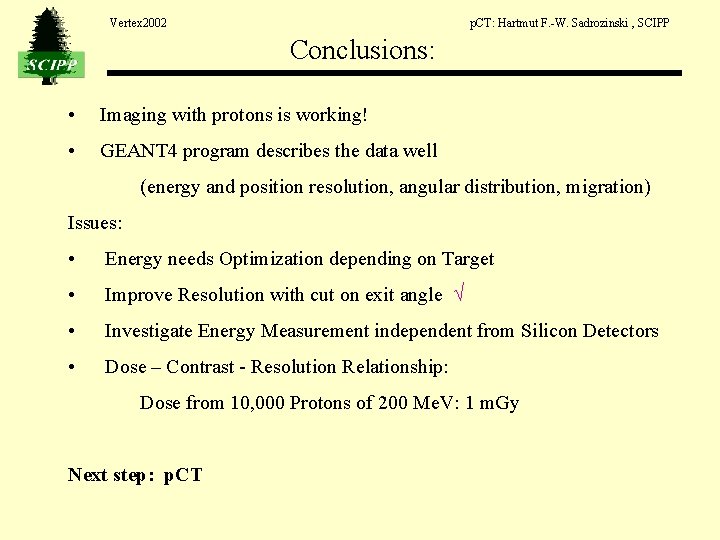
Vertex 2002 p. CT: Hartmut F. -W. Sadrozinski , SCIPP Conclusions: • Imaging with protons is working! • GEANT 4 program describes the data well (energy and position resolution, angular distribution, migration) Issues: • Energy needs Optimization depending on Target • Improve Resolution with cut on exit angle • Investigate Energy Measurement independent from Silicon Detectors • Dose – Contrast - Resolution Relationship: Dose from 10, 000 Protons of 200 Me. V: 1 m. Gy Next step: p. CT
Vertex 2002 p. CT: Hartmut F. -W. Sadrozinski , SCIPP Mahalo http: scipp. ucsc. edu/~hartmut/Kona