
Vertebrate Tissues Science in Motion 4 Basic Tissue
Vertebrate Tissues Science in Motion

4 Basic Tissue Types ●Epithelial Tissue § Protects, secretes, absorbs o. Simple squamous epithelium o. Simple cubodial epithelium o. Simple columnar epithelium o. Ciliated epithelium o. Pseudostratified ciliated columnar epithelium

Squamous Epithelium ● Flat cells ● Allows rapid diffusion of substances ● Found kidney, alveoli of lungs, etc Simple Squamous Epithelium
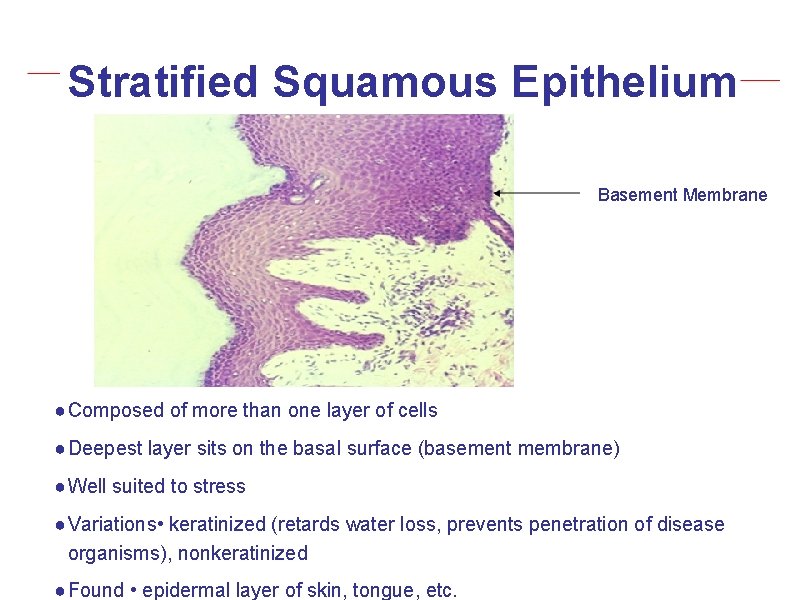
Stratified Squamous Epithelium Basement Membrane ● Composed of more than one layer of cells ● Deepest layer sits on the basal surface (basement membrane) ● Well suited to stress ● Variations • keratinized (retards water loss, prevents penetration of disease organisms), nonkeratinized ● Found • epidermal layer of skin, tongue, etc.
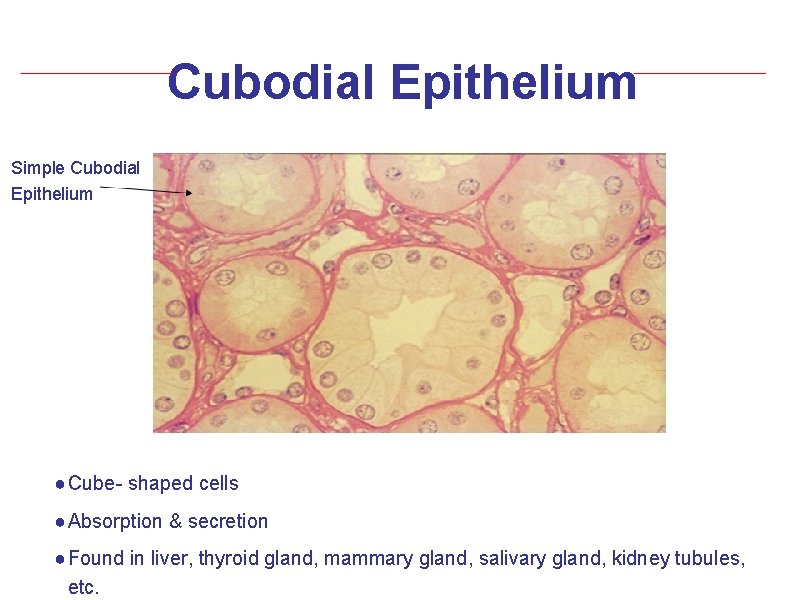
Cubodial Epithelium Simple Cubodial Epithelium ● Cube- shaped cells ● Absorption & secretion ● Found in liver, thyroid gland, mammary gland, salivary gland, kidney tubules, etc.
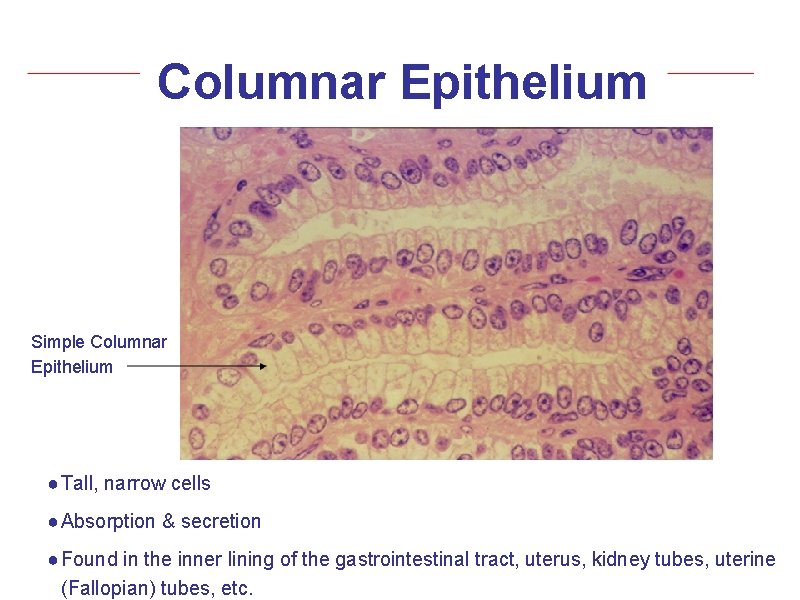
Columnar Epithelium Simple Columnar Epithelium ● Tall, narrow cells ● Absorption & secretion ● Found in the inner lining of the gastrointestinal tract, uterus, kidney tubes, uterine (Fallopian) tubes, etc.
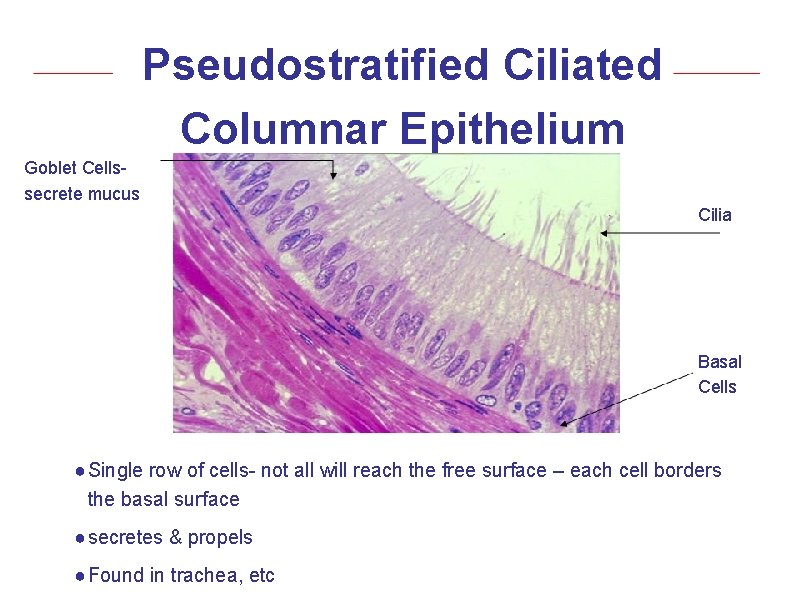
Pseudostratified Ciliated Columnar Epithelium Goblet Cellssecrete mucus Cilia Basal Cells ● Single row of cells- not all will reach the free surface – each cell borders the basal surface ● secretes & propels ● Found in trachea, etc
4 Basic Tissue Types ●Connective Tissue § Supports, binds together, protects o Bone o Adipose Tissue o Areolar Tissue o “White” Fibrous Tissue (Tendon) o “Yellow” Elastic Connective Tissue o Cartilage • Hyaline, Elastic, Fibrocartilage o Blood • Erythrocytes, Leucocytes, Thrombocytes
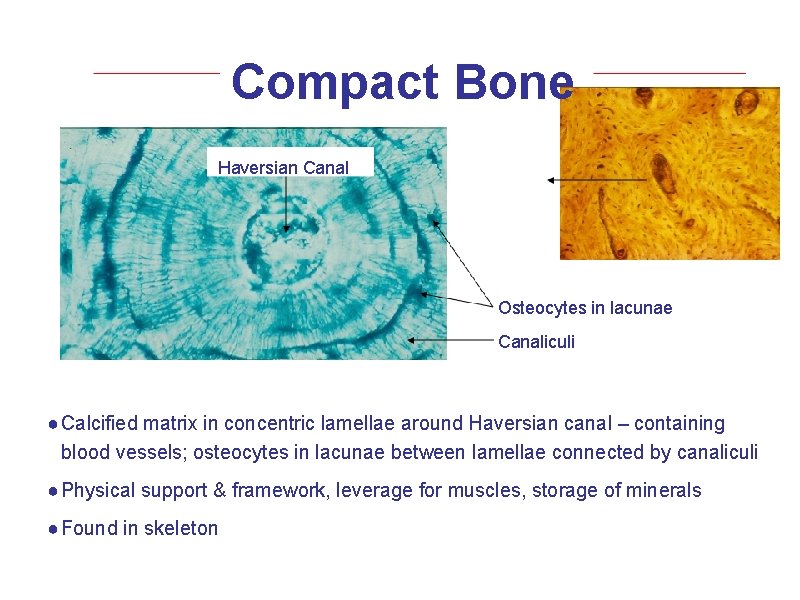
Compact Bone Haversian Canal Osteocytes in lacunae Canaliculi ● Calcified matrix in concentric lamellae around Haversian canal – containing blood vessels; osteocytes in lacunae between lamellae connected by canaliculi ● Physical support & framework, leverage for muscles, storage of minerals ● Found in skeleton
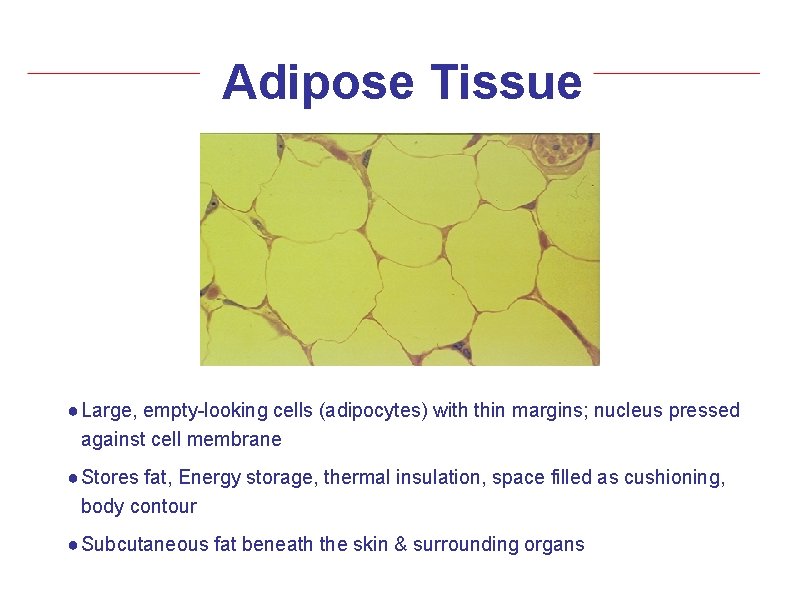
Adipose Tissue ● Large, empty-looking cells (adipocytes) with thin margins; nucleus pressed against cell membrane ● Stores fat, Energy storage, thermal insulation, space filled as cushioning, body contour ● Subcutaneous fat beneath the skin & surrounding organs
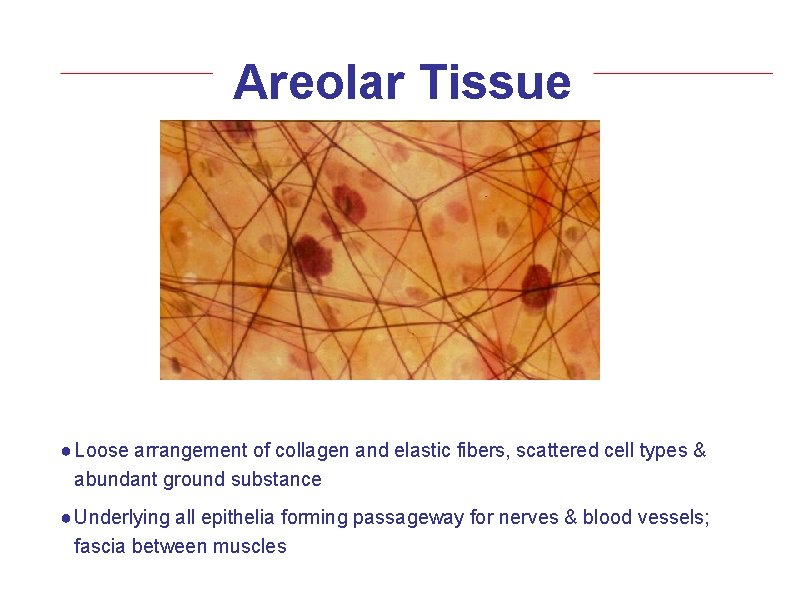
Areolar Tissue ● Loose arrangement of collagen and elastic fibers, scattered cell types & abundant ground substance ● Underlying all epithelia forming passageway for nerves & blood vessels; fascia between muscles
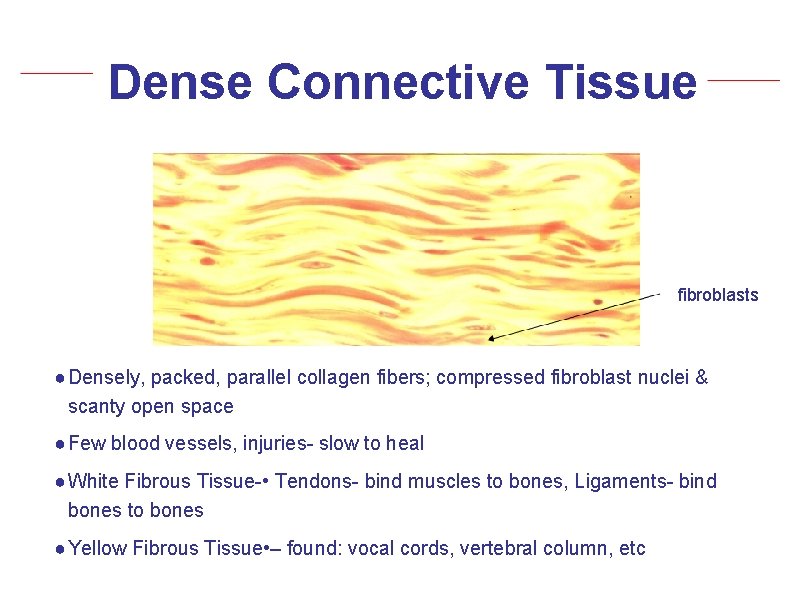
Dense Connective Tissue fibroblasts ● Densely, packed, parallel collagen fibers; compressed fibroblast nuclei & scanty open space ● Few blood vessels, injuries- slow to heal ● White Fibrous Tissue- • Tendons- bind muscles to bones, Ligaments- bind bones to bones ● Yellow Fibrous Tissue • – found: vocal cords, vertebral column, etc
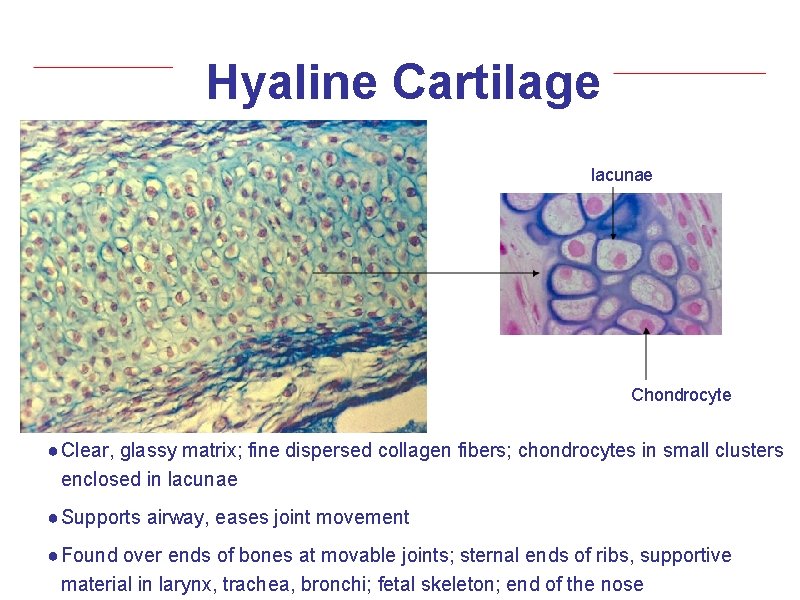
Hyaline Cartilage lacunae Chondrocyte ● Clear, glassy matrix; fine dispersed collagen fibers; chondrocytes in small clusters enclosed in lacunae ● Supports airway, eases joint movement ● Found over ends of bones at movable joints; sternal ends of ribs, supportive material in larynx, trachea, bronchi; fetal skeleton; end of the nose
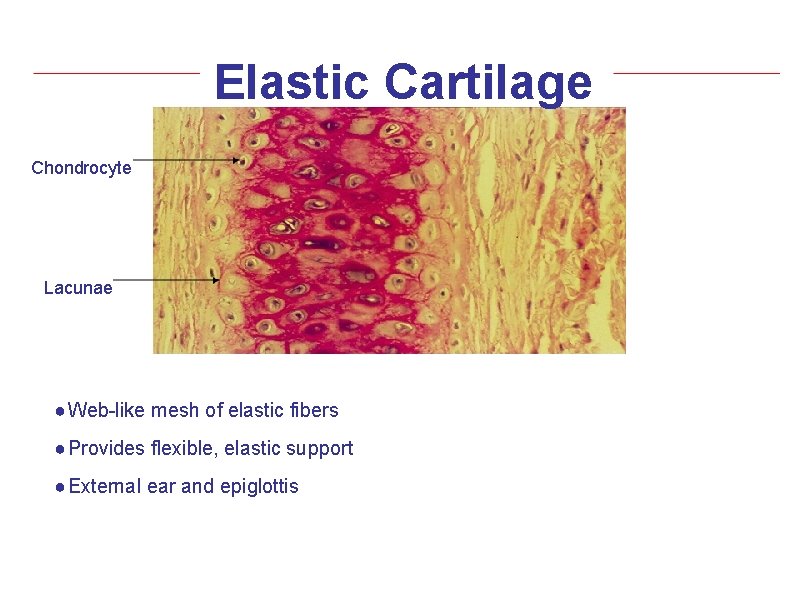
Elastic Cartilage Chondrocyte Lacunae ● Web-like mesh of elastic fibers ● Provides flexible, elastic support ● External ear and epiglottis
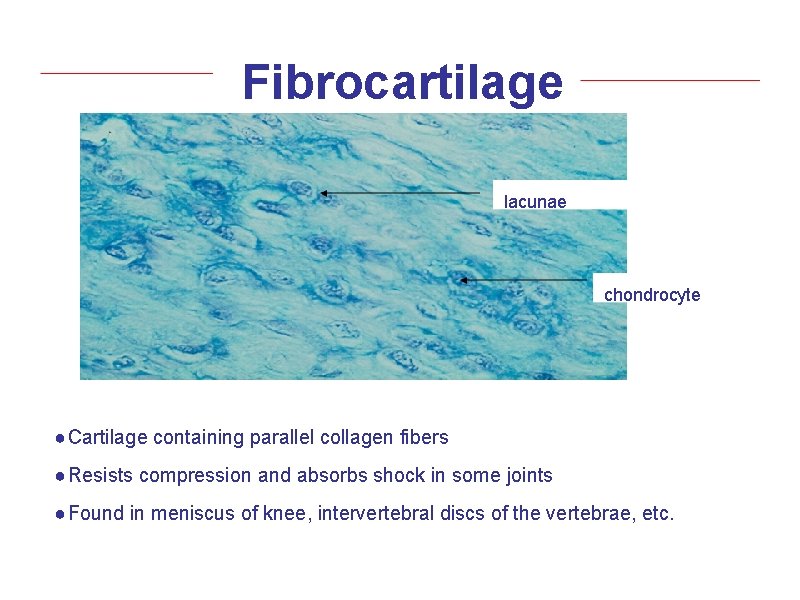
Fibrocartilage lacunae chondrocyte ● Cartilage containing parallel collagen fibers ● Resists compression and absorbs shock in some joints ● Found in meniscus of knee, intervertebral discs of the vertebrae, etc.
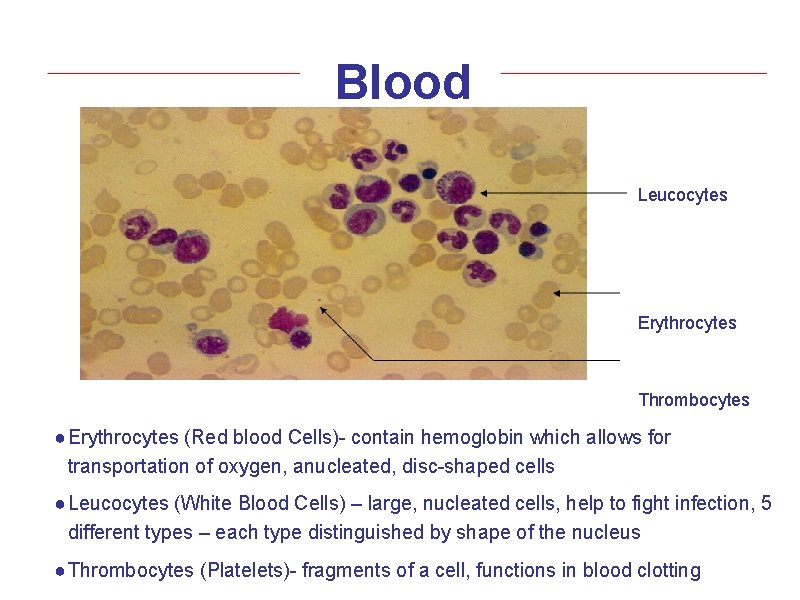
Blood Leucocytes Erythrocytes Thrombocytes ● Erythrocytes (Red blood Cells)- contain hemoglobin which allows for transportation of oxygen, anucleated, disc-shaped cells ● Leucocytes (White Blood Cells) – large, nucleated cells, help to fight infection, 5 different types – each type distinguished by shape of the nucleus ● Thrombocytes (Platelets)- fragments of a cell, functions in blood clotting
4 Basic Tissue Types ●Muscle Tissue § Movement § Moving body parts, such as the muscles of arms, legs § Moving substances throughout the body, such as the muscles that make up the blood vessels o. Striated (Skeletal) Muscle o. Visceral (Smooth) Muscle o. Cardiac Muscle
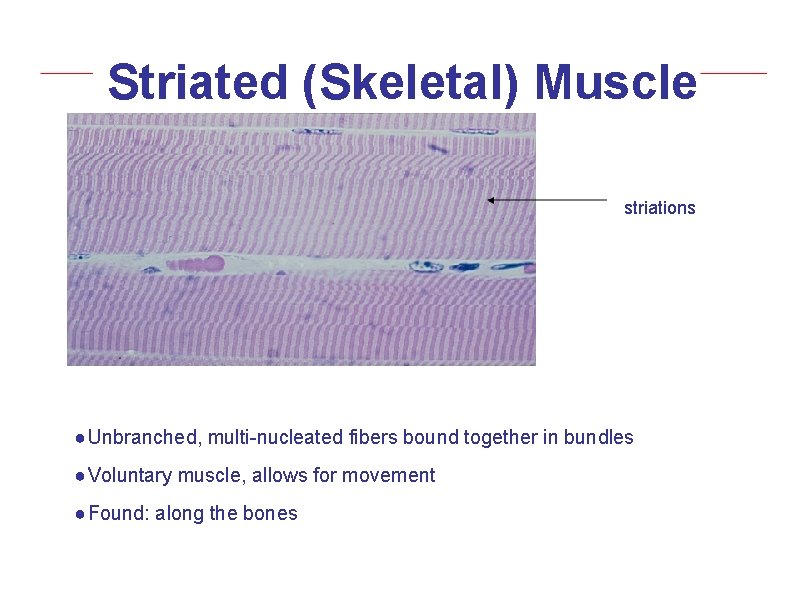
Striated (Skeletal) Muscle striations ● Unbranched, multi-nucleated fibers bound together in bundles ● Voluntary muscle, allows for movement ● Found: along the bones
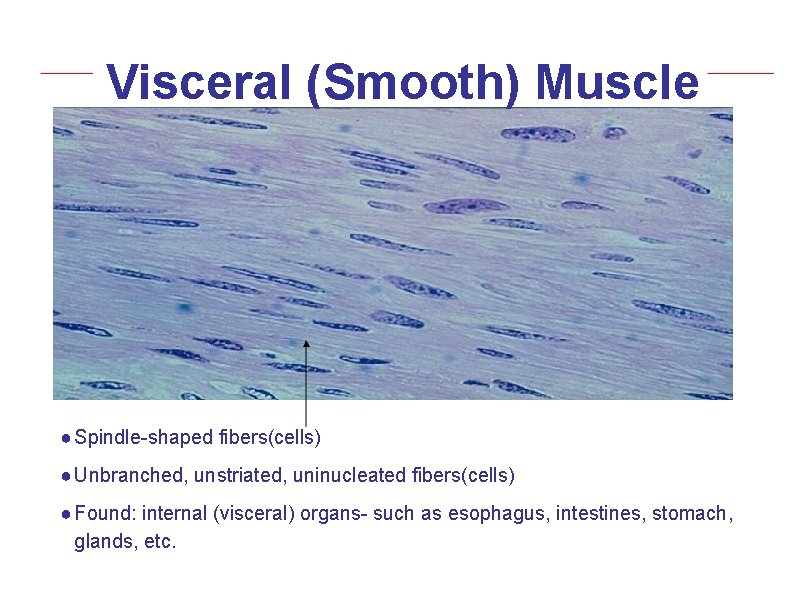
Visceral (Smooth) Muscle ● Spindle-shaped fibers(cells) ● Unbranched, unstriated, uninucleated fibers(cells) ● Found: internal (visceral) organs- such as esophagus, intestines, stomach, glands, etc.
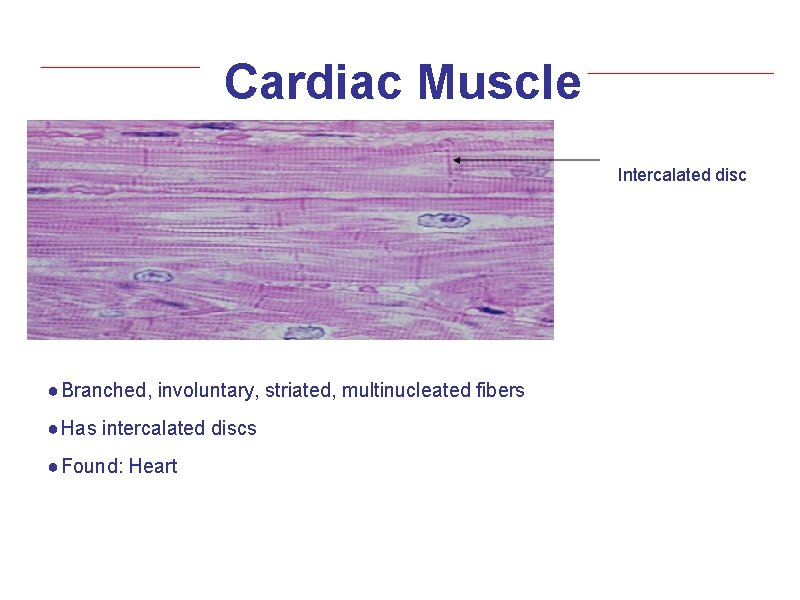
Cardiac Muscle Intercalated disc ● Branched, involuntary, striated, multinucleated fibers ● Has intercalated discs ● Found: Heart
4 Basic Tissue Types ●Nerve Tissue § Coordination, communication, integration o. Neuron § Dendrites- transport impulses toward the cell body § Axons – transport impulses away from the cell body § Cell body – interprets, coordinates
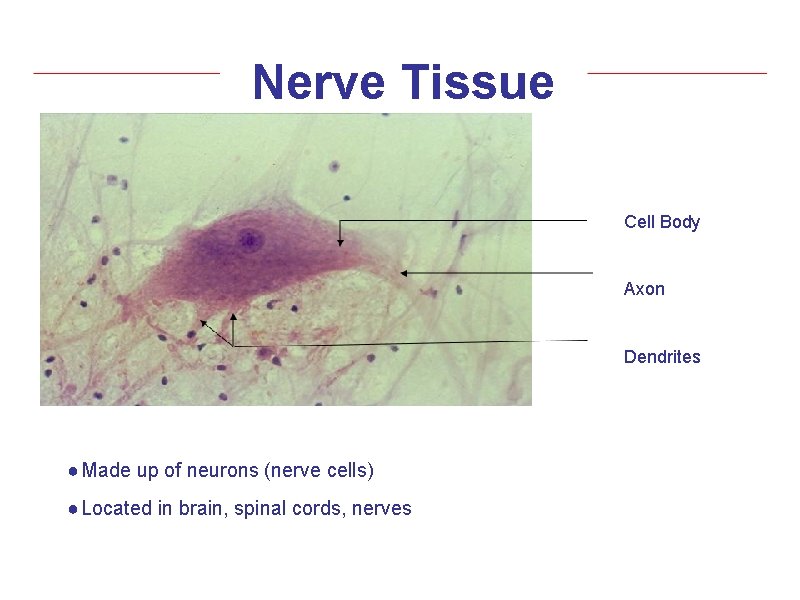
Nerve Tissue Cell Body Axon Dendrites ● Made up of neurons (nerve cells) ● Located in brain, spinal cords, nerves
- Slides: 22