
Vertebrate Diversity Chapters 19 selected sections 19 1

Vertebrate Diversity Chapters 19 (selected sections)
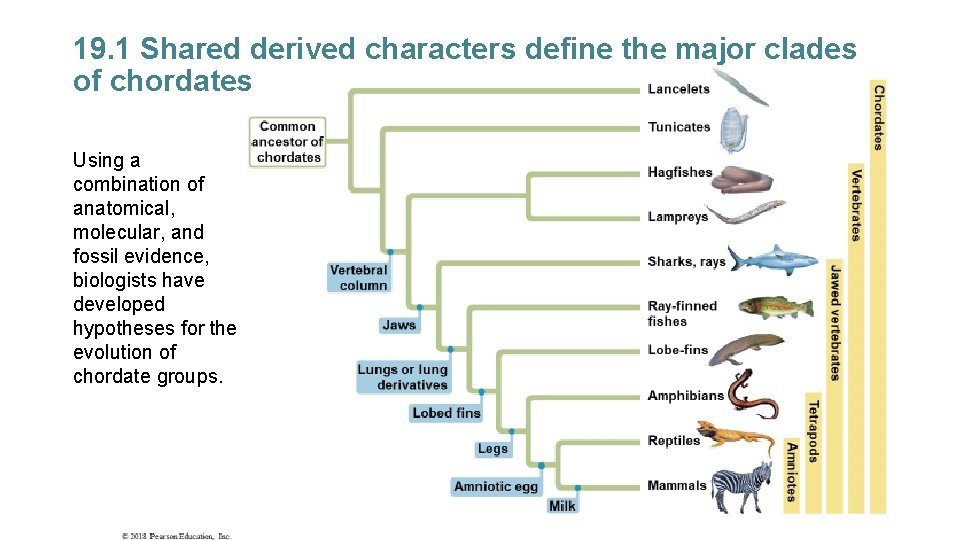
19. 1 Shared derived characters define the major clades of chordates Using a combination of anatomical, molecular, and fossil evidence, biologists have developed hypotheses for the evolution of chordate groups.
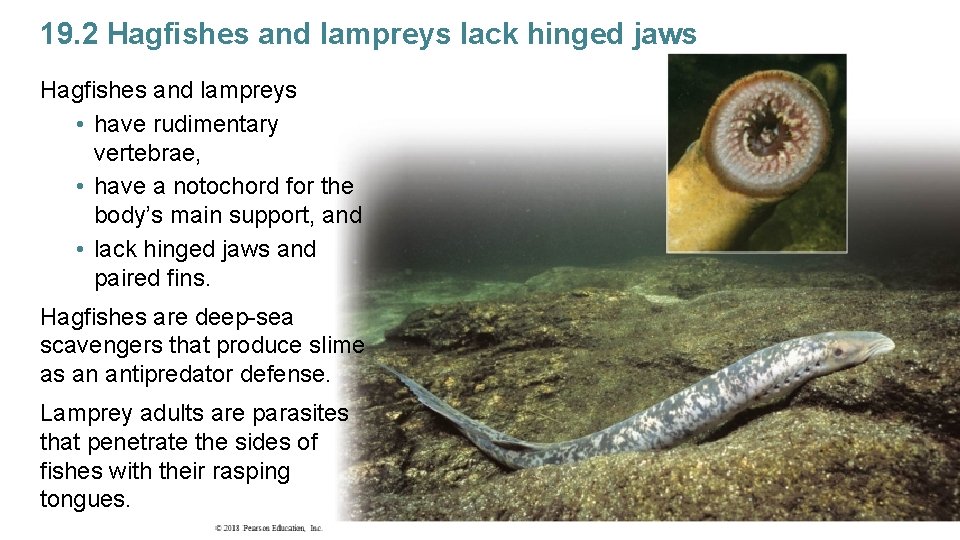
19. 2 Hagfishes and lampreys lack hinged jaws Hagfishes and lampreys • have rudimentary vertebrae, • have a notochord for the body’s main support, and • lack hinged jaws and paired fins. Hagfishes are deep-sea scavengers that produce slime as an antipredator defense. Lamprey adults are parasites that penetrate the sides of fishes with their rasping tongues.
19. 3 Jawed vertebrates with gills and paired fins include sharks, ray-finned fishes, and lobe-finned fishes • Jawed vertebrates • appeared in the fossil record about 440 million years ago and • diversified, using their paired fins and tail to chase a wide variety of prey. • Jaws may have evolved by modifications of skeletal supports of the anterior pharyngeal (gill) slits. • The remaining gill slits remained as sites of gas exchange.
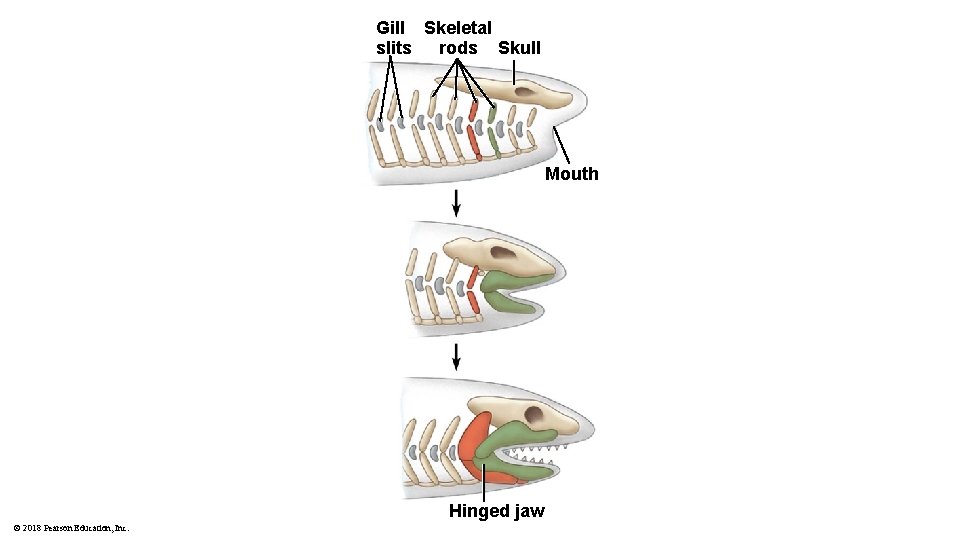
Gill Skeletal slits rods Skull Mouth Hinged jaw © 2018 Pearson Education, Inc.

19. 3 Jawed vertebrates with gills and paired fins include sharks, ray-finned fishes, and lobe-finned fishes • Three lineages of jawed vertebrates with gills and paired fins are commonly called fishes: 1. Chondrichthyans, sharks and rays, have a flexible skeleton made primarily of cartilage
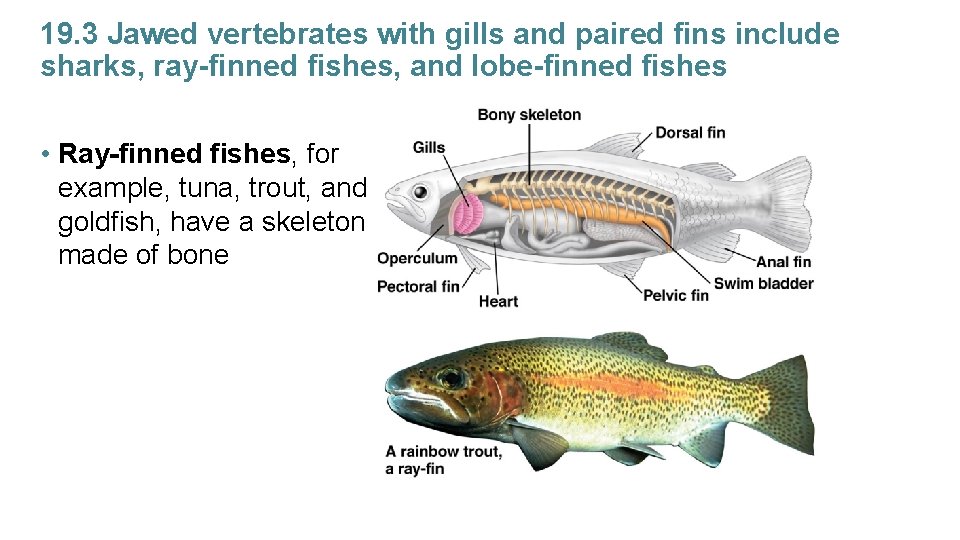
19. 3 Jawed vertebrates with gills and paired fins include sharks, ray-finned fishes, and lobe-finned fishes • Ray-finned fishes, for example, tuna, trout, and goldfish, have a skeleton made of bone
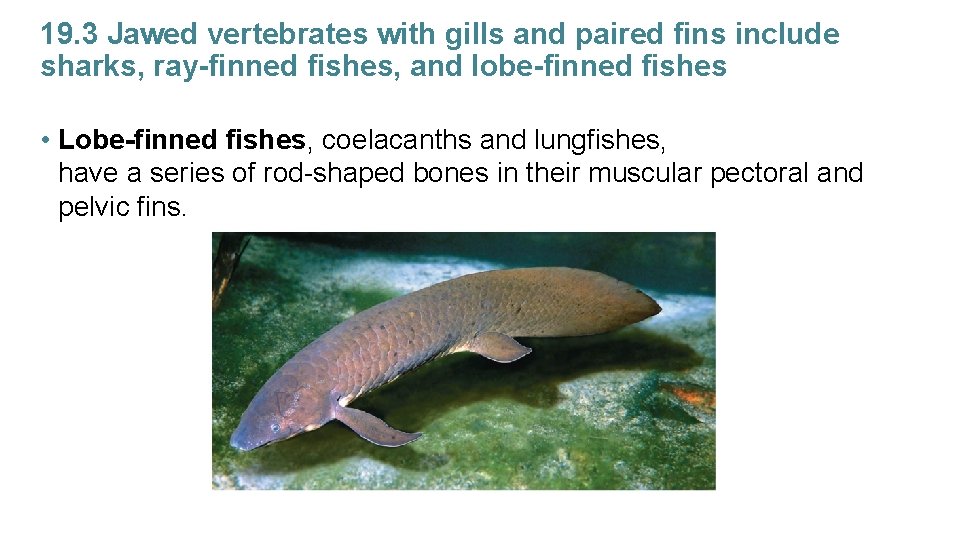
19. 3 Jawed vertebrates with gills and paired fins include sharks, ray-finned fishes, and lobe-finned fishes • Lobe-finned fishes, coelacanths and lungfishes, have a series of rod-shaped bones in their muscular pectoral and pelvic fins.
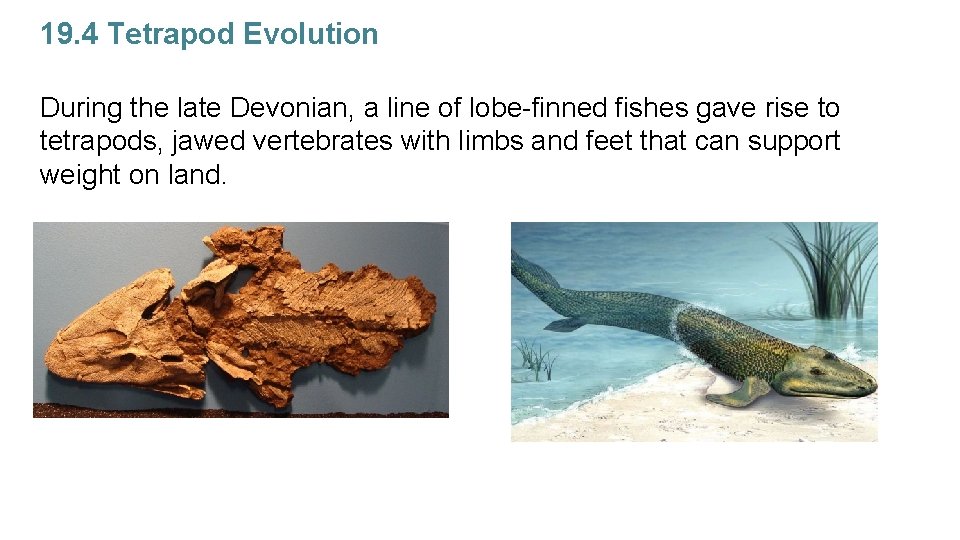
19. 4 Tetrapod Evolution During the late Devonian, a line of lobe-finned fishes gave rise to tetrapods, jawed vertebrates with limbs and feet that can support weight on land.
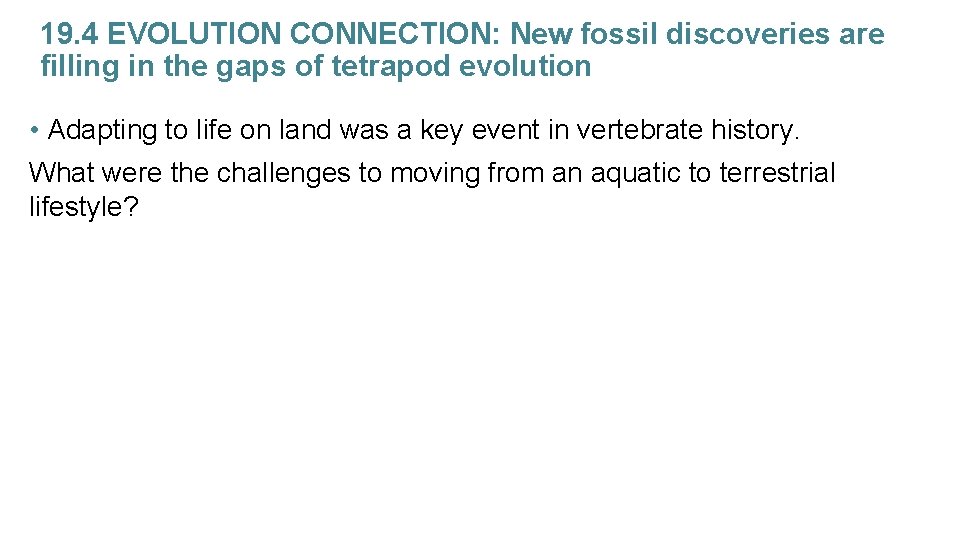
19. 4 EVOLUTION CONNECTION: New fossil discoveries are filling in the gaps of tetrapod evolution • Adapting to life on land was a key event in vertebrate history. What were the challenges to moving from an aquatic to terrestrial lifestyle?
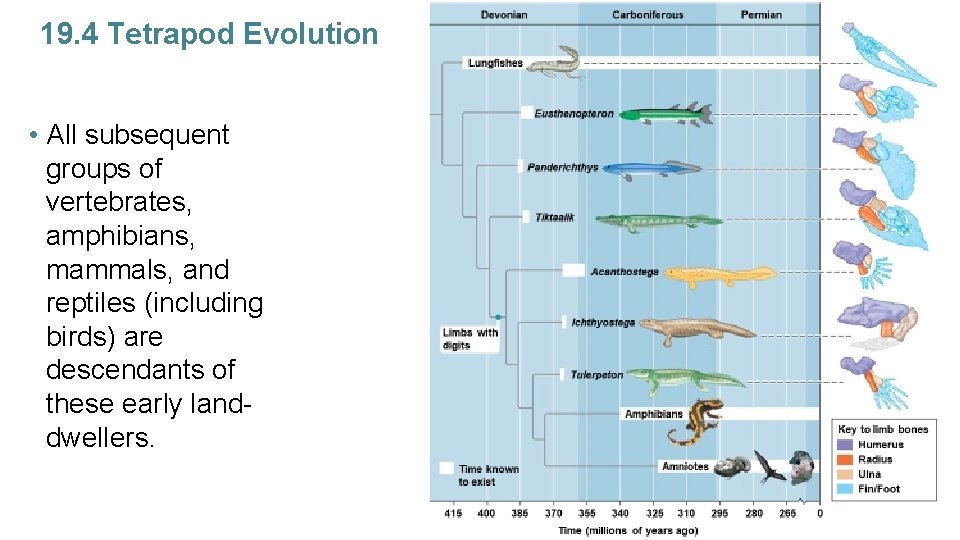
19. 4 Tetrapod Evolution • All subsequent groups of vertebrates, amphibians, mammals, and reptiles (including birds) are descendants of these early landdwellers.
19. 5 Amphibians are tetrapods—vertebrates with two pairs of limbs • Amphibians • • • include salamanders, frogs, and caecilians, use their moist skins to supplement their lungs for ____, often have poison glands in their skins, usually lay their _____ in water, undergo _______ from a larval stage to the adult form, and were the first tetrapods to colonize land. In what ways are amphibians not completely adapted for terrestrial life?
19. 6 Reptiles are amniotes—tetrapods with a terrestrially adapted egg • Reptiles (including birds) and mammals are amniotes. • The major derived character of this clade is an amniotic egg, with four internal membranes. 1. The______is a fluid-filled sac surrounding the embryo. 2. The yolk sac contains a rich store of nutrients for the developing embryo. 3. The _______(and allantois) enable the embryo to obtain oxygen from the air and dispose of carbon dioxide. 4. The allantois also helps _____________.
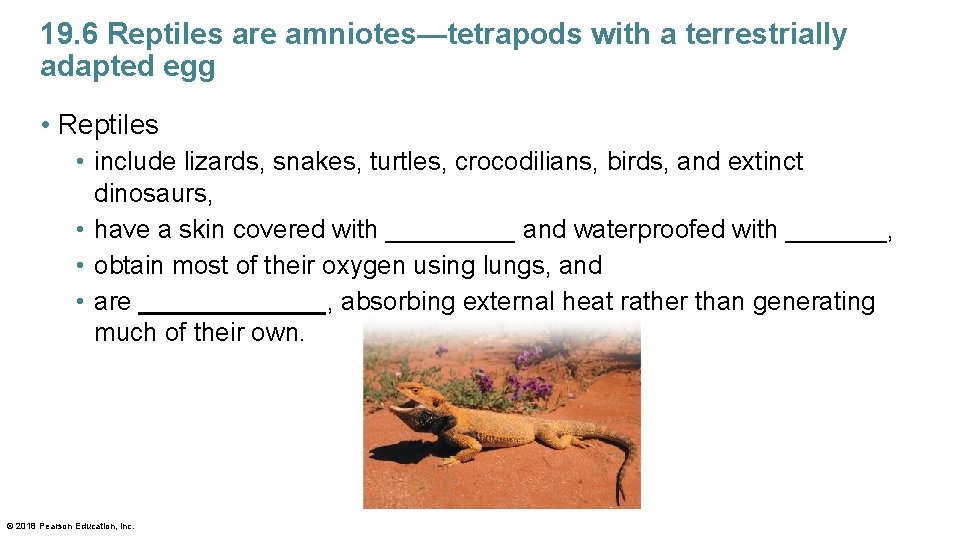
19. 6 Reptiles are amniotes—tetrapods with a terrestrially adapted egg • Reptiles • include lizards, snakes, turtles, crocodilians, birds, and extinct dinosaurs, • have a skin covered with _____ and waterproofed with _______, • obtain most of their oxygen using lungs, and • are _______, absorbing external heat rather than generating much of their own. © 2018 Pearson Education, Inc.
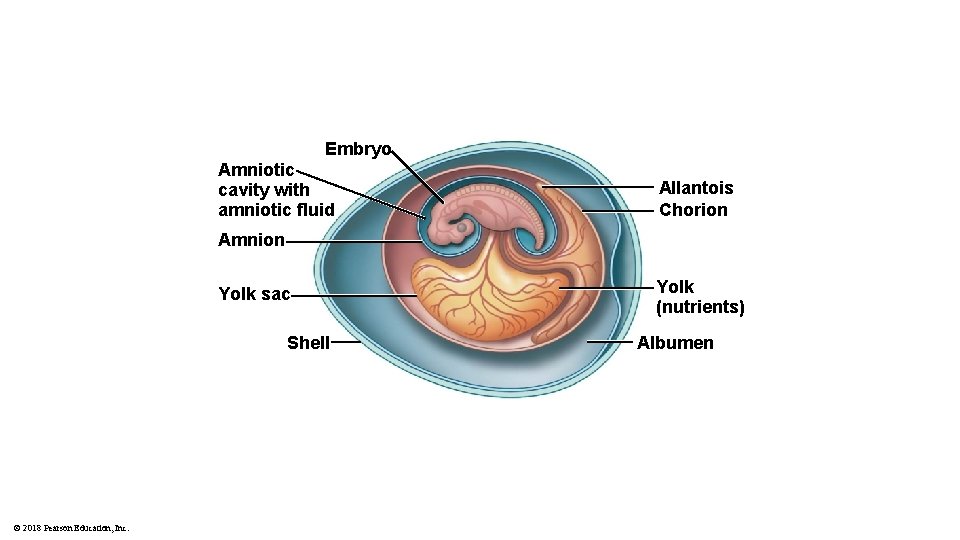
Embryo Amniotic cavity with amniotic fluid Allantois Chorion Amnion Yolk sac Shell © 2018 Pearson Education, Inc. Yolk (nutrients) Albumen
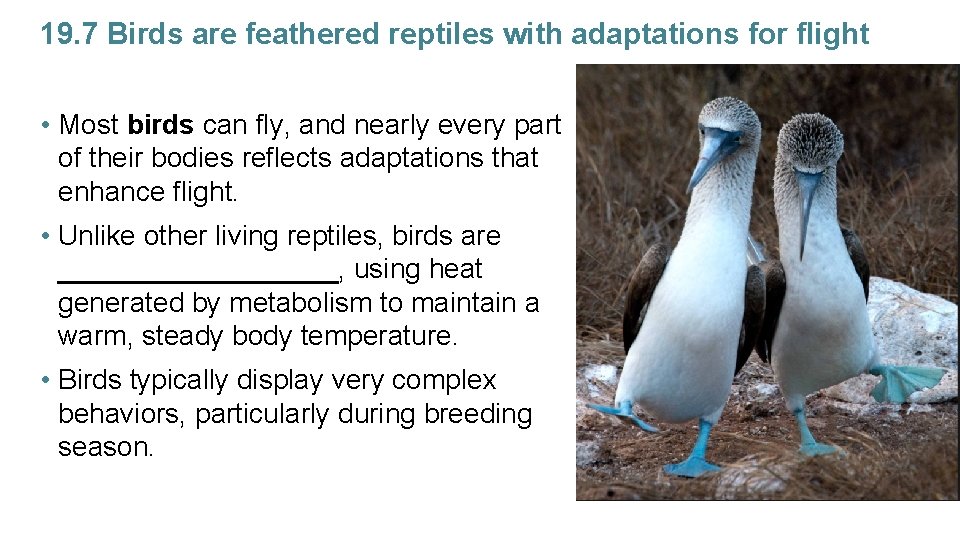
19. 7 Birds are feathered reptiles with adaptations for flight • Most birds can fly, and nearly every part of their bodies reflects adaptations that enhance flight. • Unlike other living reptiles, birds are _________, using heat generated by metabolism to maintain a warm, steady body temperature. • Birds typically display very complex behaviors, particularly during breeding season.
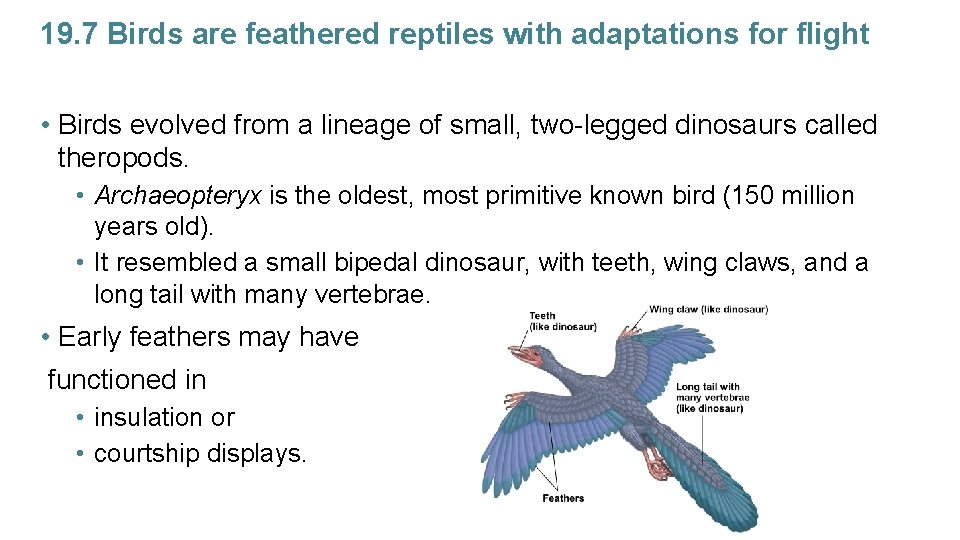
19. 7 Birds are feathered reptiles with adaptations for flight • Birds evolved from a lineage of small, two-legged dinosaurs called theropods. • Archaeopteryx is the oldest, most primitive known bird (150 million years old). • It resembled a small bipedal dinosaur, with teeth, wing claws, and a long tail with many vertebrae. • Early feathers may have functioned in • insulation or • courtship displays.
19. 8 Mammals are amniotes that have hair and produce milk • Mammals are endothermic amniotes with • hair, which insulates their bodies, and • mammary glands, which produce milk. • Mammals have efficient ______ and circulatory systems that support their high rate of metabolism. • Mammalian teeth are differentiated for many kinds of diets.
19. 8 Mammals are amniotes that have hair and produce milk • Monotremes are______- _____mammals. • All other mammals are born rather than hatched. • The embryos of marsupials and eutherians are nurtured by a placenta, in which______from the mother’s blood diffuse into the embryo’s blood. • ________ have a brief gestation and give birth to tiny, embryonic offspring that complete development while attached to the mother’s nipples. • Eutherians (placental mammals) bear fully developed live young.
19. 9 Many primate characters are adaptations to life in the trees • Primates had evolved as small arboreal mammals by 65 million years ago. • Primate characters include • • limber joints, grasping _____ and _______ with flexible digits, a short snout, and forward-pointing eyes that enhance __________.
19. 9 Many primate characters are adaptations to life in the trees • Most living primates are arboreal, and the primate body has a number of features that were shaped, through natural selection, by the demands of living in trees. • Although humans never lived in trees, the human body retains many of the traits that evolved in our arboreal ancestors. How do apes and monkeys differ physically?
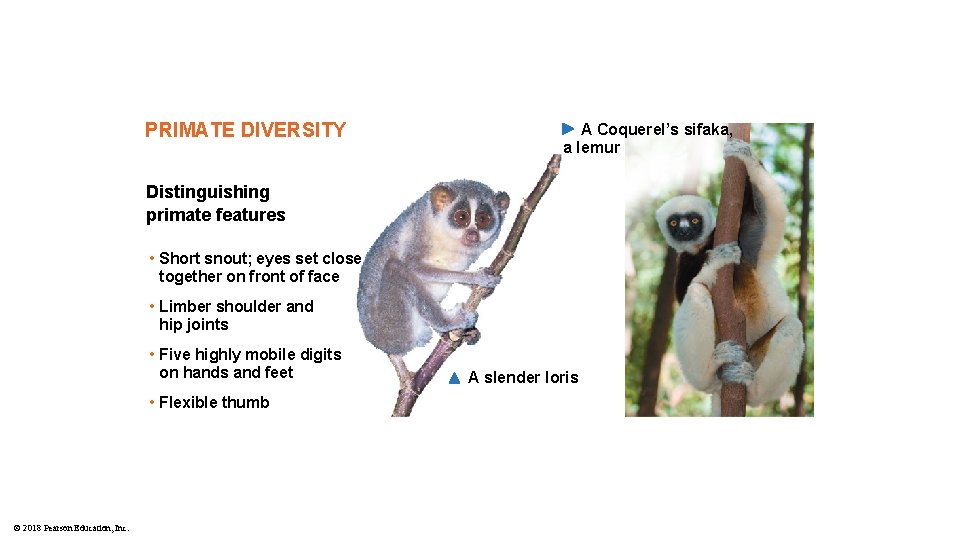
PRIMATE DIVERSITY A Coquerel’s sifaka, a lemur Distinguishing primate features • Short snout; eyes set close together on front of face • Limber shoulder and hip joints • Five highly mobile digits on hands and feet • Flexible thumb © 2018 Pearson Education, Inc. A slender loris
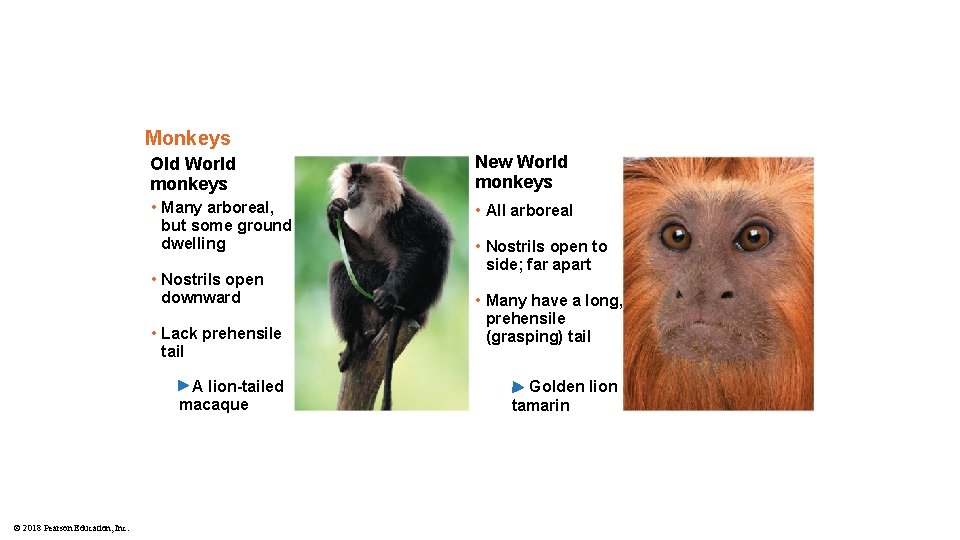
Monkeys Old World monkeys New World monkeys • Many arboreal, but some ground dwelling • All arboreal • Nostrils open downward • Lack prehensile tail A lion-tailed macaque © 2018 Pearson Education, Inc. • Nostrils open to side; far apart • Many have a long, prehensile (grasping) tail Golden lion tamarin
19. 10 The human story begins with our primate heritage • A phylogenetic tree shows that all primates are divided into three groups: 1. lemurs, lorises, and bush babies, 2. tarsiers, and 3. anthropoids, including monkeys and apes. • The fossil record indicates that anthropoids began diverging from other primates about 55 million years ago.
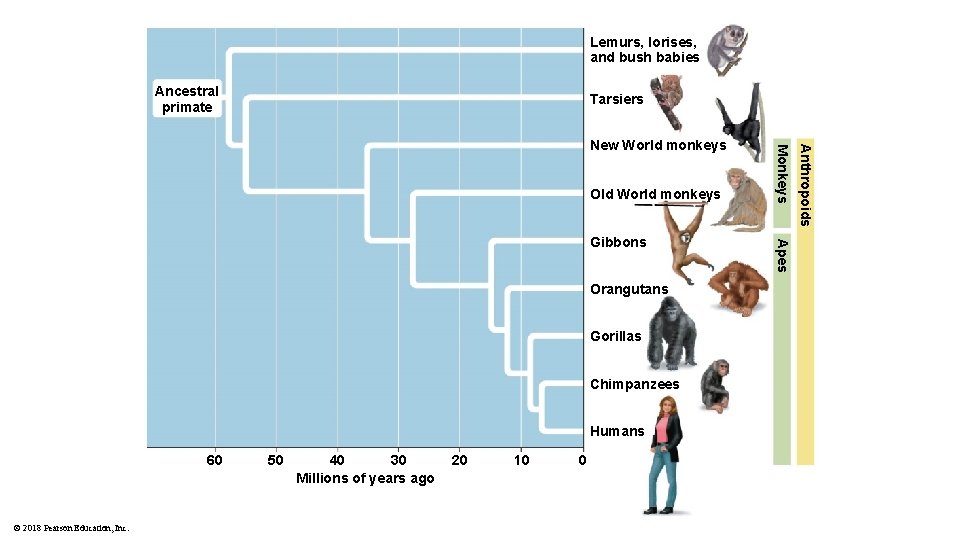
Lemurs, lorises, and bush babies Ancestral primate Tarsiers Orangutans Gorillas Chimpanzees Humans 60 © 2018 Pearson Education, Inc. 50 40 30 Millions of years ago 20 10 0 Apes Gibbons Anthropoids Old World monkeys Monkeys New World monkeys
19. 11 The hominin branch of the primate tree includes species that coexisted • Paleoanthropology, the study of human origins and evolution, focuses on the tiny slice of biological history that has occurred since the divergence of human and chimpanzee lineages from their common ancestor. • Paleoanthropologists have found about 20 species of extinct hominins, species more closely related to humans than to chimpanzees. • Some of these species lived at the same time.
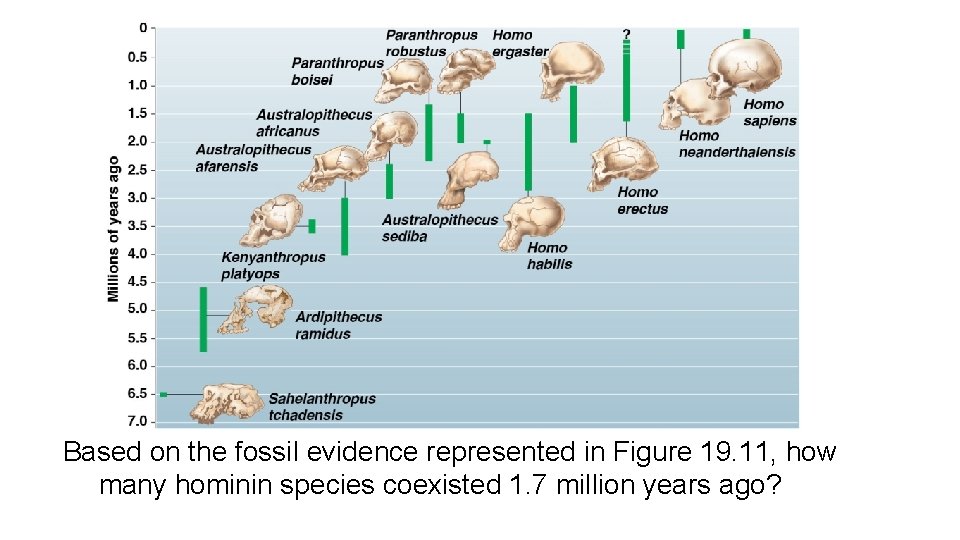
Based on the fossil evidence represented in Figure 19. 11, how many hominin species coexisted 1. 7 million years ago?
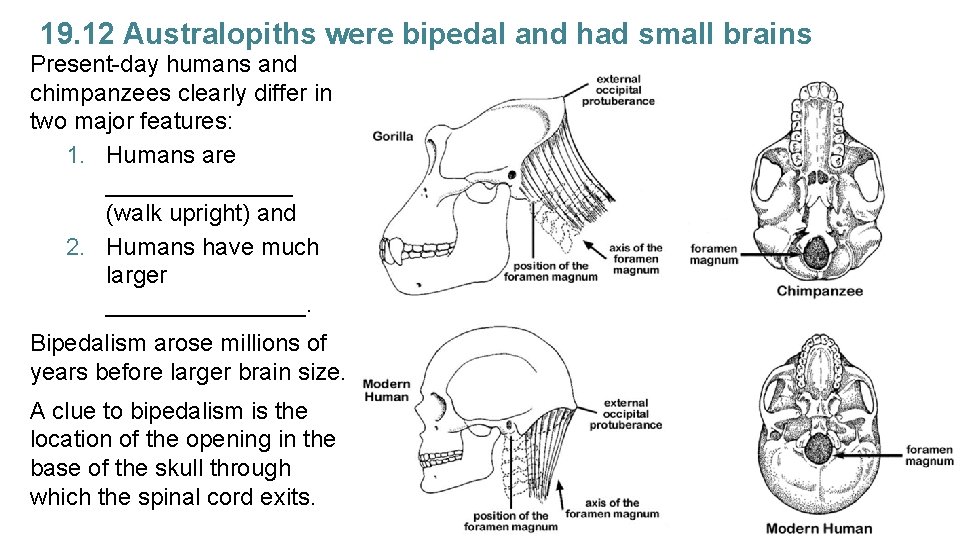
19. 12 Australopiths were bipedal and had small brains Present-day humans and chimpanzees clearly differ in two major features: 1. Humans are _______ (walk upright) and 2. Humans have much larger ________. Bipedalism arose millions of years before larger brain size. A clue to bipedalism is the location of the opening in the base of the skull through which the spinal cord exits.
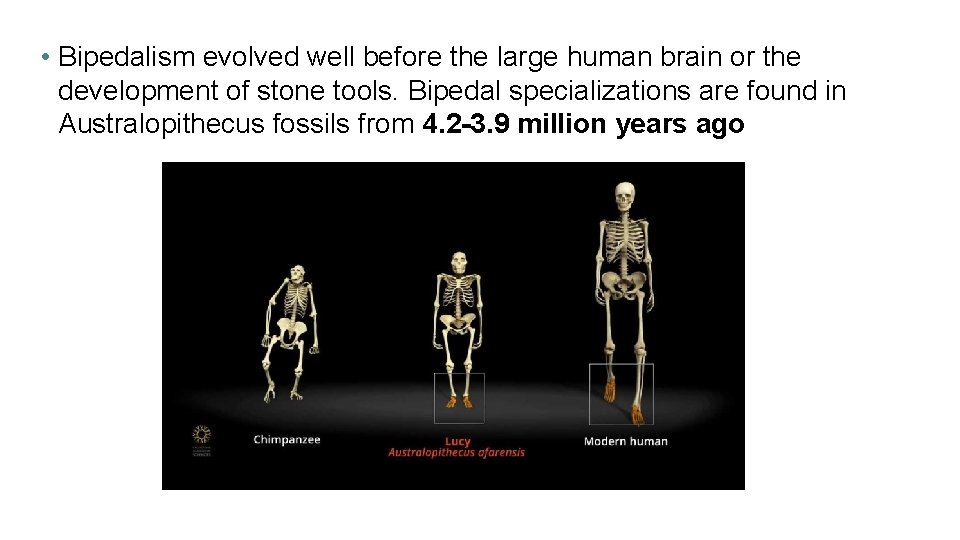
• Bipedalism evolved well before the large human brain or the development of stone tools. Bipedal specializations are found in Australopithecus fossils from 4. 2 -3. 9 million years ago
© 2018 Pearson Education, Inc.
19. 13 Larger brains mark the evolution of Homo • The genus Homo includes hominins with larger brains and evidence of tool use. • Homo ergaster had a larger brain than H. habilis. • H. erectus, with a larger brain than H. ergaster, was the first hominin to spread out of Africa.
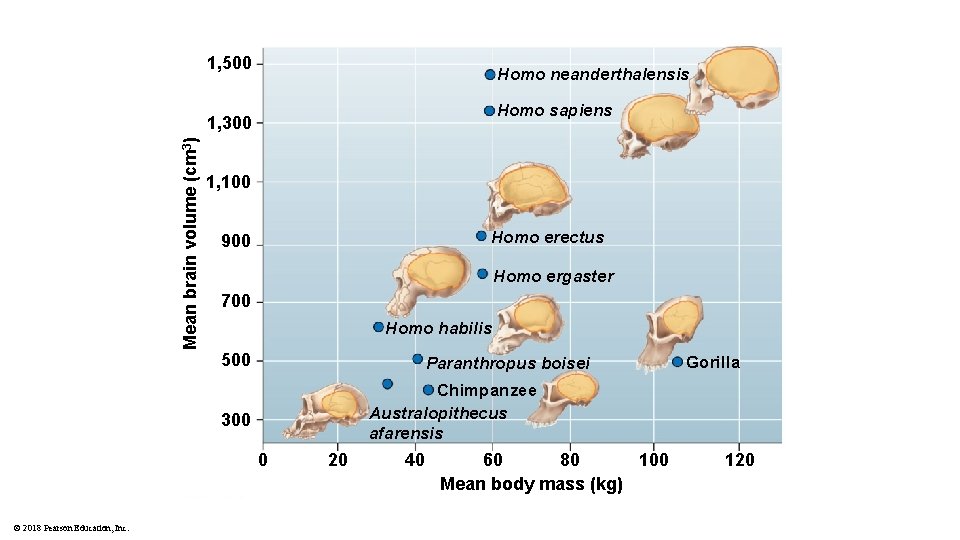
1, 500 Homo neanderthalensis Homo sapiens Mean brain volume (cm 3) 1, 300 1, 100 Homo erectus 900 Homo ergaster 700 Homo habilis 500 Paranthropus boisei Chimpanzee Australopithecus afarensis 300 0 © 2018 Pearson Education, Inc. Gorilla 20 40 60 80 100 Mean body mass (kg) 120
19. 13 Larger brains mark the evolution of Homo • Homo neanderthalensis (Neanderthals) had a brain even larger than ours and hunted big game with tools made from stone and wood. • Neanderthals were living in Europe as long as 350, 000 years ago and later spread to the Near East, but by 39, 000 years ago, the species was extinct. • Cro-magnon man was the earliest Homo sapien. (40, 000 to 10, 000 years ago.
You should now be able to 1. Describe the key derived traits of the chordates and the chordate subgroups. 2. Describe the characteristics of and distinguish between each of the following vertebrate groups: hagfishes, lampreys, chondrichthyans, ray-finned fishes, lobe-finned fishes, amphibians, reptiles, birds, and mammals. (perhaps making a comparison table would be helpful!) 3. Describe the transitional species that occupy the range between fishes and amphibians in evolutionary history.
You should now be able to 4. Distinguish between monotremes, marsupials, and placental mammals. 5. Compare three main groups of living primates. 6. Distinguish between monkeys and apes. 7. Describe the evidence that suggests that hominins did not evolve in a straight line leading directly to our species. 8. Describe the evidence that suggests when upright posture and large brains first evolved in humans.
- Slides: 35