
Vertebrate Animals What is a Vertebrate A vertebrate
Vertebrate Animals
What is a Vertebrate? A vertebrate is an animal having a backbone or spinal column. Vertebrate animals include – 1. Jawless Fish 2. Cartilagenous Fish 3. Bony Fish 4. Amphibians 5. Reptiles 6. Birds 7. Mammals

Characteristics found in all Vertebrates • All have an Endoskeleton – internal skeleton • All have a Distinct Skull • All have Bilateral Symmetry - divisible into symmetrical halves. • All have a Closed Circulatory System – blood contained in blood vessels • All have a Chambered heart
3 Ways Vertebrates Can Differ 1. Body Temperature 2. Reproductive Strategy 3. Body Covering
Different ways of maintaining Body Temperature – Ectotherm versus Endotherm • Ectotherm - an animal that is dependent on external sources of body heat; a cold-blooded animal. • Endotherm - an animal that is capable of the internal generation of heat; a warm-blooded animal.
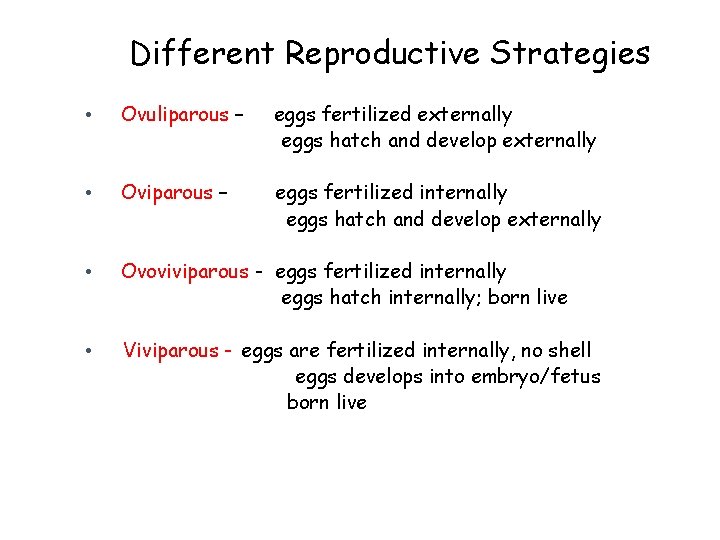
Different Reproductive Strategies • Ovuliparous – eggs fertilized externally eggs hatch and develop externally • Oviparous – eggs fertilized internally eggs hatch and develop externally • Ovoviviparous - eggs fertilized internally eggs hatch internally; born live • Viviparous - eggs are fertilized internally, no shell eggs develops into embryo/fetus born live
Different Body Coverings 1. 2. 3. 4. Moist Skin only Scales Feathers Hair
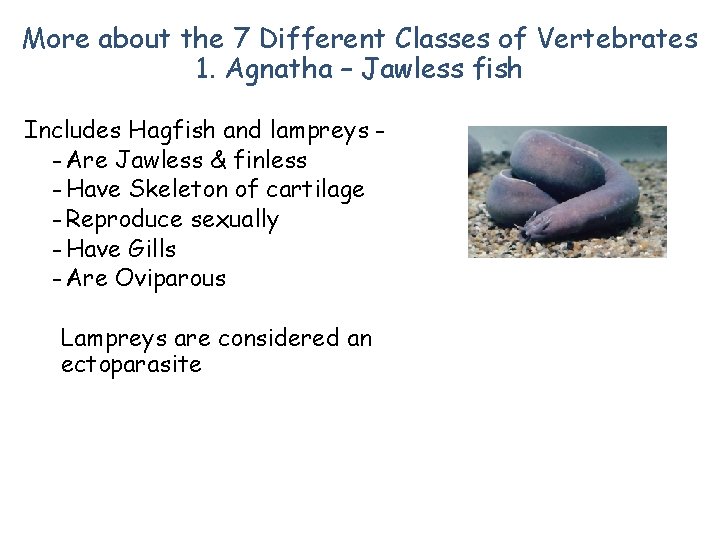
More about the 7 Different Classes of Vertebrates 1. Agnatha – Jawless fish Includes Hagfish and lampreys - Are Jawless & finless - Have Skeleton of cartilage - Reproduce sexually - Have Gills - Are Oviparous Lampreys are considered an ectoparasite
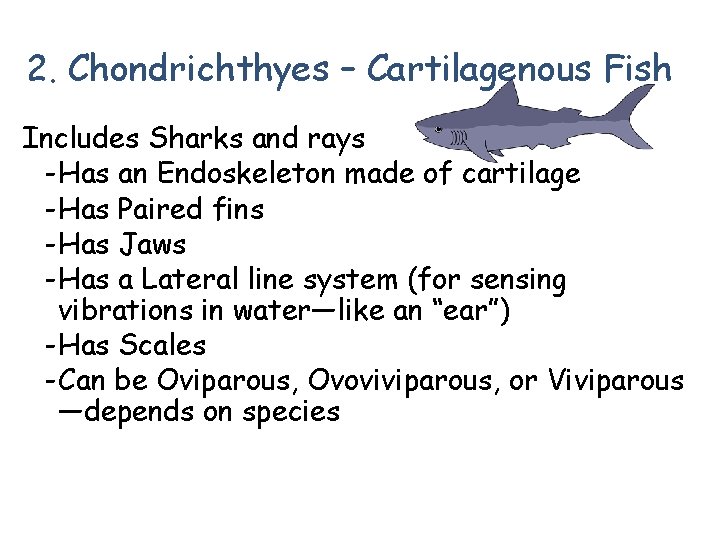
2. Chondrichthyes – Cartilagenous Fish Includes Sharks and rays - Has an Endoskeleton made of cartilage - Has Paired fins - Has Jaws - Has a Lateral line system (for sensing vibrations in water—like an “ear”) - Has Scales - Can be Oviparous, Ovoviviparous, or Viviparous —depends on species
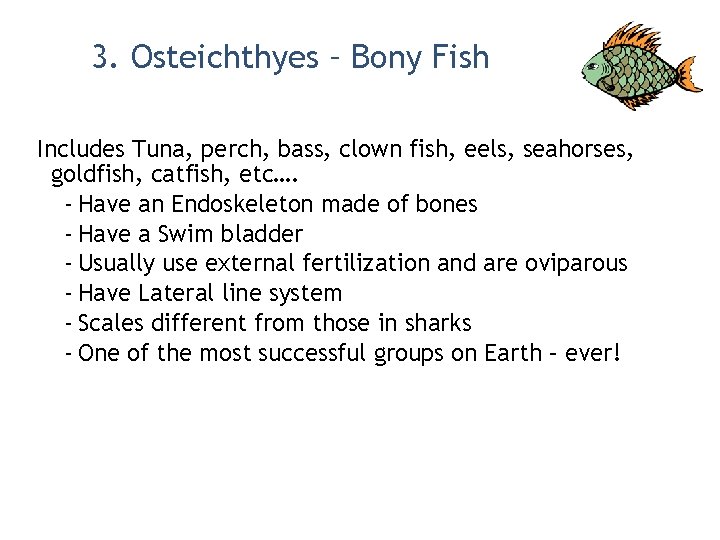
3. Osteichthyes – Bony Fish Includes Tuna, perch, bass, clown fish, eels, seahorses, goldfish, catfish, etc…. - Have an Endoskeleton made of bones - Have a Swim bladder - Usually use external fertilization and are oviparous - Have Lateral line system - Scales different from those in sharks - One of the most successful groups on Earth – ever!
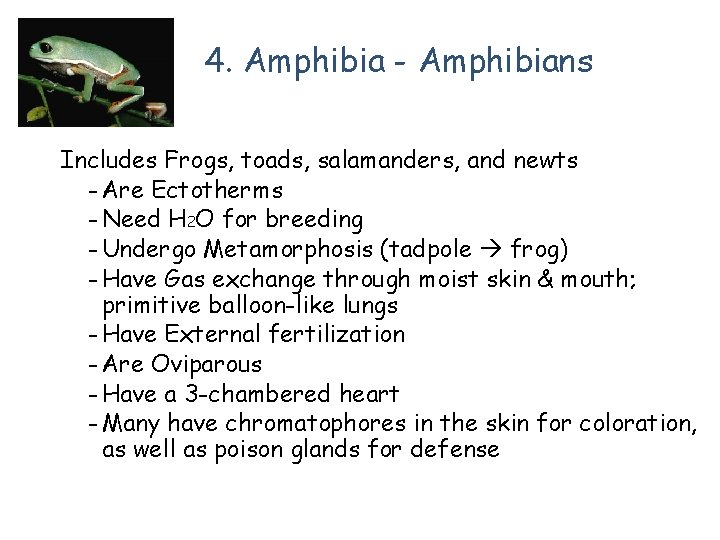
4. Amphibia - Amphibians Includes Frogs, toads, salamanders, and newts - Are Ectotherms - Need H 2 O for breeding - Undergo Metamorphosis (tadpole frog) - Have Gas exchange through moist skin & mouth; primitive balloon-like lungs - Have External fertilization - Are Oviparous - Have a 3 -chambered heart - Many have chromatophores in the skin for coloration, as well as poison glands for defense
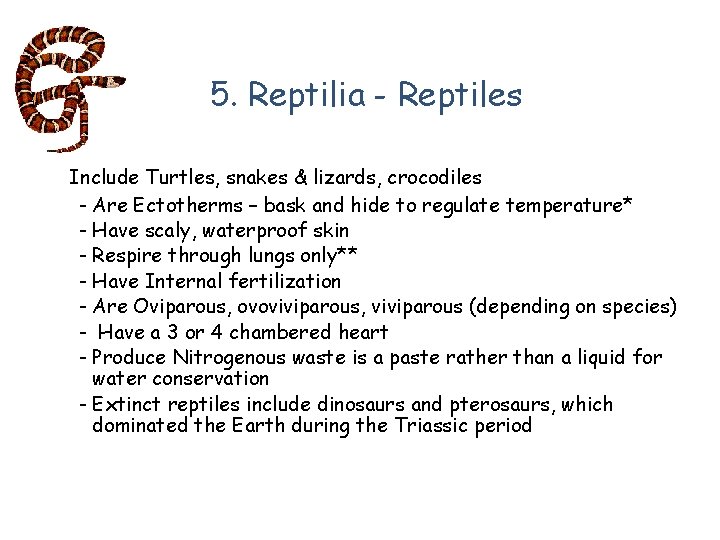
5. Reptilia - Reptiles Include Turtles, snakes & lizards, crocodiles - Are Ectotherms – bask and hide to regulate temperature* - Have scaly, waterproof skin - Respire through lungs only** - Have Internal fertilization - Are Oviparous, ovoviviparous, viviparous (depending on species) - Have a 3 or 4 chambered heart - Produce Nitrogenous waste is a paste rather than a liquid for water conservation - Extinct reptiles include dinosaurs and pterosaurs, which dominated the Earth during the Triassic period
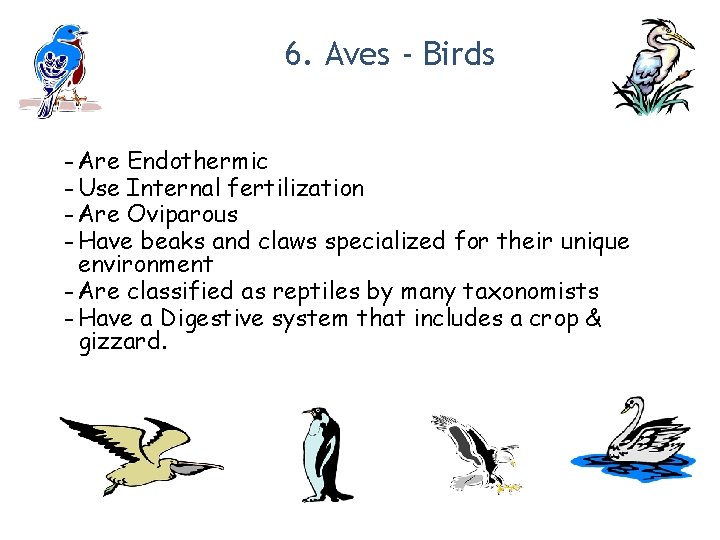
6. Aves - Birds - Are Endothermic - Use Internal fertilization - Are Oviparous - Have beaks and claws specialized for their unique environment - Are classified as reptiles by many taxonomists - Have a Digestive system that includes a crop & gizzard.
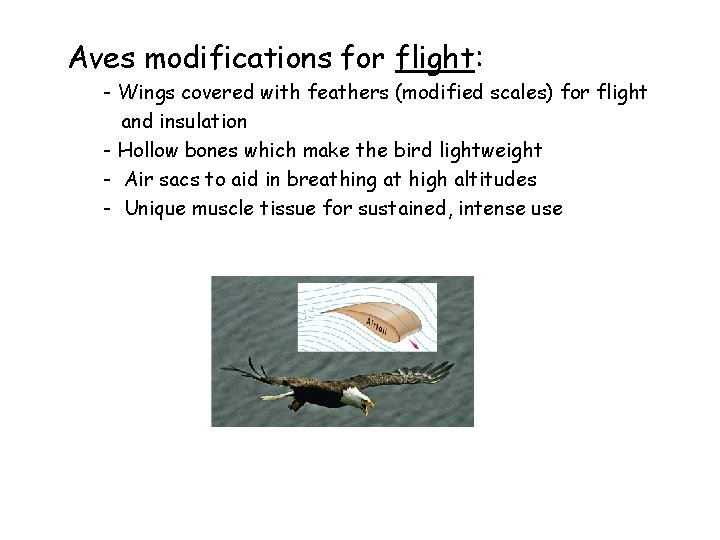
Aves modifications for flight: - Wings covered with feathers (modified scales) for flight and insulation - Hollow bones which make the bird lightweight - Air sacs to aid in breathing at high altitudes - Unique muscle tissue for sustained, intense use
7. Mammalia - Mammals Includes Humans, bears, pigs, horses, dogs, cats, whales, elephants, mice, koalas, and platypus • Are Endothermic – hair and layer of fat aid in conserving heat • Have Hair that aids in insulation • Have Mammary glands that produce milk to feed offspring • Use Internal fertilization • Use one of 3 types of development – Monotremes – young develop in eggs laid by mother Marsupials – young develop in an outside pouch Placental – young develop internally in uterus
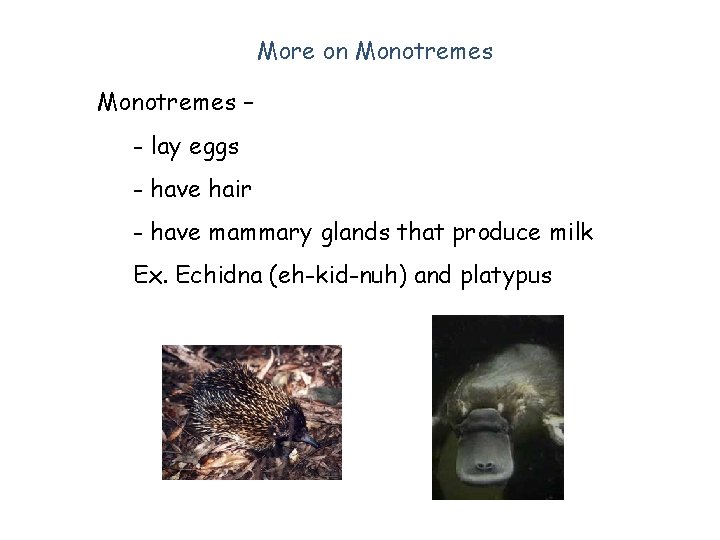
More on Monotremes – - lay eggs - have hair - have mammary glands that produce milk Ex. Echidna (eh-kid-nuh) and platypus
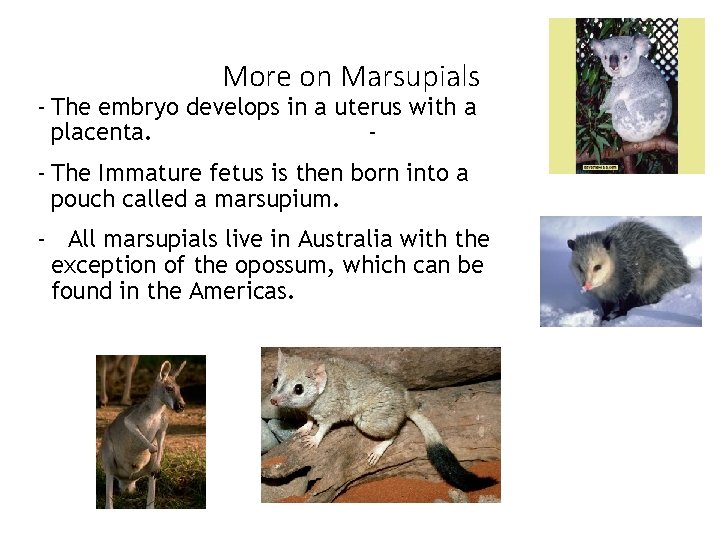
More on Marsupials - The embryo develops in a uterus with a placenta. - The Immature fetus is then born into a pouch called a marsupium. - All marsupials live in Australia with the exception of the opossum, which can be found in the Americas.
More on Placentals - Placental mammals develop in a uterus attached to a placenta until at a comparably advanced stage of development - Placentals are found in every major biome, including marine, arctic, and tundra. 10 orders of placental mammals are discussed on the following page.
Different types (orders) of Placental Mammals Rodentia- have razor sharp teeth (rats, squirrels) Lagomorpha- have fused hind leg bones (rabbits) Chiroptera- includes flying mammals (bats) Carnivora- eat meat (lions, tigers, wolves) Cetacea- have blow holes to breathe (dolphins, whales) Insectivora- eat insects (moles, shrews, hedgehog) Artiodactyla- have even # of toes (cows, sheep, goat, pigs, hippos, camels) Perissodactyla- Have odd # of toes (horse, zebra, rhino) Proboscidea- have trunks (elephants) Primates- have opposable thumbs (apes, monkeys, humans)
- Slides: 19