
Vertebral shape automatic measurement by DXA using overlapping
Vertebral shape: automatic measurement by DXA using overlapping statistical models of appearance Martin Roberts and Tim Cootes and Judith Adams martin. roberts@man. ac. uk Imaging Science and Biomedical Engineering, University of Manchester, UK
Contents l l l l Osteoporosis - Background DXA vs Conventional Radiography Fracture Classification Our aims in automating vertebral DXA Automatic Location Method Results for Vertebral Morphometry Accuracy Conclusions
Osteoporosis l Disease characterised by: – Low bone mass or – deterioration in trabecular structure Common Disease – affects up to 40% of postmenopausal women l Causes fractures of hip, vertebrae, wrist l Vertebral Fractures l – Most common osteoporotic fracture – Occur in younger patients – So provide early diagnosis
Osteoporosis – Vertebral Fractures l A vertebral fracture indicates increased risk of future fractures: – the risk of a future hip fracture is doubled (or even tripled) – the risk of any subsequent vertebral fracture increases five-fold A very important diagnosis for radiologists to make l Incident vertebral fractures used in clinical trials l – To assess the efficacy of osteoporosis therapies

Advantages of DXA Very Low Radiation Dose – 1/100 of spinal radiographs l Little or no projective effects: l – “Bean Can” effects unusual – Constant scaling across the image Whole spine on single image l C-arms offer ease of patient positioning l Convenient as supplement to BMD scan l

Example DXA image lateral view of spine Disadvantages Very low dose but noisy Poorer resolution than radiography (0. 35 mm vs 0. 1 mm) Above T 7 shoulder-blades can cause poor imaging of T 6 -T 4
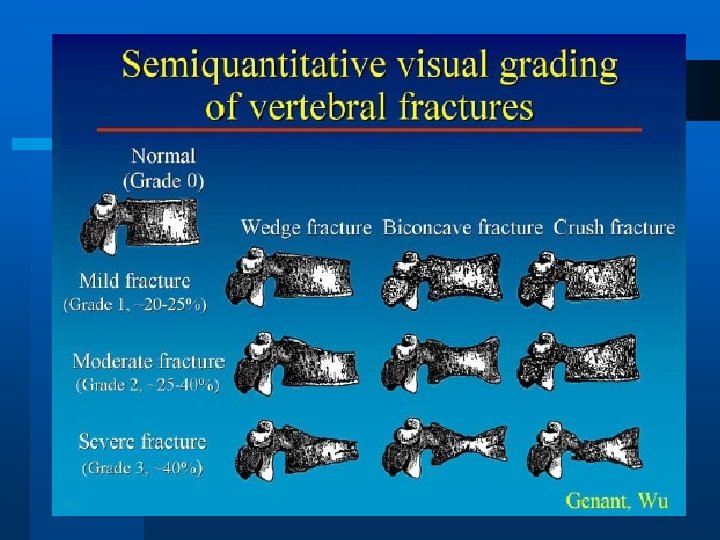
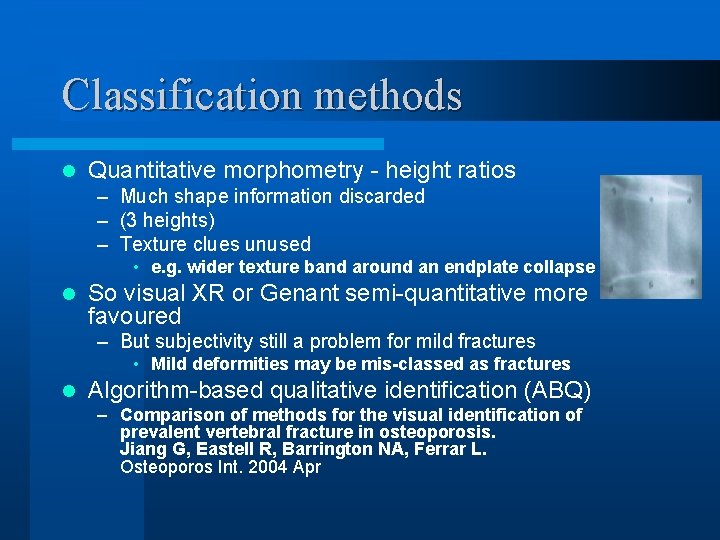
Classification methods l Quantitative morphometry - height ratios – Much shape information discarded – (3 heights) – Texture clues unused • e. g. wider texture band around an endplate collapse l So visual XR or Genant semi-quantitative more favoured – But subjectivity still a problem for mild fractures • Mild deformities may be mis-classed as fractures l Algorithm-based qualitative identification (ABQ) – Comparison of methods for the visual identification of prevalent vertebral fracture in osteoporosis. Jiang G, Eastell R, Barrington NA, Ferrar L. Osteoporos Int. 2004 Apr
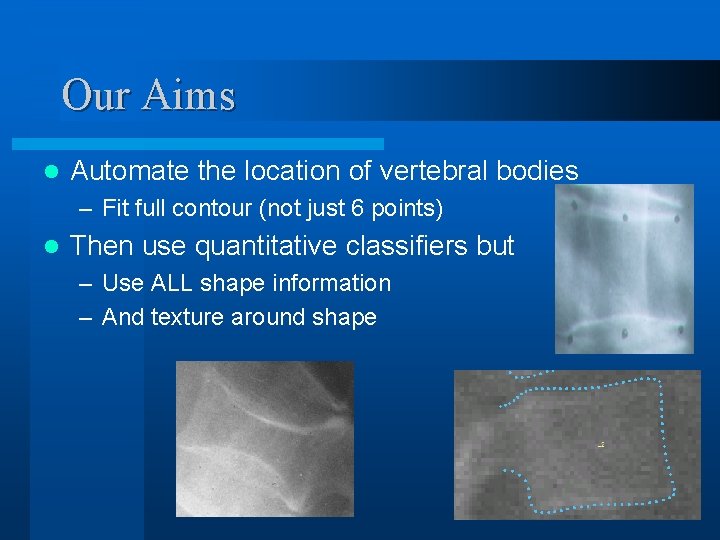
Our Aims l Automate the location of vertebral bodies – Fit full contour (not just 6 points) l Then use quantitative classifiers but – Use ALL shape information – And texture around shape
Automatic Location l User clicks on bottom, top and middle vertebrae – Start at mean shape through these 3 points l Fit a sequence of linked appearance models – Overlapping triplets • E. g (L 4/L 3/L 2), and (L 3/L 2/L 1) etc • Overlaps give helpful linking constraints l Sequence Order is dynamically adjusted based on local quality of fit – High noise or poor fit regions deferred
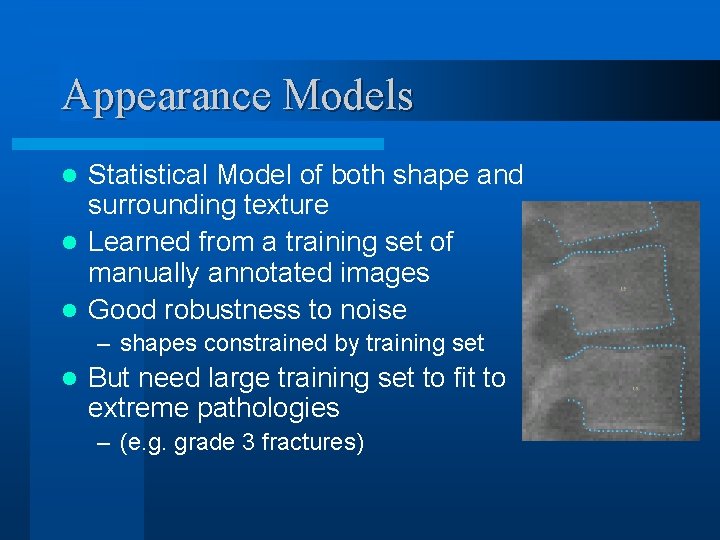
Appearance Models Statistical Model of both shape and surrounding texture l Learned from a training set of manually annotated images l Good robustness to noise l – shapes constrained by training set l But need large training set to fit to extreme pathologies – (e. g. grade 3 fractures)
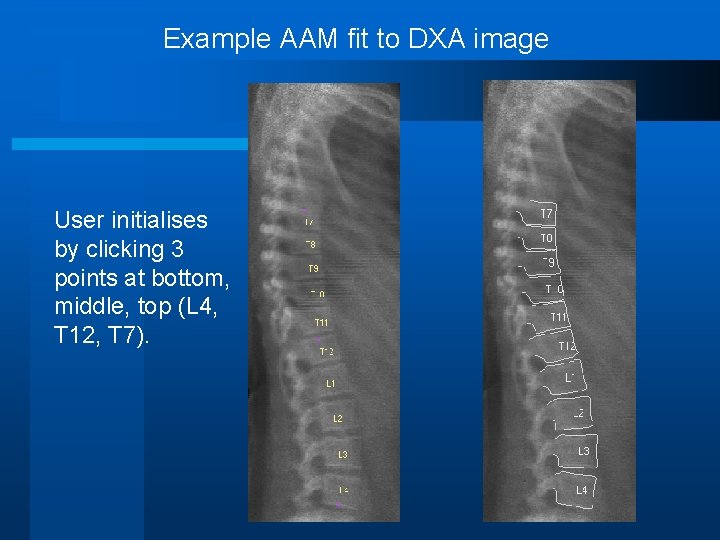
Example AAM fit to DXA image User initialises by clicking 3 points at bottom, middle, top (L 4, T 12, T 7).
Dataset l 184 DXA images l 80 images contain fractures – 137 vertebral fractures l Also a bias towards obese patients – So often high noise in lumbar l Some other pathologies present – Disk disease, large osteophytes l So challenging dataset
Experiments l Repeated Miss-4 -out tests – 180 image Training Set and 4 Test Set partition – 10 replications with emulated user-supplied initialisation (Gaussian errors) l Manual annotations as Gold Standard – Mean Abs Point-to-Curve Error per vertebra l Percentage number of points within 2 mm also calculated
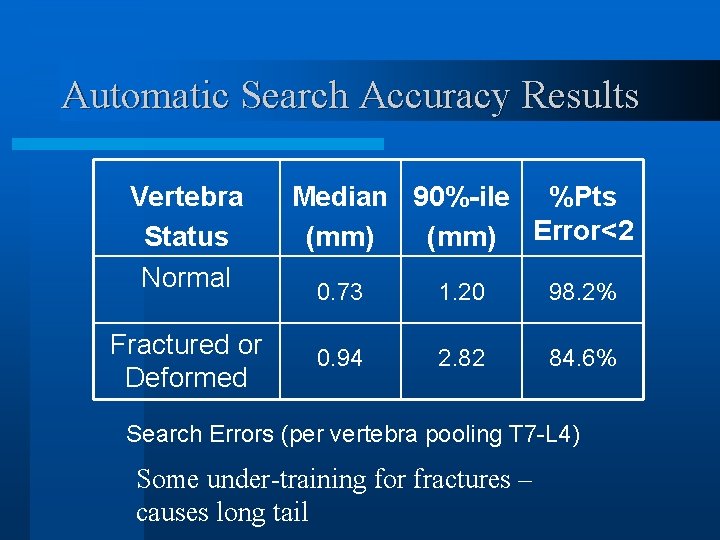
Automatic Search Accuracy Results Vertebra Status Normal Fractured or Deformed Median 90%-ile %Pts (mm) Error<2 0. 73 1. 20 98. 2% 0. 94 2. 82 84. 6% Search Errors (per vertebra pooling T 7 -L 4) Some under-training for fractures – causes long tail
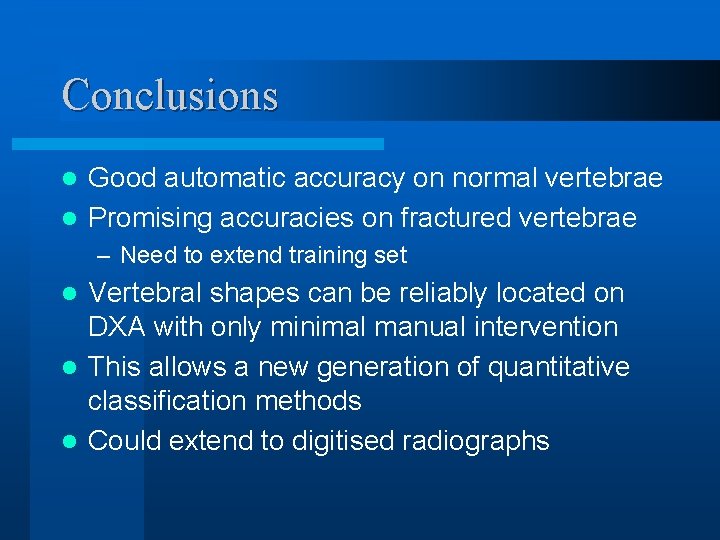
Conclusions Good automatic accuracy on normal vertebrae l Promising accuracies on fractured vertebrae l – Need to extend training set Vertebral shapes can be reliably located on DXA with only minimal manual intervention l This allows a new generation of quantitative classification methods l Could extend to digitised radiographs l

Acknowledgements l Acknowledge assistance of: – Bone Metabolism Group, University of Sheffield R Eastell, L Ferrar, G Jiang

For more… FOR MORE INFO. . . www. isbe. man. ac. uk martin. roberts@man. ac. uk
- Slides: 18