
Vertebral Column Muscles of The Back Revision Anatomy
Vertebral Column & Muscles of The Back "Revision" Anatomy Team 434 Color Index: ▪ ▪ ▪ Important Points Helping notes Explanation If you have any complaint or suggestion please don’t hesitate to contact us on: Anatomy. Team 434@gmail. com
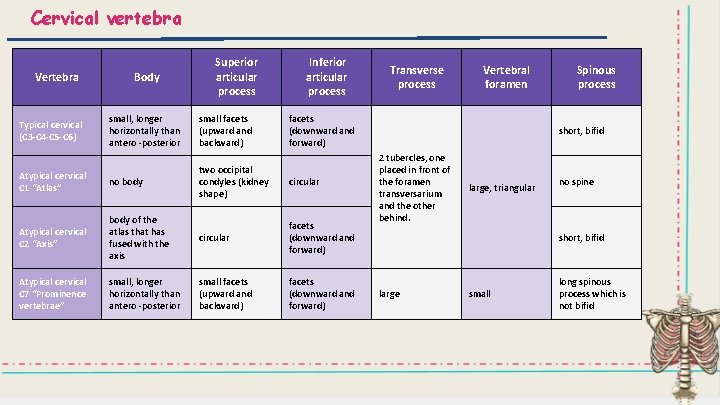
Cervical vertebra Vertebra Body Superior articular process Inferior articular process small, longer horizontally than antero -posterior small facets (upward and backward) Atypical cervical C 1 “Atlas” no body two occipital condyles (kidney shape) circular Atypical cervical C 2 “Axis” body of the atlas that has fused with the axis circular facets (downward and forward) Atypical cervical C 7 “Prominence vertebrae” small, longer horizontally than antero -posterior small facets (upward and backward) facets (downward and forward) Typical cervical (C 3 -C 4 -C 5 -C 6) Transverse process Vertebral foramen facets (downward and forward) Spinous process short, bifid 2 tubercles, one placed in front of the foramen transversarium and the other behind. large, triangular no spine short, bifid large small long spinous process which is not bifid
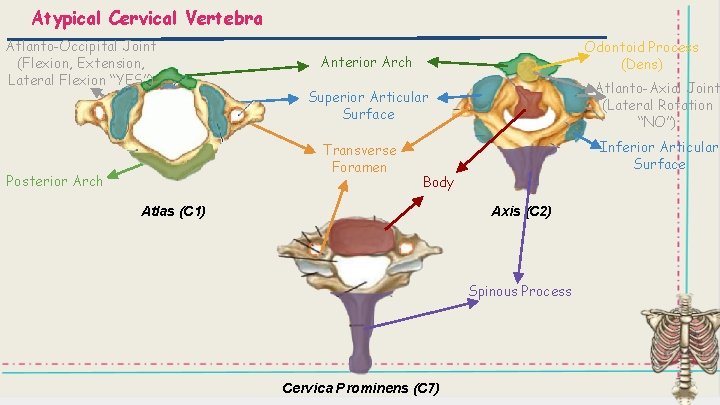
Atypical Cervical Vertebra Atlanto-Occipital Joint (Flexion, Extension, Lateral Flexion “YES”) Anterior Arch Atlanto-Axial Joint (Lateral Rotation “NO”) Superior Articular Surface Transverse Foramen Posterior Arch Odontoid Process (Dens) Inferior Articular Surface Body Atlas (C 1) Axis (C 2) Spinous Process Cervica Prominens (C 7)

Typical Cervical Vertebra Spinous Process (short bifid) Vertebral Foramen Superior Articular Facet Transverse Foramen Transverse Process (C 3, 4, 5, 6) Body

Thoracic vertebra Costal Facets (Transverse Process) (articulate with tubercles of ribs) “EXCEPT T 11, T 12” Spinous Process (long, downward) Superior Articular Processes (backward, laterally) Vertebral Foramen (small, circular) Costal Facets (Sides of Body) (articulate with head of ribs) Inferior Articular Processes (forward, medially) “T 12 laterally like Lumbar” Body (medium, heart)
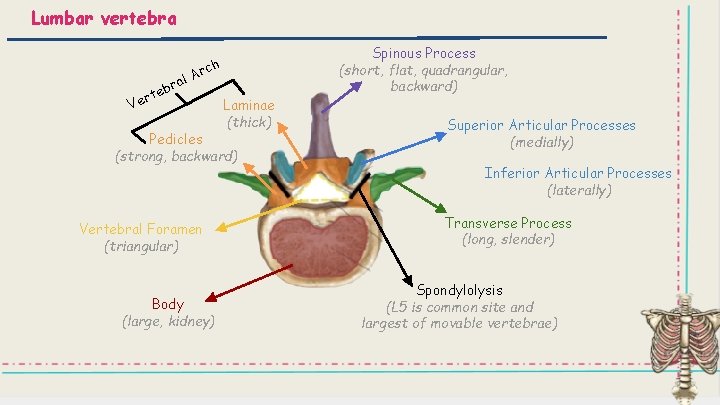
Lumbar vertebra rch al A r b rte Ve Laminae (thick) Pedicles (strong, backward) Vertebral Foramen (triangular) Body (large, kidney) Spinous Process (short, flat, quadrangular, backward) Superior Articular Processes (medially) Inferior Articular Processes (laterally) Transverse Process (long, slender) Spondylolysis (L 5 is common site and largest of movable vertebrae)
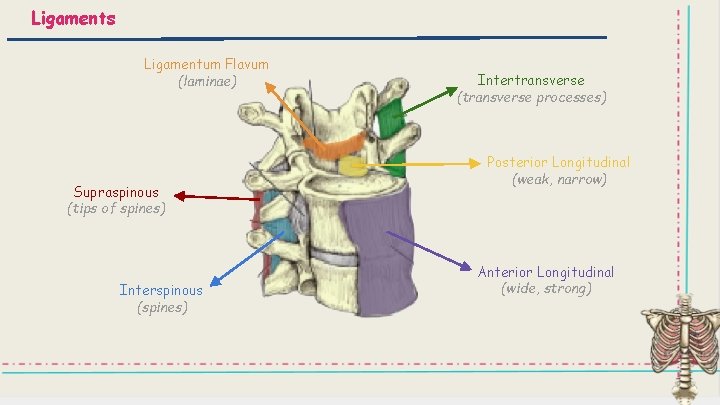
Ligaments Ligamentum Flavum (laminae) Supraspinous (tips of spines) Interspinous (spines) Intertransverse (transverse processes) Posterior Longitudinal (weak, narrow) Anterior Longitudinal (wide, strong)
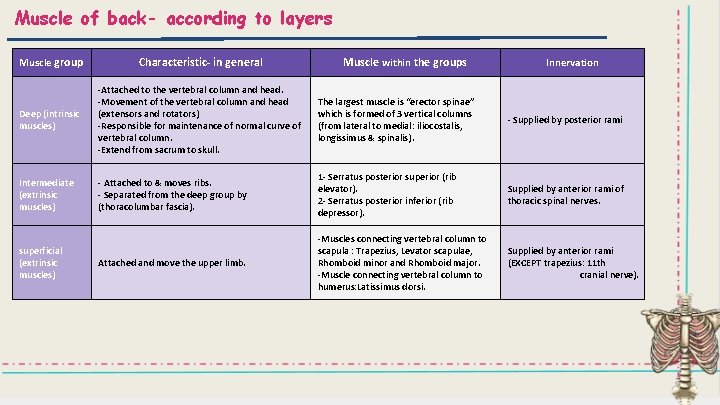
Muscle of back- according to layers Muscle group Characteristic- in general Deep (intrinsic muscles) -Attached to the vertebral column and head. -Movement of the vertebral column and head (extensors and rotators) -Responsible for maintenance of normal curve of vertebral column. -Extend from sacrum to skull. The largest muscle is “erector spinae” which is formed of 3 vertical columns (from lateral to medial: iliocostalis, longissimus & spinalis). - Supplied by posterior rami Intermediate (extrinsic muscles) - Attached to & moves ribs. - Separated from the deep group by (thoracolumbar fascia). 1 - Serratus posterior superior (rib elevator). 2 - Serratus posterior inferior (rib depressor). Supplied by anterior rami of thoracic spinal nerves. Attached and move the upper limb. -Muscles connecting vertebral column to scapula : Trapezius, Levator scapulae, Rhomboid minor and Rhomboid major. -Muscle connecting vertebral column to humerus: Latissimus dorsi. Supplied by anterior rami (EXCEPT trapezius: 11 th cranial nerve). superficial (extrinsic muscles) Muscle within the groups Innervation
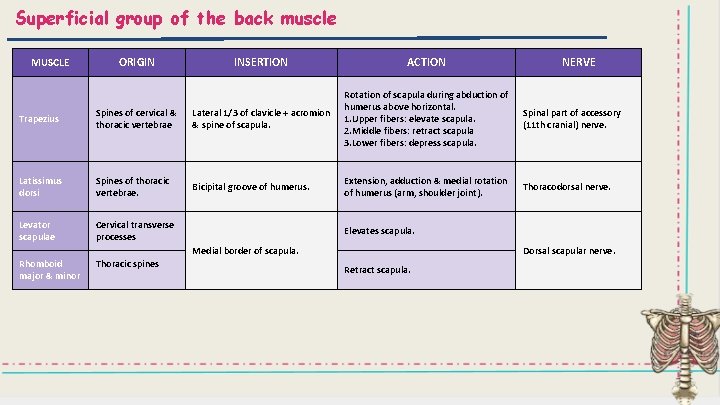
Superficial group of the back muscle MUSCLE ORIGIN INSERTION ACTION Spinal part of accessory (11 th cranial) nerve. Thoracodorsal nerve. Trapezius Spines of cervical & thoracic vertebrae Lateral 1/3 of clavicle + acromion & spine of scapula. Rotation of scapula during abduction of humerus above horizontal. 1. Upper fibers: elevate scapula. 2. Middle fibers: retract scapula 3. Lower fibers: depress scapula. Latissimus dorsi Spines of thoracic vertebrae. Bicipital groove of humerus. Extension, adduction & medial rotation of humerus (arm, shoulder joint). Levator scapulae Cervical transverse processes Rhomboid major & minor Thoracic spines NERVE Elevates scapula. Medial border of scapula. Dorsal scapular nerve. Retract scapula.
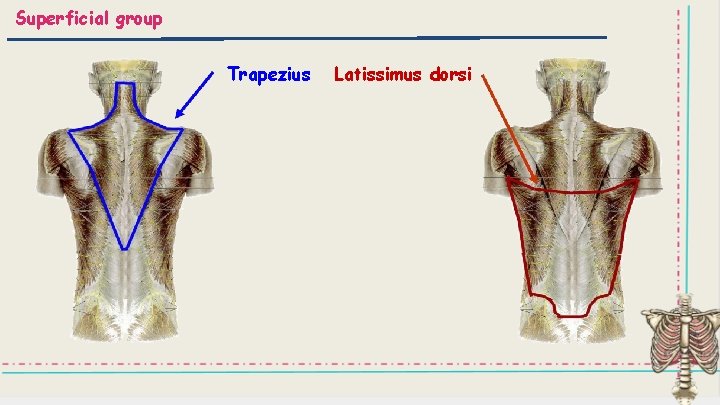
Superficial group Trapezius Latissimus dorsi
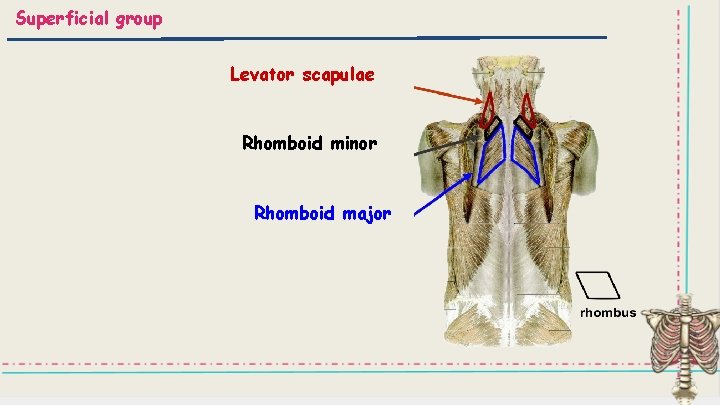
Superficial group Levator scapulae Rhomboid minor Rhomboid major
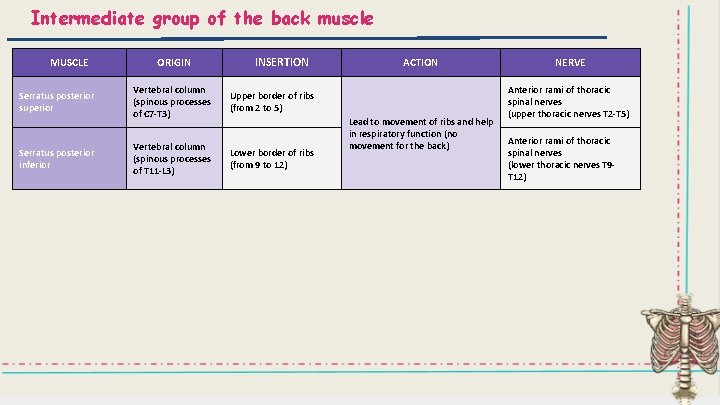
Intermediate group of the back muscle MUSCLE Serratus posterior superior Serratus posterior inferior ORIGIN INSERTION Vertebral column (spinous processes of C 7 -T 3) Upper border of ribs (from 2 to 5) Vertebral column (spinous processes of T 11 -L 3) Lower border of ribs (from 9 to 12) ACTION Lead to movement of ribs and help in respiratory function (no movement for the back) NERVE Anterior rami of thoracic spinal nerves (upper thoracic nerves T 2 -T 5) Anterior rami of thoracic spinal nerves (lower thoracic nerves T 9 T 12)
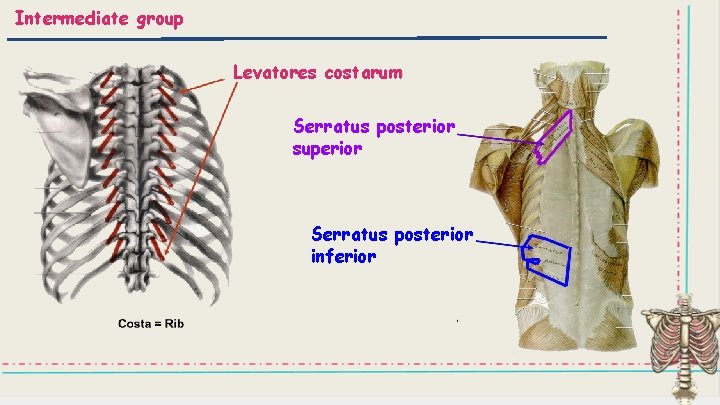
Intermediate group Levatores costarum Serratus posterior superior Serratus posterior inferior
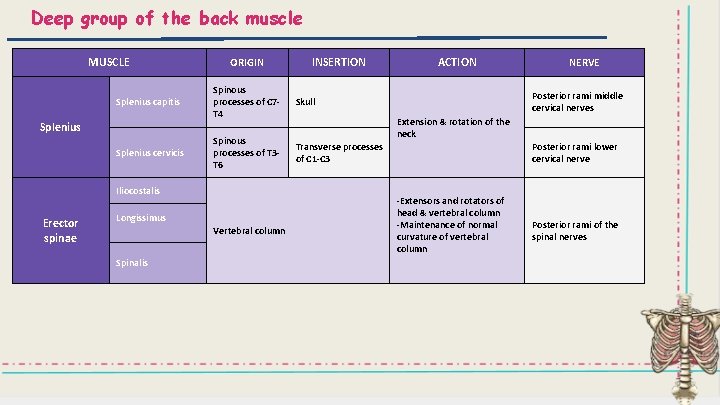
Deep group of the back muscle MUSCLE Splenius capitis Splenius cervicis ORIGIN Spinous processes of C 7 T 4 Skull Spinous processes of T 3 T 6 Transverse processes of C 1 -C 3 Iliocostalis Erector spinae Longissimus Vertebral column Spinalis INSERTION ACTION NERVE Posterior rami middle cervical nerves Extension & rotation of the neck Posterior rami lower cervical nerve -Extensors and rotators of head & vertebral column -Maintenance of normal curvature of vertebral column Posterior rami of the spinal nerves

Deep muscle group Transversospinalis
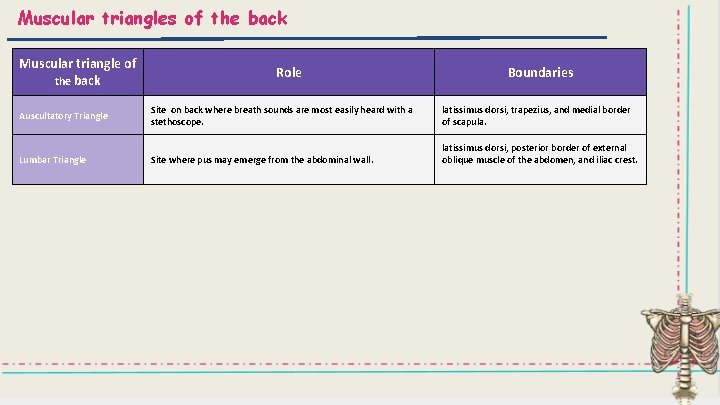
Muscular triangles of the back Muscular triangle of the back Role Boundaries Auscultatory Triangle Site on back where breath sounds are most easily heard with a stethoscope. latissimus dorsi, trapezius, and medial border of scapula. Lumbar Triangle Site where pus may emerge from the abdominal wall. latissimus dorsi, posterior border of external oblique muscle of the abdomen, and iliac crest.
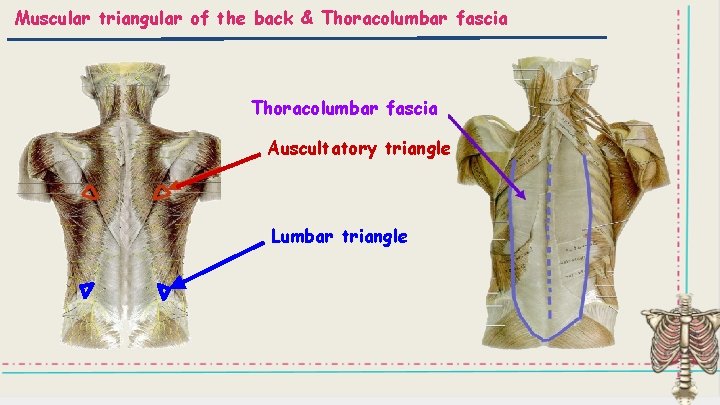
Muscular triangular of the back & Thoracolumbar fascia Auscultatory triangle Lumbar triangle

Done by: Noha Al. Gwaiz & Tariq Al. Hassan
- Slides: 18