
Version 820 Kesler Science LLC Your Answers 1




- Slides: 20
Version 8/20 © Kesler Science, LLC
Your Answers: 1. Answer here Watch It! Go to this link and watch the video: https: //www. britannica. com/video/166994/discussion-someevidence-Earth-continental-drift 2. Answer here Brittanica: “Uncover Alfred Wegner's theory of continental drift through biological and geological evidence and theory of plate tectonics” Then answer these questions: 3. Answer here 1. What two continents fit together like puzzle pieces? 2. What did Alfred Wegener call the singular supercontinent he proposed existed? 3. What pieces of evidence did Wegener use to support his theory? Is your work saved? Go Back to Lab Room INPUT STATION © Kesler Science, LLC
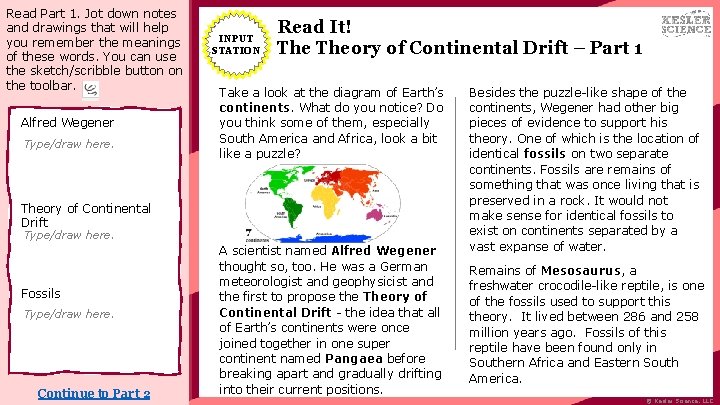
Read Part 1. Jot down notes and drawings that will help you remember the meanings of these words. You can use the sketch/scribble button on the toolbar. Alfred Wegener Type/draw here. INPUT STATION Read It! Theory of Continental Drift – Part 1 Take a look at the diagram of Earth’s continents. What do you notice? Do you think some of them, especially South America and Africa, look a bit like a puzzle? Theory of Continental Drift Type/draw here. Fossils Type/draw here. Continue to Part 2 A scientist named Alfred Wegener thought so, too. He was a German meteorologist and geophysicist and the first to propose the Theory of Continental Drift - the idea that all of Earth’s continents were once joined together in one super continent named Pangaea before breaking apart and gradually drifting into their current positions. Besides the puzzle-like shape of the continents, Wegener had other big pieces of evidence to support his theory. One of which is the location of identical fossils on two separate continents. Fossils are remains of something that was once living that is preserved in a rock. It would not make sense for identical fossils to exist on continents separated by a vast expanse of water. Remains of Mesosaurus, a freshwater crocodile-like reptile, is one of the fossils used to support this theory. It lived between 286 and 258 million years ago. Fossils of this reptile have been found only in Southern Africa and Eastern South America. © Kesler Science, LLC
Read Part 2. Jot down notes and drawings that will help you remember the meanings of these words. You can use the sketch/scribble button on the toolbar. Continent Type/draw here. Pangea Type/draw here. Continue to Questions INPUT STATION Read It! Theory of Continental Drift – Part 2 It would have been impossible for Mesosaurus to swim the distance between these two continents, so this fossil find suggests that South America and Africa were connected during its lifetime. Lystrosaurus, which means “shovel reptile, ” was a land animal that lived about 250 million years ago. This animal is thought to have been a plant eater. It grew to about one meter in length and had with a stocky build like a pig. Fossils of Lystrosaurus were found in Antarctica, India, and South Africa. This is more evidence to support the claim that these land masses were once linked. Glossopteris was a woody shrub or tree. It was named after “tongue” because of the shape of the leaves. Some of these plants reached 30 meters tall! This plant lived about 299 million years ago. Fossils were found in Australia, South Africa, South America, India, and Antarctica. When the continents are reassembled into a single landmass, it is easy to see how these fossil patterns support the Theory of Continental Drift. © Kesler Science, LLC
Your Answers: 1. Answer here 2. Answer here 3. Answer here INPUT STATION Read It! Theory of Continental Drift – Questions 1. What would be the best title for this passage? A. How Continental Drift Works B. Fossil Evidence in Support of Continental Drift C. Where Did the Mesosaurus Live? D. Who Was Alfred Wegener? 2. Which of the following statements is best supported by the details in the article? A. The continents were once joined into a Is your work saved? Go Back to Lab Room supercontinent that broke apart very quickly. B. Alfred Wegener was a scientist who sought to disprove the Theory of Continental Drift. C. Theory of Continental Drift is proven by the location of fossils found, but not the shape of the continents. D. Theory of Continental Drift is supported by both the shape of the continents and the pattern of fossils found. 3. Where do you think Mesosaurus lived when the continents were still joined? Near the junction of… A. North America & South America B. South America & Africa C. Africa & Asia D. Antarctica & Australia © Kesler Science, LLC
Take the blank puzzle pieces and try to put them together in 3 minutes. Explore It! Part 1 Use a stopwatch or your cell phone as a timer. Be careful not to resize the shapes when you drag them. 1. Were you able to finish the puzzle in three minutes? Your Answer: 1. Answer here INPUT STATION Go to Part 2 © Kesler Science, LLC
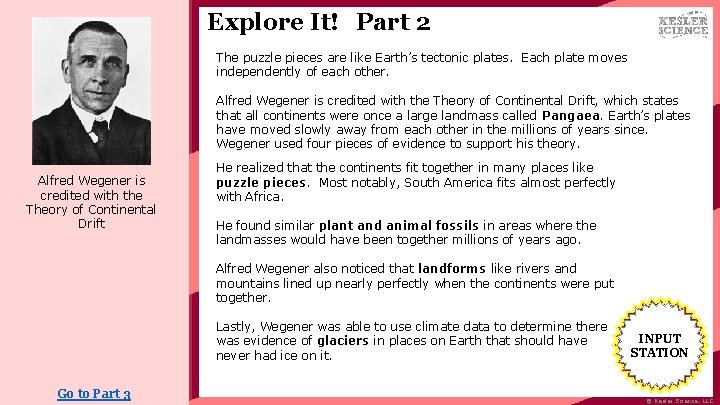
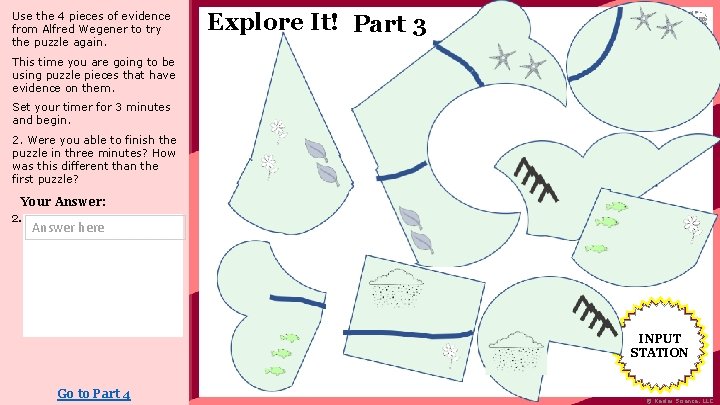
Explore It! Part 2 The puzzle pieces are like Earth’s tectonic plates. Each plate moves independently of each other. Alfred Wegener is credited with the Theory of Continental Drift, which states that all continents were once a large landmass called Pangaea. Earth’s plates have moved slowly away from each other in the millions of years since. Wegener used four pieces of evidence to support his theory. Alfred Wegener is credited with the Theory of Continental Drift He realized that the continents fit together in many places like puzzle pieces. Most notably, South America fits almost perfectly with Africa. He found similar plant and animal fossils in areas where the landmasses would have been together millions of years ago. Alfred Wegener also noticed that landforms like rivers and mountains lined up nearly perfectly when the continents were put together. Lastly, Wegener was able to use climate data to determine there was evidence of glaciers in places on Earth that should have never had ice on it. Go to Part 3 INPUT STATION © Kesler Science, LLC
Use the 4 pieces of evidence from Alfred Wegener to try the puzzle again. Explore It! Part 3 This time you are going to be using puzzle pieces that have evidence on them. Set your timer for 3 minutes and begin. 2. Were you able to finish the puzzle in three minutes? How was this different than the first puzzle? Your Answer: 2. Answer here INPUT STATION Go to Part 4 © Kesler Science, LLC
3. Summarize the 4 pieces of evidence that Alfred Wegener used to support his theory of continental drift. Is your work saved? Go Back to Lab Room Explore It! Part 4 3. Answer here INPUT STATION © Kesler Science, LLC
Your Answers: Research It! 1. Answer here • Go to https: //dinosaurpictures. org/ancient-earth#220 • Play around with the interactive globe for a minute or two and make some general observations. You can even try viewing the city you live in at different points in time. 1. Make some general observations about the globe at different points in time. Give at least three specific pieces of information. • In the top-right corner, click the “Jump to…” dropdown • Select “first dinosaurs”. Examine the continents during this time. • Click “Jump to…” • Select “dinosaur extinction” Go to Part 2 INPUT STATION © Kesler Science, LLC
Your Answers: Research It! 2. How are the continents different during this time? 3. Do you think all dinosaurs had equal access to all continents during their lifetime? Explain your thinking. 3. 4. Name a few specific implications of this timeline of the continents’ separation. 4. Is your work saved? Go Back to Lab Room INPUT STATION © Kesler Science, LLC
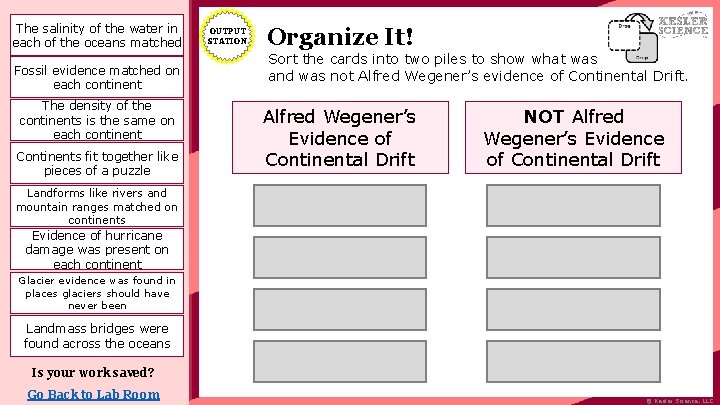
The salinity of the water in each of the oceans matched Fossil evidence matched on each continent The density of the continents is the same on each continent Continents fit together like pieces of a puzzle OUTPUT STATION Organize It! Sort the cards into two piles to show what was and was not Alfred Wegener’s evidence of Continental Drift. Alfred Wegener’s Evidence of Continental Drift NOT Alfred Wegener’s Evidence of Continental Drift Landforms like rivers and mountain ranges matched on continents Evidence of hurricane damage was present on each continent Glacier evidence was found in places glaciers should have never been Landmass bridges were found across the oceans Is your work saved? Go Back to Lab Room © Kesler Science, LLC
Draw a picture to represent each of Alfred Wegener’s 4 pieces of evidence that he used to develop the Continental Drift Theory. See the next page for help on inserting pictures into the page. Go to Image Help OUTPUT STATION Illustrate It!
OUTPUT STATION Illustrate It! There are several ways to get images into these pages. 1. Draw on your own paper. Take a picture and upload that picture to this device, OR, 2. Draw with an app. Open Google Draw, Paint, or any other graphics app. Draw your image, then either take a screenshot or picture of your image. For either option, go to the “Insert” menu on the upper left corner and choose “Pictures. ” Is your work saved? Go Back to Illustrate It! or Go Back to Lab Room Select “This Device” and browse to the folder where you saved the picture. Click on the file name and click “Insert. ”
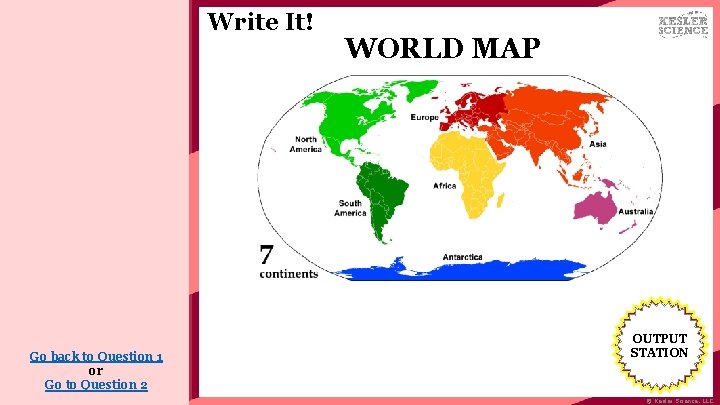
Write It! Question 1 Using the World Map on the next slide, explain which continents appear to fit together like puzzle pieces. Go to World Map or Go to Question 2 1. Answer here OUTPUT STATION © Kesler Science, LLC
Write It! Go back to Question 1 or Go to Question 2 WORLD MAP OUTPUT STATION © Kesler Science, LLC
Write It! Question 2 How did Alfred Wegener use landforms to help make a case for his theory of continental drift? 2. Answer here OUTPUT STATION Go to Question 3 © Kesler Science, LLC
One thing Wegener was unable to explain before he died was WHY the Earth’s plates moved away from each other. Write It! Question 3 3. Answer here We know the reason now. Explain what causes the plates to move. OUTPUT STATION Is your work saved? Go Back to Lab Room © Kesler Science, LLC
Your Answers: 1. Answer here 2. Answer here 3. Answer here Assess It! Part 1 1. Which of the following processes causes the Earth’s tectonic plates to move? A. B. C. D. the daily cycle of high and low tides convection currents in the Earth’s mantle the continuous flow of ocean currents high pressure in the atmosphere 2. Which of the following statements best explains why fossils of Mesosaurus were found in both Africa and S. America? A. The animals swam back and forth between Africa and South America. B. The animals crossed between the continents using a land bridge. C. Africa and S. America were likely once adjacent to each other in one continent. D. The animals evolved and flew over the ocean. 3. Which of the following pieces of evidence was NOT used to support the Theory of Continental Drift? A. The shape of the continents appear to fit together like a puzzle. B. Identical fossils have been found on multiple continents separated by oceans. C. Similar landforms are continuous between two continents OUTPUT when matched up. STATION D. There was traces of land bridges connecting separate continents. Go to Part 2 © Kesler Science, LLC
Your Answers: Assess It! Part 2 4. Answer here 5. Answer here 6. Answer here 7. Answer here 8. Answer here Use the vocabulary words from “Read It” to complete the following sentences. In 1915, a German scientist named 4) _____ proposed the 5) _____. He noticed that identical 6) _____ were found separate continents, and it was unlikely the animals would have been able to swim across the oceans. He also observed that each 7) _____ appears to fit together like a puzzle. He theorized that all of the current continents were once joined together into a supercontinent named 8) _____, which broke apart, and the landforms slowly drifted apart into their current positions. OUTPUT STATION Is your work saved? Go Back to Lab Room © Kesler Science, LLC