
Version 1 March 2019 Electrical Power Distribution Safety
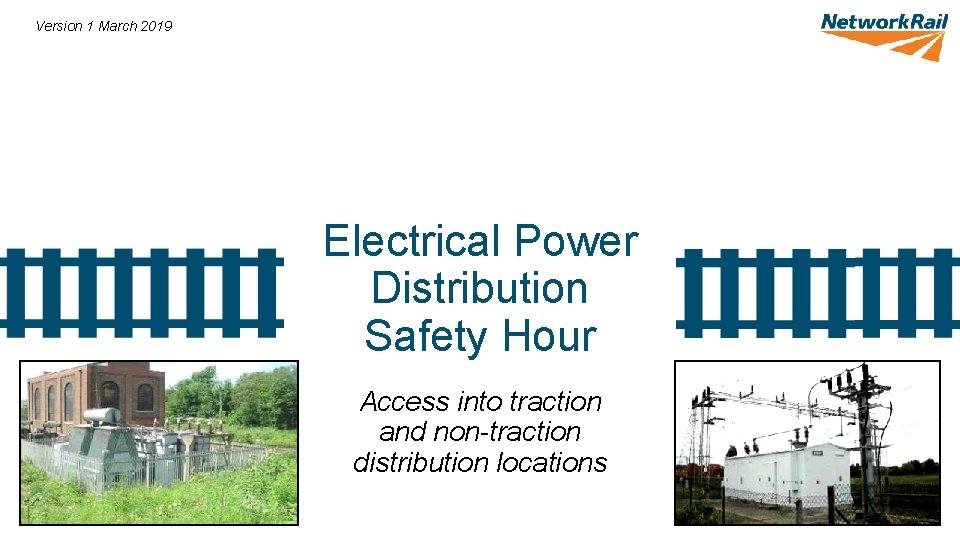
Version 1 March 2019 Electrical Power Distribution Safety Hour Access into traction and non-traction distribution locations 1
Contents Where you see this icon at the top of slide, it denotes a team discussion Section 1 – Safety Hour: • Introduction and purpose of the session • Overview of the incident at Godinton Substation in December 2018 • Accessing distribution locations Discussion topics • Arc Flash PPE Section 2 – Sentinel Competence Re-brief: • Re-briefing on the Safety Requirements for Accessing Distribution sites (mandatory for all Level A, B, C competence holders) 2
Section 1: Safety Hour 3
Introduction and Purpose o Following a serious safety incident at Godinton DC traction substation in December 2018, this safety hour has been produced to share key learning from the incident. o It is targeted at all holders of DIST Level A, B or C competence within Network Rail and contractors organisations i. e. people that take a lead safety role when accessing or working in traction and/or non traction distribution locations. o The learning from this safety hour should be applied to all traction and non-traction distribution locations regardless of electrification type. o A formal re-briefing of the safety requirements when accessing traction and nontraction distribution locations is contained as part of this safety hour. This needs to be recorded in Sentinel prior to 29 th July 2019 in order to maintain your DIST Level A, B or C competence. 4
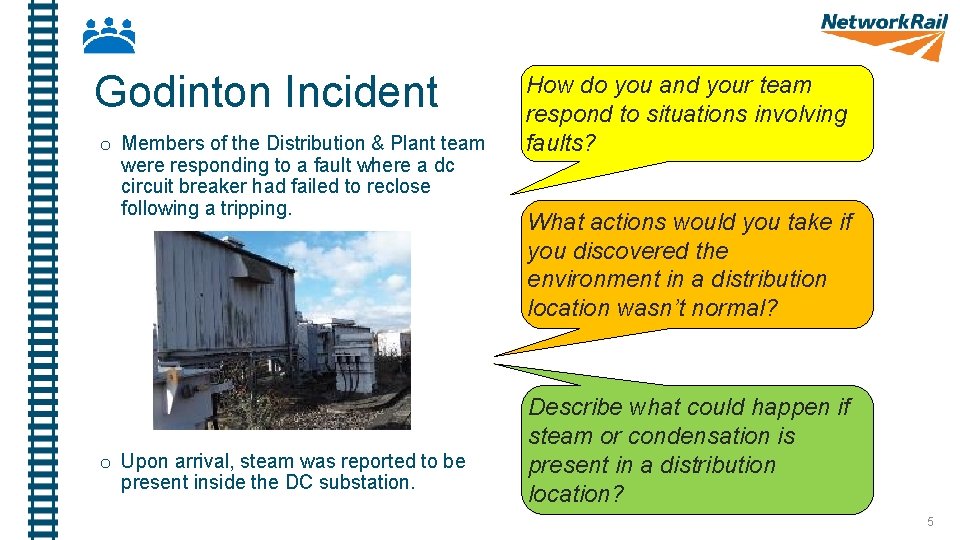
Godinton Incident o Members of the Distribution & Plant team were responding to a fault where a dc circuit breaker had failed to reclose following a tripping. o Upon arrival, steam was reported to be present inside the DC substation. How do you and your team respond to situations involving faults? What actions would you take if you discovered the environment in a distribution location wasn’t normal? Describe what could happen if steam or condensation is present in a distribution location? 5
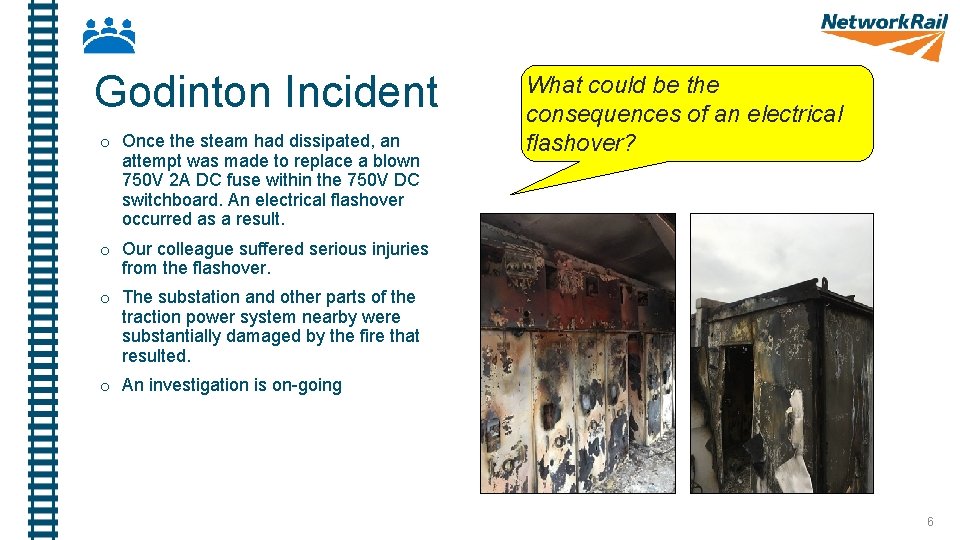
Godinton Incident o Once the steam had dissipated, an attempt was made to replace a blown 750 V 2 A DC fuse within the 750 V DC switchboard. An electrical flashover occurred as a result. What could be the consequences of an electrical flashover? o Our colleague suffered serious injuries from the flashover. o The substation and other parts of the traction power system nearby were substantially damaged by the fire that resulted. o An investigation is on-going 6
Godinton Incident Discussion What have you heard about Godinton and what were your initial thoughts, concerns? What have you learnt? If you felt unsure when asked to access a distribution substation would you say so? How do you feel about challenging and being challenged? 7
A challenging discussion…. ‘…they have got a lot more experience than me, I don’t want to sound stupid…’ ‘…if we just get the task done we can get back on time…’ ‘…we’ve got to get this job done quickly to get trains moving…’ What do you think may stop us from challenging either ourselves, colleagues, managers or our contractors? ‘…just need to get the job done or my manager will not be happy…’ ‘…what’s the point…I raised this before but nothing was done about it…’ ‘…we were OK when we did it like this last time…’ 8
Challenge may feel hard, but don’t let it… At Network Rail we encourage it…. What might happen if you don’t challenge or raise your concern ? What do you think are the benefits of challenging when a situation arises? 9
Helping us to challenge …. ‘…no question is a stupid question, it could save a life…’ ‘…if we need more time to do the job safely we need to raise this…’ ‘…yes we have to get the job done, but only if it is safe to do so…’ How can we help each other to make the challenge and also respond to challenge? What might we say differently? ‘…I need to tell my manager its just not feeling safe or right…’ ‘…I will keep raising this until it’s sorted…’ ‘…we might have been OK last time, but this looks different…’ 10
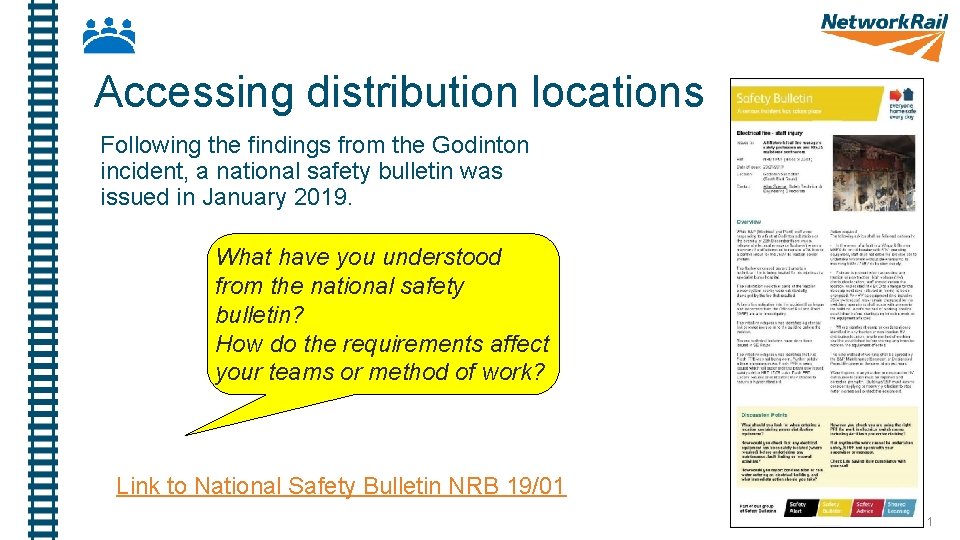
Accessing distribution locations Following the findings from the Godinton incident, a national safety bulletin was issued in January 2019. What have you understood from the national safety bulletin? How do the requirements affect your teams or method of work? Link to National Safety Bulletin NRB 19/01 11
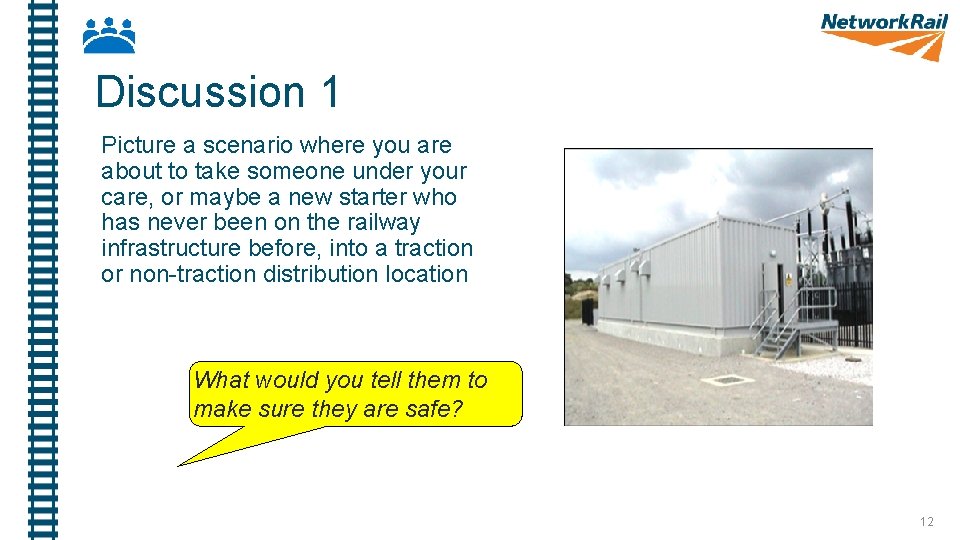
Discussion 1 Picture a scenario where you are about to take someone under your care, or maybe a new starter who has never been on the railway infrastructure before, into a traction or non-traction distribution location What would you tell them to make sure they are safe? 12
Discussion 2 What do you think are the personal factors that should also be checked before accessing or undertaking a task in a distribution location? What do you need to know before you enter - who could tell you? 13
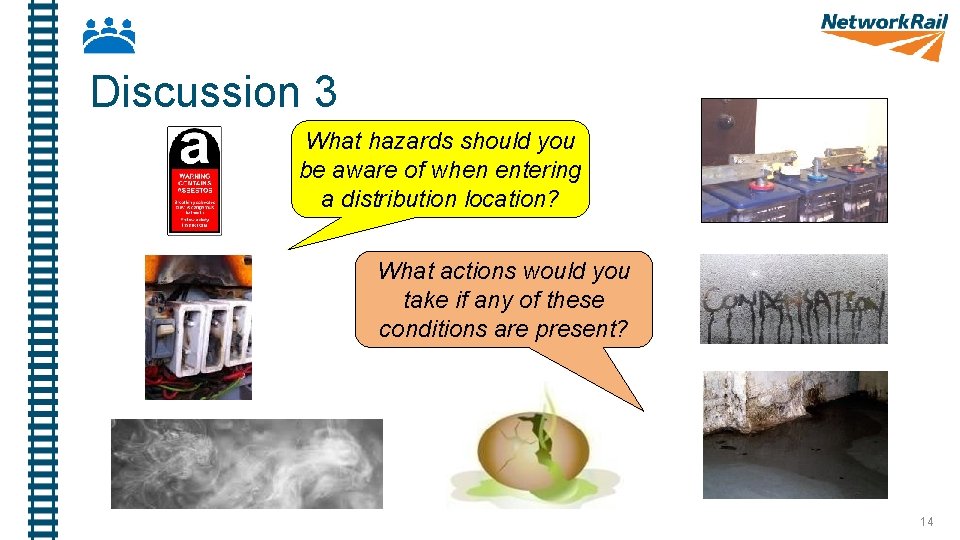
Discussion 3 What hazards should you be aware of when entering a distribution location? What actions would you take if any of these conditions are present? 14
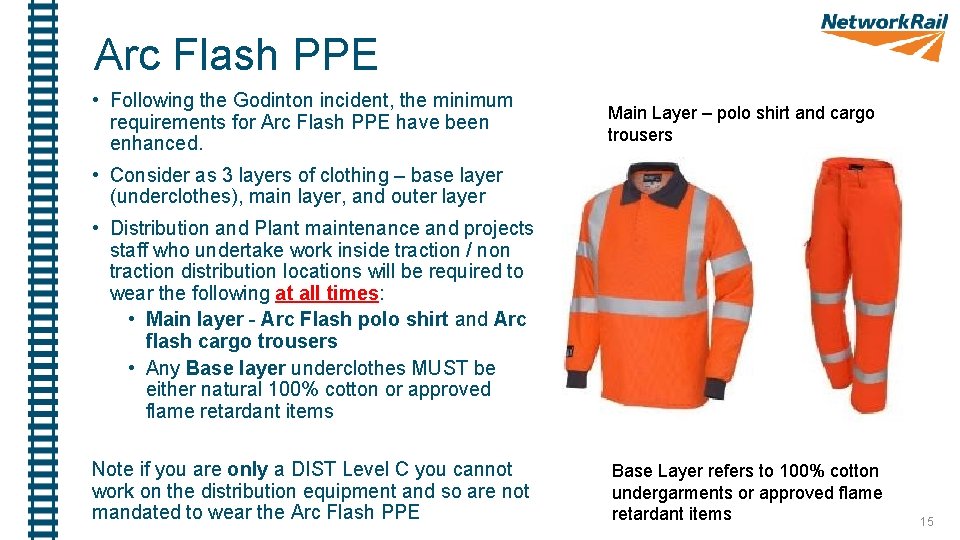
Arc Flash PPE • Following the Godinton incident, the minimum requirements for Arc Flash PPE have been enhanced. Main Layer – polo shirt and cargo trousers • Consider as 3 layers of clothing – base layer (underclothes), main layer, and outer layer • Distribution and Plant maintenance and projects staff who undertake work inside traction / non traction distribution locations will be required to wear the following at all times: • Main layer - Arc Flash polo shirt and Arc flash cargo trousers • Any Base layer underclothes MUST be either natural 100% cotton or approved flame retardant items Note if you are only a DIST Level C you cannot work on the distribution equipment and so are not mandated to wear the Arc Flash PPE Base Layer refers to 100% cotton undergarments or approved flame retardant items 15
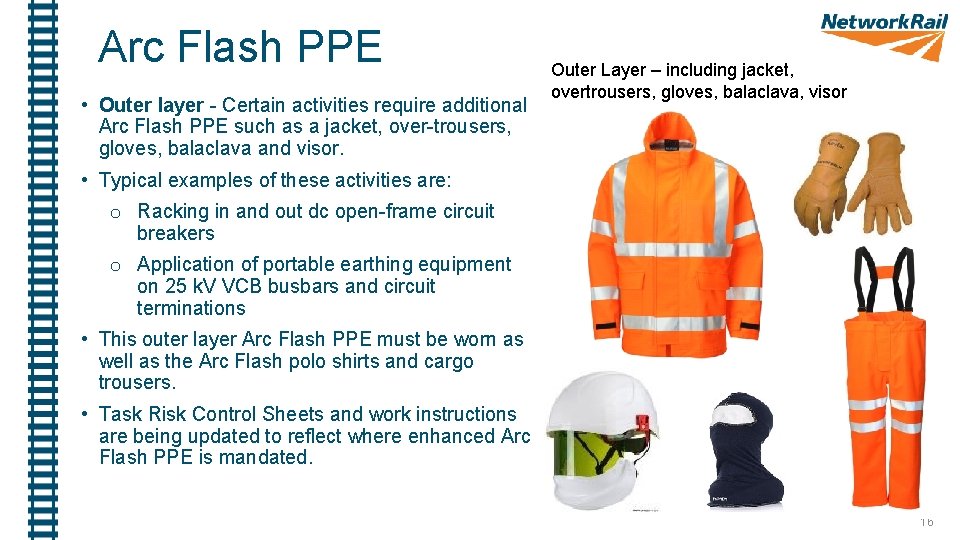
Arc Flash PPE • Outer layer - Certain activities require additional Arc Flash PPE such as a jacket, over-trousers, gloves, balaclava and visor. Outer Layer – including jacket, overtrousers, gloves, balaclava, visor • Typical examples of these activities are: o Racking in and out dc open-frame circuit breakers o Application of portable earthing equipment on 25 k. V VCB busbars and circuit terminations • This outer layer Arc Flash PPE must be worn as well as the Arc Flash polo shirts and cargo trousers. • Task Risk Control Sheets and work instructions are being updated to reflect where enhanced Arc Flash PPE is mandated. 16
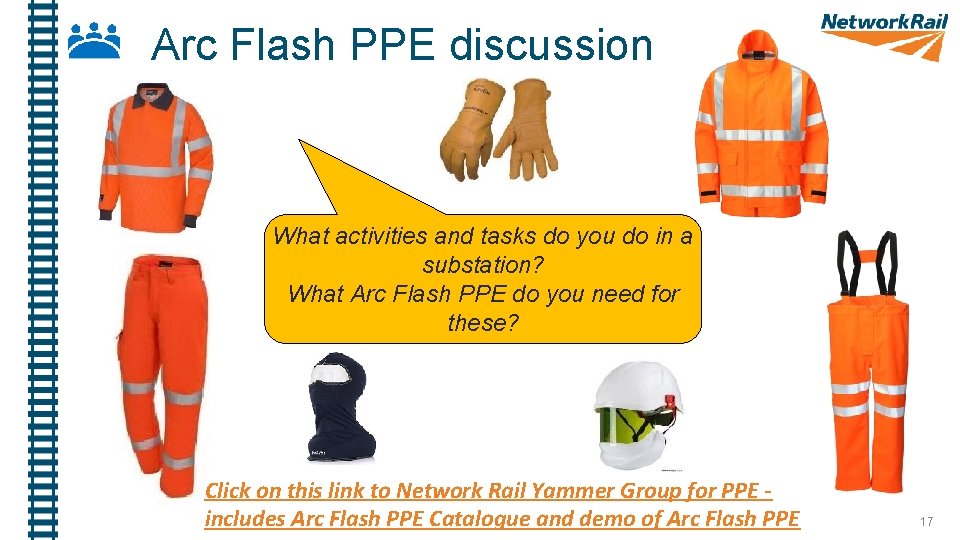
Arc Flash PPE discussion What activities and tasks do you do in a substation? What Arc Flash PPE do you need for these? Click on this link to Network Rail Yammer Group for PPE includes Arc Flash PPE Catalogue and demo of Arc Flash PPE 17
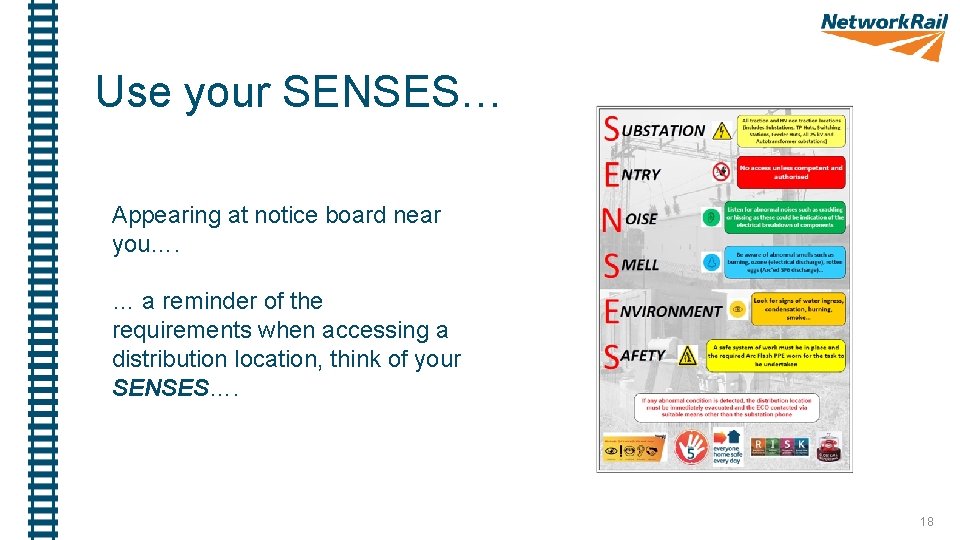
Use your SENSES… Appearing at notice board near you…. … a reminder of the requirements when accessing a distribution location, think of your SENSES…. 18
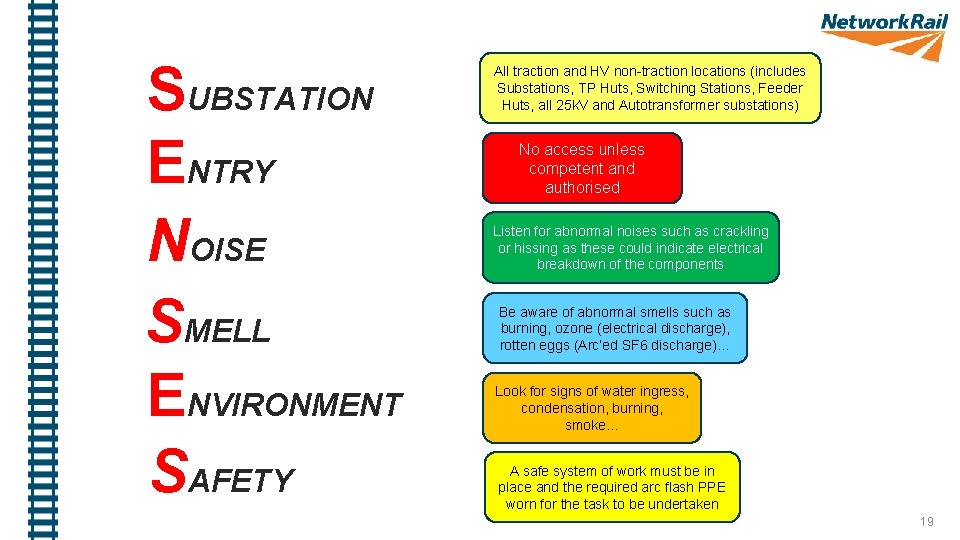
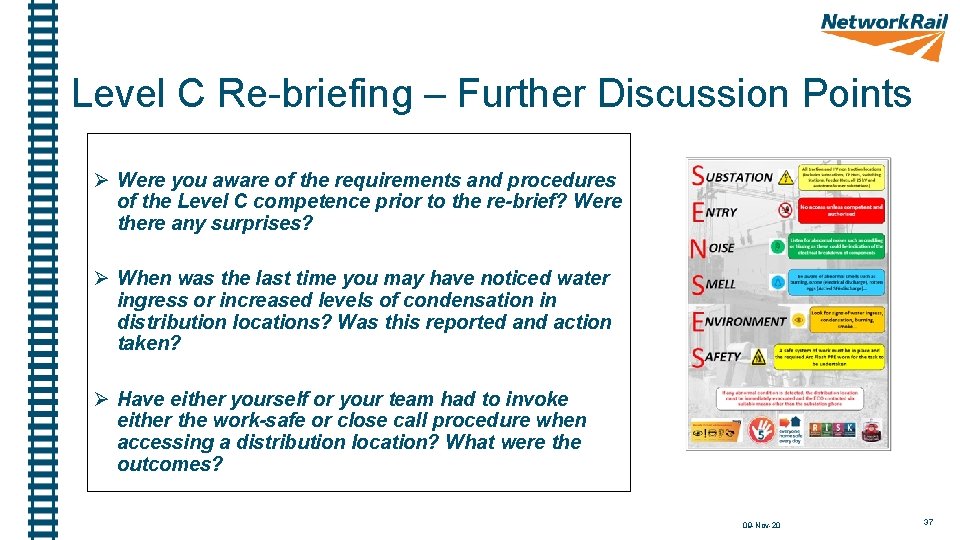
SUBSTATION ENTRY NOISE SMELL ENVIRONMENT SAFETY All traction and HV non-traction locations (includes Substations, TP Huts, Switching Stations, Feeder Huts, all 25 k. V and Autotransformer substations) No access unless competent and authorised Listen for abnormal noises such as crackling or hissing as these could indicate electrical breakdown of the components Be aware of abnormal smells such as burning, ozone (electrical discharge), rotten eggs (Arc’ed SF 6 discharge)… Look for signs of water ingress, condensation, burning, smoke… A safe system of work must be in place and the required arc flash PPE worn for the task to be undertaken 19
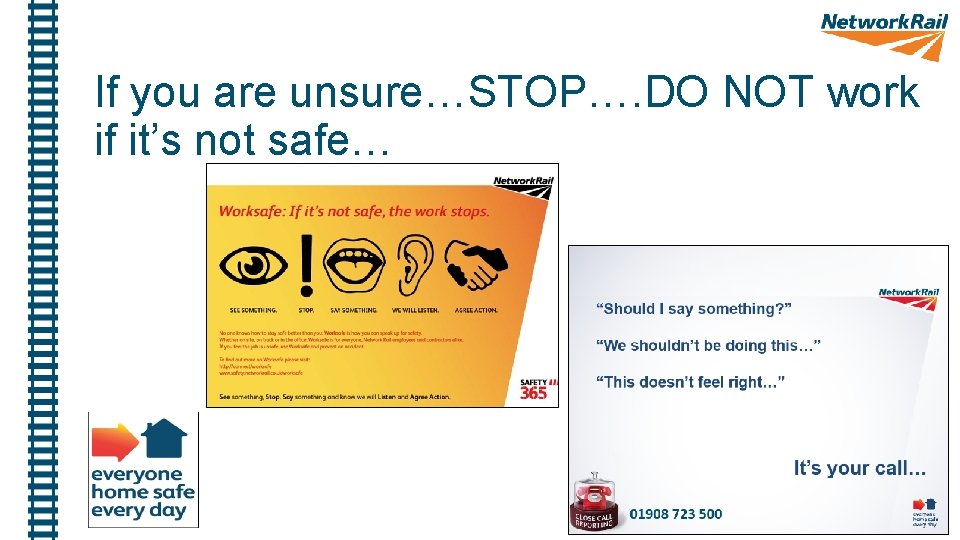
If you are unsure…STOP…. DO NOT work if it’s not safe… 20
Section 2: Sentinel Re-brief Access into Traction / Non Traction Distribution Locations 21
Contents Where you see this icon at the top of slide, it denotes a team discussion • Section 2 - Sentinel Re-brief for Access into Traction / Non Traction Distribution Locations • • Purpose of the session Scope Hazards Be Aware and Act Procedure Reminder Arc Flash PPE Discussion points Feedback and contact 22
Access into Traction / Non Traction Distribution Locations - Purpose Following a serious safety incident at Godinton DC traction substation in December 2018, we require that all personnel who hold the following competences: • Level C DIST, • Level B DIST (ACi, ACi+DCi), • Level A DIST …undertake this re-briefing of the safety requirements from the current DIST level C competence to reinforce understanding of the safety risks when accessing traction and non traction distribution locations. This briefing has been set up as a Sentinel competence event (LC DIST REBRIEF) and must be recorded by your Sentinel Sponsor before 29 th July 2019 in order to retain your Level A, B or C competence. 09 -Nov-20 23
DIST Level C Re-briefing - Scope • The Level C competence (in accordance with NR Standard NR/L 2/CTM/018) covers the requirements and procedure when accessing and egressing a traction or nontraction distribution location (such as DC substations, 25 k. V Feeder Stations, Track Paralleling Huts, 6. 6 k. V substations, etc. . ). • Note: the distribution location also includes the compound and the electrical distribution equipment installed within it. • The Level C competence alone does not allow work to be carried on any of the equipment inside the distribution location, it is solely for access and egress. Where work is required to be undertaken on the equipment, the individual shall either hold a higher competence such Level B or Level A, or the specific equipment competence (such as Network Rail telecoms staff working on the modem / communications equipment) 09 -Nov-20 24
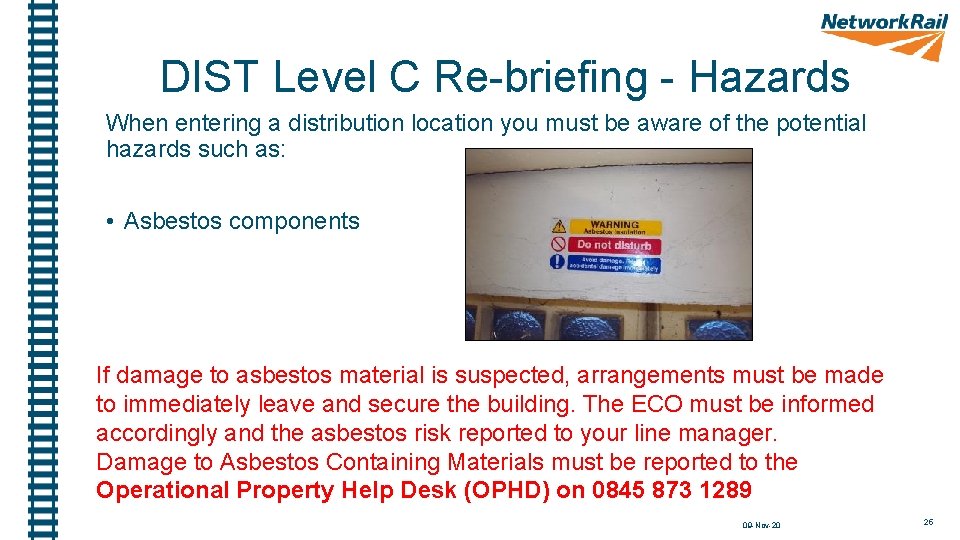
DIST Level C Re-briefing - Hazards When entering a distribution location you must be aware of the potential hazards such as: • Asbestos components If damage to asbestos material is suspected, arrangements must be made to immediately leave and secure the building. The ECO must be informed accordingly and the asbestos risk reported to your line manager. Damage to Asbestos Containing Materials must be reported to the Operational Property Help Desk (OPHD) on 0845 873 1289 09 -Nov-20 25
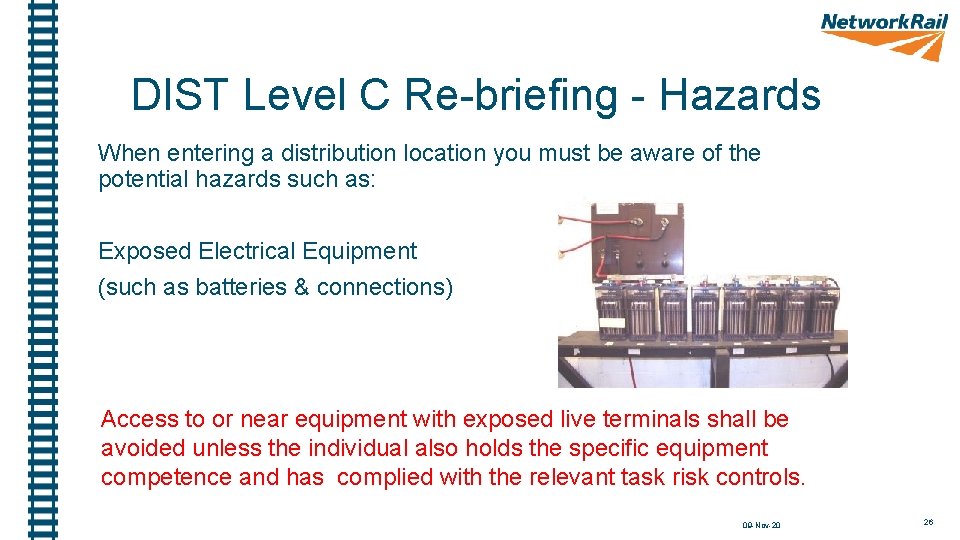
DIST Level C Re-briefing - Hazards When entering a distribution location you must be aware of the potential hazards such as: Exposed Electrical Equipment (such as batteries & connections) Access to or near equipment with exposed live terminals shall be avoided unless the individual also holds the specific equipment competence and has complied with the relevant task risk controls. 09 -Nov-20 26
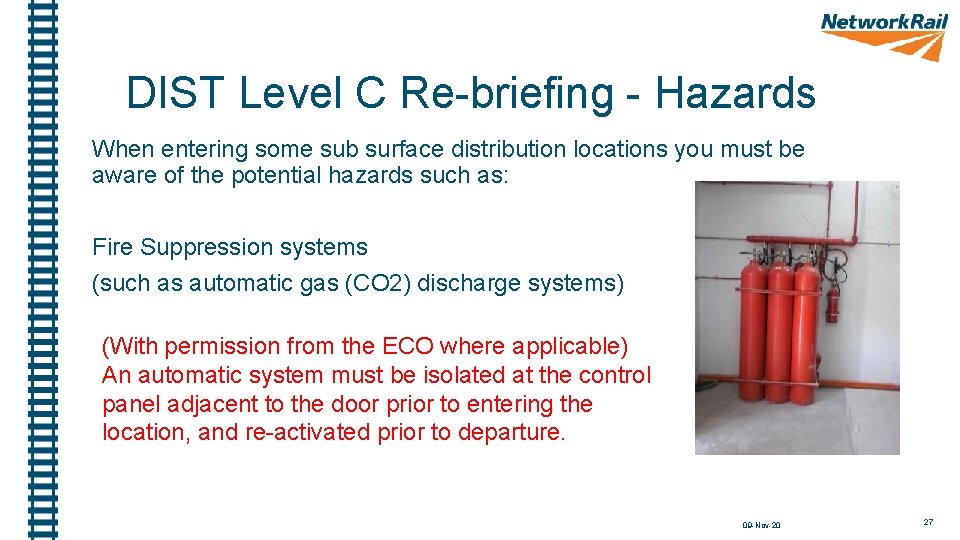
DIST Level C Re-briefing - Hazards When entering some sub surface distribution locations you must be aware of the potential hazards such as: Fire Suppression systems (such as automatic gas (CO 2) discharge systems) (With permission from the ECO where applicable) An automatic system must be isolated at the control panel adjacent to the door prior to entering the location, and re-activated prior to departure. 09 -Nov-20 27
DIST Level C Re-briefing – be aware and act • When entering a distribution location it is extremely important to remain vigilant and alert to changes in the environmental conditions inside. • Changes in environmental conditions can include: • Crackling or hissing noises • Smells (such as burning, ozone or rotten eggs) • Smoke • Water ingress, steam or significant condensation 09 -Nov-20 28
DIST Level C Re-briefing – be aware and act Crackling or hissing noises This can be the indication of electrical discharge and/or the breakdown of the electrical equipment which may lead to hazardous / lethal voltages appearing on metalwork or present an explosion risk. If this is detected, the distribution location must be immediately evacuated and the ECO contacted via suitable means other than the substation phone. 09 -Nov-20 29
DIST Level C Re-briefing – be aware and act Smells (such as burning or ozone) This can be the indication of electrical discharge and the breakdown of components of the electrical equipment which may lead to hazardous / lethal voltages appearing on metalwork or present an explosion risk. Rotten Eggs This is associated when an fault has occurred within SF 6 filled equipment and has led to a breakdown of the SF 6 gas components. There may also be evidence of a white ash like material. Do not touch. If any of the above is detected, the distribution location must be immediately evacuated and the ECO contacted via suitable means other than the substation phone. 09 -Nov-20 30
DIST Level C Re-briefing – be aware and act Smoke This can be the indication of overloaded electrical equipment, flash over and the breakdown of the electrical equipment which may present a fire/explosion risk. If the above is detected, the distribution location must be immediately evacuated and the ECO contacted via suitable means other than the substation phone. 09 -Nov-20 31
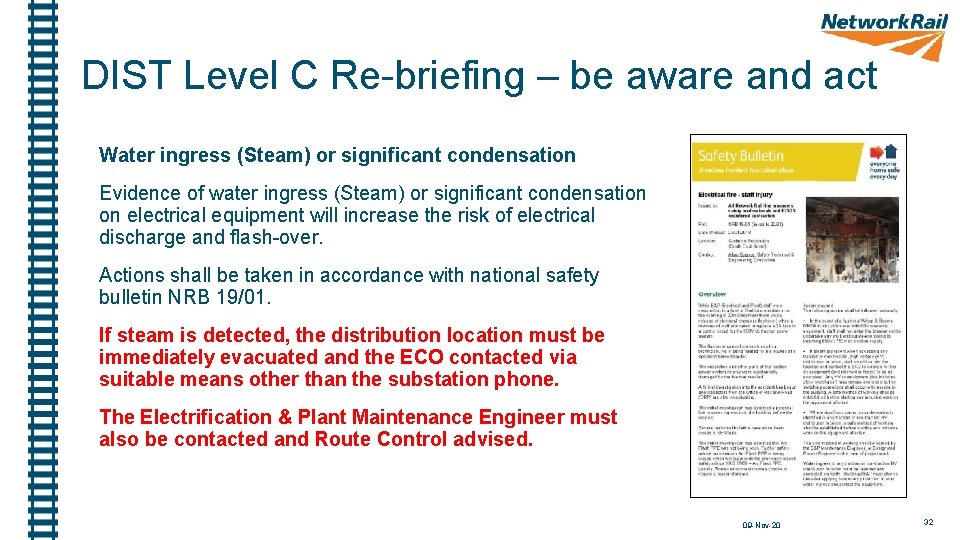
DIST Level C Re-briefing – be aware and act Water ingress (Steam) or significant condensation Evidence of water ingress (Steam) or significant condensation on electrical equipment will increase the risk of electrical discharge and flash-over. Actions shall be taken in accordance with national safety bulletin NRB 19/01. If steam is detected, the distribution location must be immediately evacuated and the ECO contacted via suitable means other than the substation phone. The Electrification & Plant Maintenance Engineer must also be contacted and Route Control advised. 09 -Nov-20 32
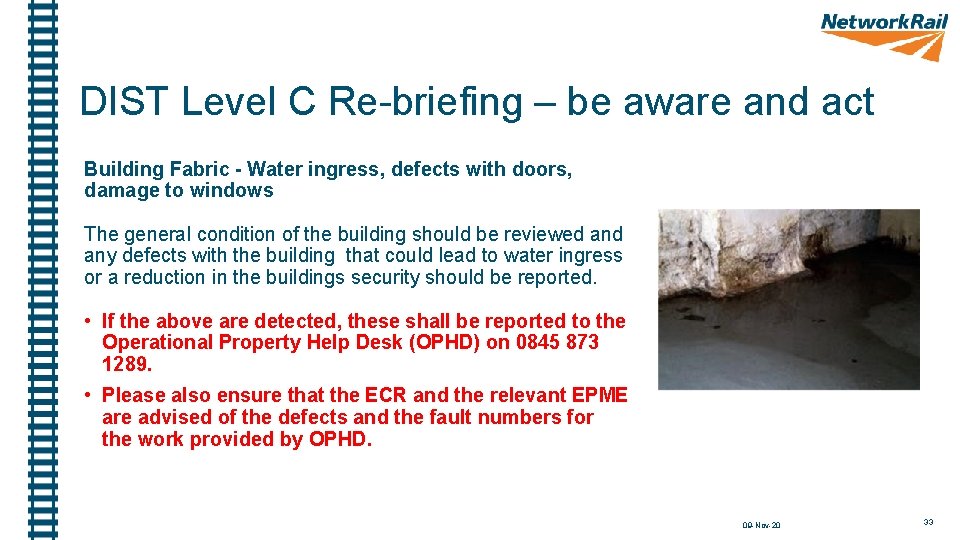
DIST Level C Re-briefing – be aware and act Building Fabric - Water ingress, defects with doors, damage to windows The general condition of the building should be reviewed any defects with the building that could lead to water ingress or a reduction in the buildings security should be reported. • If the above are detected, these shall be reported to the Operational Property Help Desk (OPHD) on 0845 873 1289. • Please also ensure that the ECR and the relevant EPME are advised of the defects and the fault numbers for the work provided by OPHD. 09 -Nov-20 33
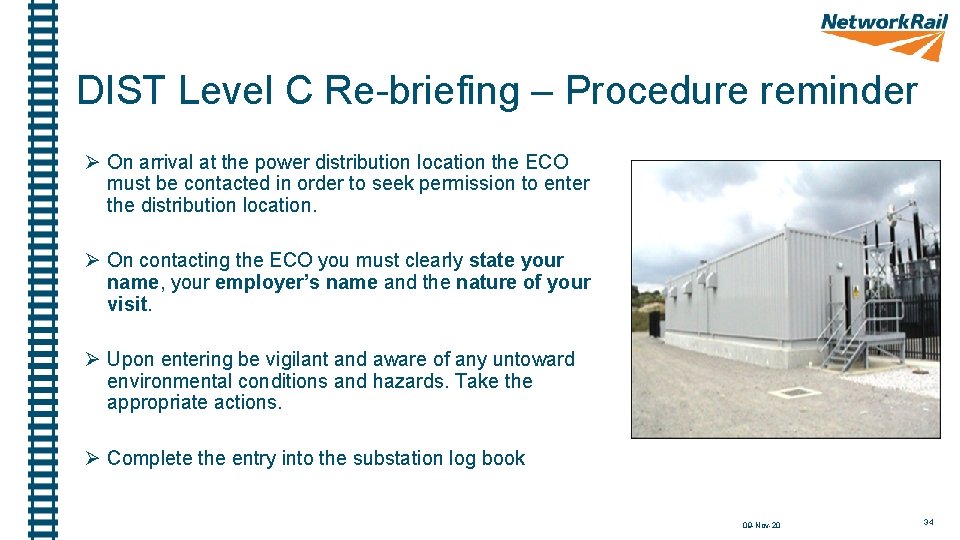
DIST Level C Re-briefing – Procedure reminder Ø On arrival at the power distribution location the ECO must be contacted in order to seek permission to enter the distribution location. Ø On contacting the ECO you must clearly state your name, your employer’s name and the nature of your visit. Ø Upon entering be vigilant and aware of any untoward environmental conditions and hazards. Take the appropriate actions. Ø Complete the entry into the substation log book 09 -Nov-20 34
DIST Level C Re-briefing – Procedure reminder Ø Upon leaving, the distribution location must be left safe and secure Ø On exiting, contact must be made with the ECO in order to request confirmation that all alarms have been cleared. Ø The ECO shall reset door alarms (where applicable). Note: for non traction HV substations, there is no requirement to contact the ECO, however, authority to enter the location may be required from the Station Manager, or delegated responsible person, even if the person requiring entry is a permanent key holder. 09 -Nov-20 35
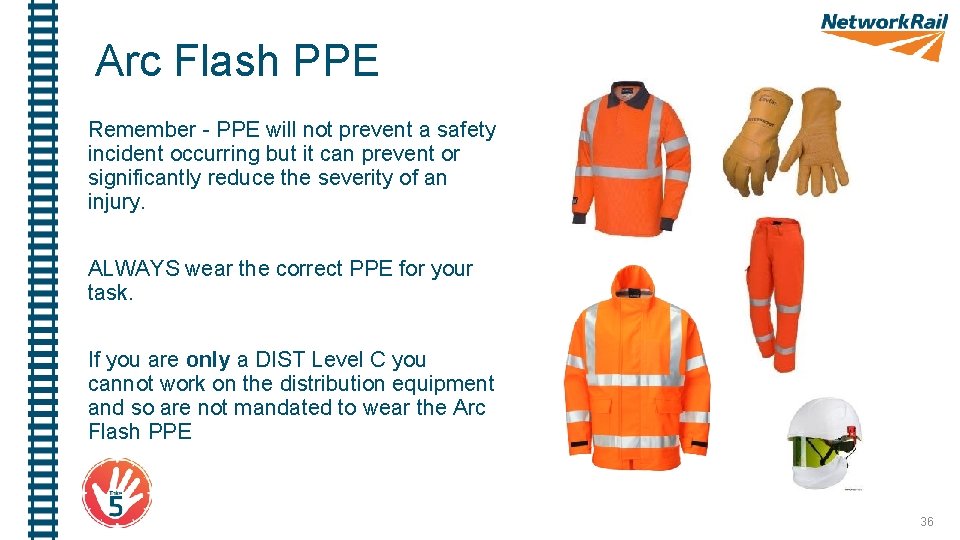
Arc Flash PPE Remember - PPE will not prevent a safety incident occurring but it can prevent or significantly reduce the severity of an injury. ALWAYS wear the correct PPE for your task. If you are only a DIST Level C you cannot work on the distribution equipment and so are not mandated to wear the Arc Flash PPE 36
Level C Re-briefing – Further Discussion Points Ø Were you aware of the requirements and procedures of the Level C competence prior to the re-brief? Were there any surprises? Ø When was the last time you may have noticed water ingress or increased levels of condensation in distribution locations? Was this reported and action taken? Ø Have either yourself or your team had to invoke either the work-safe or close call procedure when accessing a distribution location? What were the outcomes? 09 -Nov-20 37
Safety Hour and Level C Briefing – Your views Feedback from this briefing is greatly appreciated and can be directed to the Network Rail M&EE Distribution Team via: Kyle. Windsor@networkrail. co. uk 09 -Nov-20 38
- Slides: 38