
Version 1 a 2018 NZ IAS 19 EMPLOYEE
- Slides: 1
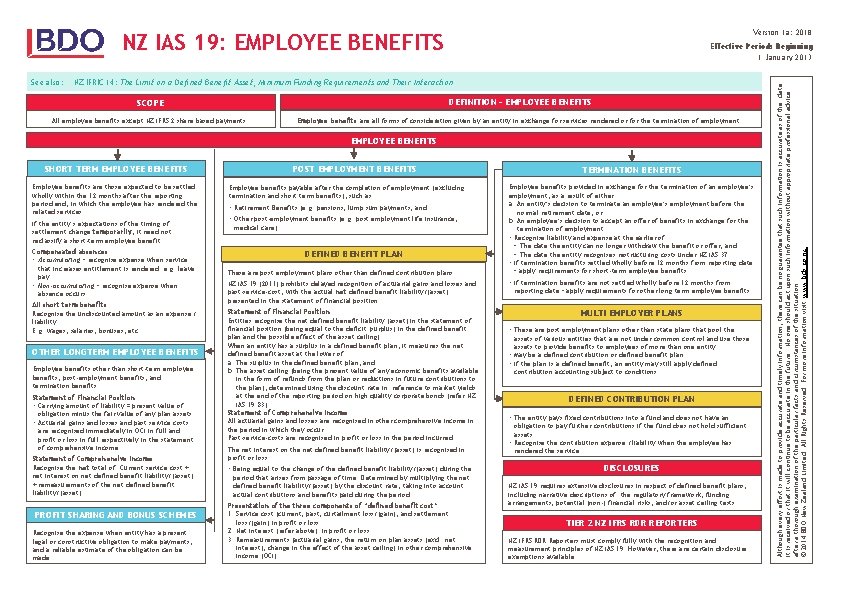
Version 1 a: 2018 NZ IAS 19: EMPLOYEE BENEFITS NZ IFRIC 14: The Limit on a Defined Benefit Asset, Minimum Funding Requirements and Their Interaction SCOPE DEFINITION – EMPLOYEE BENEFITS All employee benefits except NZ IFRS 2 share based payments. Employee benefits are all forms of consideration given by an entity in exchange for services rendered or for the termination of employment. EMPLOYEE BENEFITS SHORT TERM EMPLOYEE BENEFITS Employee benefits are those expected to be settled wholly within the 12 months after the reporting period end, in which the employee has rendered the related services. If the entity’s expectations of the timing of settlement change temporarily, it need not reclassify a short-term employee benefit. Compensated absences • Accumulating – recognise expense when service that increases entitlement is rendered. e. g. leave pay. • Non-accumulating – recognise expense when absence occurs. All short term benefits Recognise the undiscounted amount as an expense / liability. E. g. wages, salaries, bonuses, etc. OTHER LONGTERM EMPLOYEE BENEFITS Employee benefits other than short-term employee benefits, post-employment benefits, and termination benefits. Statement of Financial Position • Carrying amount of liability = present value of obligation minus the fair value of any plan assets. • Actuarial gains and losses and past service costs are recognised immediately in OCI in full and profit or loss in full respectively in the statement of comprehensive income. Statement of Comprehensive Income Recognise the net total of: Current service cost + net interest on net defined benefit liability/(asset) + remeasurements of the net defined benefit liability/(asset). PROFIT SHARING AND BONUS SCHEMES Recognise the expense when entity has a present legal or constructive obligation to make payments; and a reliable estimate of the obligation can be made. POST EMPLOYMENT BENEFITS Employee benefits payable after the completion of employment (excluding termination and short term benefits), such as: • Retirement Benefits (e. g. pensions, lump sum payments; and • Other post-employment benefits (e. g. post employment life insurance, medical care). DEFINED BENEFIT PLAN These are post employment plans other than defined contribution plans. NZ IAS 19 (2011) prohibits delayed recognition of actuarial gains and losses and past-service-cost, with the actual net defined benefit liability/(asset) presented in the statement of financial position. Statement of Financial Position Entities recognise the net defined benefit liability (asset) in the statement of financial position (being equal to the deficit (surplus) in the defined benefit plan and the possible effect of the asset ceiling). When an entity has a surplus in a defined benefit plan, it measures the net defined benefit asset at the lower of: a. The surplus in the defined benefit plan; and b. The asset ceiling (being the present value of any economic benefits available in the form of refunds from the plan or reductions in future contributions to the plan), determined using the discount rate in reference to market yields at the end of the reporting period on high quality corporate bonds (refer NZ IAS 19. 83). Statement of Comprehensive Income All actuarial gains and losses are recognised in other comprehensive income in the period in which they occur. Past-service-costs are recognised in profit or loss in the period incurred. The net interest on the net defined benefit liability/(asset) is recognised in profit or loss: • Being equal to the change of the defined benefit liability/(asset) during the period that arises from passage of time. Determined by multiplying the net defined benefit liability/(asset) by the discount rate, taking into account actual contributions and benefits paid during the period. Presentation of the three components of “defined benefit cost” 1. Service cost (current, past, curtailment loss/(gain), and settlement loss/(gain) in profit or loss 2. Net Interest (refer above) in profit or loss. 3. Remeasurements (actuarial gains, the return on plan assets (excl. net interest), change in the effect of the asset ceiling) in other comprehensive income (OCI). TERMINATION BENEFITS Employee benefits provided in exchange for the termination of an employee’s employment, as a result of either: a. An entity’s decision to terminate an employee’s employment before the normal retirement date; or b. An employee’s decision to accept an offer of benefits in exchange for the termination of employment. • Recognise liability and expense at the earlier of: – The date the entity can no longer withdraw the benefit or offer; and – The date the entity recognises restructuring costs under NZ IAS 37. • If termination benefits settled wholly before 12 months from reporting date – apply requirements for short-term employee benefits. • If termination benefits are not settled wholly before 12 months from reporting date – apply requirements for other long term employee benefits. MULTI EMPLOYER PLANS • These are post employment plans other than state plans that pool the assets of various entities that are not under common control and use those assets to provide benefits to employees of more than one entity. • May be a defined contribution or defined benefit plan. • If the plan is a defined benefit, an entity may still apply defined contribution accounting subject to conditions. DEFINED CONTRIBUTION PLAN • The entity pays fixed contributions into a fund and does not have an obligation to pay further contributions if the fund does not hold sufficient assets. • Recognise the contribution expense /liability when the employee has rendered the service. DISCLOSURES NZ IAS 19 requires extensive disclosures in respect of defined benefit plans, including narrative descriptions of: the regulatory framework; funding arrangements; potential (non-) financial risks; and/or asset ceiling tests. TIER 2 NZ IFRS RDR REPORTERS NZ IFRS RDR Reporters must comply fully with the recognition and measurement principles of NZ IAS 19. However, there are certain disclosure exemptions available. Although every effort is made to provide accurate and timely information, there can be no guarantee that such information is accurate as of the date it is received or that it will continue to be accurate in the future. No one should act upon such information without appropriate professional advice after a thorough examination of the particular facts and circumstances of the situation. © 2014 BDO New Zealand Limited. All Rights Reserved. For more information visit www. bdo. co. nz. See also: Effective Periods Beginning 1 January 2013