
Version 02 02092015 THE LHIRESIII SPECTROGRAPH JeanPierre Rivet





- Slides: 39
Version 02, 02/09/2015 THE LHIRES-III SPECTROGRAPH Jean-Pierre Rivet CNRS, OCA, Dept. Lagrange jean-pierre. rivet@oca. eu © C 2 PU, Observatoire de la Cote d’Azur, Université de Nice Sophia-Antipolis
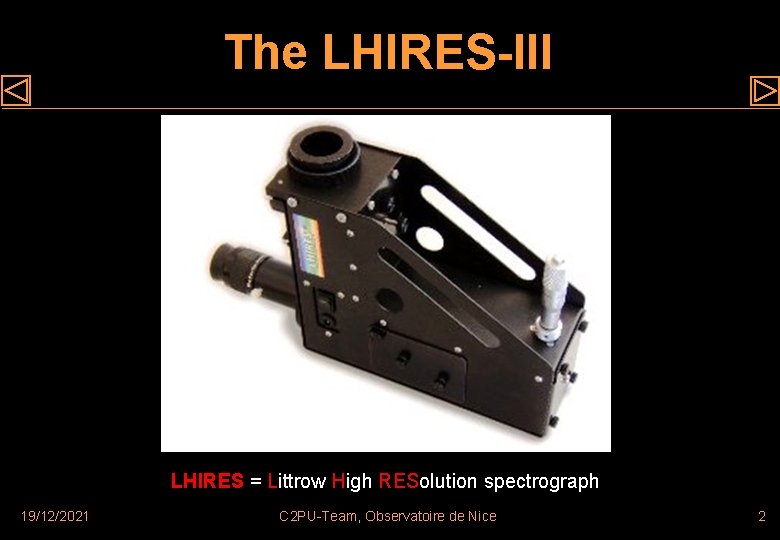
The LHIRES-III LHIRES = Littrow High RESolution spectrograph 19/12/2021 C 2 PU-Team, Observatoire de Nice 2
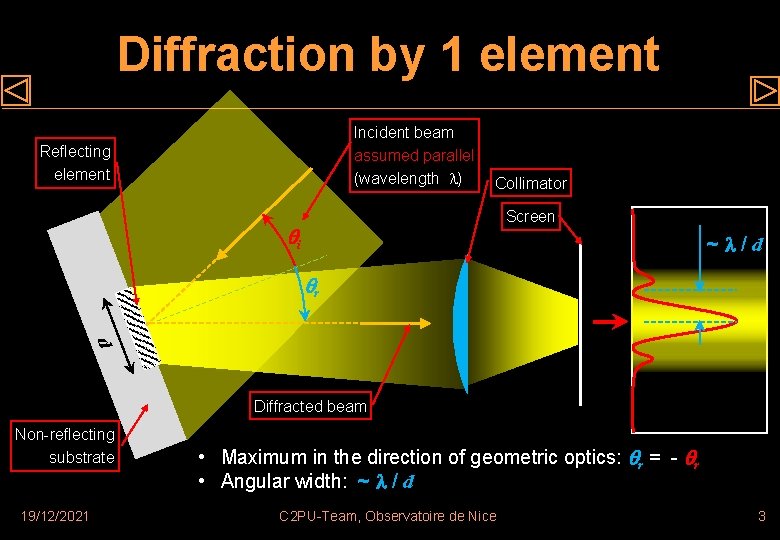
Diffraction by 1 element Incident beam assumed parallel (wavelength ) Reflecting element Collimator Screen i ~ /d r d Diffracted beam Non-reflecting substrate 19/12/2021 • Maximum in the direction of geometric optics: r = - r • Angular width: ~ / d C 2 PU-Team, Observatoire de Nice 3
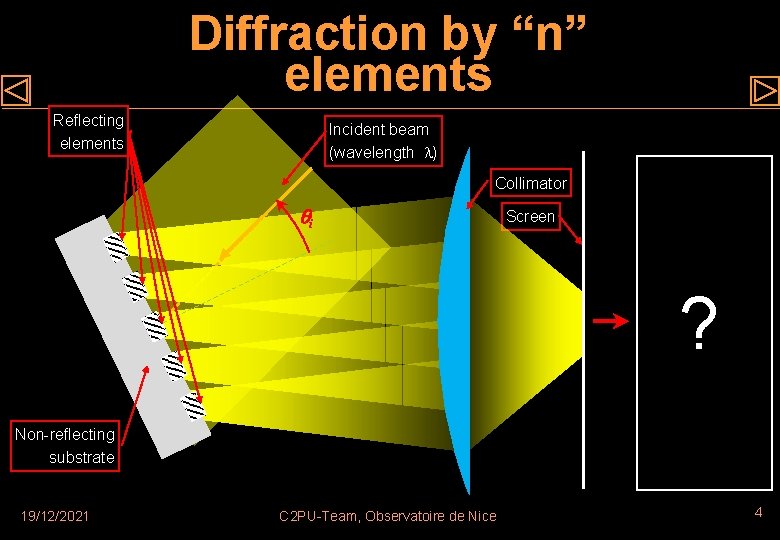
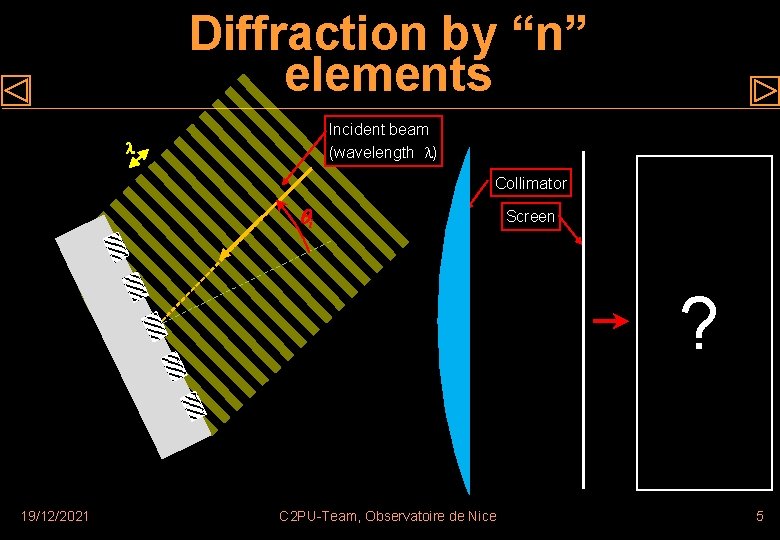
Diffraction by “n” elements Reflecting elements Incident beam (wavelength ) Collimator i Screen ? Non-reflecting substrate 19/12/2021 C 2 PU-Team, Observatoire de Nice 4
Diffraction by “n” elements Incident beam (wavelength ) Collimator i Screen ? 19/12/2021 C 2 PU-Team, Observatoire de Nice 5
Diffraction by “n” elements Diffracted beams out of phase : destructive interferences NO LIGHT Collimator Screen NO LIGHT ! 19/12/2021 C 2 PU-Team, Observatoire de Nice 6
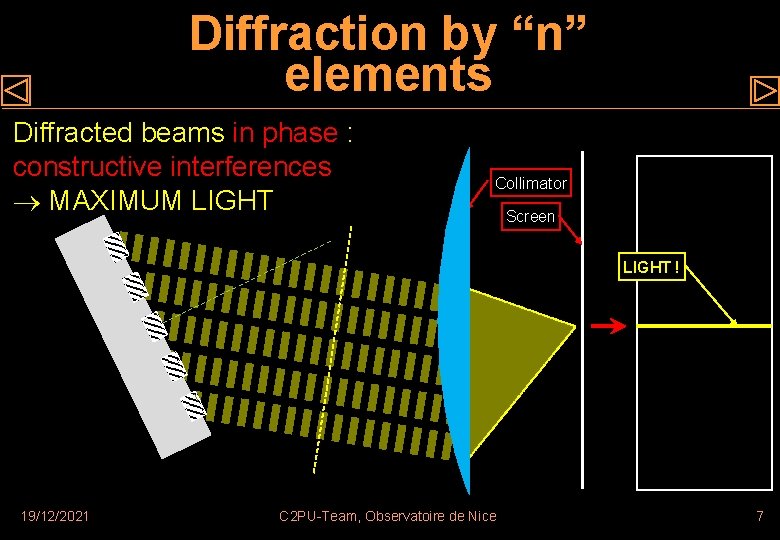
Diffraction by “n” elements Diffracted beams in phase : constructive interferences MAXIMUM LIGHT Collimator Screen LIGHT ! 19/12/2021 C 2 PU-Team, Observatoire de Nice 7
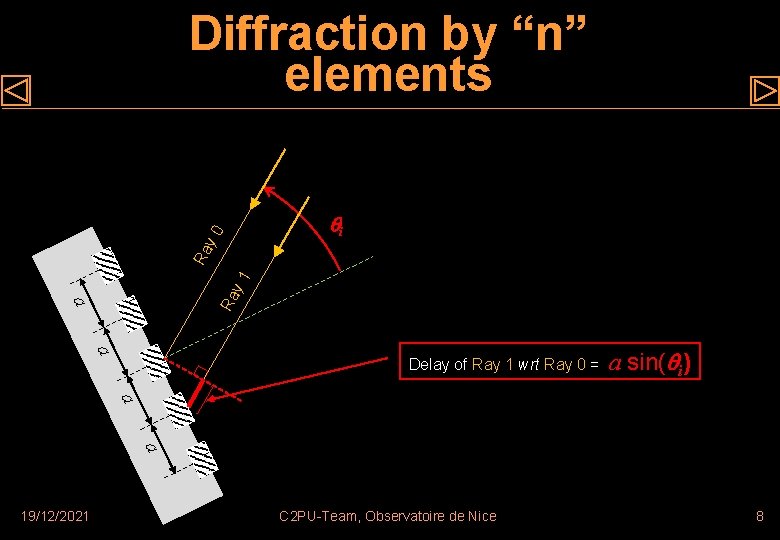
Diffraction by “n” elements a Ra y 1 Ra y 0 i a Delay of Ray 1 wrt Ray 0 = a sin( i) a a 19/12/2021 C 2 PU-Team, Observatoire de Nice 8
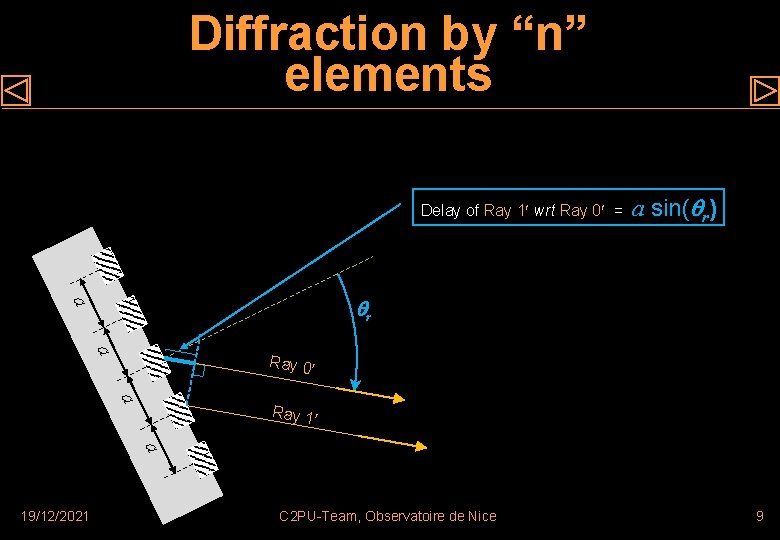
Diffraction by “n” elements Delay of Ray 1 wrt Ray 0 = a sin( r) a r a Ray 0 a Ray 1 a 19/12/2021 C 2 PU-Team, Observatoire de Nice 9
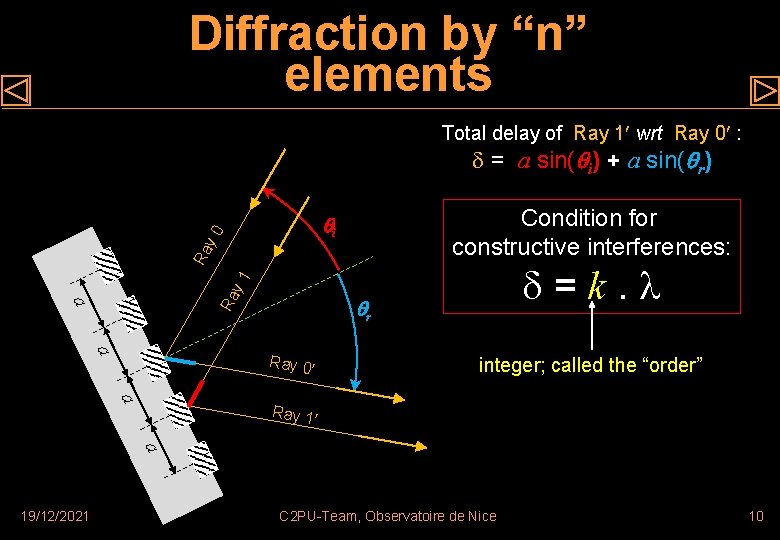
Diffraction by “n” elements Total delay of Ray 1 wrt Ray 0 : = a sin( i) + a sin( r) Condition for constructive interferences: =k. a Ra y 1 Ra y 0 i r a Ray 0 integer; called the “order” a Ray 1 a 19/12/2021 C 2 PU-Team, Observatoire de Nice 10
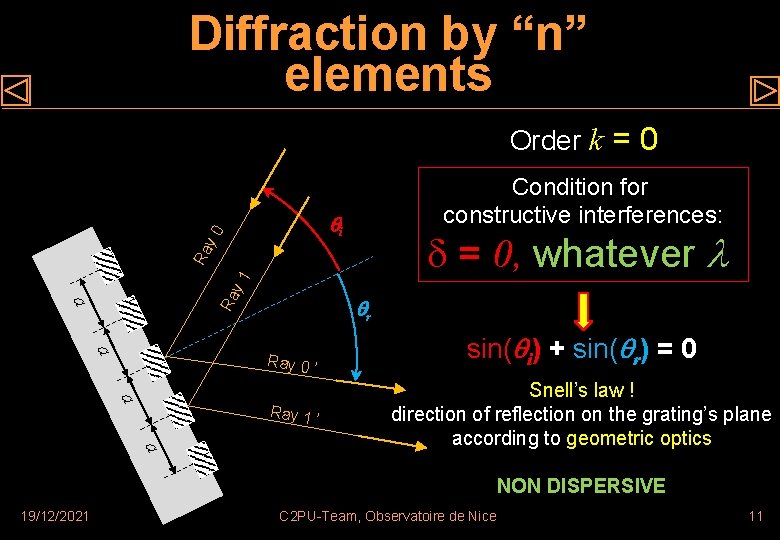
Diffraction by “n” elements Order k = 0 Condition for constructive interferences: = 0, whatever a Ra y 1 Ra y 0 i r a Ray 0 a Ray 1 ’ ’ sin( i) + sin( r) = 0 a Snell’s law ! direction of reflection on the grating’s plane according to geometric optics NON DISPERSIVE 19/12/2021 C 2 PU-Team, Observatoire de Nice 11
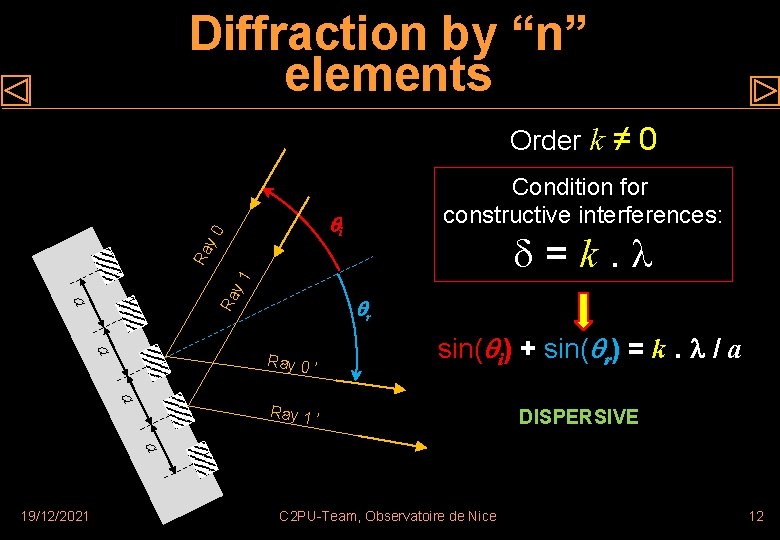
Diffraction by “n” elements Order k ≠ 0 Condition for constructive interferences: =k. a Ra y 1 Ra y 0 i r a a Ray 0 ’ Ray 1 ’ sin( i) + sin( r) = k. / a DISPERSIVE a 19/12/2021 C 2 PU-Team, Observatoire de Nice 12
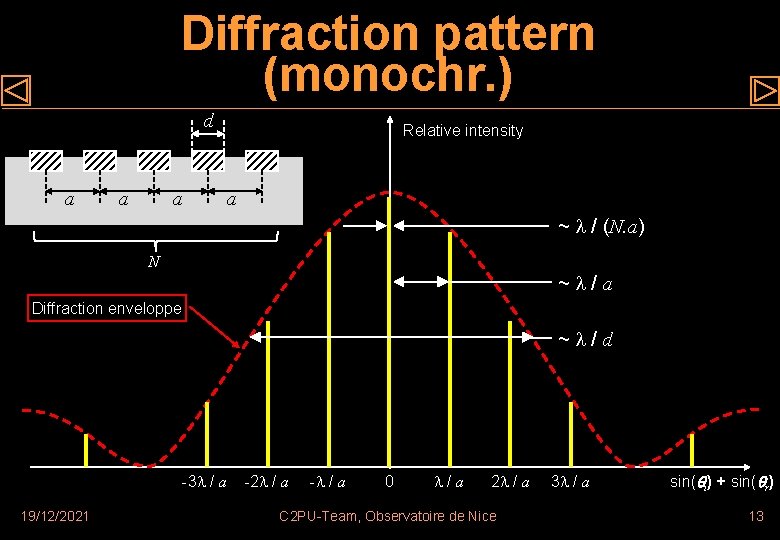
Diffraction pattern (monochr. ) d a a a Relative intensity a ~ / (N. a) N ~ /a Diffraction enveloppe ~ /d -3 / a 19/12/2021 -2 / a - / a 0 /a 2 / a C 2 PU-Team, Observatoire de Nice 3 / a sin( i) + sin( r) 13
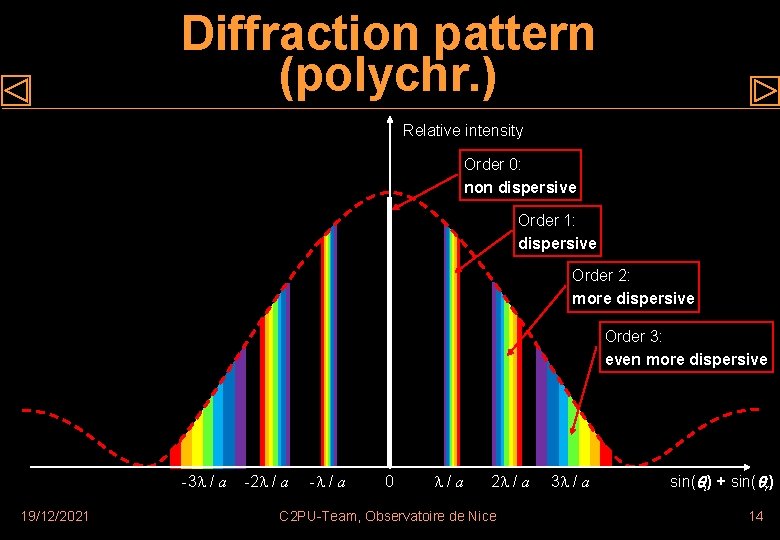
Diffraction pattern (polychr. ) Relative intensity Order 0: non dispersive Order 1: dispersive Order 2: more dispersive Order 3: even more dispersive -3 / a 19/12/2021 -2 / a - / a 0 /a 2 / a C 2 PU-Team, Observatoire de Nice 3 / a sin( i) + sin( r) 14
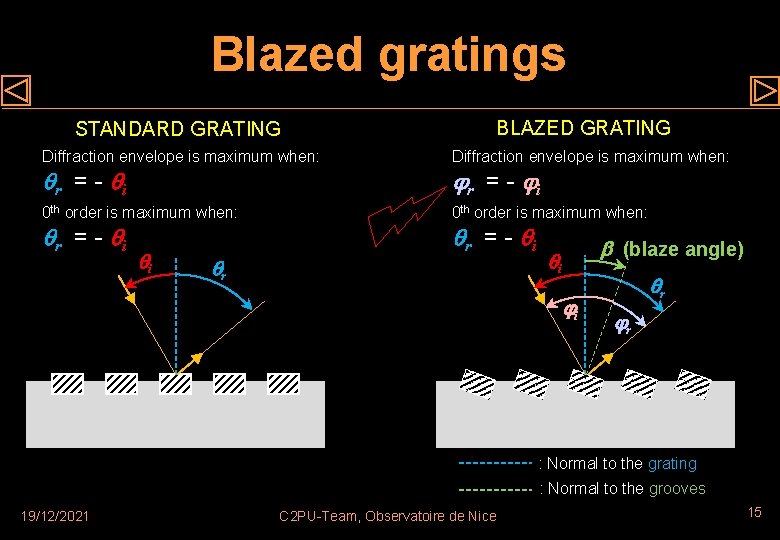
Blazed gratings STANDARD GRATING BLAZED GRATING Diffraction envelope is maximum when: 0 th order is maximum when: r = - i i r r = - i (blaze angle) i i r r : Normal to the grating : Normal to the grooves 19/12/2021 C 2 PU-Team, Observatoire de Nice 15
Diffraction pattern Relative intensity STANDARD GRATING Order 0: non dispersive Order 1: dispersive Order 2: more dispersive Order 3: even more dispersive -3 / a 19/12/2021 -2 / a - / a 0 /a 2 / a C 2 PU-Team, Observatoire de Nice 3 / a sin( i) + sin( r) 16
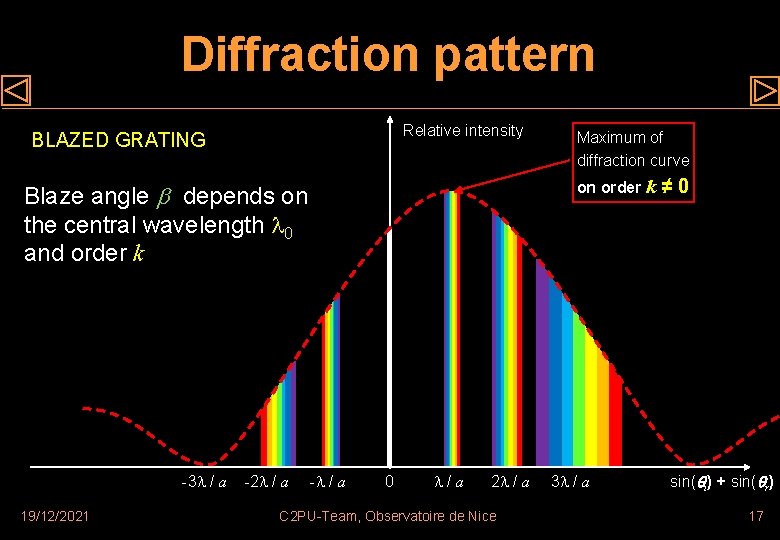
Diffraction pattern Relative intensity BLAZED GRATING on order k Blaze angle depends on the central wavelength 0 and order k -3 / a 19/12/2021 -2 / a Maximum of diffraction curve - / a 0 /a 2 / a C 2 PU-Team, Observatoire de Nice 3 / a ≠ 0 sin( i) + sin( r) 17
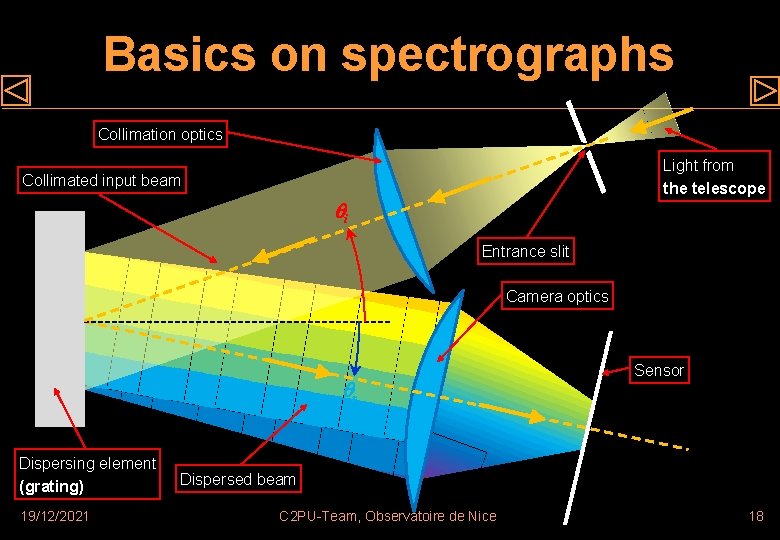
Basics on spectrographs Collimation optics Light from the telescope Collimated input beam i Entrance slit Camera optics r Dispersing element (grating) 19/12/2021 Sensor Dispersed beam C 2 PU-Team, Observatoire de Nice 18
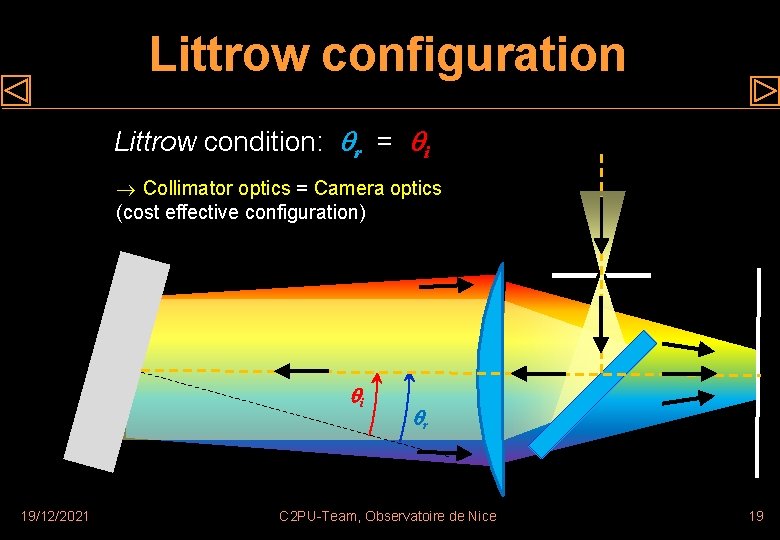
Littrow configuration Littrow condition: r = i Collimator optics = Camera optics (cost effective configuration) i 19/12/2021 r C 2 PU-Team, Observatoire de Nice 19
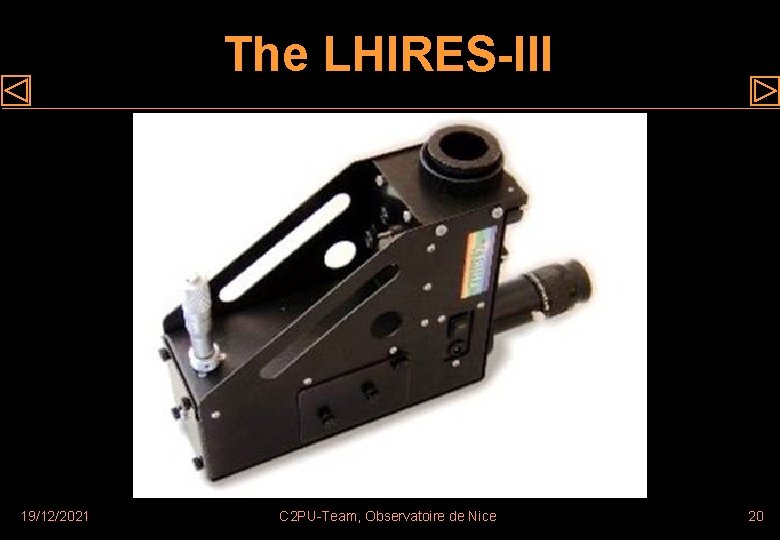
The LHIRES-III 19/12/2021 C 2 PU-Team, Observatoire de Nice 20
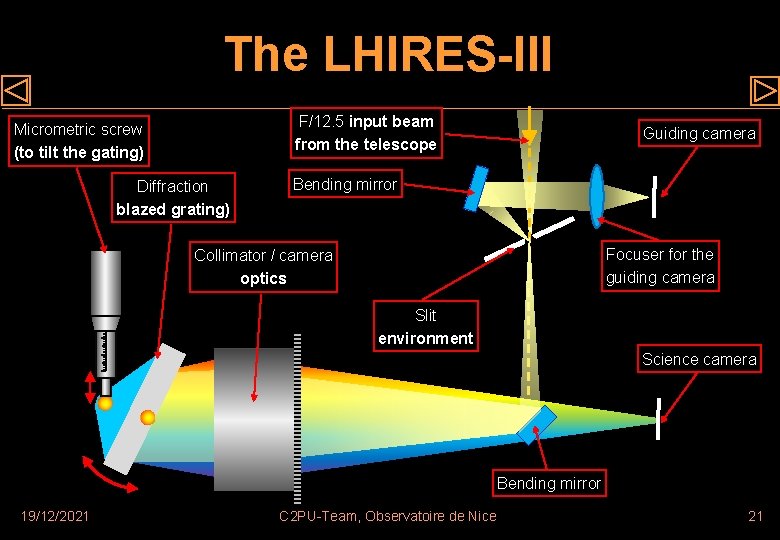
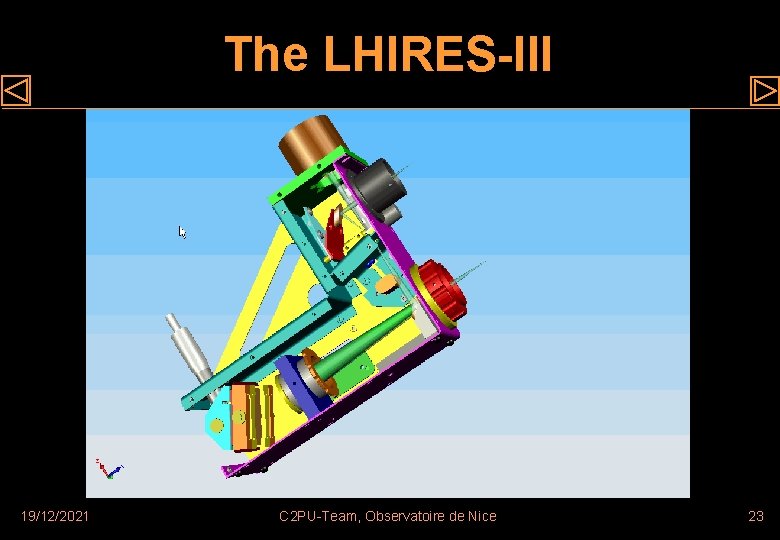
The LHIRES-III F/12. 5 input beam from the telescope Micrometric screw (to tilt the gating) Diffraction blazed grating) Guiding camera Bending mirror Focuser for the guiding camera Collimator / camera optics Slit environment Science camera Bending mirror 19/12/2021 C 2 PU-Team, Observatoire de Nice 21
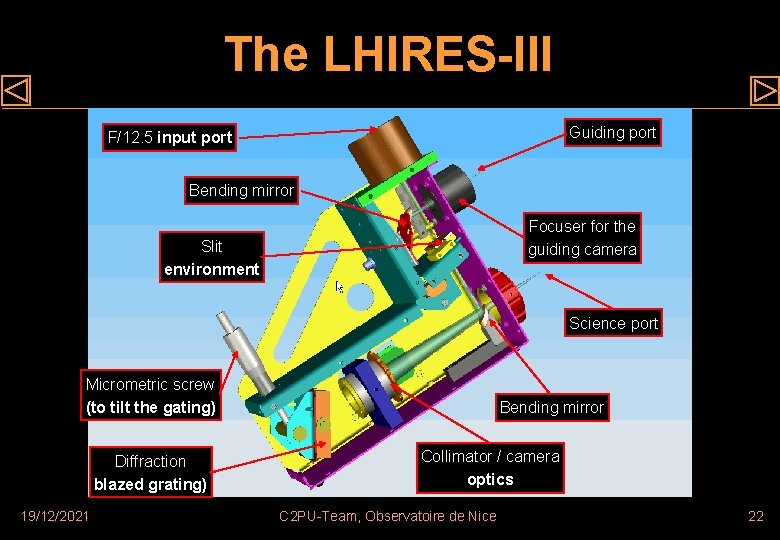
The LHIRES-III Guiding port F/12. 5 input port Bending mirror Focuser for the guiding camera Slit environment Science port Micrometric screw (to tilt the gating) Diffraction blazed grating) 19/12/2021 Bending mirror Collimator / camera optics C 2 PU-Team, Observatoire de Nice 22
The LHIRES-III 19/12/2021 C 2 PU-Team, Observatoire de Nice 23
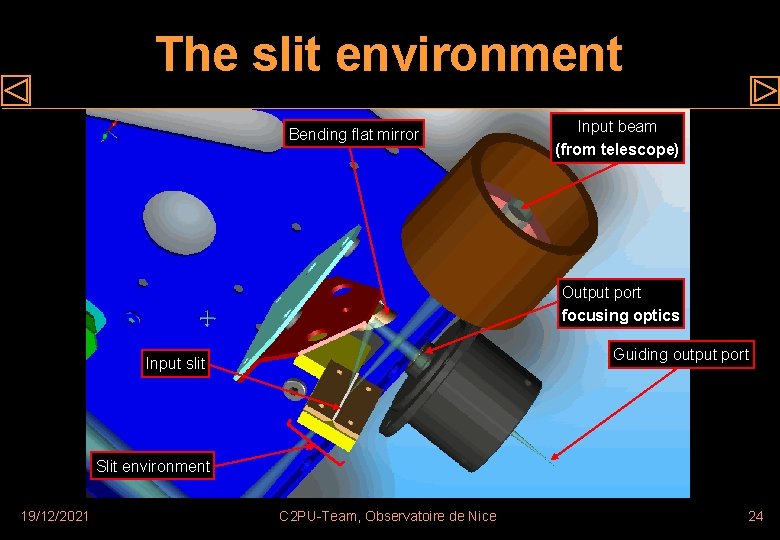
The slit environment Bending flat mirror Input beam (from telescope) Output port focusing optics Guiding output port Input slit Slit environment 19/12/2021 C 2 PU-Team, Observatoire de Nice 24
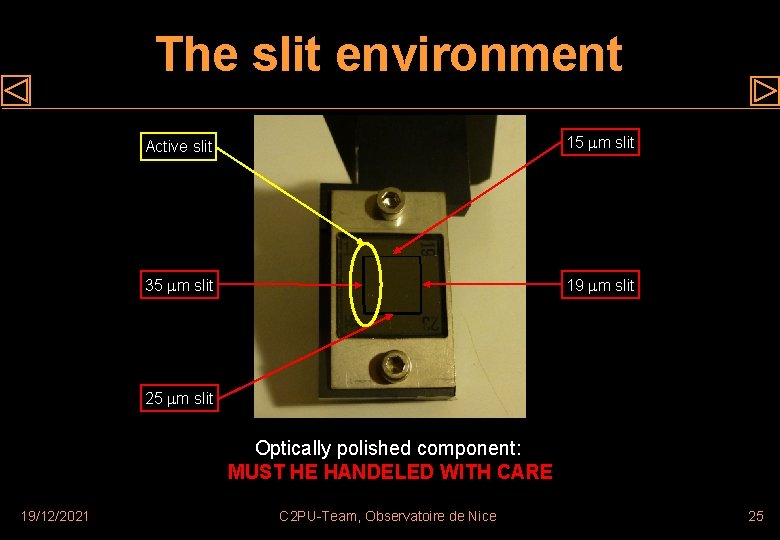
The slit environment Active slit 15 m slit 35 m slit 19 m slit 25 m slit Optically polished component: MUST HE HANDELED WITH CARE 19/12/2021 C 2 PU-Team, Observatoire de Nice 25
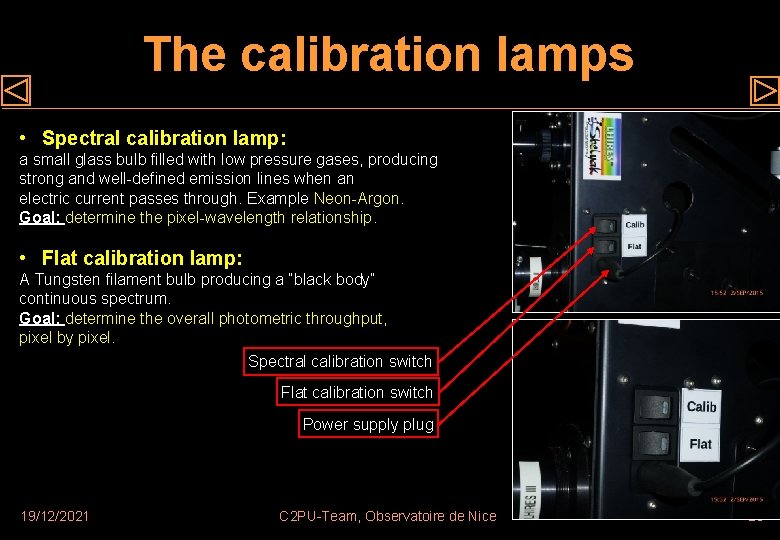
The calibration lamps • Spectral calibration lamp: a small glass bulb filled with low pressure gases, producing strong and well-defined emission lines when an electric current passes through. Example Neon-Argon. Goal: determine the pixel-wavelength relationship. • Flat calibration lamp: A Tungsten filament bulb producing a “black body” continuous spectrum. Goal: determine the overall photometric throughput, pixel by pixel. Spectral calibration switch Flat calibration switch Power supply plug 19/12/2021 C 2 PU-Team, Observatoire de Nice 26
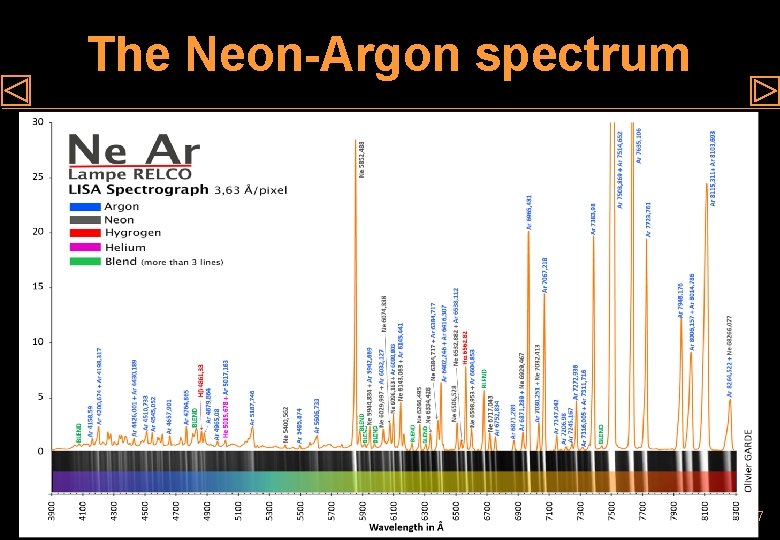
The Neon-Argon spectrum 19/12/2021 C 2 PU-Team, Observatoire de Nice 27
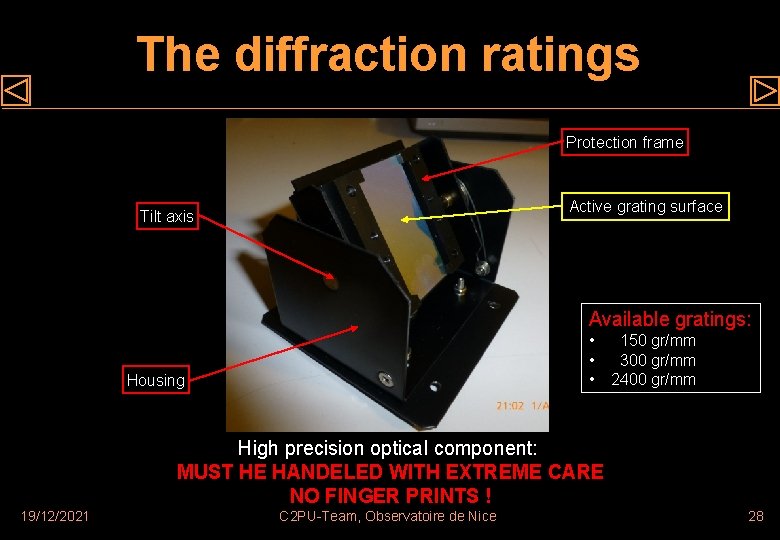
The diffraction ratings Protection frame Active grating surface Tilt axis Available gratings: • • • Housing 150 gr/mm 300 gr/mm 2400 gr/mm High precision optical component: MUST HE HANDELED WITH EXTREME CARE NO FINGER PRINTS ! 19/12/2021 C 2 PU-Team, Observatoire de Nice 28
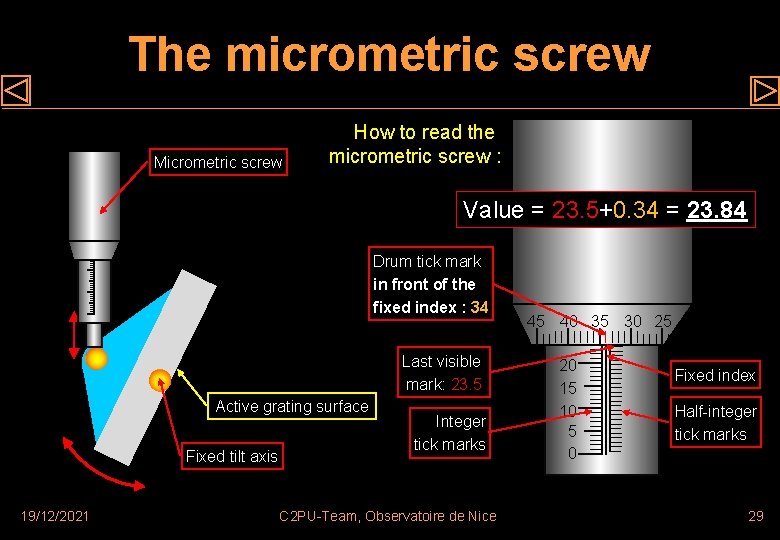
The micrometric screw Micrometric screw How to read the micrometric screw : Value = 23. 5+0. 34 = 23. 84 Drum tick mark in front of the fixed index : 34 Last visible mark: 23. 5 Active grating surface Fixed tilt axis 19/12/2021 Integer tick marks C 2 PU-Team, Observatoire de Nice 45 40 35 30 25 20 15 10 5 0 Fixed index Half-integer tick marks 29
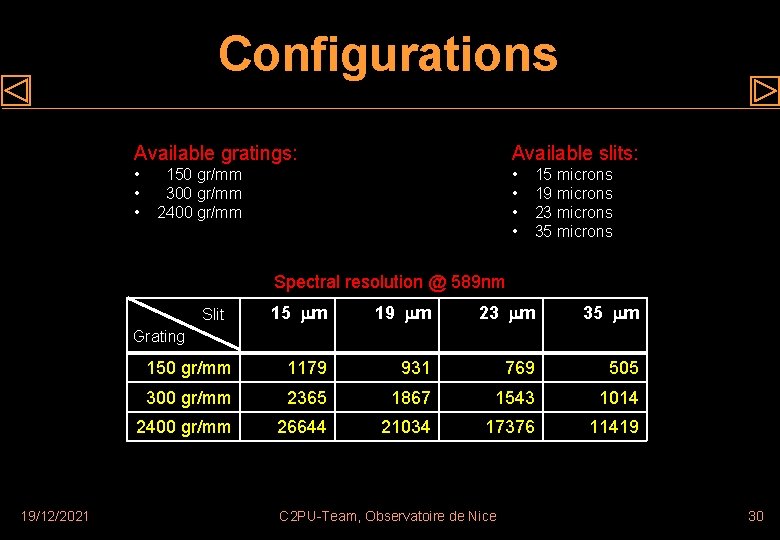
Configurations Available gratings: Available slits: • • 150 gr/mm 300 gr/mm 2400 gr/mm 15 microns 19 microns 23 microns 35 microns Spectral resolution @ 589 nm 15 m 19 m 23 m 35 m 150 gr/mm 1179 931 769 505 300 gr/mm 2365 1867 1543 1014 2400 gr/mm 26644 21034 17376 11419 Slit Grating 19/12/2021 C 2 PU-Team, Observatoire de Nice 30
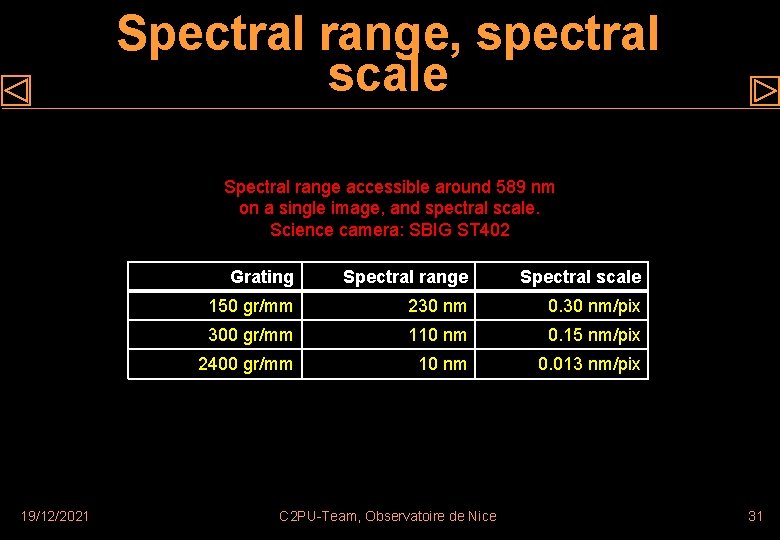
Spectral range, spectral scale Spectral range accessible around 589 nm on a single image, and spectral scale. Science camera: SBIG ST 402 19/12/2021 Grating Spectral range Spectral scale 150 gr/mm 230 nm 0. 30 nm/pix 300 gr/mm 110 nm 0. 15 nm/pix 2400 gr/mm 10 nm 0. 013 nm/pix C 2 PU-Team, Observatoire de Nice 31
Sample spectra The Hydrogen H line in the solar spectrum (LHIRES-III + 2400 gr/mm) 19/12/2021 32
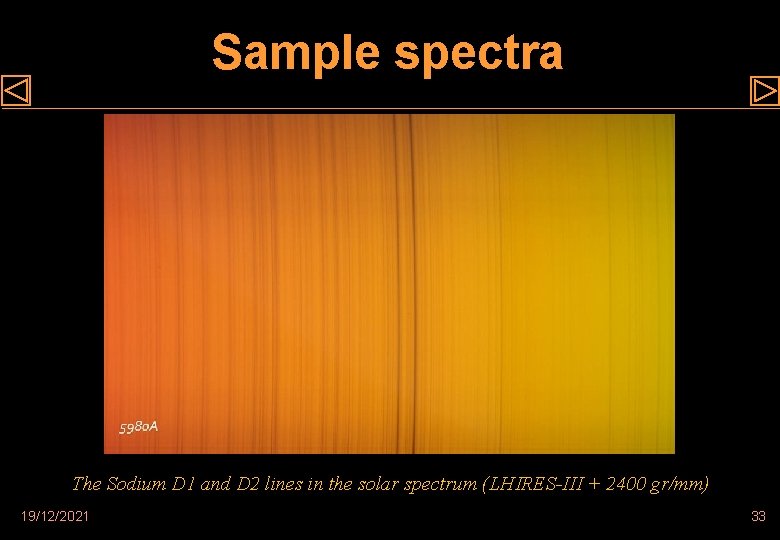
Sample spectra The Sodium D 1 and D 2 lines in the solar spectrum (LHIRES-III + 2400 gr/mm) 19/12/2021 33
Sample spectra The Magnesium triplet in the solar spectrum (LHIRES-III + 2400 gr/mm) 19/12/2021 34
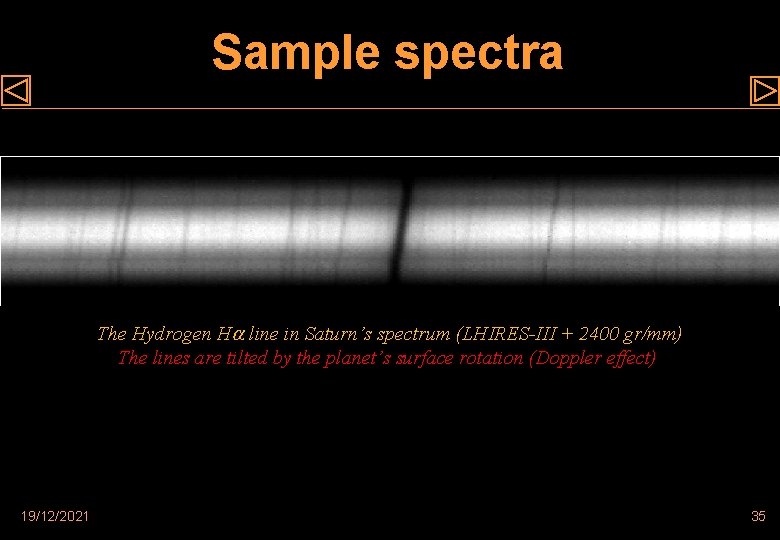
Sample spectra The Hydrogen H line in Saturn’s spectrum (LHIRES-III + 2400 gr/mm) The lines are tilted by the planet’s surface rotation (Doppler effect) 19/12/2021 35
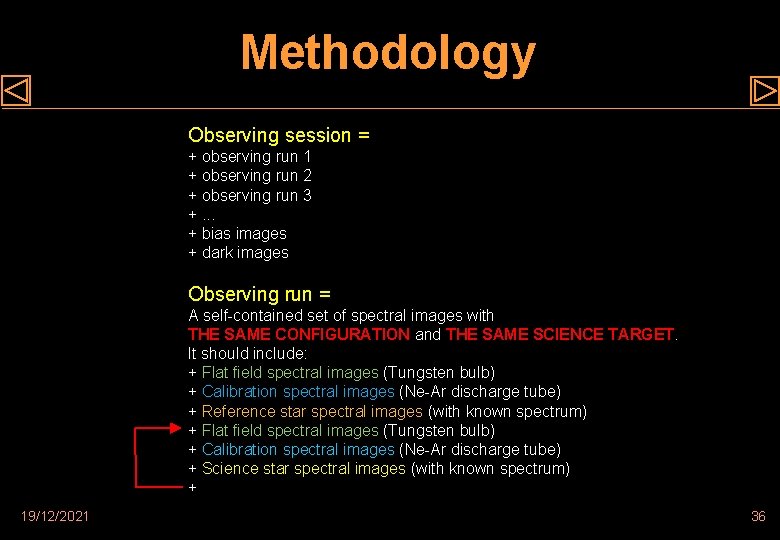
Methodology Observing session = + observing run 1 + observing run 2 + observing run 3 +. . . + bias images + dark images Observing run = A self-contained set of spectral images with THE SAME CONFIGURATION and THE SAME SCIENCE TARGET. It should include: + Flat field spectral images (Tungsten bulb) + Calibration spectral images (Ne-Ar discharge tube) + Reference star spectral images (with known spectrum) + Flat field spectral images (Tungsten bulb) + Calibration spectral images (Ne-Ar discharge tube) + Science star spectral images (with known spectrum) + 19/12/2021 36
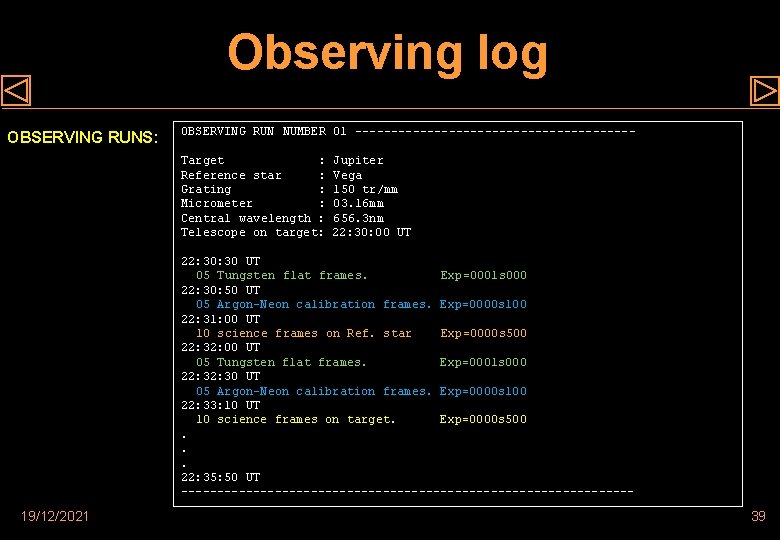
Methodology Rules for a good observing sessions: • Organize the session so as to minimize the grating changes. • Maintain the log file (see template) accurately, including UT timestamps before and after any group of similar frames, and before and after any hardware change (grating, micrometer). • Minimal working group: two persons (one person for log file and one for telescope/camera operation). • Do flat field and spectral calibration frames before any group of science frames (reference star or target). • Do reference star spectra only if absolute spectro-photometric calibration is needed. • Groups of science frames should not last more than 10 minutes. • Don’t forget to specify the type of frame (Flat, Callib, Science) to the acquisition software (it can’t guess). 19/12/2021 37
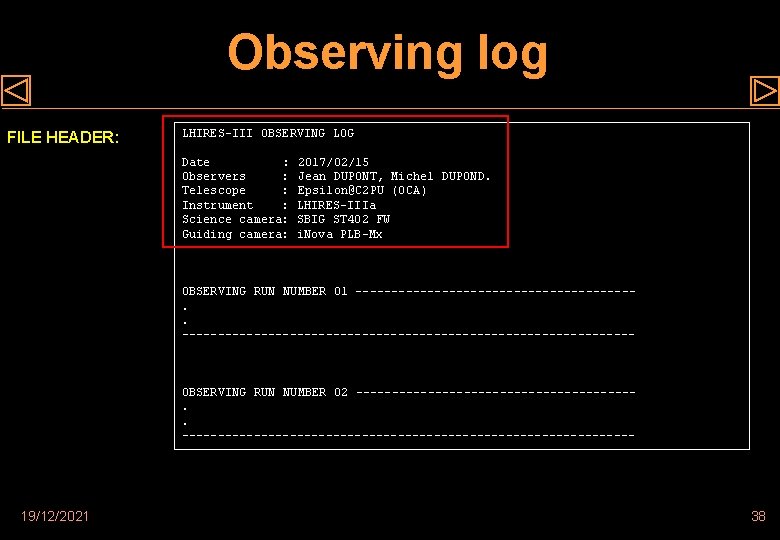
Observing log FILE HEADER: LHIRES-III OBSERVING LOG Date : Observers : Telescope : Instrument : Science camera: Guiding camera: 2017/02/15 Jean DUPONT, Michel DUPOND. Epsilon@C 2 PU (OCA) LHIRES-IIIa SBIG ST 402 FW i. Nova PLB-Mx OBSERVING RUN NUMBER 01 -------------------. . -------------------------------- OBSERVING RUN NUMBER 02 -------------------. . -------------------------------- 19/12/2021 38
Observing log OBSERVING RUNS: OBSERVING RUN NUMBER 01 -------------------Target : Reference star : Grating : Micrometer : Central wavelength : Telescope on target: Jupiter Vega 150 tr/mm 03. 16 mm 656. 3 nm 22: 30: 00 UT 22: 30 UT 05 Tungsten flat frames. Exp=0001 s 000 22: 30: 50 UT 05 Argon-Neon calibration frames. Exp=0000 s 100 22: 31: 00 UT 10 science frames on Ref. star Exp=0000 s 500 22: 32: 00 UT 05 Tungsten flat frames. Exp=0001 s 000 22: 30 UT 05 Argon-Neon calibration frames. Exp=0000 s 100 22: 33: 10 UT 10 science frames on target. Exp=0000 s 500. . . 22: 35: 50 UT -------------------------------- 19/12/2021 39