
Verilog VS VHDL By Kurt Leyba VHDL Verilog

Verilog VS VHDL By Kurt Leyba
¿VHDL & Verilog? • They are Hardware description languages. • They are each a notation to describe the behavioral and structural aspects of an electronic digital circuit.

VHDL Background • VHSIC Hardware Description Language. – VHSIC is an abbreviation for Very High Speed Integrated Circuit. • Developed by the department of defense (1981) – In 1986 rights where given to IEEE – Became a standard and published in 1987 – Revised standard we know published in 1993 (VHDL 1076 -1993) regulated by VHDL international (VI)
VHDL • Uses top-down approach to partition design into small blocks ‘components’ – Entity: describes interface signals & basic building blocks – Architecture: describes behavior, each entity can have multiple Architectures – Configuration: sort of parts list for a design, which behavior to use for each entity. – Package: toolbox used to build design
Verilog Background • Developed by Gateway Design Automation (1980) – Later acquired by Cadence Design(1989) who made it public in 1990 – Became a standardized in 1995 by IEEE (Std 1364) regulated by Open Verilog International (OVI)
VERILOG • Verilog only has one building block – Module: modules connect through their port similarly as in VHDL – Usually there is only one module per file. – A top level invokes instances of other modules. – Modules can be specified behaviorally or structurally. • Behavioral specification defines behavior of digital system • Structural specification defines hierarchical interconnection of sub modules
Similarities • These languages have taken designers from low level detail to much higher level of abstraction. • In 2000 VI & OVI merged into Accellera • Simulation & synthesis are the two main kinds of tools which operate on the VHDL & Verilog languages. • They are not a toolset or methodology they are each a different language. – However toolsets and methodologies are essential for their effective use.
Differences? • There are not many differences as to the capabilities of each. • The choice of which one to use is often based in personal preference & other issues such as availability of tools & commercial terms. • VHDL is “harder” to learn ADA-like. • Verilog is “easier” to learn C-like.
Market analysis • According to Gary Smith, EDA Analyst at Dataquest, he says that although Verilog is dominating the market, it is going into the use of a mix of Verilog and VHDL. (report of march 2000)
EDA Tools • Electronic Design Automation Tools • Looking at the market trend and we have to look at tools that is not just specific to one language but that can integrate both languages. • Out of all the different tools I’ve seen model SIM by Model inc, is the one that should be used both Altera & Xilinx recommend it, and it’s free for download from their websites. • Model inc university program
EDA Tools • Altera & Xilinx both have their own design environment Max + Plus II & ISE respectively. • They each have their own board to use with programs. The boards vary a lot in prices. • I ended using Altera’s environment & board (kit) which can be purchased at Altera for $150
Simulation of counters • Demonstration of simple verilog & vhdl
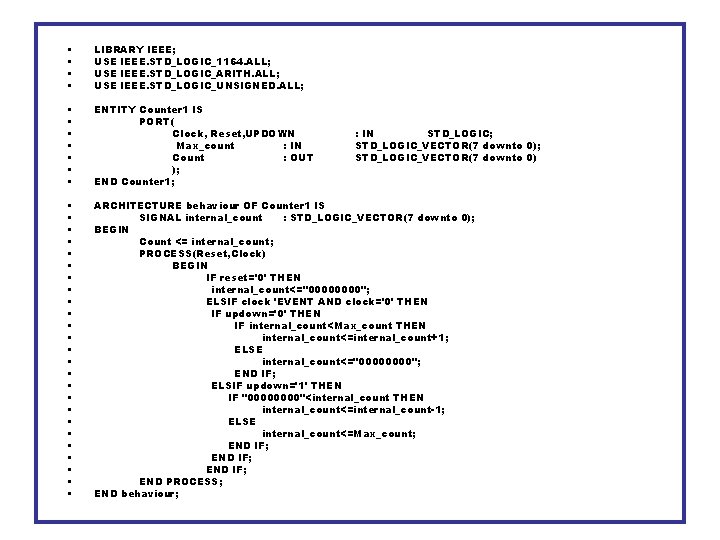
• • LIBRARY IEEE; USE IEEE. STD_LOGIC_1164. ALL; USE IEEE. STD_LOGIC_ARITH. ALL; USE IEEE. STD_LOGIC_UNSIGNED. ALL; • • ENTITY Counter 1 IS PORT( Clock, Reset, UPDOWN Max_count : IN Count : OUT ); END Counter 1; • • • • • • • ARCHITECTURE behaviour OF Counter 1 IS SIGNAL internal_count : STD_LOGIC_VECTOR(7 downto 0); BEGIN Count <= internal_count; PROCESS(Reset, Clock) BEGIN IF reset='0' THEN internal_count<="0000"; ELSIF clock 'EVENT AND clock='0' THEN IF updown='0' THEN IF internal_count<Max_count THEN internal_count<=internal_count+1; ELSE internal_count<="0000"; END IF; ELSIF updown='1' THEN IF "0000"<internal_count THEN internal_count<=internal_count-1; ELSE internal_count<=Max_count; END IF; END PROCESS; END behaviour; : IN STD_LOGIC; STD_LOGIC_VECTOR(7 downto 0)
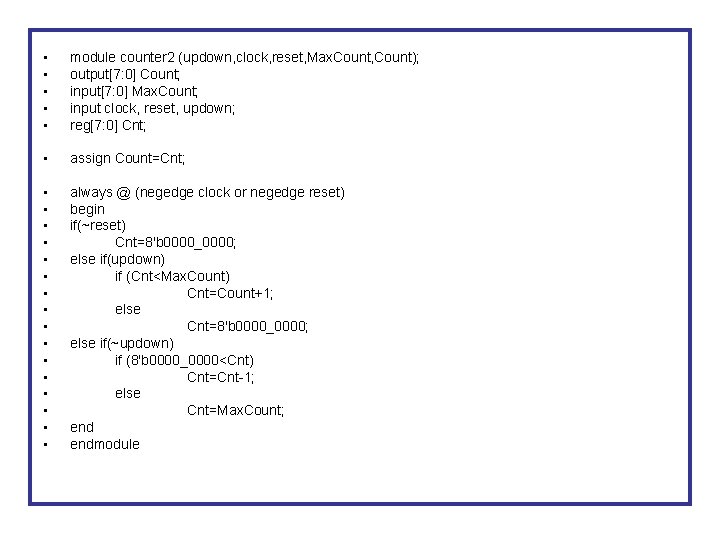
• • • module counter 2 (updown, clock, reset, Max. Count, Count); output[7: 0] Count; input[7: 0] Max. Count; input clock, reset, updown; reg[7: 0] Cnt; • assign Count=Cnt; • • • • always @ (negedge clock or negedge reset) begin if(~reset) Cnt=8'b 0000_0000; else if(updown) if (Cnt<Max. Count) Cnt=Count+1; else Cnt=8'b 0000_0000; else if(~updown) if (8'b 0000_0000<Cnt) Cnt=Cnt-1; else Cnt=Max. Count; endmodule
Book Excellent resource fro VHDL & Verilog Digital System Design and Prototyping Using Field Programmable Logic and Hardware Description Language Author: Zoran Salcic Asim Smailagic Kluwer Academic Publishers ISBN: 0 -7923 -7920 -9
- Slides: 15