
VERIFY Observationbased system for monitoring and verification of
VERIFY: Observation-based system for monitoring and verification of greenhouse gases VERIFY partners Contributions from : R. Petrescu, R. Thomson, R. Andrews, H. Dolman, D. Günther, L. Perugini, G. Peters, G. Maenhout, P. Peylin, P. Ciais • • Funded by H 2020 from 2018 to 2021 Consortium of 38 institutes and inventory agencies Coordinated by LSCE ( P. Peylin ) Designed to : – Advance the methods for quantifying GHG emissions and sinks – Facilitate the development of a GHG verification system for practical use for policy and societal stakeholders.
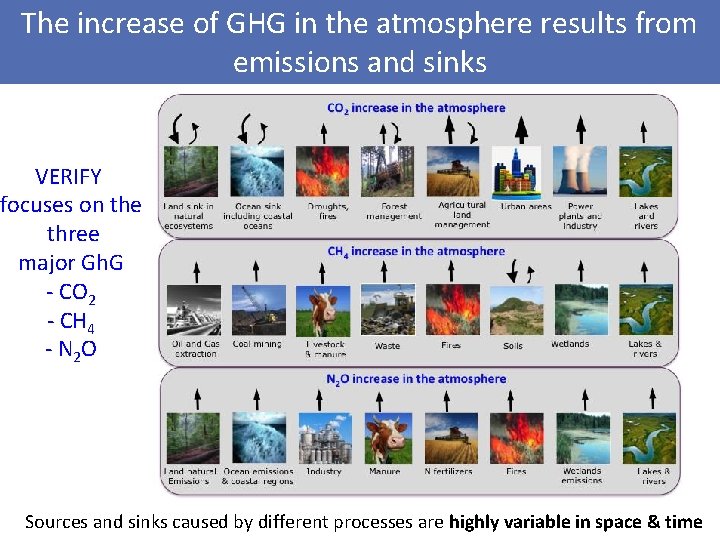
The increase of GHG in the atmosphere results from emissions and sinks VERIFY focuses on the three major Gh. G - CO 2 - CH 4 - N 2 O Sources and sinks caused by different processes are highly variable in space & time
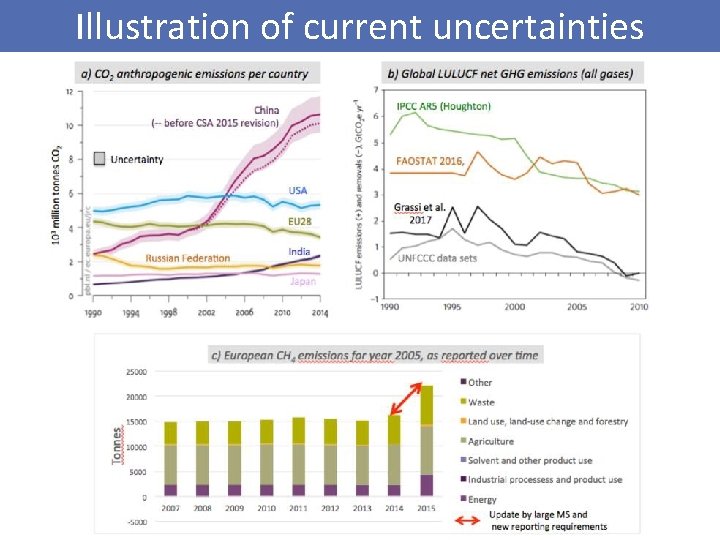
Illustration of current uncertainties

Project objectives • Objective 1. Integrate the efforts between the research community, operational centers, national inventory compilers and international organizations for actionable GHG flux estimates. • Objective 2. Enhance the current observation and modeling ability to quantify accurately the land-use fluxes of GHGs for the tracking of land-based mitigation activities. • Objective 3. Develop new research to monitor anthropogenic GHG emissions in support of the EU commitments. • Objective 4. Produce periodical scientific synthesis of the national GHG balance in Europe and practical assessments using methodologies that can be scaled-up to other regions.
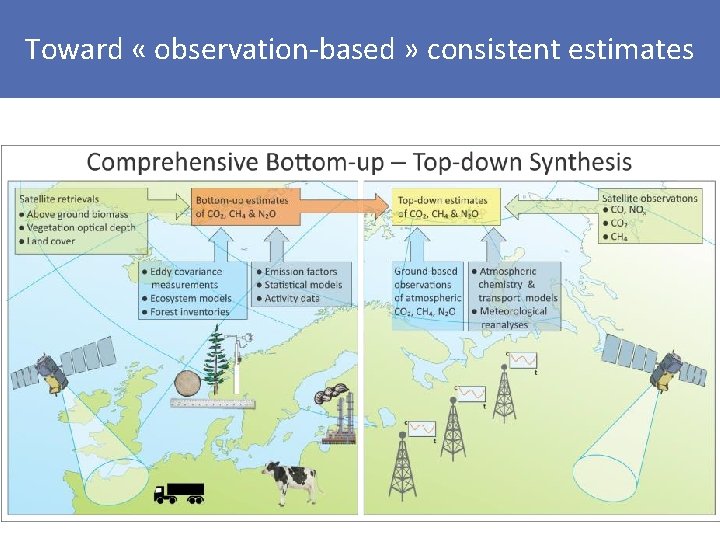
Toward « observation-based » consistent estimates
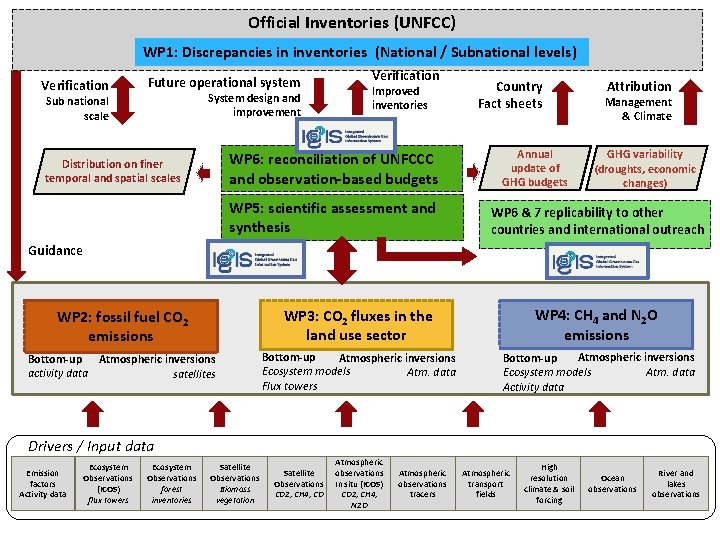
Official Inventories (UNFCC) WP 1: Discrepancies in inventories (National / Subnational levels) Verification Future operational system System design and improvement Sub national scale Verification Improved inventories WP 6: reconciliation of UNFCCC and observation-based budgets Distribution on finer temporal and spatial scales WP 5: scientific assessment and synthesis Country Fact sheets Annual update of GHG budgets Attribution Management & Climate GHG variability (droughts, economic changes) WP 6 & 7 replicability to other countries and international outreach Guidance WP 2: fossil fuel CO 2 emissions WP 3: CO 2 fluxes in the land use WPsector WP 4: CH 4 and N 2 O emissions Bottom-up Atmospheric inversions activity data satellites Bottom-up Atmospheric inversions Ecosystem models Atm. data Flux towers Atmospheric inversions Bottom-up Atm. data Ecosystem models Activity data Drivers / Input data Emission factors Activity data Ecosystem Observations (ICOS) flux towers Ecosystem Observations forest inventories Satellite Observations Biomass vegetation Satellite Observations CO 2, CH 4, CO Atmospheric observations In situ (ICOS) CO 2, CH 4, N 2 O Atmospheric observations tracers Atmospheric transport fields High resolution climate & soil forcing Ocean observations River and lakes observations

Global Stock Take GST • GST is the main tool for the assessment of the achievement of the global targets of the PA. • Two main sources of data: – globally aggregated data from the NGHGI reports 13. 7(a)) of the PA – best available science (art 14. 1) such as IPCC. • This will require comparability between these two data sources! Source Grassi et al 2018 NCC 7
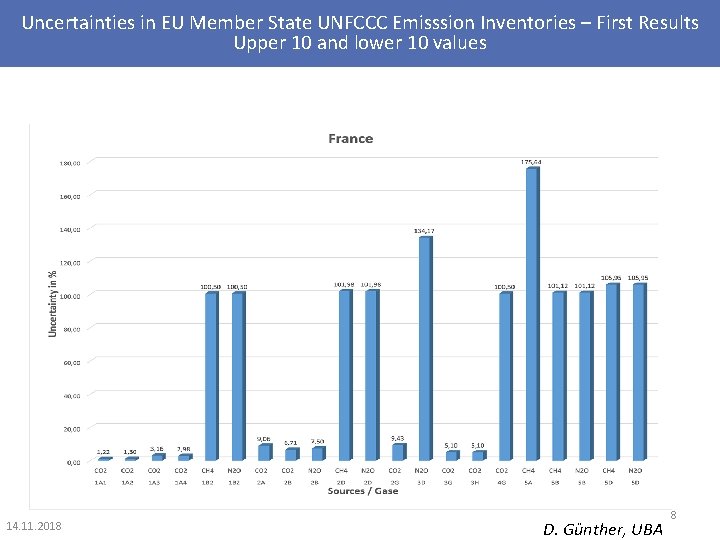
Uncertainties in EU Member State UNFCCC Emisssion Inventories – First Results Upper 10 and lower 10 values 14. 11. 2018 D. Günther, UBA 8
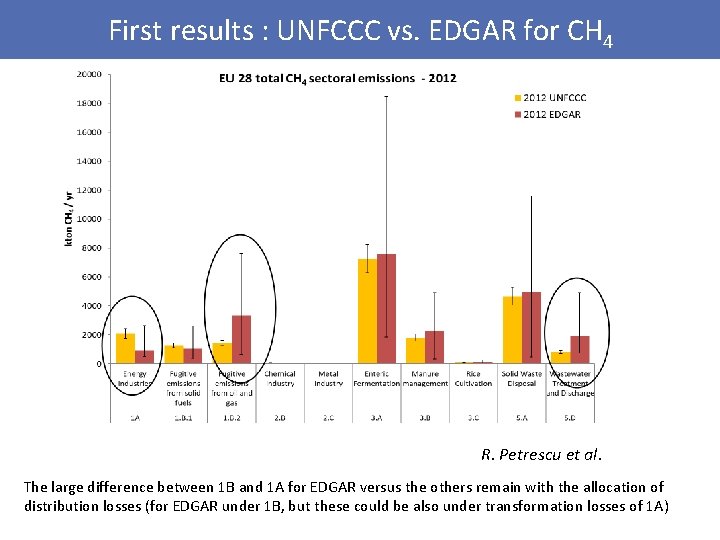
First results : UNFCCC vs. EDGAR for CH 4 R. Petrescu et al. The large difference between 1 B and 1 A for EDGAR versus the others remain with the allocation of distribution losses (for EDGAR under 1 B, but these could be also under transformation losses of 1 A)

Bottom-up EF data and uncertainties R. Petrescu et al. Total EU 28 Agriculture CH 4 emissions from five data sources, UNFCCC, EDGAR, FAO, CAPRI and GAINS. CAPRI: Tier 2 and 3, some countries use same mean EF than CAPRI
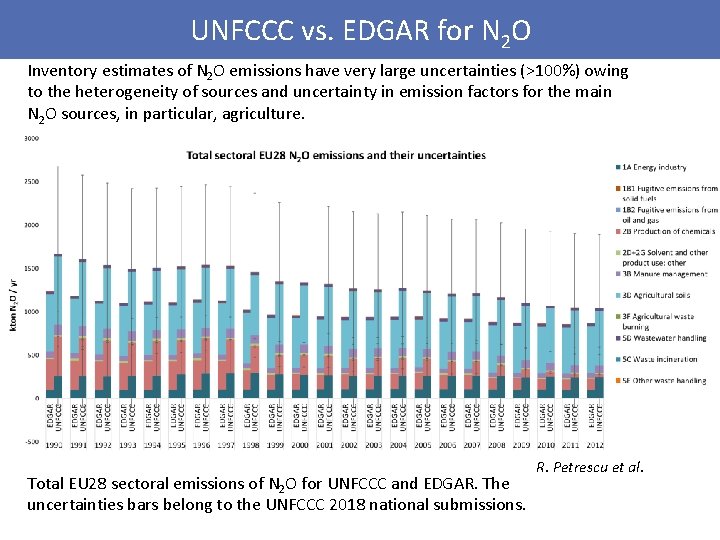
UNFCCC vs. EDGAR for N 2 O Inventory estimates of N 2 O emissions have very large uncertainties (>100%) owing to the heterogeneity of sources and uncertainty in emission factors for the main N 2 O sources, in particular, agriculture. Total EU 28 sectoral emissions of N 2 O for UNFCCC and EDGAR. The uncertainties bars belong to the UNFCCC 2018 national submissions. R. Petrescu et al.
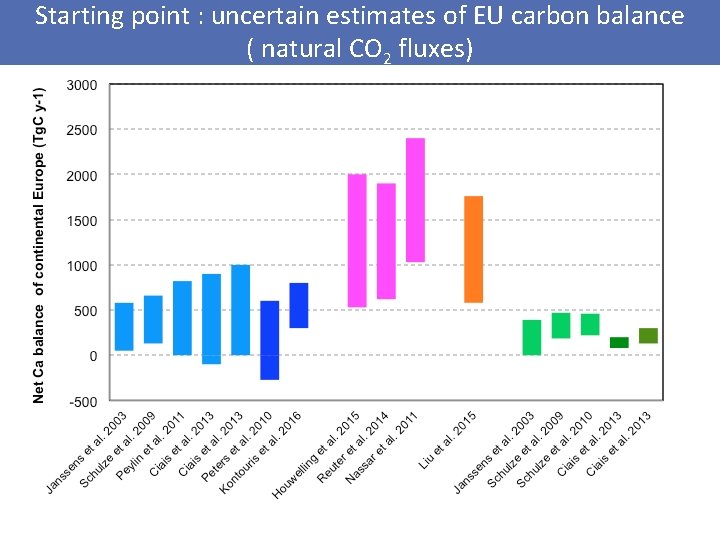
Starting point : uncertain estimates of EU carbon balance ( natural CO 2 fluxes)
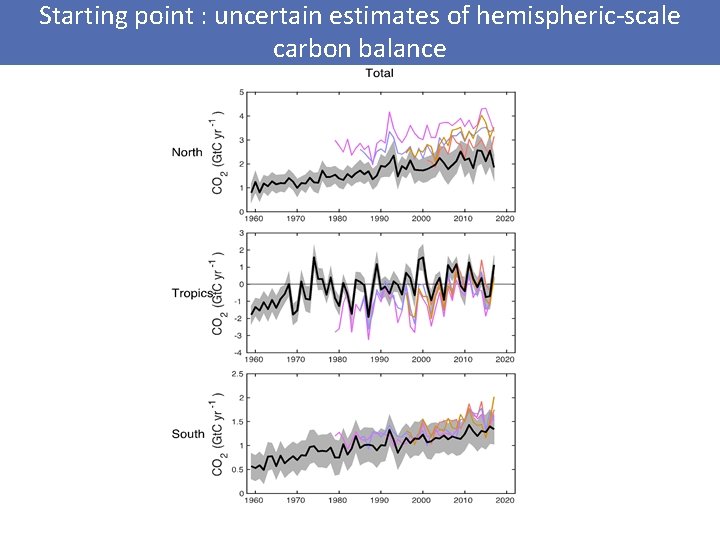
Starting point : uncertain estimates of hemispheric-scale carbon balance
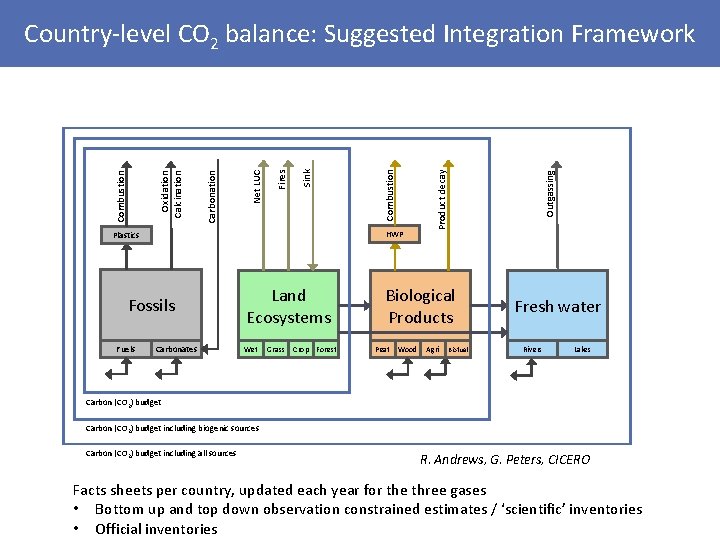
Fossils Carbonates Land Ecosystems Wet Grass Crop Forest Biological Products Peat Wood Agri Biofuel Outgassing Product decay HWP Plastics Fuels Combustion Sink Fires Net LUC Carbonation Combustion Oxidation Calcination Country-level CO 2 balance: Suggested Integration Framework Fresh water Rivers Lakes Carbon (CO 2) budget including biogenic sources Carbon (CO 2) budget including all sources R. Andrews, G. Peters, CICERO Facts sheets per country, updated each year for the three gases • Bottom up and top down observation constrained estimates / ‘scientific’ inventories • Official inventories
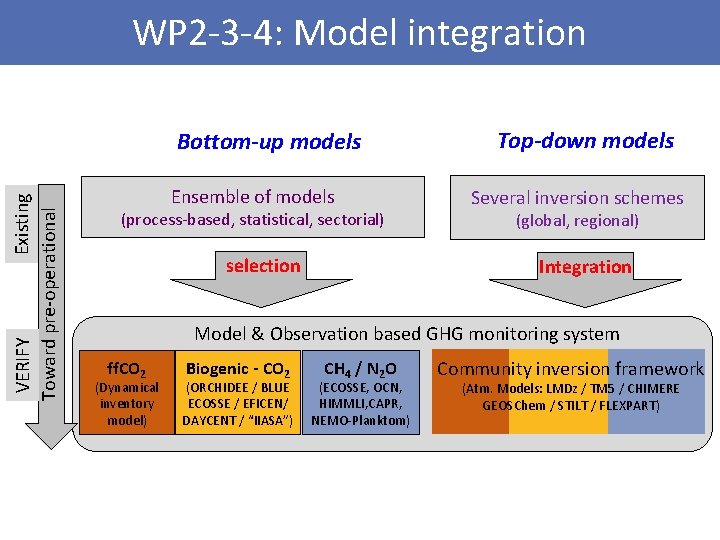
WP 2 -3 -4: Model integration Existing VERIFY Toward pre-operational Bottom-up models Ensemble of models (process-based, statistical, sectorial) selection Top-down models Several inversion schemes (global, regional) Integration Model & Observation based GHG monitoring system ff. CO 2 (Dynamical inventory model) Biogenic - CO 2 (ORCHIDEE / BLUE ECOSSE / EFICEN/ DAYCENT / “IIASA”) CH 4 / N 2 O (ECOSSE, OCN, HIMMLI, CAPR, NEMO-Planktom) Community inversion framework (Atm. Models: LMDz / TM 5 / CHIMERE GEOSChem / STILT / FLEXPART)
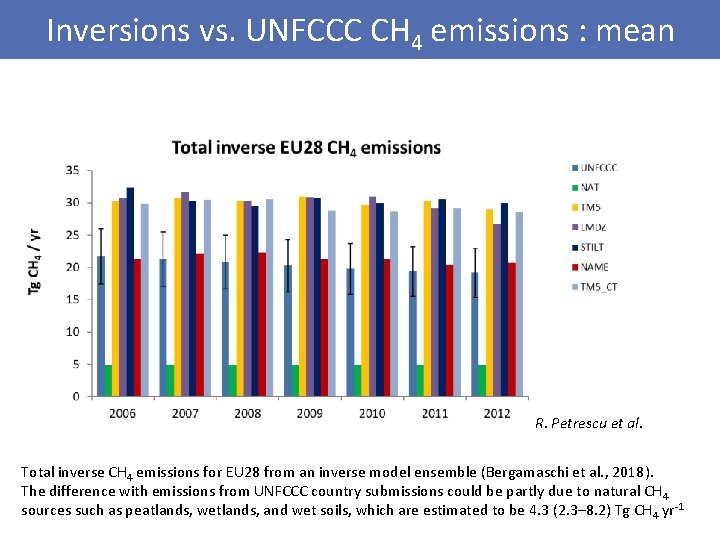
Inversions vs. UNFCCC CH 4 emissions : mean R. Petrescu et al. Total inverse CH 4 emissions for EU 28 from an inverse model ensemble (Bergamaschi et al. , 2018). The difference with emissions from UNFCCC country submissions could be partly due to natural CH 4 sources such as peatlands, wetlands, and wet soils, which are estimated to be 4. 3 (2. 3– 8. 2) Tg CH 4 yr-1
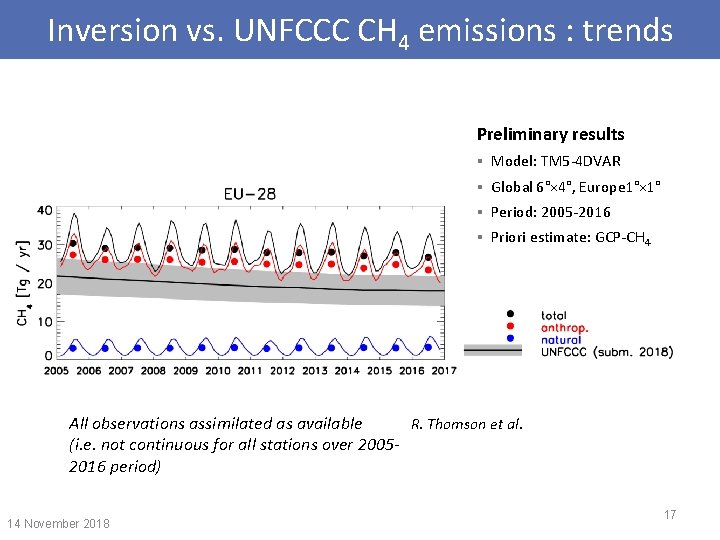
Inversion vs. UNFCCC CH 4 emissions : trends Preliminary results § Model: TM 5 -4 DVAR § Global 6°× 4°, Europe 1°× 1° § Period: 2005 -2016 § Priori estimate: GCP-CH 4 All observations assimilated as available R. Thomson et al. (i. e. not continuous for all stations over 20052016 period) 14 November 2018 17
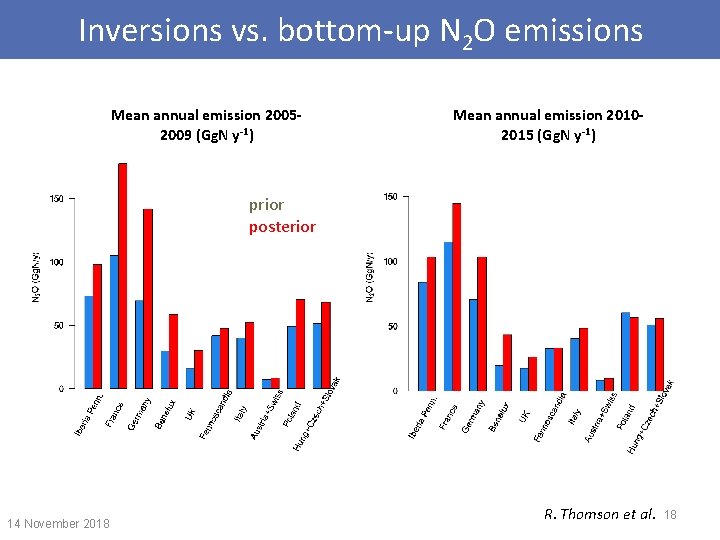
Inversions vs. bottom-up N 2 O emissions Mean annual emission 20052009 (Gg. N y-1) Mean annual emission 20102015 (Gg. N y-1) prior posterior 14 November 2018 R. Thomson et al. 18
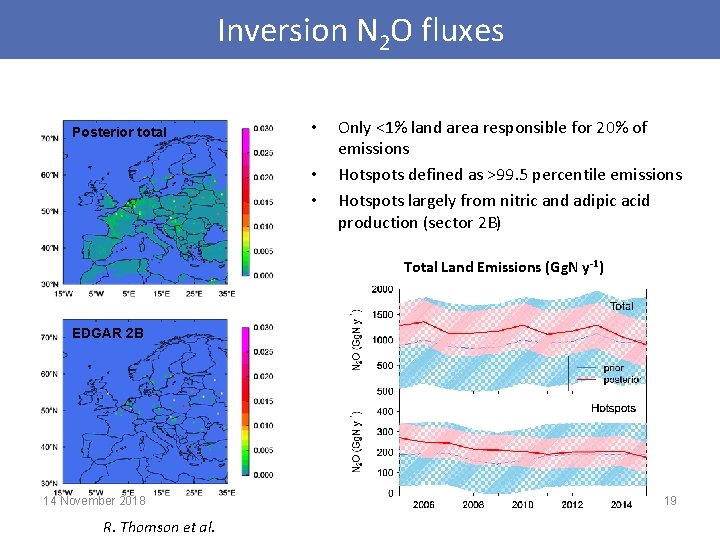
Inversion N 2 O fluxes Posterior total • • • Only <1% land area responsible for 20% of emissions Hotspots defined as >99. 5 percentile emissions Hotspots largely from nitric and adipic acid production (sector 2 B) Total Land Emissions (Gg. N y-1) EDGAR 2 B 14 November 2018 R. Thomson et al. 19
Community Inversion framework Develop a new Community Inversion Framework (CIF) which will be suitable for a future operational GHG monitoring system • Built to run with different atmospheric transport models, regional and global, Eulerian and Lagrangian assess errors due to modelled transport • Flexible, transparent and open-source tool to estimate the fluxes of different GHGs both at global and regional scales. • Include a modelled transport evaluation package to exploit campaign-based observations, especially from the IAGOS airliner measurement programme.
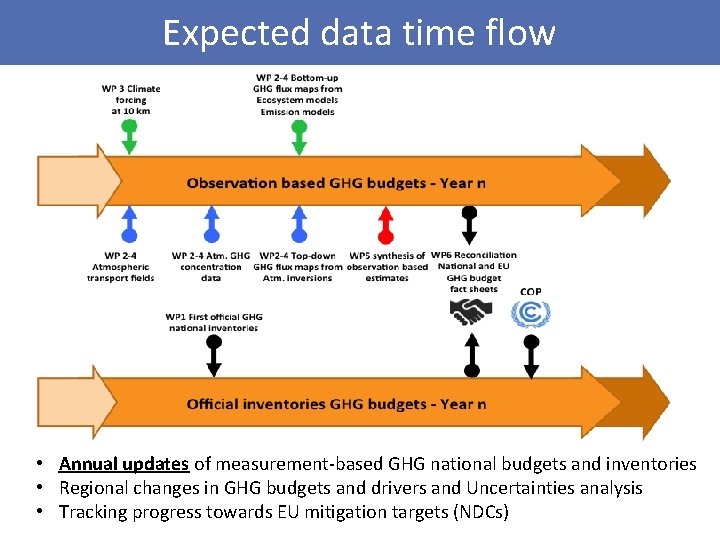
Expected dataoutput time flow Expected • Annual updates of measurement-based GHG national budgets and inventories • Regional changes in GHG budgets and drivers and Uncertainties analysis • Tracking progress towards EU mitigation targets (NDCs)
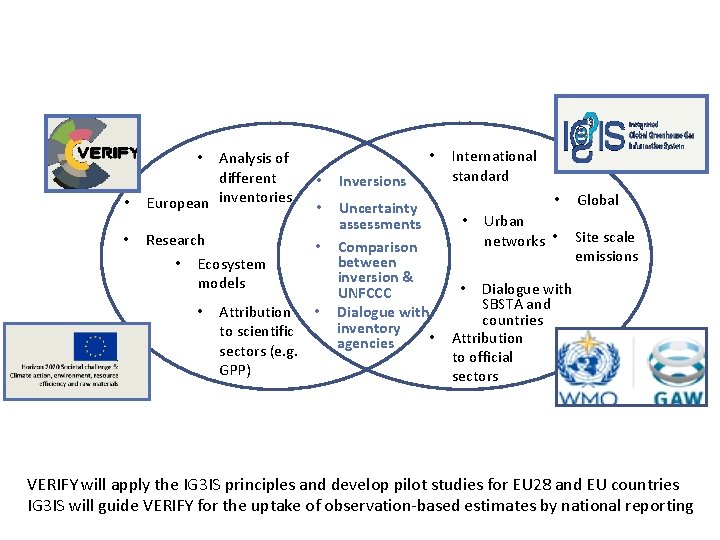
• Analysis of different European inventories • Inversions • Research • Uncertainty assessments Comparison between inversion & UNFCCC Dialogue with inventory • agencies • • Ecosystem models • Attribution to scientific sectors (e. g. GPP) • International standard • • Urban networks • Global Site scale emissions Dialogue with SBSTA and countries Attribution to official sectors • VERIFY will apply the IG 3 IS principles and develop pilot studies for EU 28 and EU countries IG 3 IS will guide VERIFY for the uptake of observation-based estimates by national reporting
Thank you… VERIFY will apply the IG 3 IS principles and develop pilot studies for EU 28 and EU countries IG 3 IS will guide VERIFY for the uptake of observation-based estimates by national reporting
- Slides: 23