
Verificationism and religious language Michael Lacewing enquiriesalevelphilosophy co
- Slides: 10
Verificationism and religious language Michael Lacewing enquiries@alevelphilosophy. co. uk
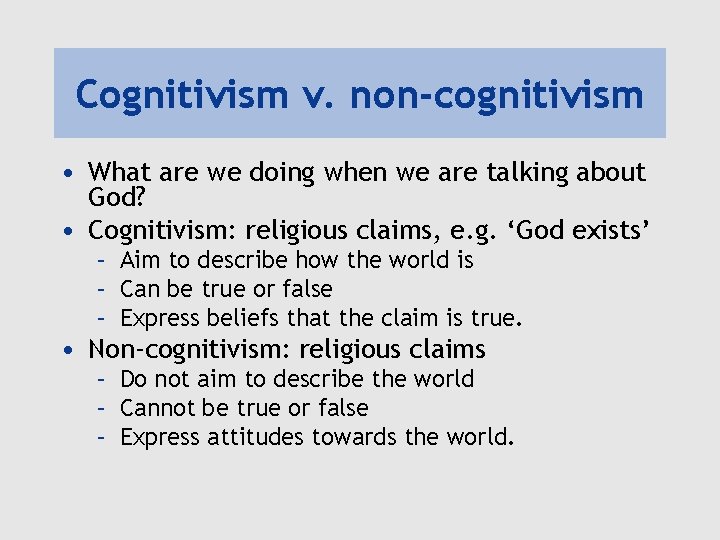
Cognitivism v. non-cognitivism • What are we doing when we are talking about God? • Cognitivism: religious claims, e. g. ‘God exists’ – Aim to describe how the world is – Can be true or false – Express beliefs that the claim is true. • Non-cognitivism: religious claims – Do not aim to describe the world – Cannot be true or false – Express attitudes towards the world.
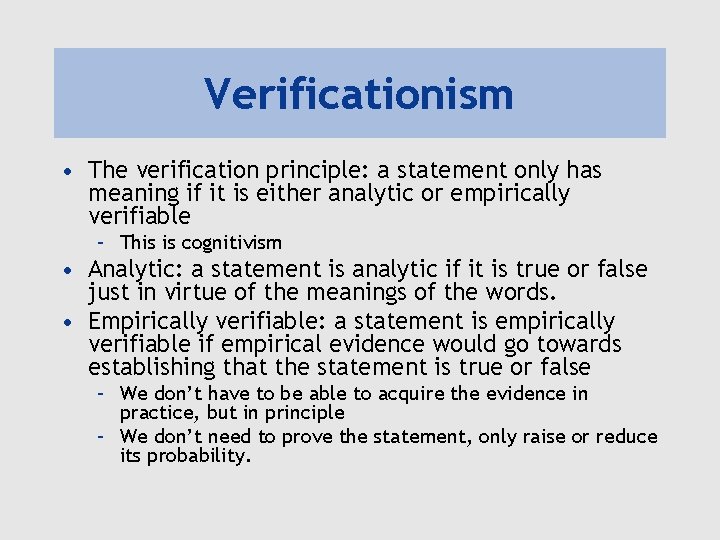
Verificationism • The verification principle: a statement only has meaning if it is either analytic or empirically verifiable – This is cognitivism • Analytic: a statement is analytic if it is true or false just in virtue of the meanings of the words. • Empirically verifiable: a statement is empirically verifiable if empirical evidence would go towards establishing that the statement is true or false – We don’t have to be able to acquire the evidence in practice, but in principle – We don’t need to prove the statement, only raise or reduce its probability.
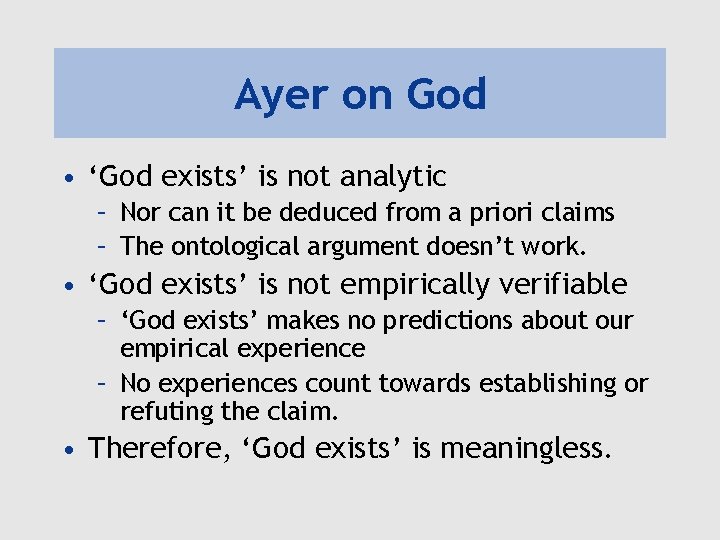
Ayer on God • ‘God exists’ is not analytic – Nor can it be deduced from a priori claims – The ontological argument doesn’t work. • ‘God exists’ is not empirically verifiable – ‘God exists’ makes no predictions about our empirical experience – No experiences count towards establishing or refuting the claim. • Therefore, ‘God exists’ is meaningless.
Widening empirical verification • Objection: Ayer understands ‘verification’ too narrowly – ‘God exists’ can’t be directly tested against empirical experience – However, its probability is raised or reduced by how it makes sense of empirical experience, e. g. as an inference to the best explanation – The problem of evil and argument from design are relevant.
Hick: eschatological verification • Verification: removing rational doubt, ignorance or uncertainty through experience. • Claims involve predictions about experience under conditions. • ‘God exists’ makes no predictions about our experience in this life, but does make predictions about our experience in life after death – This is eschatological verification.
Rejecting the verification principle • According the verification principle, the principle itself is meaningless – ‘a statement only has meaning if it is analytic or can be verified empirically’ is not analytic – And cannot be verified empirically. • If the principle is meaningless, it is not true. • If it is not true, it cannot show that religious language is meaningless.
Ayer’s response • The principle is intended as a definition. • Whether it is the right definition of ‘meaning’ is established by arguments about its implications. • Objection: if we are not convinced by the implications, we will not accept it as a definition. • The principle provides no independent support for thinking that religious language is meaningless.
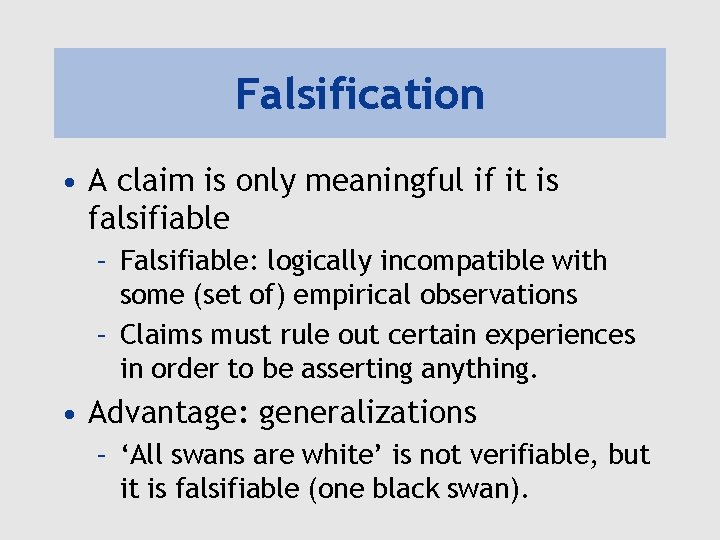
Falsification • A claim is only meaningful if it is falsifiable – Falsifiable: logically incompatible with some (set of) empirical observations – Claims must rule out certain experiences in order to be asserting anything. • Advantage: generalizations – ‘All swans are white’ is not verifiable, but it is falsifiable (one black swan).
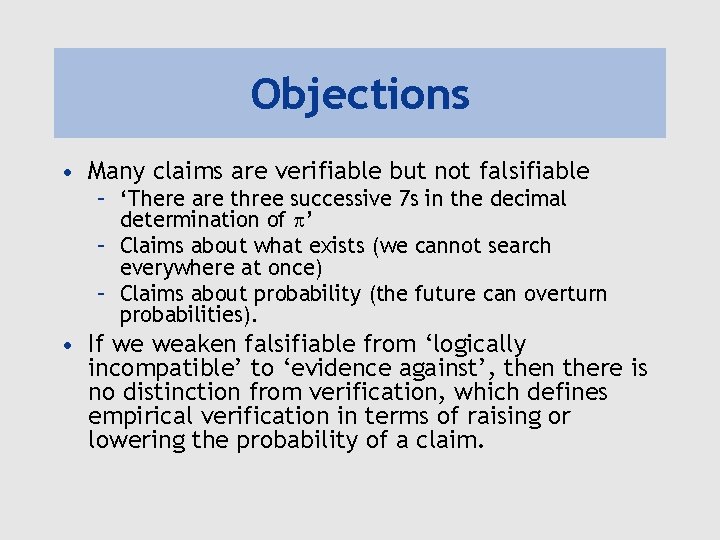
Objections • Many claims are verifiable but not falsifiable – ‘There are three successive 7 s in the decimal determination of ’ – Claims about what exists (we cannot search everywhere at once) – Claims about probability (the future can overturn probabilities). • If we weaken falsifiable from ‘logically incompatible’ to ‘evidence against’, then there is no distinction from verification, which defines empirical verification in terms of raising or lowering the probability of a claim.