
VERIFICATION SYNTHESIS AND THE CREATIVE HABIT COURSE REVIEW

VERIFICATION, SYNTHESIS, AND THE CREATIVE HABIT: COURSE REVIEW George Varghese 1
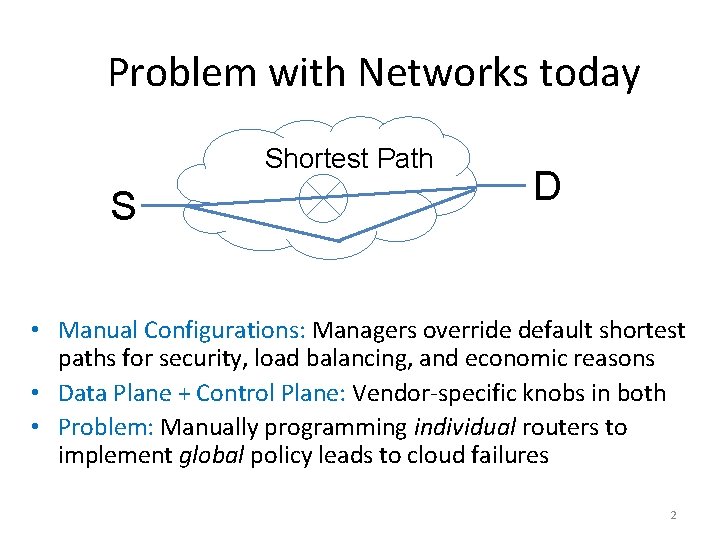
Problem with Networks today Shortest Path S D • Manual Configurations: Managers override default shortest paths for security, load balancing, and economic reasons • Data Plane + Control Plane: Vendor-specific knobs in both • Problem: Manually programming individual routers to implement global policy leads to cloud failures 2
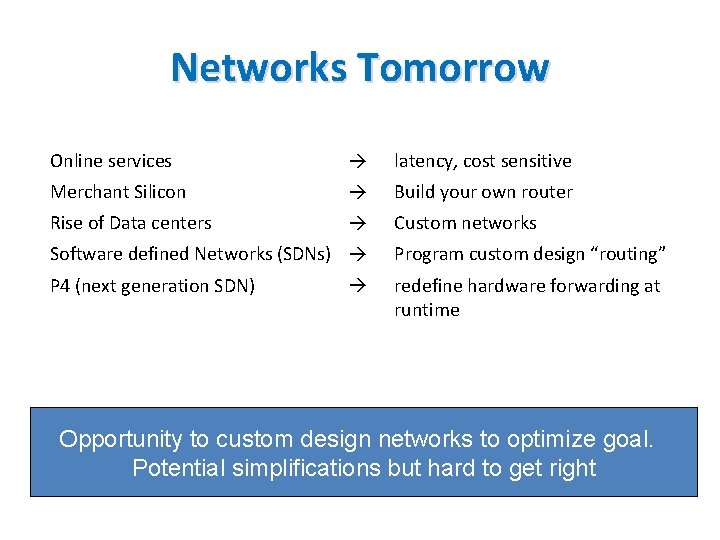
Networks Tomorrow Online services latency, cost sensitive Merchant Silicon Build your own router Rise of Data centers Custom networks Software defined Networks (SDNs) Program custom design “routing” P 4 (next generation SDN) redefine hardware forwarding at runtime Opportunity to custom design networks to optimize goal. Potential simplifications but hard to get right
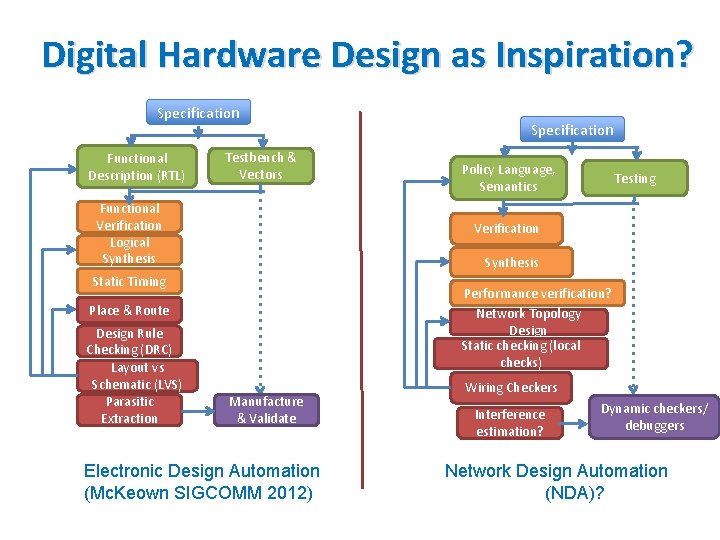
Digital Hardware Design as Inspiration? Specification Functional Description (RTL) Testbench & Vectors Functional Verification Logical Synthesis Policy Language, Semantics Testing Verification Synthesis Static Timing Performance verification? Network Topology Design Static checking (local checks) Place & Route Design Rule Checking (DRC) Layout vs Schematic (LVS) Parasitic Extraction Specification Manufacture & Validate Electronic Design Automation (Mc. Keown SIGCOMM 2012) Wiring Checkers Interference estimation? Dynamic checkers/ debuggers Network Design Automation (NDA)?
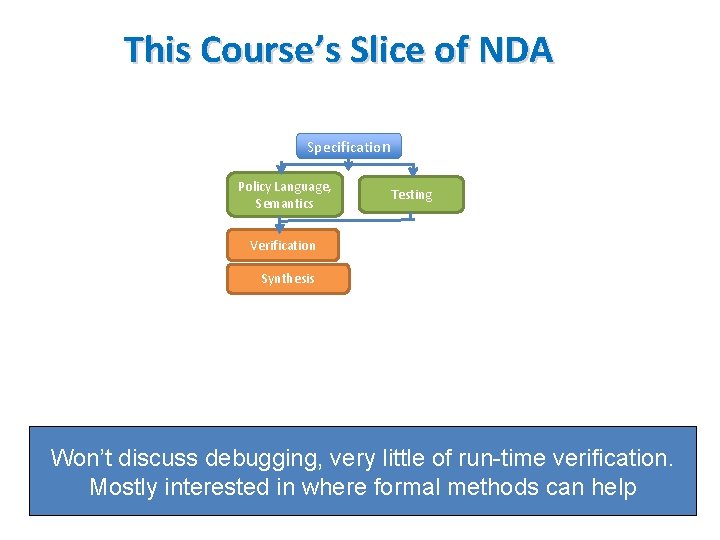
This Course’s Slice of NDA Specification Policy Language, Semantics Testing Verification Synthesis Won’t discuss debugging, very little of run-time verification. Mostly interested in where formal methods can help
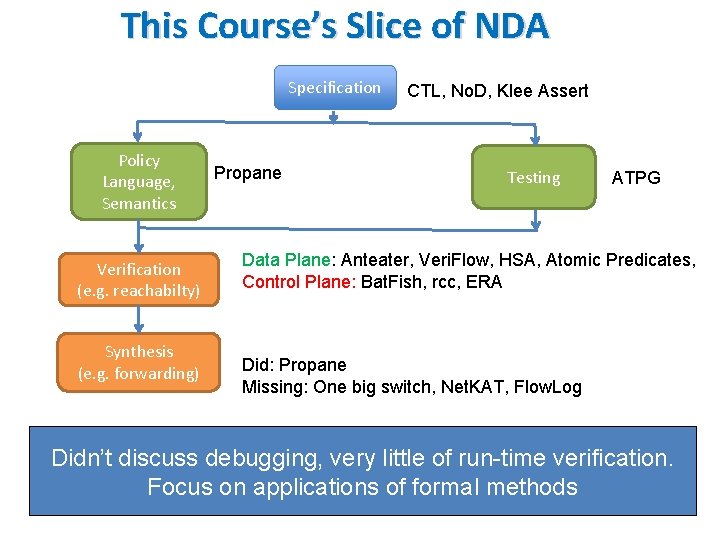
This Course’s Slice of NDA Specification Policy Language, Semantics Verification (e. g. reachabilty) Synthesis (e. g. forwarding) Propane CTL, No. D, Klee Assert Testing ATPG Data Plane: Anteater, Veri. Flow, HSA, Atomic Predicates, Control Plane: Bat. Fish, rcc, ERA Did: Propane Missing: One big switch, Net. KAT, Flow. Log Didn’t discuss debugging, very little of run-time verification. Focus on applications of formal methods
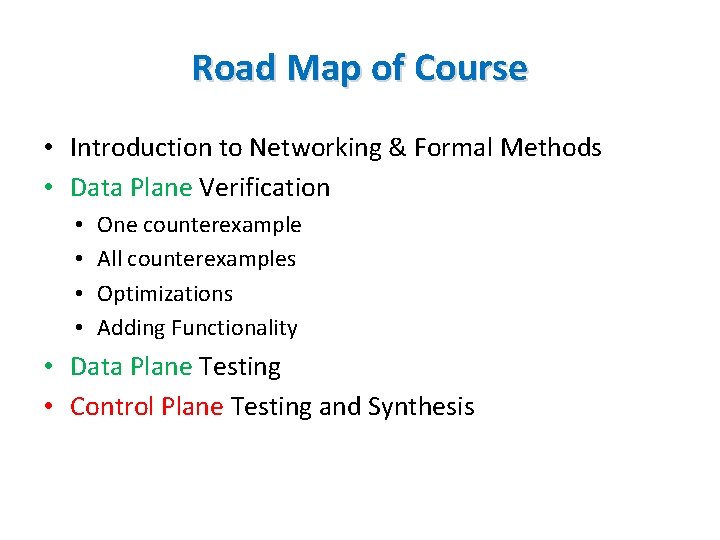
Road Map of Course • Introduction to Networking & Formal Methods • Data Plane Verification • • One counterexample All counterexamples Optimizations Adding Functionality • Data Plane Testing • Control Plane Testing and Synthesis
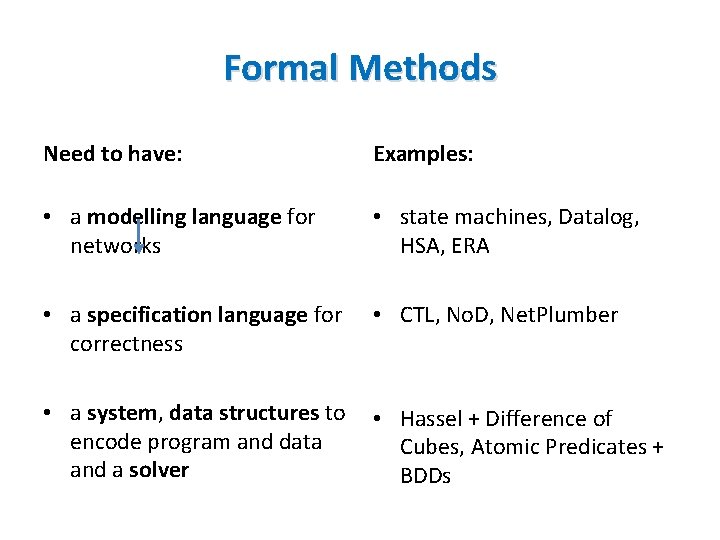
Formal Methods Need to have: Examples: • a modelling language for networks • state machines, Datalog, HSA, ERA • a specification language for correctness • CTL, No. D, Net. Plumber • a system, data structures to encode program and data and a solver • Hassel + Difference of Cubes, Atomic Predicates + BDDs
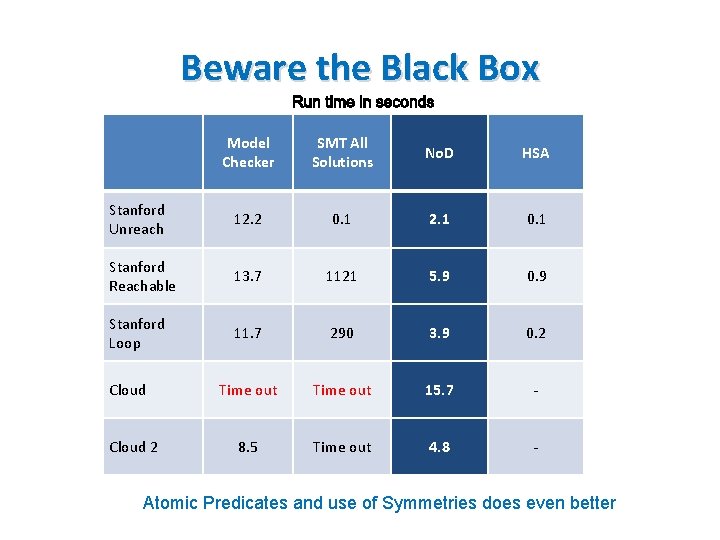
Beware the Black Box Model Checker SMT All Solutions No. D HSA Stanford Unreach 12. 2 0. 1 2. 1 0. 1 Stanford Reachable 13. 7 1121 5. 9 0. 9 Stanford Loop 11. 7 290 3. 9 0. 2 Time out 15. 7 - 8. 5 Time out 4. 8 - Cloud 2 Atomic Predicates and use of Symmetries does even better
![Verification Tasks [Fayazbakhsh 15] •](http://slidetodoc.com/presentation_image_h2/d5f0f13903ce34aef19b7047101a291b/image-10.jpg "Verification Tasks [Fayazbakhsh 15] •")
Verification Tasks [Fayazbakhsh 15] •
Introduction to Formal Methods Data Plane Verification • One counterexample • All counterexamples • Optimizations • Adding Functionality Control Plane Testing and Synthesis DATA PLANE VERIFICATION: IF ONE COUNTEREXAMPLE SUFFICES
![Historically: Encode networks using existing verification engines • • [Xie 05] Theoretical reachability algorithm](http://slidetodoc.com/presentation_image_h2/d5f0f13903ce34aef19b7047101a291b/image-12.jpg "Historically: Encode networks using existing verification engines • • [Xie 05] Theoretical reachability algorithm")
Historically: Encode networks using existing verification engines • • [Xie 05] Theoretical reachability algorithm [Al. Shaer 09]: Model checking approach [Mai 11]: SAT Based Anteater If 1 counterexample + small networks, reusing existing tools works fine. Only clever encoding
Introduction to Formal Methods Data Plane Verification • One counterexample • All counterexamples • Optimizations • Adding Functionality Data Plane Testing Control Plane Testing and Synthesi DATA PLANE VERIFICATION: ALL COUNTEREXAMPLES
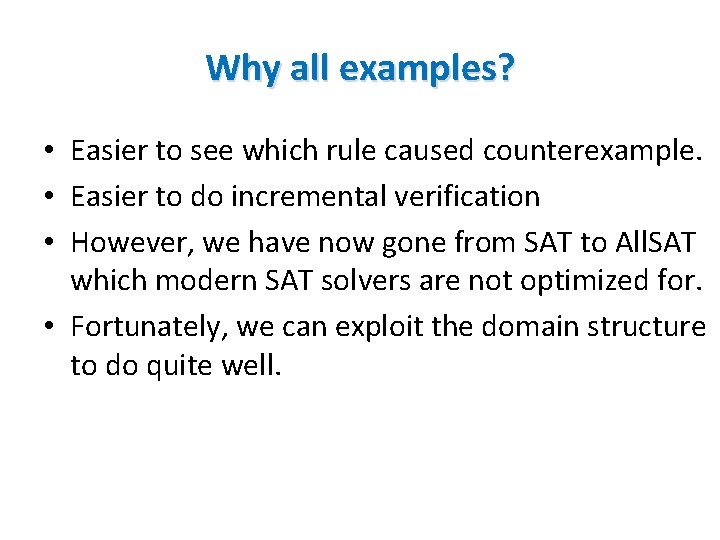
Why all examples? • Easier to see which rule caused counterexample. • Easier to do incremental verification • However, we have now gone from SAT to All. SAT which modern SAT solvers are not optimized for. • Fortunately, we can exploit the domain structure to do quite well.
![All Solutions: Header Space [Kazemian 12] • • • Step 1 - Model a](http://slidetodoc.com/presentation_image_h2/d5f0f13903ce34aef19b7047101a291b/image-15.jpg "All Solutions: Header Space [Kazemian 12] • • • Step 1 - Model a")
All Solutions: Header Space [Kazemian 12] • • • Step 1 - Model a packet, based on its header bits, as a point in {0, 1}L space – the Header Space Two abstractions: 1. All layers collapsed into a flat sequence of bits 2. Wildcards ignore header bits irrelevant to forwarding Two technical ideas: 1. Ternary Algebra 2. Difference of cubes Header 0 xxxx 0101 xxx 01110011… 1 L Data
Introduction to Formal Methods Data Plane Verification • One counterexample • All counterexamples • Optimizations • Adding Functionality Data Plane Testing Control Plane Testing & Synthesis DATA PLANE VERIFICATION: OPTIMIZATIONS
![Scaling to Large Networks Exploit: Incrementality [Net. Plumber] – Only small parts of program](http://slidetodoc.com/presentation_image_h2/d5f0f13903ce34aef19b7047101a291b/image-17.jpg "Scaling to Large Networks Exploit: Incrementality [Net. Plumber] – Only small parts of program")
Scaling to Large Networks Exploit: Incrementality [Net. Plumber] – Only small parts of program change on rule change Equivalence Classes [Atomic Predicates] – Number of header equivalence classes is small Symmetries [Plotkin 15] – Many rules and boxes are repeated (redundancy)
![Exploiting incrementality: Net. Plumber [Kazemian 13] S . . ? . . . VERIFYING](http://slidetodoc.com/presentation_image_h2/d5f0f13903ce34aef19b7047101a291b/image-18.jpg "Exploiting incrementality: Net. Plumber [Kazemian 13] S . . ? . . . VERIFYING")
Exploiting incrementality: Net. Plumber [Kazemian 13] S . . ? . . . VERIFYING CHANGES BY SDN CONTROLLERS BEFORE THEY TAKE EFFECT 18
![Atomic Predicates Intuition [Yang 13] • From run-time compression via Difference of cubes to](http://slidetodoc.com/presentation_image_h2/d5f0f13903ce34aef19b7047101a291b/image-19.jpg "Atomic Predicates Intuition [Yang 13] • From run-time compression via Difference of cubes to")
Atomic Predicates Intuition [Yang 13] • From run-time compression via Difference of cubes to precomputed compression via Ai • Computes pairwise intersection of router and ACL guards to generate Ai using BDDs • Then rewrites forwarding rules using a simple set of integer labels for each • Symbolic propagation propagating sets of integers. Fast. No rule matching, less space • Analog to MPLS versus IP forwarding!
![Exploiting Symmetry [Plotkin 15] Symmetry Modularity Can exploit regularities in rules and topology (not](http://slidetodoc.com/presentation_image_h2/d5f0f13903ce34aef19b7047101a291b/image-20.jpg "Exploiting Symmetry [Plotkin 15] Symmetry Modularity Can exploit regularities in rules and topology (not")
Exploiting Symmetry [Plotkin 15] Symmetry Modularity Can exploit regularities in rules and topology (not headers): • Symmetry Theorem: Can reduce fat tree to “thin tree” using a “simulation” and verify reachability cheaply in latter • Modularity Theorem: reuse of parts of switching network
Introduction to Formal Methods Data Plane Verification • One counterexample • All counterexamples • Optimizations • Adding Functionality Data Plane Testing Control Plane Verification Control Plane Testing Synthesis, Semantics DATA PLANE VERIFICATION: ADDING FUNCTIONALITY
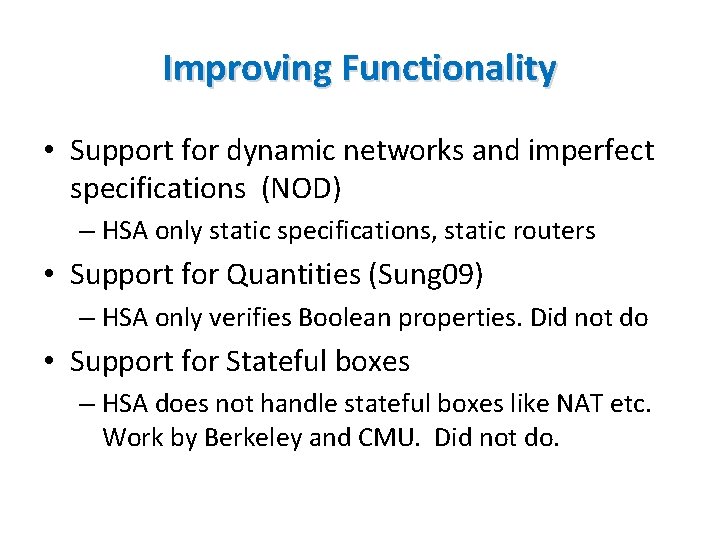
Improving Functionality • Support for dynamic networks and imperfect specifications (NOD) – HSA only static specifications, static routers • Support for Quantities (Sung 09) – HSA only verifies Boolean properties. Did not do • Support for Stateful boxes – HSA does not handle stateful boxes like NAT etc. Work by Berkeley and CMU. Did not do.
![Dynamic Networks: Network Optimized Datalog [Lopes 15] • Classical model checking provides languages based](http://slidetodoc.com/presentation_image_h2/d5f0f13903ce34aef19b7047101a291b/image-23.jpg "Dynamic Networks: Network Optimized Datalog [Lopes 15] • Classical model checking provides languages based")
Dynamic Networks: Network Optimized Datalog [Lopes 15] • Classical model checking provides languages based on temporal logic to specify a variety of properties • Header Space hard codes some properties • Classical verification tools compute only 1 solution • Datalog computes all but was inefficient. Had to redo Datalog engine. Datalog allows some dynamism. But for more have to model control plane a la Batfish Datalog nearly as fast as HSA but much more expressive Included in Z 3. Being used to check Azure configurations
Introduction to Formal Methods Data Plane Verification Data Plane Testing Control Plane Testing and Synthesis DATA PLANE TESTING
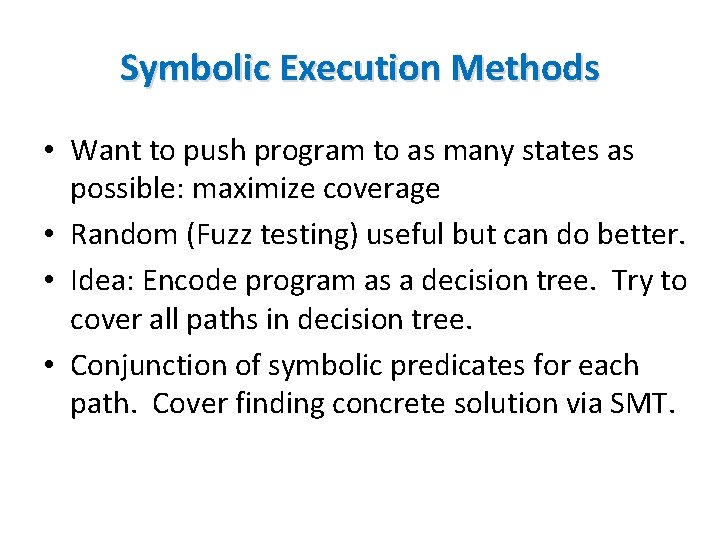
Symbolic Execution Methods • Want to push program to as many states as possible: maximize coverage • Random (Fuzz testing) useful but can do better. • Idea: Encode program as a decision tree. Try to cover all paths in decision tree. • Conjunction of symbolic predicates for each path. Cover finding concrete solution via SMT.
![ATPG vs Klee [Zheng 13] • Monitor the data plane by sending test packets.](http://slidetodoc.com/presentation_image_h2/d5f0f13903ce34aef19b7047101a291b/image-26.jpg "ATPG vs Klee [Zheng 13] • Monitor the data plane by sending test packets.")
ATPG vs Klee [Zheng 13] • Monitor the data plane by sending test packets. – Maximum rule coverage (like Klee: rules lines) – Minimize number of packets required (like Klee: packets test cases) – Constraints on terminal ports and headers of test packets (unlike Klee) • Once error is detected, localize it (unlike Klee more like tomography)
![Software Data Plane Verification [Dobrescu 14] • Verifies actual code of Click software router.](http://slidetodoc.com/presentation_image_h2/d5f0f13903ce34aef19b7047101a291b/image-27.jpg "Software Data Plane Verification [Dobrescu 14] • Verifies actual code of Click software router.")
Software Data Plane Verification [Dobrescu 14] • Verifies actual code of Click software router. • Checks for new physical bugs (e. g. , crash freedom, loops) using symbolic testing. • No path explosion: since router is a pipeline only compose potentially buggy path fragments • Use verified data structures (no pointers). Tradeoff verification ease with runtime cost. • Found bugs: e. g. , IP option + fragmentation.
Introduction to Formal Methods Data Plane Verification Data Plane Testing Control Plane Testing and Synthesis CONTROL PLANE TESTING
![Earlier Control Plane Work • BGP Loops Possible – [Govindan, Griffin-Wilfong] • Sufficient Conditions](http://slidetodoc.com/presentation_image_h2/d5f0f13903ce34aef19b7047101a291b/image-29.jpg "Earlier Control Plane Work • BGP Loops Possible – [Govindan, Griffin-Wilfong] • Sufficient Conditions")
Earlier Control Plane Work • BGP Loops Possible – [Govindan, Griffin-Wilfong] • Sufficient Conditions for Avoiding Loops – [Gao-Rexford] • Route redistribution cause loops – [Le 2008] But based on human analysis and proofs. We studied tools for automated analysis
![Cellular Protocol Testing [Li et al] • Cellular Control Plan but tests for protocol](http://slidetodoc.com/presentation_image_h2/d5f0f13903ce34aef19b7047101a291b/image-30.jpg "Cellular Protocol Testing [Li et al] • Cellular Control Plan but tests for protocol")
Cellular Protocol Testing [Li et al] • Cellular Control Plan but tests for protocol and implementation bugs not config bugs • Modest checking via SPIN to suggest buggy use cases and experiments with phones and Qualcomm debugger to confirm • Bugs in feature interaction (e. g. , 3 G to 4 G) • Config bugs in later papers! Similar to IP.
![Static Checking BGP Configs: RCC [Feamster 05] • Checks BGP configs for path visibility,](http://slidetodoc.com/presentation_image_h2/d5f0f13903ce34aef19b7047101a291b/image-31.jpg "Static Checking BGP Configs: RCC [Feamster 05] • Checks BGP configs for path visibility,")
Static Checking BGP Configs: RCC [Feamster 05] • Checks BGP configs for path visibility, validity • Example, route reflector configuration bugs Route r (not visible to all) Route s (visible to all)
![Testing Across Announcements [ERA] • Batfish: symbolic simulation of 1 environment • ERA looks](http://slidetodoc.com/presentation_image_h2/d5f0f13903ce34aef19b7047101a291b/image-32.jpg "Testing Across Announcements [ERA] • Batfish: symbolic simulation of 1 environment • ERA looks")
Testing Across Announcements [ERA] • Batfish: symbolic simulation of 1 environment • ERA looks for route reachability and computes a maximal announcement that finds bugs • Seems to work to find an interesting set of bugs (backup equivalence, valley free etc) • Bugs correspond almost 1 -1 with data plane bugs (loops, blackholes) but for announcements
![Config Synthesis [Propane] • New language for route preferences based on ordered regular expressions](http://slidetodoc.com/presentation_image_h2/d5f0f13903ce34aef19b7047101a291b/image-33.jpg "Config Synthesis [Propane] • New language for route preferences based on ordered regular expressions")
Config Synthesis [Propane] • New language for route preferences based on ordered regular expressions • Regular expression state machine crossproduct with topology encode transitions with communities, LPs • Regret freedom encodes choices that are oblivious to any failure. May be too strong.
![Config Verification [Minesweeper] • Encodes stable path problem in SAT for routes and usual](http://slidetodoc.com/presentation_image_h2/d5f0f13903ce34aef19b7047101a291b/image-34.jpg "Config Verification [Minesweeper] • Encodes stable path problem in SAT for routes and usual")
Config Verification [Minesweeper] • Encodes stable path problem in SAT for routes and usual data plane reachability in SAT • Uses a graph to encode the network to model redistribution, output & input filters etc. • Optimizations like slicing and transferring prefix matching in CP to inequalities in DP. • Scales but only 1 counterexample on failure

LESSONS AND LOOKING BACK
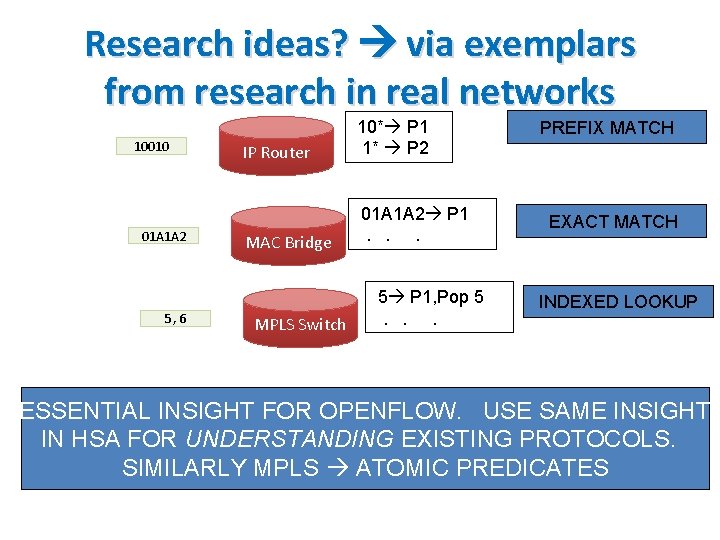
Research ideas? via exemplars from research in real networks 10010 01 A 1 A 2 5, 6 IP Router 10* P 1 1* P 2 MAC Bridge 01 A 1 A 2 P 1. . . MPLS Switch 5 P 1, Pop 5. . . PREFIX MATCH EXACT MATCH INDEXED LOOKUP ESSENTIAL INSIGHT FOR OPENFLOW. USE SAME INSIGHT IN HSA FOR UNDERSTANDING EXISTING PROTOCOLS. SIMILARLY MPLS ATOMIC PREDICATES 36
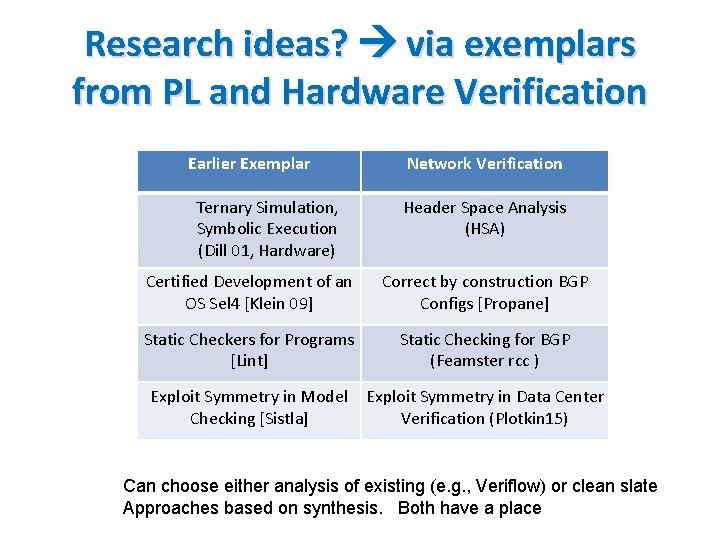
Research ideas? via exemplars from PL and Hardware Verification Earlier Exemplar Ternary Simulation, Symbolic Execution (Dill 01, Hardware) Network Verification Header Space Analysis (HSA) Certified Development of an OS Sel 4 [Klein 09] Correct by construction BGP Configs [Propane] Static Checkers for Programs [Lint] Static Checking for BGP (Feamster rcc ) Exploit Symmetry in Model Checking [Sistla] Exploit Symmetry in Data Center Verification (Plotkin 15) Can choose either analysis of existing (e. g. , Veriflow) or clean slate Approaches based on synthesis. Both have a place
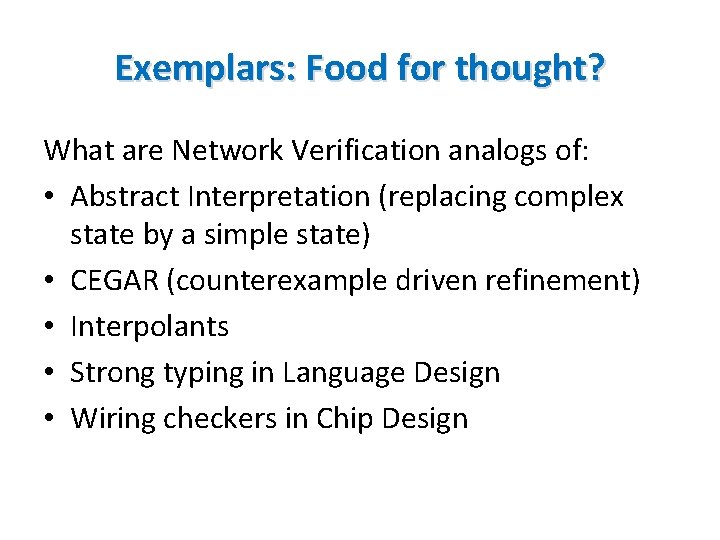
Exemplars: Food for thought? What are Network Verification analogs of: • Abstract Interpretation (replacing complex state by a simple state) • CEGAR (counterexample driven refinement) • Interpolants • Strong typing in Language Design • Wiring checkers in Chip Design
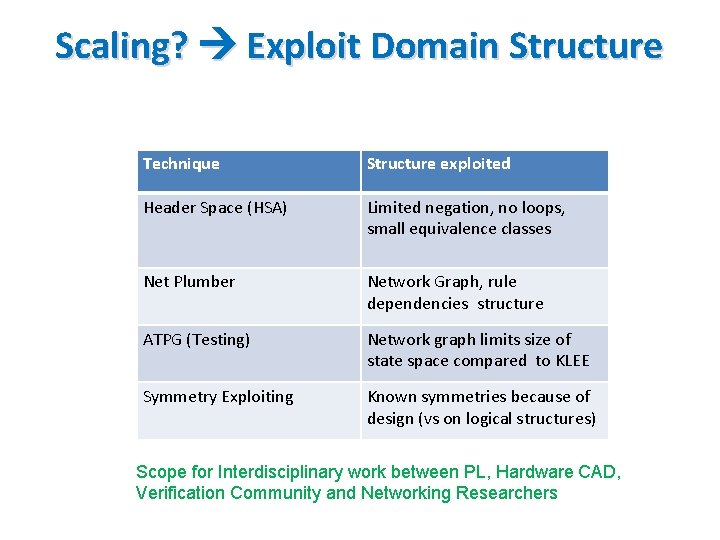
Scaling? Exploit Domain Structure Technique Structure exploited Header Space (HSA) Limited negation, no loops, small equivalence classes Net Plumber Network Graph, rule dependencies structure ATPG (Testing) Network graph limits size of state space compared to KLEE Symmetry Exploiting Known symmetries because of design (vs on logical structures) Scope for Interdisciplinary work between PL, Hardware CAD, Verification Community and Networking Researchers
![No Specifications? Use Beliefs Paper Bugs as Deviant Behavior [Engler 01] Example Beliefs Dereferencing](http://slidetodoc.com/presentation_image_h2/d5f0f13903ce34aef19b7047101a291b/image-40.jpg "No Specifications? Use Beliefs Paper Bugs as Deviant Behavior [Engler 01] Example Beliefs Dereferencing")
No Specifications? Use Beliefs Paper Bugs as Deviant Behavior [Engler 01] Example Beliefs Dereferencing Pointer P that could be NULL is a bug Routing Config Checker (RCC) Routes from a Peer should not be [Feamster rcc] re-advertised to another peer Network Optimized Datalog [NOD] Customer VMs should not be able to access router ports Batifsh Control Plane Testing Equal cost routes should have equivalent reachabiliyt
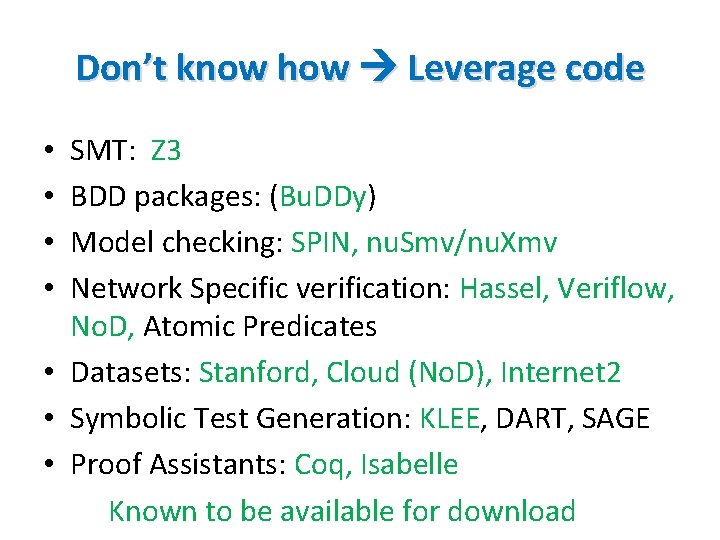
Don’t know how Leverage code SMT: Z 3 BDD packages: (Bu. DDy) Model checking: SPIN, nu. Smv/nu. Xmv Network Specific verification: Hassel, Veriflow, No. D, Atomic Predicates • Datasets: Stanford, Cloud (No. D), Internet 2 • Symbolic Test Generation: KLEE, DART, SAGE • Proof Assistants: Coq, Isabelle Known to be available for download • •
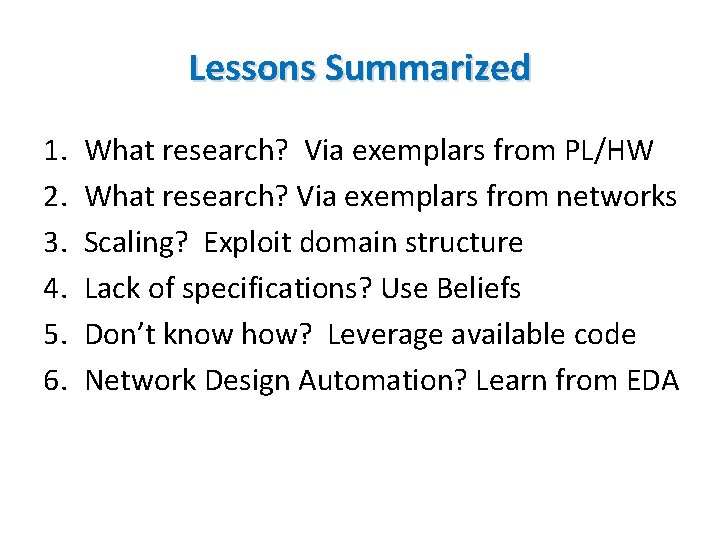
Lessons Summarized 1. 2. 3. 4. 5. 6. What research? Via exemplars from PL/HW What research? Via exemplars from networks Scaling? Exploit domain structure Lack of specifications? Use Beliefs Don’t know how? Leverage available code Network Design Automation? Learn from EDA
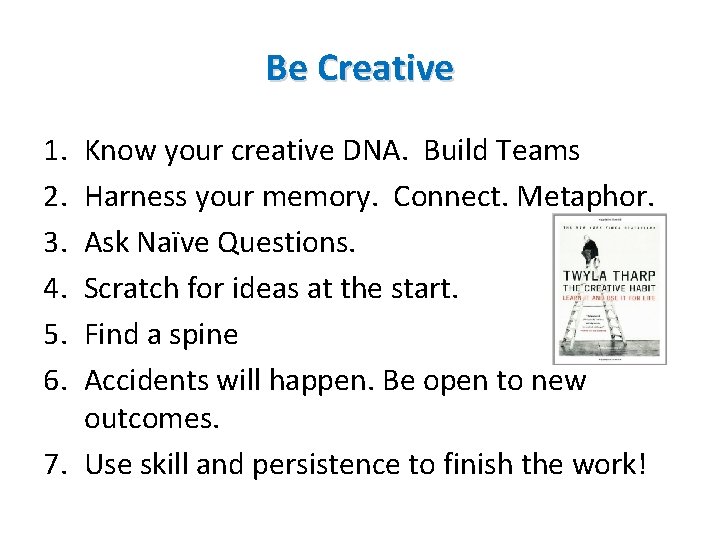
Be Creative 1. 2. 3. 4. 5. 6. Know your creative DNA. Build Teams Harness your memory. Connect. Metaphor. Ask Naïve Questions. Scratch for ideas at the start. Find a spine Accidents will happen. Be open to new outcomes. 7. Use skill and persistence to finish the work!
What made me happy 1. Each of your insights during discussions 2. Your performance in the test 3. The idea of using verification for business processes 4. Many of your other ideas. Will try and return with your finals.
Conclusion • Inflection Point: Rise of services, data centers, Software Defined Networks • Ideas: Creatively adapt Verification ideas to domain • Intellectual Opportunity: Rethink existing techniques exploiting domain structure • Systems Opportunity Change way large operational networks are built Lot more than Verification and Formal Methods (have to add debugging, run-time checks etc. ) but EDA suggests this is an Essential foundation 45
- Slides: 45