
Verification of the reference intervals proposed by Abbott
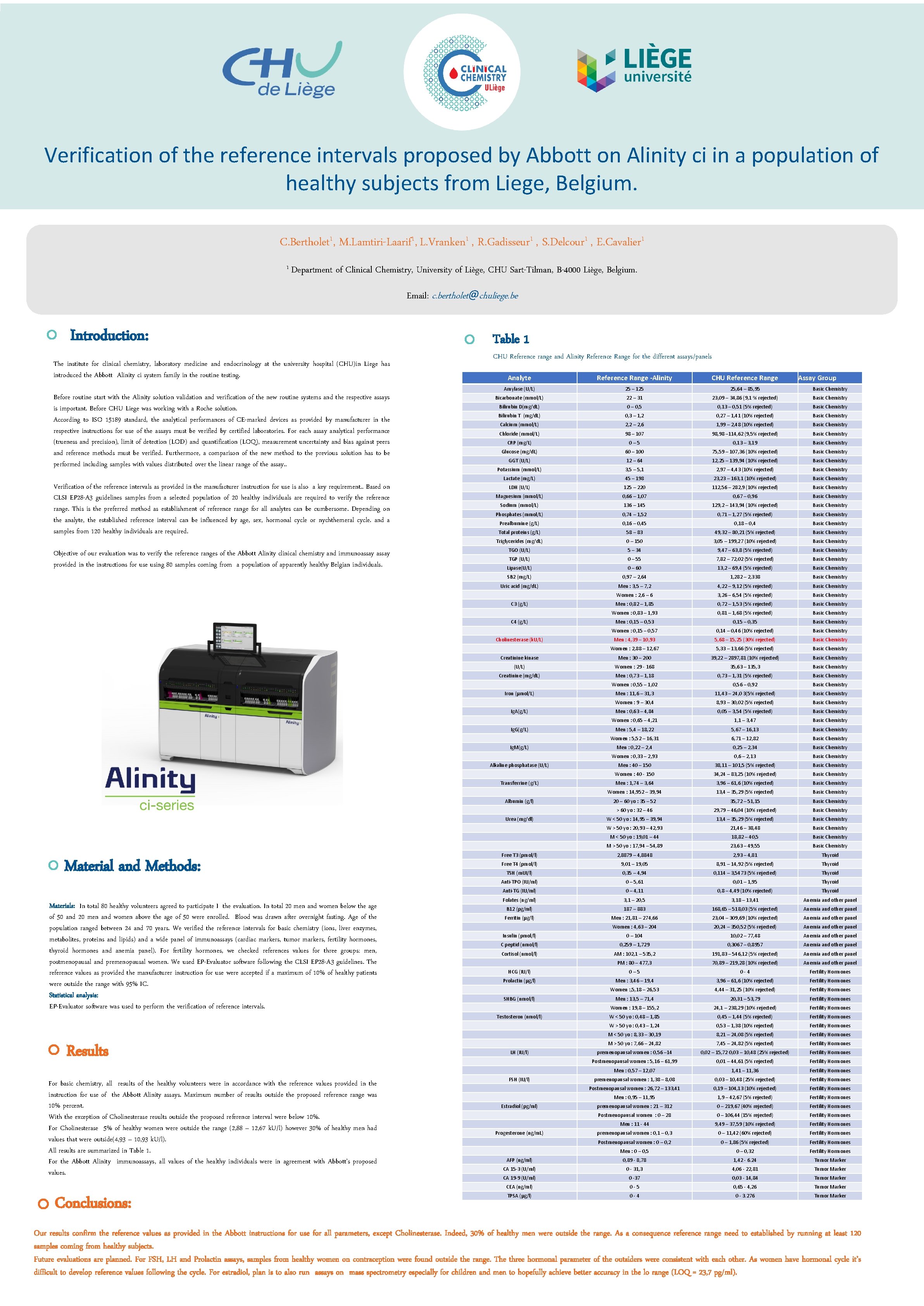
Verification of the reference intervals proposed by Abbott on Alinity ci in a population of healthy subjects from Liege, Belgium. C. Bertholet 1, M. Lamtiri-Laarif 1, L. Vranken 1 , R. Gadisseur 1 , S. Delcour 1 , E. Cavalier 1 1 Department of Clinical Chemistry, University of Liège, CHU Sart-Tilman, B-4000 Liège, Belgium. Email: c. bertholet@chuliege. be Introduction: The institute for clinical chemistry, laboratory medicine and endocrinology at the university hospital (CHU)in Liege has introduced the Abbott Alinity ci system family in the routine testing. Before routine start with the Alinity solution validation and verification of the new routine systems and the respective assays is important. Before CHU Liege was working with a Roche solution. According to ISO 15189 standard, the analytical performances of CE-marked devices as provided by manufacturer in the respective instructions for use of the assays must be verified by certified laboratories. For each assay analytical performance (trueness and precision), limit of detection (LOD) and quantification (LOQ), measurement uncertainty and bias against peers and reference methods must be verified. Furthermore, a comparison of the new method to the previous solution has to be performed including samples with values distributed over the linear range of the assay. . Verification of the reference intervals as provided in the manufacturer instruction for use is also a key requirement. . Based on CLSI EP 28 -A 3 guidelines samples from a selected population of 20 healthy individuals are required to verify the reference range. This is the preferred method as establishment of reference range for all analytes can be cumbersome. Depending on the analyte, the established reference interval can be influenced by age, sex, hormonal cycle or nychthemeral cycle. and a samples from 120 healthy individuals are required. Objective of our evaluation was to verify the reference ranges of the Abbott Alinity clinical chemistry and immunoassay provided in the instructions for use using 80 samples coming from a population of apparently healthy Belgian individuals. Material and Methods: Materials: In total 80 healthy volunteers agreed to participate I the evaluation. In total 20 men and women below the age of 50 and 20 men and women above the age of 50 were enrolled. Blood was drawn after overnight fasting. Age of the population ranged between 24 and 70 years. We verified the reference intervals for basic chemistry (ions, liver enzymes, metabolites, proteins and lipids) and a wide panel of immunoassays (cardiac markers, tumor markers, fertility hormones, thyroid hormones and anemia panel). For fertility hormones, we checked references values for three groups: men, postmenopausal and premenopausal women. We used EP-Evaluator software following the CLSI EP 28 -A 3 guidelines. The reference values as provided the manufacturer instruction for use were accepted if a maximum of 10% of healthy patients were outside the range with 95% IC. Statistical analysis: EP-Evaluator software was used to perform the verification of reference intervals. Results For basic chemistry, all results of the healthy volunteers were in accordance with the reference values provided in the instruction for use of the Abbott Alinity assays. Maximum number of results outside the proposed reference range was 10% percent. With the exception of Cholinesterase results outside the proposed reference interval were below 10%. For Cholinesterase 5% of healthy women were outside the range (2, 88 – 12, 67 k. U/l) however 30% of healthy men had values that were outside(4, 93 – 10, 93 k. U/l). All results are summarized in Table 1. For the Abbott Alinity immunoassays, all values of the healthy individuals were in agreement with Abbott’s proposed values. Conclusions: Table 1 CHU Reference range and Alinity Reference Range for the different assays/panels Analyte Reference Range -Alinity CHU Reference Range Assay Group Amylase (U/L) 25 – 125 25, 64 – 85, 95 Basic Chemistry Bicarbonate (mmol/L) 22 – 31 23, 09 – 34, 86 (9, 1 % rejected) Basic Chemistry Bilirubin D(mg/d. L) 0 – 0, 5 0, 13 – 0, 51 (5% rejected) Basic Chemistry Bilirubin T (mg/d. L) 0, 3 – 1, 2 0, 27 – 1, 41 (10% rejected) Basic Chemistry Calcium (mmol/L) 2, 2 – 2, 6 1, 99 – 2, 48 (10% rejected) Basic Chemistry Chloride (mmol/L) 98 – 107 98, 98 – 114, 62 (9, 5% rejected) Basic Chemistry CRP (mg/L) 0 – 5 0, 13 – 3, 19 Basic Chemistry Glucose (mg/d. L) 60 – 100 75, 59 – 107, 36 (10% rejected) Basic Chemistry GGT (U/L) 12 – 64 12, 25 – 139, 94 (10% rejected) Basic Chemistry Potassium (mmol/L) 3, 5 – 5, 1 2, 97 – 4, 43 (10% rejected) Basic Chemistry Lactate (mg/L) 45 – 198 23, 23 – 163, 1 (10% rejected) Basic Chemistry LDH (U/L) 125 – 220 112, 56 – 282, 9 (10% rejected) Basic Chemistry Magnesium (mmol/L) 0, 66 – 1, 07 0, 67 – 0, 96 Basic Chemistry Sodium (mmol/L) 136 – 145 129, 2 – 143, 94 (10% rejected) Basic Chemistry Phosphates (mmol/L) 0, 74 – 1, 52 0, 71 – 1, 27 (5% rejected) Basic Chemistry Prealbumine (g/L) 0, 16 – 0, 45 0, 18 – 0, 4 Basic Chemistry Total proteins (g/L) 58 – 83 49, 32 – 80, 21 (5% rejected) Basic Chemistry Triglycerides (mg/d. L) 0 – 150 3, 05 – 199, 27 (10% rejected) Basic Chemistry TGO (U/L) 5 – 34 9, 47 – 63, 8 (5% rejected) Basic Chemistry TGP (U/L) 0 – 55 7, 82 – 72, 02 (5% rejected) Basic Chemistry Lipase(U/L) 0 – 60 13, 2 – 69, 4 (5% rejected) Basic Chemistry SB 2 (mg/L) 0, 97 – 2, 64 1, 282 – 2, 338 Basic Chemistry Uric acid (mg/d. L) Men : 3, 5 – 7, 2 4, 22 – 9, 12 (5% rejected) Basic Chemistry Women : 2, 6 – 6 3, 26 – 6, 54 (5% rejected) Basic Chemistry C 3 (g/L) Men : 0, 82 – 1, 85 0, 72 – 1, 53 (5% rejected) Basic Chemistry Women : 0, 83 – 1, 93 0, 81 – 1, 68 (5% rejected) Basic Chemistry C 4 (g/L) Men : 0, 15 – 0, 53 0, 15 – 0, 35 Basic Chemistry Women : 0, 15 – 0, 57 0, 14 – 0, 46 (10% rejected) Basic Chemistry Cholinesterase (k. U/L) Men : 4, 39 – 10, 93 5, 68 – 15, 25 (30% rejected) Basic Chemistry Women : 2, 88 – 12, 67 5, 33 – 13, 66 (5% rejected) Basic Chemistry Creatinine kinase Men : 30 – 200 39, 22 – 2897, 81 (10% rejected) Basic Chemistry (U/L) Women : 29 - 168 35, 63 – 135, 3 Basic Chemistry Creatinine (mg/d. L) Men : 0, 73 – 1, 18 0, 73 – 1, 31 (5% rejected) Basic Chemistry Women : 0, 55 – 1, 02 0, 56 – 0, 92 Basic Chemistry Iron (µmol/L) Men : 11, 6 – 31, 3 11, 43 – 24, 0 3(5% rejected) Basic Chemistry Women : 9 – 30, 4 8, 93 – 30, 02 (5% rejected) Basic Chemistry Ig. A(g/L) Men : 0, 63 – 4, 84 0, 05 – 3, 54 (5% rejected) Basic Chemistry Women : 0, 65 – 4, 21 1, 1 – 3, 47 Basic Chemistry Ig. G(g/L) Men : 5, 4 – 18, 22 5, 67 – 16, 13 Basic Chemistry Women : 5, 52 – 16, 31 6, 71 – 12, 82 Basic Chemistry Ig. M(g/L) Men : 0, 22 – 2, 4 0, 25 – 2, 34 Basic Chemistry Women : 0, 33 – 2, 93 0, 6 – 2, 13 Basic Chemistry Alkaline phosphatase (U/L) Men : 40 – 150 38, 11 – 101, 5 (5% rejected) Basic Chemistry Women : 40 - 150 34, 24 – 83, 25 (10% rejected) Basic Chemistry Transferrine (g/L) Men : 1, 74 – 3, 64 3, 96 – 61, 6 (10% rejected) Basic Chemistry Women : 14, 952 – 39, 94 13, 4 – 35, 29 (5% rejected) Basic Chemistry Albumin (g/l) 20 – 60 yo : 35 – 52 35, 72 – 51, 15 Basic Chemistry > 60 yo : 32 – 46 29, 79 – 46, 04 (10% rejected) Basic Chemistry Urea (mg/dl) W < 50 yo : 14, 95 – 39, 94 13, 4 – 35, 29 (5% rejected) Basic Chemistry W > 50 yo : 20, 93 – 42, 93 21, 46 – 38, 48 Basic Chemistry M < 50 yo : 19, 01 – 44 18, 82 – 40, 5 Basic Chemistry M > 50 yo : 17, 94 – 54, 89 23, 63 – 49, 55 Basic Chemistry Free T 3 (pmol/l) 2, 8879 – 4, 8848 2, 93 – 4, 81 Thyroid Free T 4 (pmol/l) 9, 01 – 19, 05 8, 91 – 14, 92 (5% rejected) Thyroid TSH (m. UI/l) 0, 35 – 4, 94 0, 114 – 3, 5473 (5% rejected) Thyroid Anti-TPO (IU/ml) 0 – 5, 61 0, 01 – 1, 95 Thyroid Anti-TG (IU/ml) 0 – 4, 11 0, 8 – 4, 49 (10% rejected) Thyroid Folates (ng/ml) 3, 1 – 20, 5 3, 18 – 13, 41 Anemia and other panel B 12 (pg/ml) 187 – 883 168, 65 – 518, 03 (5% rejected) Anemia and other panel Ferritin (µg/l) Men : 21, 81 – 274, 66 23, 04 – 309, 69 (10% rejected) Anemia and other panel Women : 4, 63 – 204 20, 24 – 350, 52 (5% rejected) Anemia and other panel Insulin (pmol/l) 0 – 104 10, 02 – 77, 48 Anemia and other panel C peptid (nmol/l) 0, 259 – 1, 729 0, 3067 – 0, 8957 Anemia and other panel Cortisol (nmol/l) AM : 102, 1 – 535, 2 191, 83 – 546, 12 (5% rejected) Anemia and other panel PM : 80 – 477, 3 70, 89 – 219, 28 (10% rejected) Anemia and other panel HCG (IU/l) 0 – 5 0 - 4 Fertility Hormones Prolactin (µg/l) Men : 3, 46 – 19, 4 3, 96 – 61, 6 (10% rejected) Fertility Hormones Women : , 5, 18 – 26, 53 4, 44 – 31, 25 (10% rejected) Fertility Hormones SHBG (nmol/l) Men : 13, 5 – 71, 4 20, 31 – 53, 79 Fertility Hormones Women : 19, 8 – 155, 2 24, 1 – 238, 29 (10% rejected) Fertility Hormones Testosteron (nmol/l) W < 50 yo : 0, 48 – 1, 85 0, 45 – 1, 44 (5% rejected) Fertility Hormones W > 50 yo : 0, 43 – 1, 24 0, 53 – 1, 38 (10% rejected) Fertility Hormones M < 50 yo : 8, 33 – 30, 19 8, 21 – 24, 08 (5% rejected) Fertility Hormones M > 50 yo : 7, 66 – 24, 82 7, 45 – 24, 82 (5% rejected) Fertility Hormones LH (IU/l) premenopausal women : 0, 56 – 14 0, 02 – 15, 72 0, 03 – 10, 48 (25% rejected) Fertility Hormones Postmenopausal women : 5, 16 – 61, 99 0, 01 – 44, 61 (5% rejected) Fertility Hormones Men : 0, 57 – 12, 07 1, 41 – 11, 36 Fertility Hormones FSH (IU/l) premenopausal women : 1, 38 – 8, 08 0, 03 – 10, 48 (25% rejected) Fertility Hormones Postmenopausal women : 26, 72 – 133, 41 0, 19 – 104, 13 (10% rejected) Fertility Hormones Men : 0, 95 – 11, 95 1, 9 – 42, 67 (5% rejected) Fertility Hormones Estradiol (pg/ml) premenopausal women : 21 – 312 0 – 219, 67 (40% rejected) Fertility Hormones Postmenopausal women : 0 – 28 0 – 106, 44 (15% rejected) Fertility Hormones Men : 11 - 44 9, 49 – 37, 59 (10% rejected) Fertility Hormones Progesterone (ng/m. L) premenopausal women : 0, 1 – 0, 3 0 – 11, 42 (60% rejected) Fertility Hormones Postmenopausal women : 0 – 0, 2 0 – 1, 86 (5% rejected) Fertility Hormones Men : 0 – 0, 5 0 – 0, 32 Fertility Hormones AFP (ng/ml) 0, 89 - 8, 78 1, 42 - 6. 24 Tumor Marker CA 15 -3 (U/ml) 0 - 31, 3 4, 06 - 22, 81 Tumor Marker CA 19 -9 (U/ml) 0 -37 0, 03 - 14, 84 Tumor Marker CEA (ng/ml) 0 - 5 0, 65 - 4, 26 Tumor Marker TPSA (µg/l) 0 - 4 0 - 3. 276 Tumor Marker Our results confirm the reference values as provided in the Abbott instructions for use for all parameters, except Cholinesterase. Indeed, 30% of healthy men were outside the range. As a consequence reference range need to established by running at least 120 samples coming from healthy subjects. Future evaluations are planned. For FSH, LH and Prolactin assays, samples from healthy women on contraception were found outside the range. The three hormonal parameter of the outsiders were consistent with each other. As women have hormonal cycle it’s difficult to develop reference values following the cycle. For estradiol, plan is to also run assays on mass spectrometry especially for children and men to hopefully achieve better accuracy in the lo range (LOQ = 23, 7 pg/ml).
- Slides: 1