
Verification of Predictive Modeling in the Management of
- Slides: 21
Verification of Predictive Modeling in the Management of Rare, Chronic Diseases Jason Cooper 1, M. S. ; Daryl Wansink 2, Ph. D. ; Alexander Marano 1 1 Accordant Health Services; 2 Independence Blue Cross
Outline § § § Confidential and proprietary information. Not for distribution. Background Objectives Methodology Results Next Steps Q&A
Background § Accordant Health Services is a Disease Management Organization (DMO) that specializes in managing chronic conditions for two primary categories: § Common (Asthma, CAD, CHF, COPD, and Diabetes) § Rare (ALS, CF, CIDP, Crohn’s, Gaucher, Hemophilia, Lupus, MS, Myasthenia Gravis, Myositis, Parkinson’s, RA, Scleroderma, Sickle Cell disease, and Seizure disorders) § Independence Blue Cross (IBC) is a Managed Care Organization (MCO) headquartered in Philadelphia, PA. § Approximately 3. 4 million insured members § Utilize Accordant’s services as a provider of rare disease management Confidential and proprietary information. Not for distribution.
Objectives § Study Symmetry’s Episode Treatment Group (ETG) and Episode Risk Group (ERG) predictive modeling tools for analyses of IBC’s members and determination of risk relevance to rare, chronic population § Determine statistically relevant risk category groupings § Consider how best to incorporate results for novel approaches to clinical intervention strategies Confidential and proprietary information. Not for distribution.
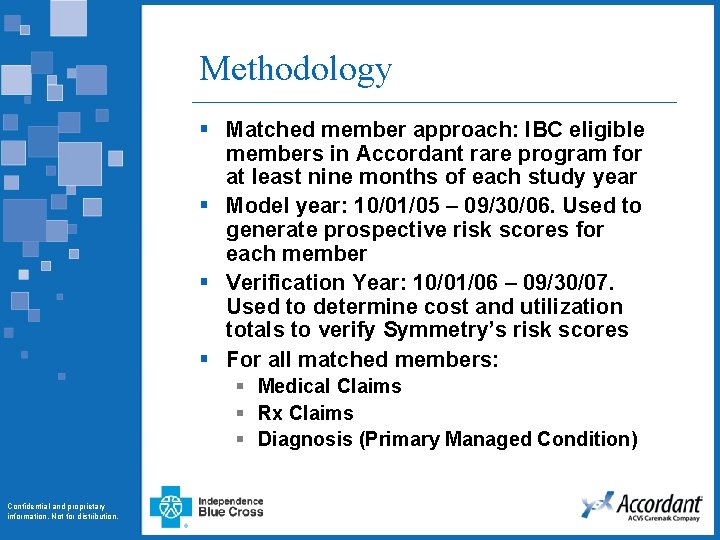
Methodology § Matched member approach: IBC eligible members in Accordant rare program for at least nine months of each study year § Model year: 10/01/05 – 09/30/06. Used to generate prospective risk scores for each member § Verification Year: 10/01/06 – 09/30/07. Used to determine cost and utilization totals to verify Symmetry’s risk scores § For all matched members: § Medical Claims § Rx Claims § Diagnosis (Primary Managed Condition) Confidential and proprietary information. Not for distribution.
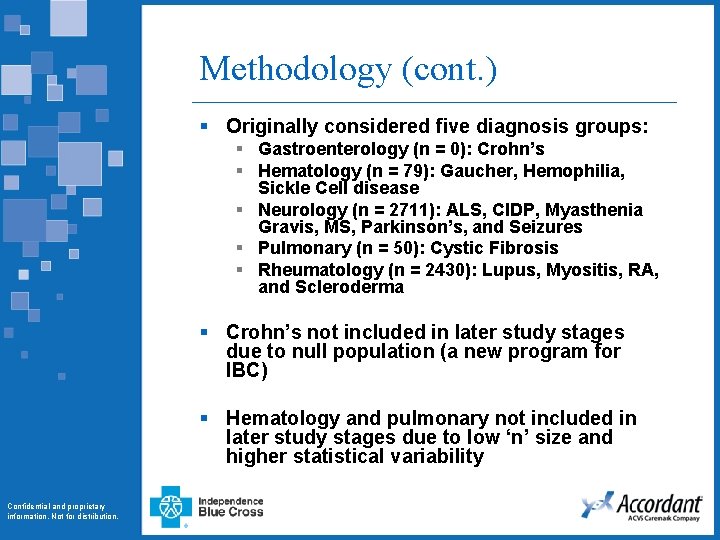
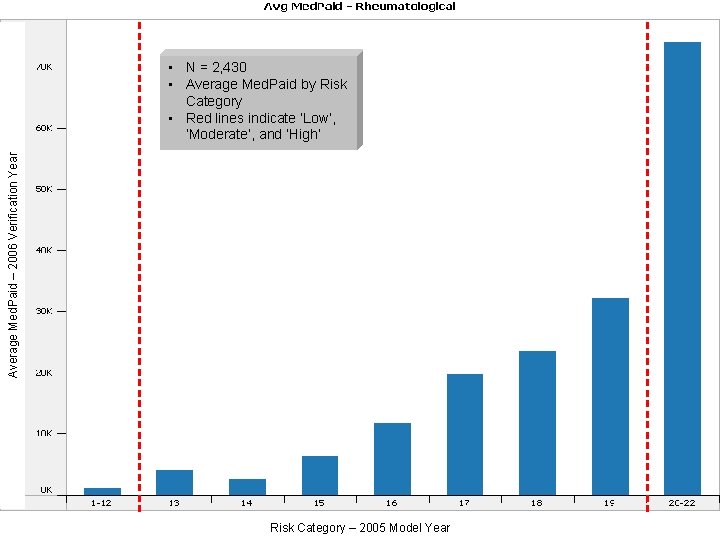
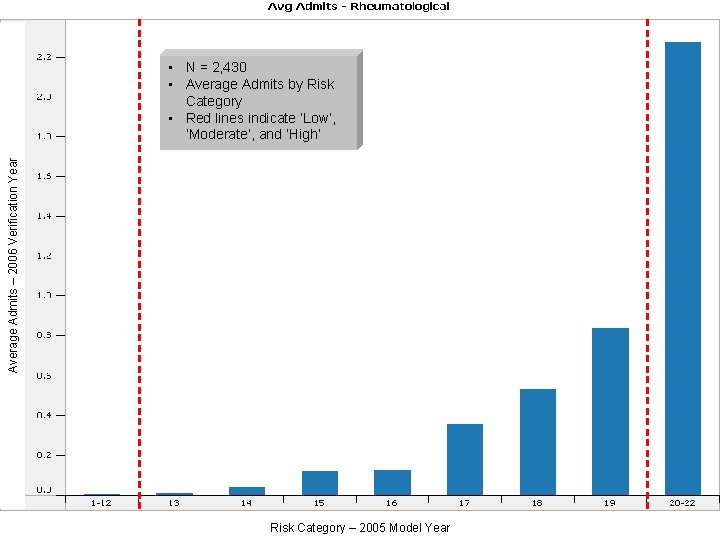
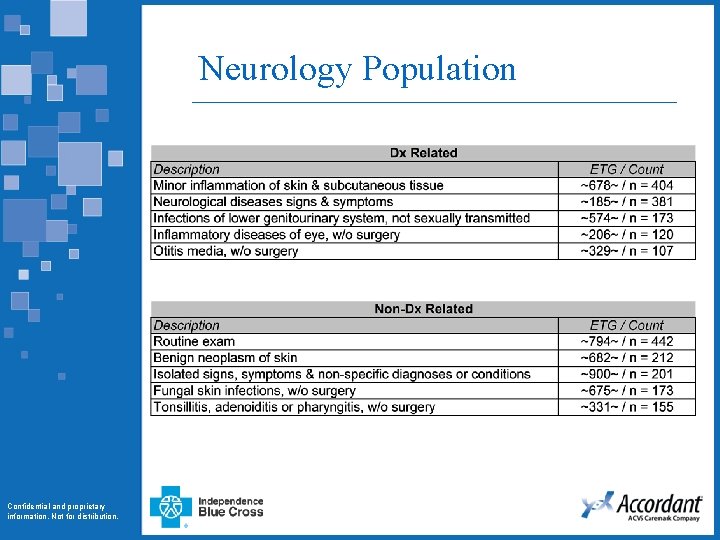
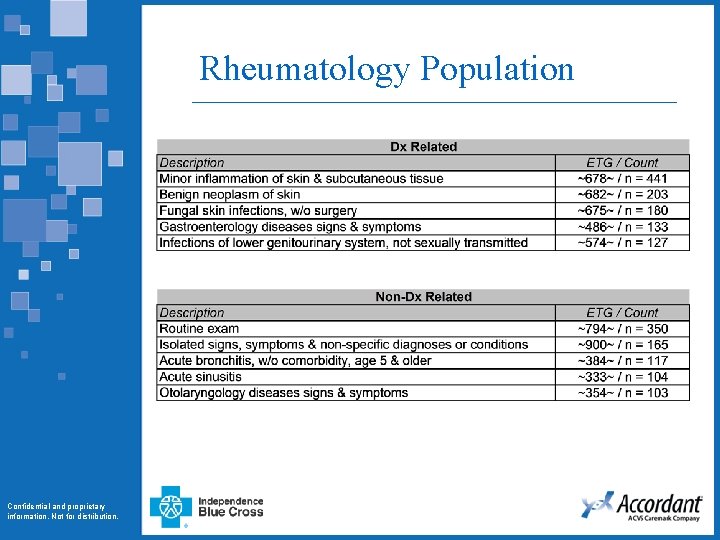
Methodology (cont. ) § Originally considered five diagnosis groups: § Gastroenterology (n = 0): Crohn’s § Hematology (n = 79): Gaucher, Hemophilia, Sickle Cell disease § Neurology (n = 2711): ALS, CIDP, Myasthenia Gravis, MS, Parkinson’s, and Seizures § Pulmonary (n = 50): Cystic Fibrosis § Rheumatology (n = 2430): Lupus, Myositis, RA, and Scleroderma § Crohn’s not included in later study stages due to null population (a new program for IBC) § Hematology and pulmonary not included in later study stages due to low ‘n’ size and higher statistical variability Confidential and proprietary information. Not for distribution.
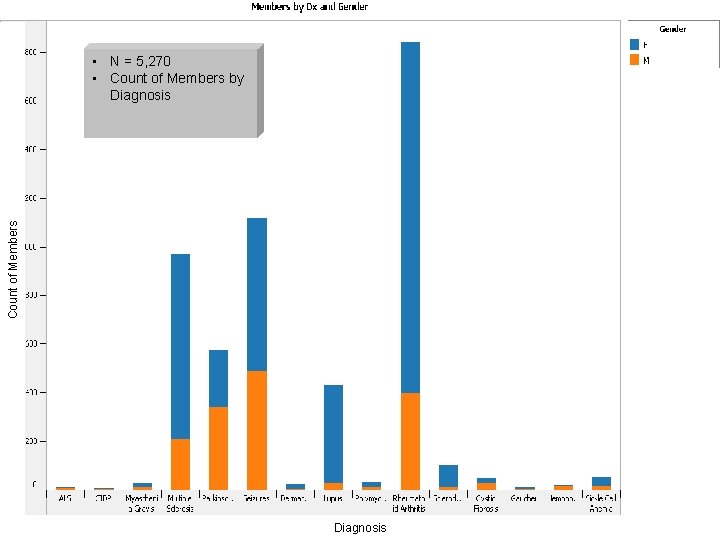
Count of Members • N = 5, 270 • Count of Members by Diagnosis Confidential and proprietary information. Not for distribution. Diagnosis
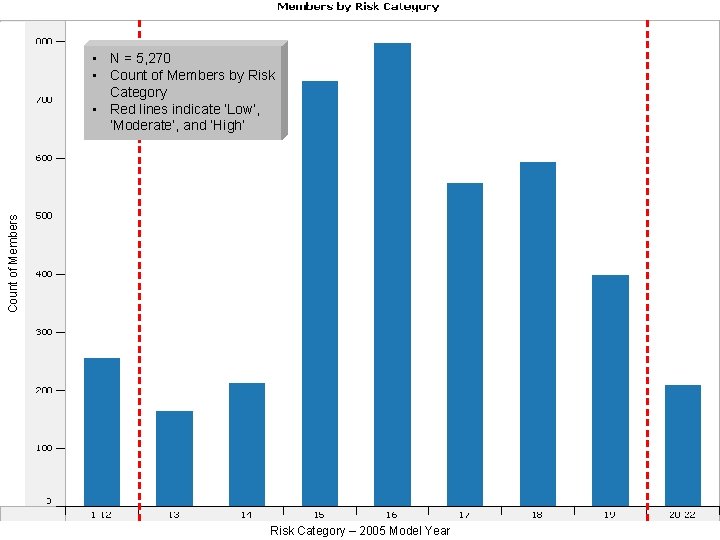
Count of Members • N = 5, 270 • Count of Members by Risk Category • Red lines indicate ‘Low’, ‘Moderate’, and ‘High’ Confidential and proprietary information. Not for distribution. Risk Category – 2005 Model Year
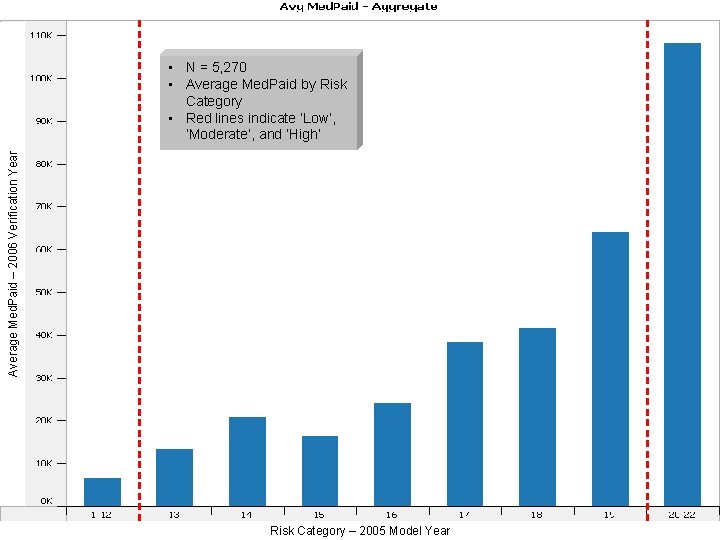
Average Med. Paid – 2006 Verification Year • N = 5, 270 • Average Med. Paid by Risk Category • Red lines indicate ‘Low’, ‘Moderate’, and ‘High’ Confidential and proprietary information. Not for distribution. Risk Category – 2005 Model Year
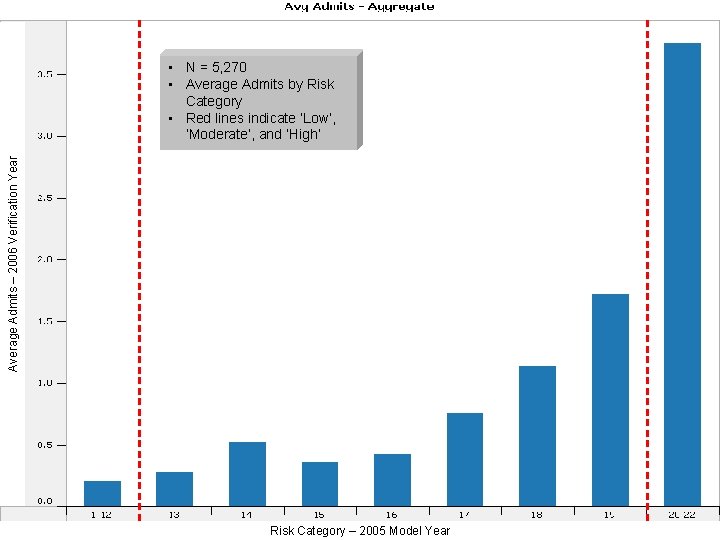
Average Admits – 2006 Verification Year • N = 5, 270 • Average Admits by Risk Category • Red lines indicate ‘Low’, ‘Moderate’, and ‘High’ Confidential and proprietary information. Not for distribution. Risk Category – 2005 Model Year
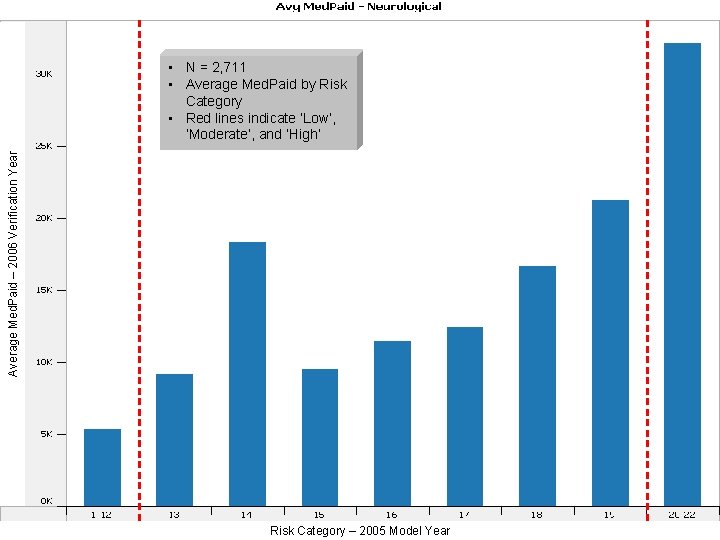
Average Med. Paid – 2006 Verification Year • N = 2, 711 • Average Med. Paid by Risk Category • Red lines indicate ‘Low’, ‘Moderate’, and ‘High’ Confidential and proprietary information. Not for distribution. Risk Category – 2005 Model Year
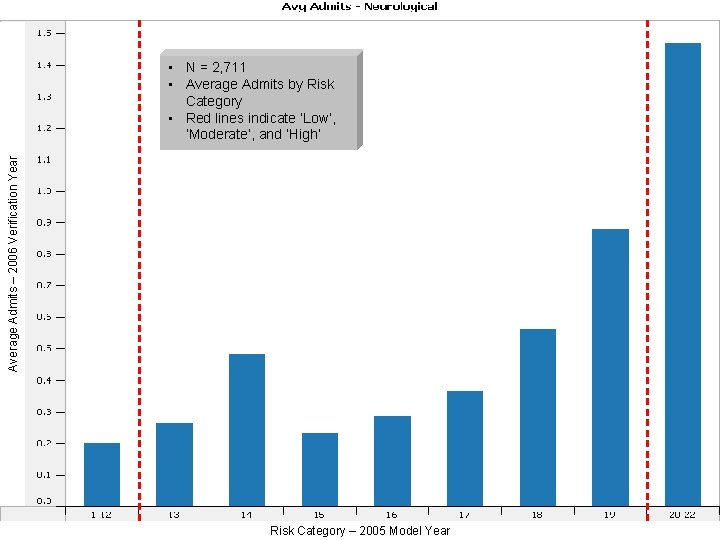
Average Admits – 2006 Verification Year • N = 2, 711 • Average Admits by Risk Category • Red lines indicate ‘Low’, ‘Moderate’, and ‘High’ Confidential and proprietary information. Not for distribution. Risk Category – 2005 Model Year
Average Med. Paid – 2006 Verification Year • N = 2, 430 • Average Med. Paid by Risk Category • Red lines indicate ‘Low’, ‘Moderate’, and ‘High’ Confidential and proprietary information. Not for distribution. Risk Category – 2005 Model Year
Average Admits – 2006 Verification Year • N = 2, 430 • Average Admits by Risk Category • Red lines indicate ‘Low’, ‘Moderate’, and ‘High’ Confidential and proprietary information. Not for distribution. Risk Category – 2005 Model Year
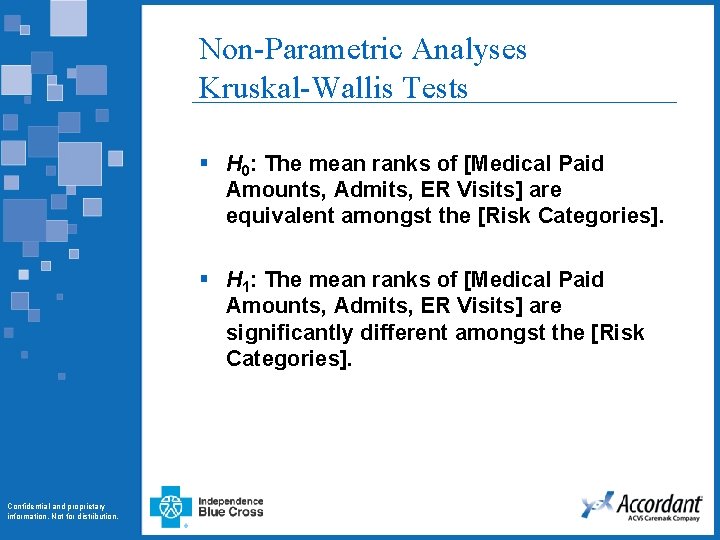
Non-Parametric Analyses Kruskal-Wallis Tests § H 0: The mean ranks of [Medical Paid Amounts, Admits, ER Visits] are equivalent amongst the [Risk Categories]. § H 1: The mean ranks of [Medical Paid Amounts, Admits, ER Visits] are significantly different amongst the [Risk Categories]. Confidential and proprietary information. Not for distribution.
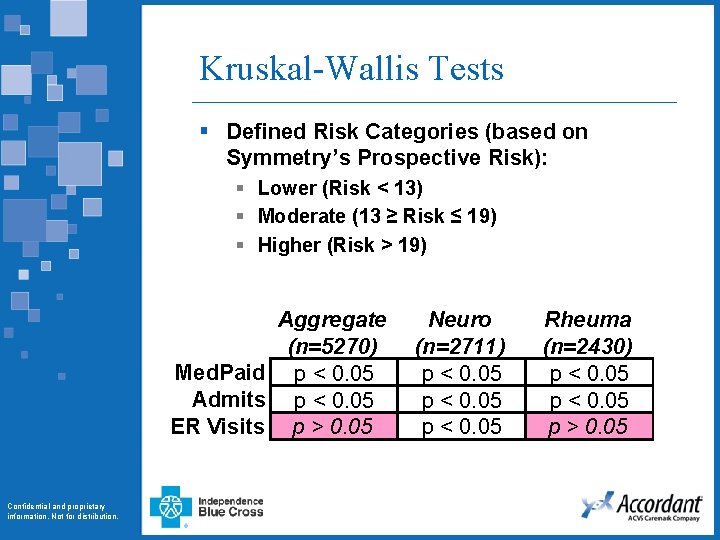
Kruskal-Wallis Tests § Defined Risk Categories (based on Symmetry’s Prospective Risk): § Lower (Risk < 13) § Moderate (13 ≥ Risk ≤ 19) § Higher (Risk > 19) Aggregate (n=5270) Med. Paid p < 0. 05 Admits p < 0. 05 ER Visits p > 0. 05 Confidential and proprietary information. Not for distribution. Neuro (n=2711) p < 0. 05 Rheuma (n=2430) p < 0. 05 p > 0. 05
Neurology Population Confidential and proprietary information. Not for distribution.
Rheumatology Population Confidential and proprietary information. Not for distribution.
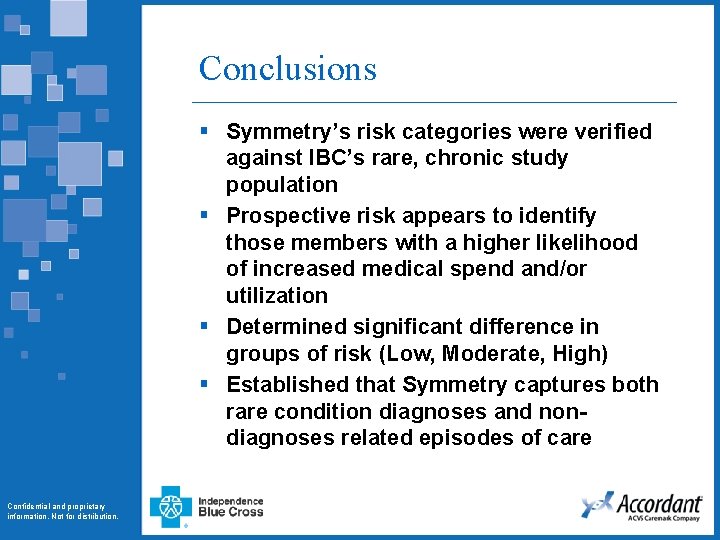
Conclusions § Symmetry’s risk categories were verified against IBC’s rare, chronic study population § Prospective risk appears to identify those members with a higher likelihood of increased medical spend and/or utilization § Determined significant difference in groups of risk (Low, Moderate, High) § Established that Symmetry captures both rare condition diagnoses and nondiagnoses related episodes of care Confidential and proprietary information. Not for distribution.
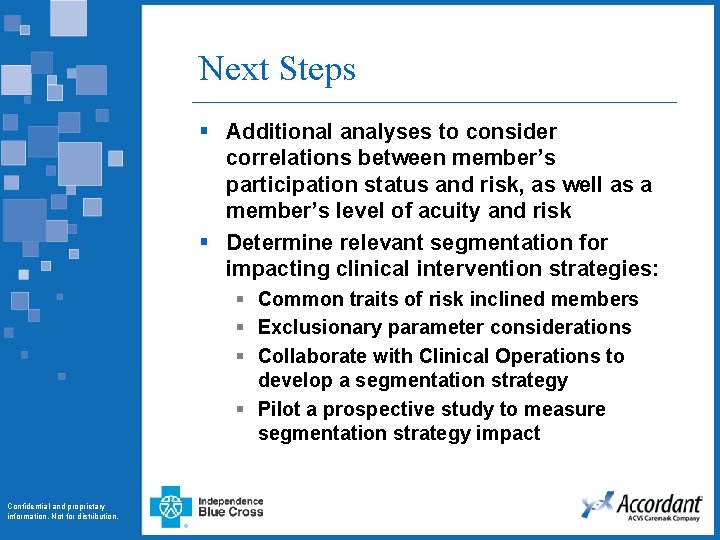
Next Steps § Additional analyses to consider correlations between member’s participation status and risk, as well as a member’s level of acuity and risk § Determine relevant segmentation for impacting clinical intervention strategies: § Common traits of risk inclined members § Exclusionary parameter considerations § Collaborate with Clinical Operations to develop a segmentation strategy § Pilot a prospective study to measure segmentation strategy impact Confidential and proprietary information. Not for distribution.
Questions? Thank You. . . § JCooper@accordant. net § Daryl. Wansink@ibx. com § AMarano@accordant. net Confidential and proprietary information. Not for distribution.