
Verification of NFV Services Problem Statement and Challenges
Verification of NFV Services : Problem Statement and Challenges draft-shin-nfvrg-service-verification-01 M-K. Shin, ETRI K. Nam, Friesty S. Pack, Korea Univ. S. Lee, ETRI Tae-wan Kim, LG U+ NFVRG Meeting@IETF 92, Dallas
Update since IETF 91 New Title Verification of NFV Services : Problem Statement and Challenges A co-author added Tae-wan Kim from operators Verification framework is newly revised and discussed based on the latest NFV phase-2 works (e. g. , terms, framework, etc. ) Table of Contents 1. Introduction 2. Problem statement : Property to be checked 2. 1 Dependencies of Network Service Components 2. 2 Loop-Free in VNF FGs 2. 3 Load Balancing and Optimization among VNF Instances 2. 4 Policy and State Consistency 2. 5 Performance 2. 6 Security 3. Minimal Requirements 4. Architectural Framework 4. 1 Properties and Invariants 4. 2 APIs 5. Challenging Issues 6. Security Considerations
Motivation and Problems Motivation Check consistency and safety of network service configurations on virtual and physical resources Ø Incomplete or inconsistent configuration of VNF and forwarding graph (FG, aka service chain) could cause break-down of the supporting infrastructure. Network and service properties to be checked 1. 2. 3. 4. 5. 6. Dependencies of Network Service Components Loop-Free in VNF FGs Policy and State Consistency Load Balancing and Optimization among VNF Instances Performance Bottleneck Security Hole

Properties (NFV vs. SDN) NFV context (Service-level) SDN context (Network-level) Dependency of network service components (e. g. , network controller vs. VNF/resource manager/orchestrator) No blackhole (e. g. , no packet loss) Loop-free in VNF FGs (aka. service chains) Loop-free (e. g, routing/switching) Load balancing and optimization in VNF FGs (aka. service chains) Flow table rule consistency between multiple applications (E. g. , Open. Flow) Policy and state consistency (e. g. , end-to-end context, virtual vs. physical resource, etc. ) Dynamic info/statistics consistency (e. g. , flow, port, Qo. S, etc. ) Performance Consistency with legacy L 2/L 3 protocols (e. g. , STP) Security (L 4 -L 7) Security (L 3 firewall, etc. )
Minimal Requirements R 1 : It SHOULD be able to check global and local properties and invariants. (E. g. , Loop-freeness and resource isolation between VNFs can be regarded as global. The policies that are related only to the specific network controllers or devices are local. ) R 2 : It SHOULD be able to access to the entire resource DBs as well as network states whenever verification tasks are started. R 3 : It SHOULD be independent from specific solutions and frameworks, and APIs. R 4 : It SHOULD process standard protocols such as Netconf, YANG, Open. Flow, I 2 RS, etc. and northbound and southbound interfaces that are related network configurations, and used by OSS.
Verification Framework Option 1 : Verification Manager in MANO Option 2 : OSS interaction Option 3 : VNF instances

Verification Framework Option 1 MANO Orchestrato r OSS/BSS Verificati on Manager Service, VNF and Infrastructure Description Verification Server APIs EMS 1 EMS 2 EMS 3 VNF 1 VNF 2 VNF 3 Virtual Computin g Virtual Storage Virtual Network VNF Manager( s) Property Library NFVI Virtualisation Layer Computin g Hardware Compiler & Interpreter Verifier Virtualised Infrastructur e Manager(s) Hardware resources Storage Network Hardware Note that Verification Service and Verification Manager in the NFV MANO should communicate using APIs to accomplish the verification tasks. Network States DB
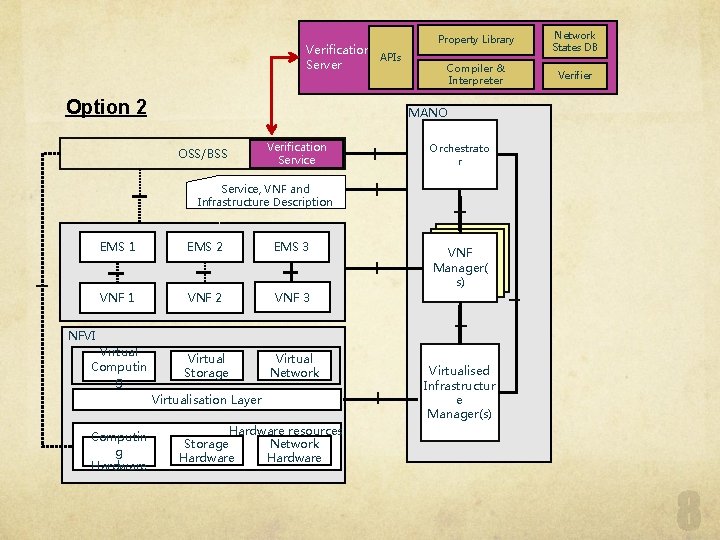
Verification APIs Server Option 2 Property Library Network States DB Compiler & Interpreter Verifier MANO OSS/BSS Verification Service Orchestrato r Service, VNF and Infrastructure Description EMS 1 EMS 2 EMS 3 VNF 1 VNF 2 VNF 3 Virtual Computin g Virtual Storage Virtual Network VNF Manager( s) NFVI Virtualisation Layer Computin g Hardware resources Storage Network Hardware Virtualised Infrastructur e Manager(s)
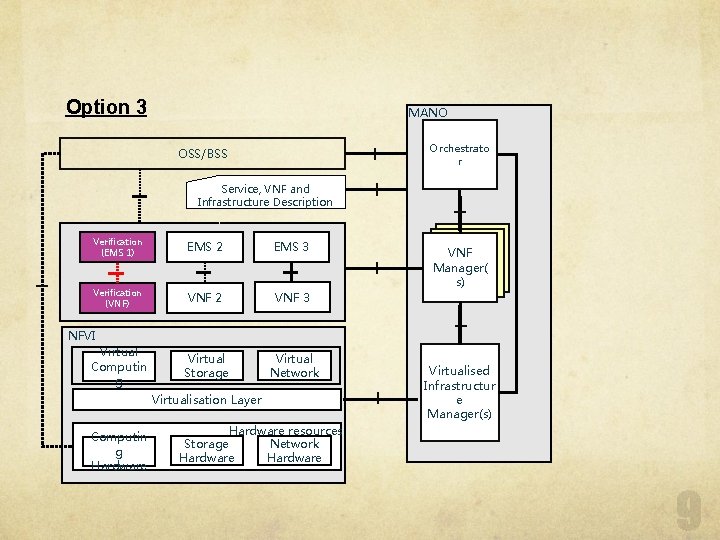
Option 3 MANO Orchestrato r OSS/BSS Service, VNF and Infrastructure Description Verification (EMS 1) EMS 2 EMS 3 Verification (VNF) VNF 2 VNF 3 Virtual Storage Virtual Network VNF Manager( s) NFVI Virtual Computin g Virtualisation Layer Computin g Hardware resources Storage Network Hardware Virtualised Infrastructur e Manager(s)
Challenging Issues Finding infinite loops General solutions for the infinite loop can lead to intractable problem (e. g. the halting problem). To make the verification practical and minimize the complexity, some of the restrictions are required. Real-time verification A few invariants can be checked in real-time but it would be impossible if the size of VNFs increases or properties checked are complex. Languages and their semantics Network service descriptions in NFV need to be precisely expressed using appropriate semantics (e. g. , formal method). Languages and semantic models optimized to the verification framework need to selected or newly developed.
Next Step Collect more requirements from operators and collaborate with ETSI NFV TST WG Investigate and be involved in open source projects (e. g. , OPNFV as well as Open Daylight) Adopt as a RG document
- Slides: 11