
Verification of Moderate Complexity IP Case Study MILSTD1553
- Slides: 16
Verification of Moderate Complexity IP: Case Study, MIL-STD-1553 B Interface Rod Barto NASA Office of Logic Design Barto 1 B 170 -W/MAPLD 2005
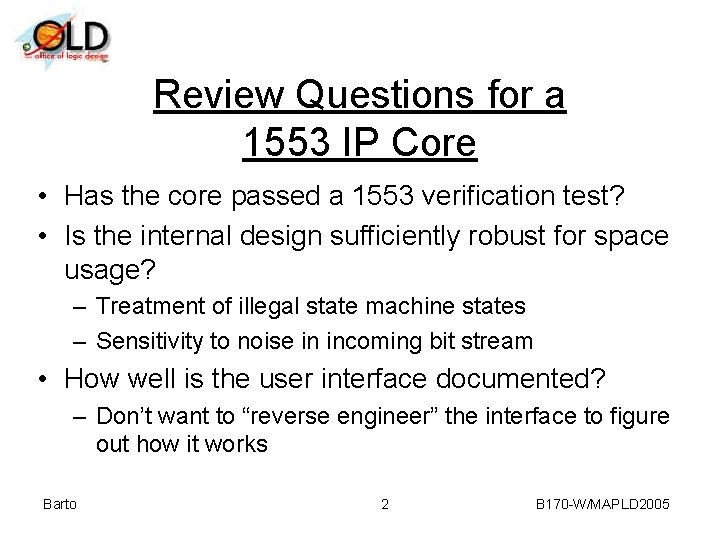
Review Questions for a 1553 IP Core • Has the core passed a 1553 verification test? • Is the internal design sufficiently robust for space usage? – Treatment of illegal state machine states – Sensitivity to noise in incoming bit stream • How well is the user interface documented? – Don’t want to “reverse engineer” the interface to figure out how it works Barto 2 B 170 -W/MAPLD 2005
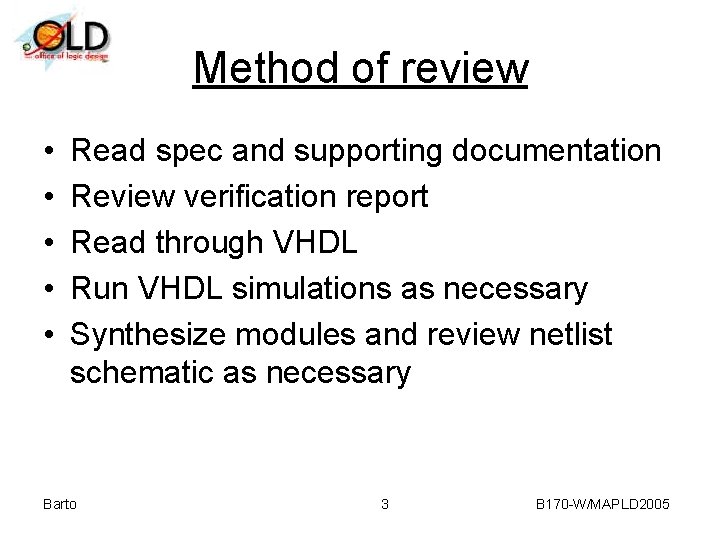
Method of review • • • Read spec and supporting documentation Review verification report Read through VHDL Run VHDL simulations as necessary Synthesize modules and review netlist schematic as necessary Barto 3 B 170 -W/MAPLD 2005
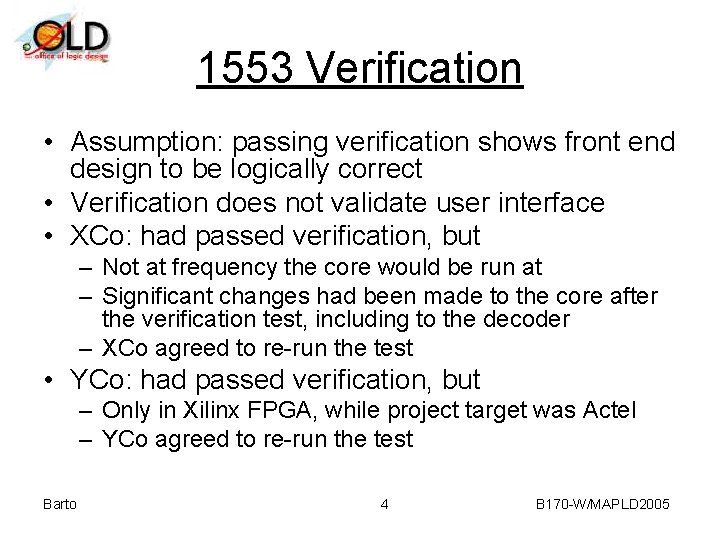
1553 Verification • Assumption: passing verification shows front end design to be logically correct • Verification does not validate user interface • XCo: had passed verification, but – Not at frequency the core would be run at – Significant changes had been made to the core after the verification test, including to the decoder – XCo agreed to re-run the test • YCo: had passed verification, but – Only in Xilinx FPGA, while project target was Actel – YCo agreed to re-run the test Barto 4 B 170 -W/MAPLD 2005
Design Robustness • XCo – “Safe” attribute not used – Decoder showed sensitivity to bit errors, and would require pre-filtering • YCo – “Safe” attribute used – Decoder incorporated pre-filtering and was otherwise by design less sensitive to bit errors Barto 5 B 170 -W/MAPLD 2005
Documentation • Documentation Standard: TI Data Book – Truth tables, timing diagrams, etc. , always provided – Never any confusion about how a TI part worked – Never had to call tech support to resolve ambiguities • Neither core met this standard – Both XCo and YCo had to be contacted to resolve documentation deficiencies Barto 6 B 170 -W/MAPLD 2005
Conclusions Regarding IP • Use of proven IP cores can reduce the time required to produce a proven design, but: – Users should be skeptical about how well “proven” the core is – Users should be skeptical that the design meets their robustness requirements – Vendors should raise the quality of their documentation • No IP reviewed to date meets the overall quality standard set by the vendors of SSI/MSI/LSI parts Barto 7 B 170 -W/MAPLD 2005
What Documentation Should the User Request? • Full data sheet and any user guides, application notes, etc. • Verification reports – Every piece of IP should have been subjected to some formal verification test by the vendor • Change and verification history • VHDL or other circuit description – IP vendors are reluctant to release this – Can obtain some information in other ways, e. g. , • Ask direct questions • Review synthesis reports for information about state machine handling, asynchronous design techniques, etc. Barto 8 B 170 -W/MAPLD 2005
Example: ACTgen RTAX-S FIFO • Candidate FIFO for 1553 backend circuitry • Uses RTAX RAM and FIFO resources • Generated by ACTgen, so it really is IP Barto 9 B 170 -W/MAPLD 2005
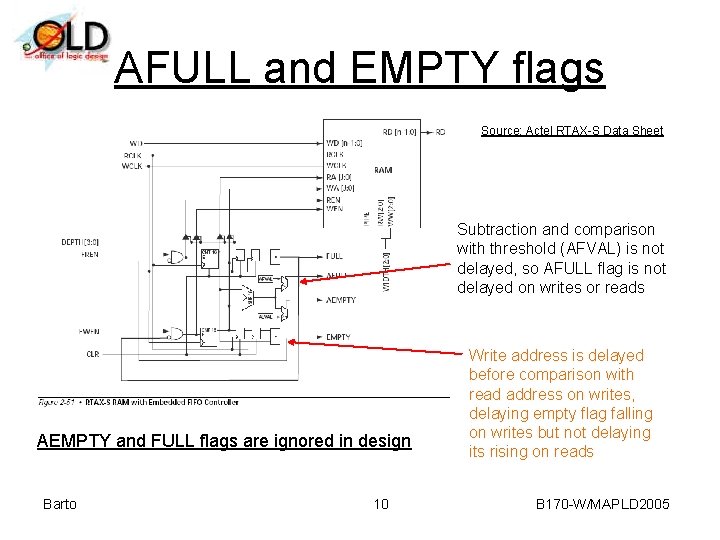
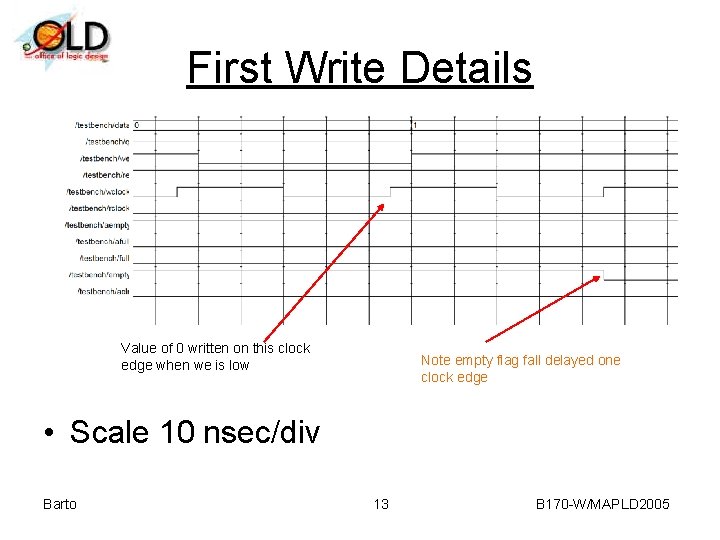
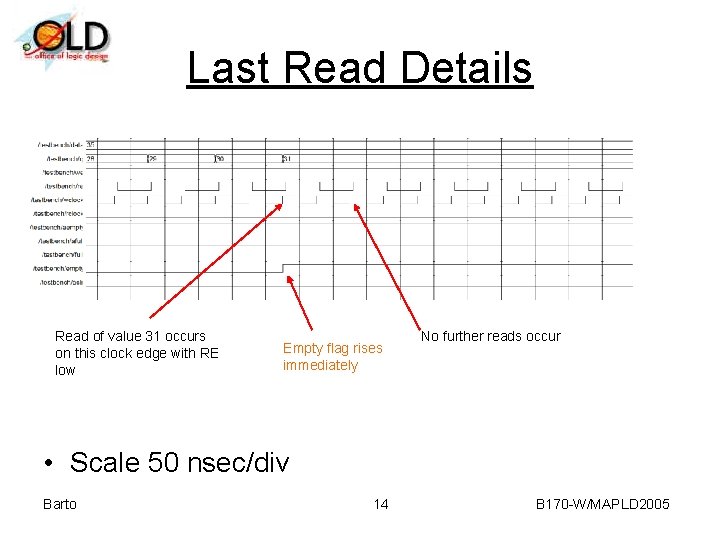
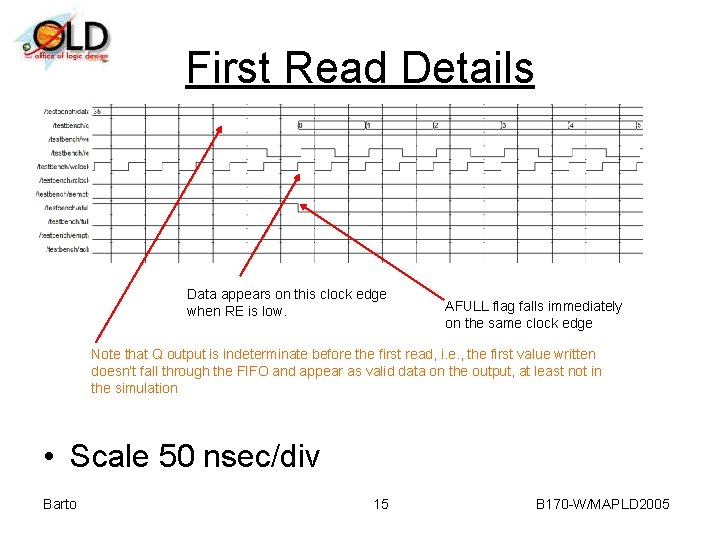
AFULL and EMPTY flags Source: Actel RTAX-S Data Sheet Subtraction and comparison with threshold (AFVAL) is not delayed, so AFULL flag is not delayed on writes or reads AEMPTY and FULL flags are ignored in design Barto 10 Write address is delayed before comparison with read address on writes, delaying empty flag falling on writes but not delaying its rising on reads B 170 -W/MAPLD 2005
Verification Plan: Run FIFO Simulations • Actel doesn’t provide any verification results • So, IP verification task falls to user • Verification plan: write test bench – Resets FIFO – Writes 35 words, values 0 to 34 • AFULL flag should rise after value 31 written • Logic checks the AFULL flag, only values 0 to 31 should be written – Reads 40 words • Only values 0 through 31 should come out, empty flag should rise after 31 Barto 11 B 170 -W/MAPLD 2005
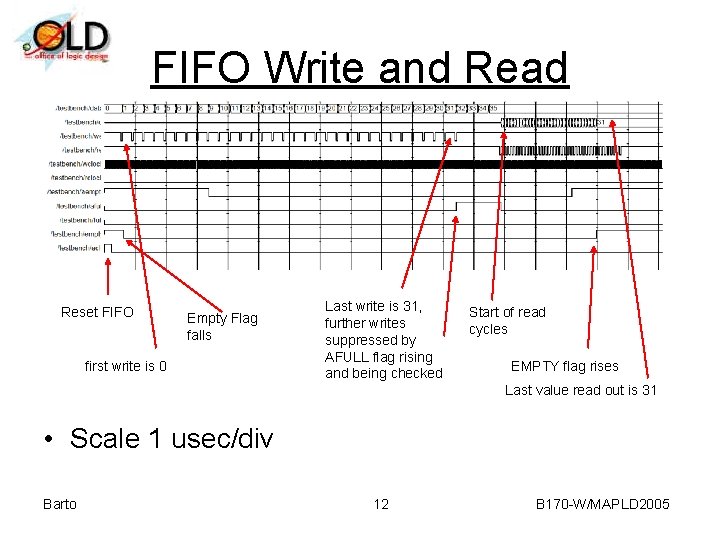
FIFO Write and Read Reset FIFO Empty Flag falls first write is 0 Last write is 31, further writes suppressed by AFULL flag rising and being checked Start of read cycles EMPTY flag rises Last value read out is 31 • Scale 1 usec/div Barto 12 B 170 -W/MAPLD 2005
First Write Details Value of 0 written on this clock edge when we is low Note empty flag fall delayed one clock edge • Scale 10 nsec/div Barto 13 B 170 -W/MAPLD 2005
Last Read Details Read of value 31 occurs on this clock edge with RE low Empty flag rises immediately No further reads occur • Scale 50 nsec/div Barto 14 B 170 -W/MAPLD 2005
First Read Details Data appears on this clock edge when RE is low. AFULL flag falls immediately on the same clock edge Note that Q output is indeterminate before the first read, i. e. , the first value written doesn’t fall through the FIFO and appear as valid data on the output, at least not in the simulation • Scale 50 nsec/div Barto 15 B 170 -W/MAPLD 2005
Conclusion • Investigation shows idiosyncrasies of IP – Empty flag rise/fall inconsistency could be inferred by reviewing RTAX-S documentation, but simulation shows it clearly – Indeterminate Q output before Read was a surprise • Better to take a skeptical approach to IP than to accept it blindly Barto 16 B 170 -W/MAPLD 2005