
Verification of expected death The role of the




- Slides: 38
Verification of expected death - The role of the nurse 3 rd February 2017 Sue Parrott – Clinical Trainer
Aims of the session • Explore professional and legal issues surrounding nurse initiated verification of expected death • Identify the stages of confirming death • What happens after someone dies
Verification? • • • What? Why? When? Who? How?
What does verification mean? • Confirmation of Death • That ALL signs of life are absent
Why is VOED by nurses necessary? • Unacceptable delays for relatives and carers in making further arrangements • Achievement of person's preferences • Delay in removal of medical devices • Increased use of nurses in management of long term conditions and end of life care • “Storage” issues “Proceed without unnecessary and distressing delay”
When can a nurse verify death? • When the death is expected – Medical responsibility to decide whether death is expected or anticipated • In accordance with LOCAL policy • Completed training & deemed competent • An “experienced” registered nurse? • Confident !
When not ……………… List as many situations that you can think of when a nurse CAN NOT verify the death of a person
What is an expected death? • “Acute or chronic deterioration in a clients health status, or confirmation of an infection likely to exacerbate a client's existing medical condition, which has been documented by the Medical Practitioner within the last two weeks” • “A case where discussions have taken place between the medical and nursing team and the patient’s relatives and a decision has been made and documented that no further intervention is appropriate”
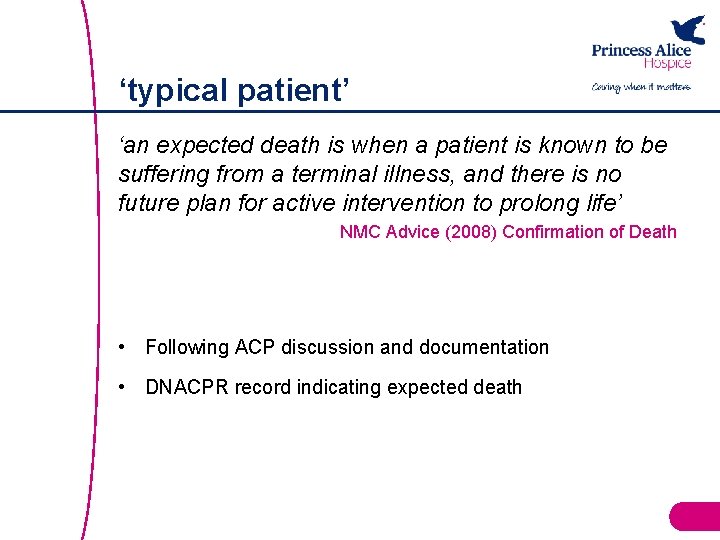
‘typical patient’ ‘an expected death is when a patient is known to be suffering from a terminal illness, and there is no future plan for active intervention to prolong life’ NMC Advice (2008) Confirmation of Death • Following ACP discussion and documentation • DNACPR record indicating expected death
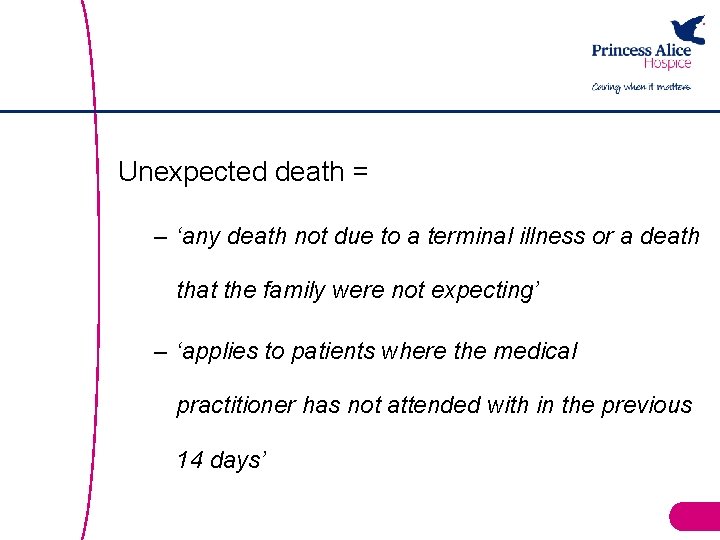
Unexpected death = – ‘any death not due to a terminal illness or a death that the family were not expecting’ – ‘applies to patients where the medical practitioner has not attended with in the previous 14 days’
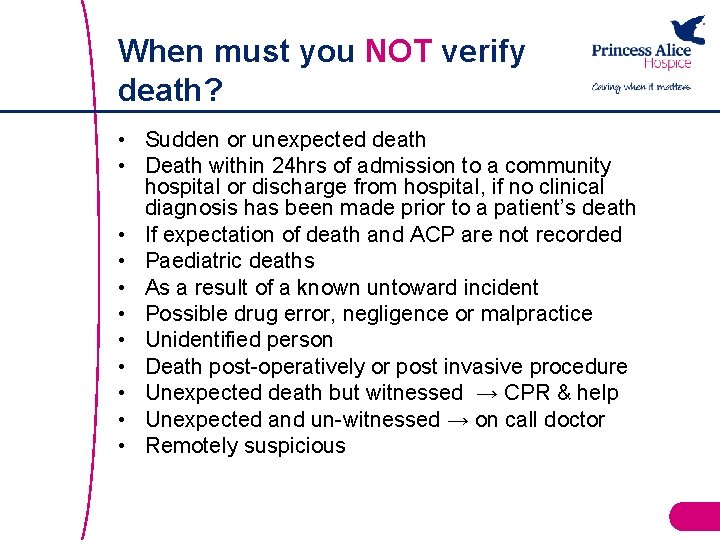
When must you NOT verify death? • Sudden or unexpected death • Death within 24 hrs of admission to a community hospital or discharge from hospital, if no clinical diagnosis has been made prior to a patient’s death • If expectation of death and ACP are not recorded • Paediatric deaths • As a result of a known untoward incident • Possible drug error, negligence or malpractice • Unidentified person • Death post-operatively or post invasive procedure • Unexpected death but witnessed → CPR & help • Unexpected and un-witnessed → on call doctor • Remotely suspicious
• What does the NMC say? – Accountable – Competent • What if you have ANY concerns AT ALL?
The NMC (2004) states: “ A nurse cannot legally certify death as this is one of the few activities that the law requires to be performed by registered medical practitioners. The nurse may however confirm death has occurred, providing there is an explicit policy in place to allow such an action” NB: This policy only applies to those patients whose death is anticipated, expected and predicted and where a clear not for resuscitation decision has been made and recorded
Verification v. certification • Verification confirms the FACT that someone has died • Certification confirms the CAUSE of the death
A “suitably” trained nurse therefore can… • Verify death • Notify relatives • Arrange & carry out last offices OR care after death • Arrange for the removal of the body to the mortuary
English law • Deciding whether life is extinct does not require a medically registered practitioner • Doctor must certify cause of death but not the fact of death • Nurses can not certify death • Does not require a doctor to view body • Does require the doctor attending the deceased during the last illness to issue a certificate detailing cause of death
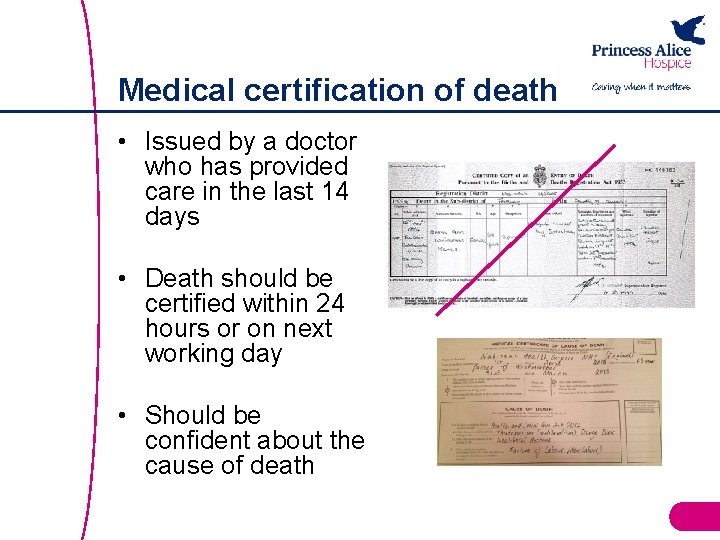
Medical certification of death • Issued by a doctor who has provided care in the last 14 days • Death should be certified within 24 hours or on next working day • Should be confident about the cause of death
Responsibility of attending Doctor • For burial – Complete “medical certificate of cause of death” – View body (? ) – Discuss case with nurse who has cared for the person • For cremation – As above and in addition complete Cremation form – Doctor to view body and complete Confirmatory Certificate Section – 2 nd Doctor discusses and agrees cause of death – Fee payable by family via Funeral Director
Proposed reforms • • Aim for a unified system Safeguards for burials as well as cremations Appointment of local “medical examiners” Not yet fully implemented……. .
What could go wrong? Person may appear dead! • • Prolonged submersion in cold water Following ingestion of alcohol or drugs Hypoglycaemic In a coma
Shipman Inquiry 2005 “You need to be very certain that the heart has really stopped, that it is not beating very, very slowly and very, very slightly. That respiration really has stopped and that you are not missing very slow, very shallow respirations”
Independent Newspaper April 2007 “Embarrassed hospital officials have admitted they have no idea how a man was declared dead and later discovered to be breathing. They have begun an investigation after mortuary staff, who came to collect the man, pointed out to staff he was still alive”.
Daily Mail Newspaper January 2014 • Man wakes up in mortuary more than 15 hours after hospital pronounced him dead • 24 -year-old man from central Kenya was rushed to hospital • He had drunk insecticide in an apparent suicide attempt • Pronounced dead, he was taken to the morgue to be embalmed • The anti-poison drugs may have made him appear to have died • Hospital is investigating how the mistake could have happened
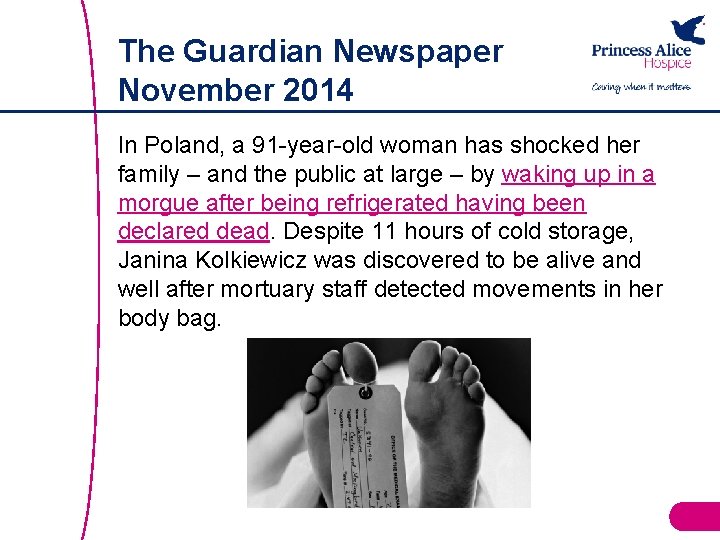
The Guardian Newspaper November 2014 In Poland, a 91 -year-old woman has shocked her family – and the public at large – by waking up in a morgue after being refrigerated having been declared dead. Despite 11 hours of cold storage, Janina Kolkiewicz was discovered to be alive and well after mortuary staff detected movements in her body bag.
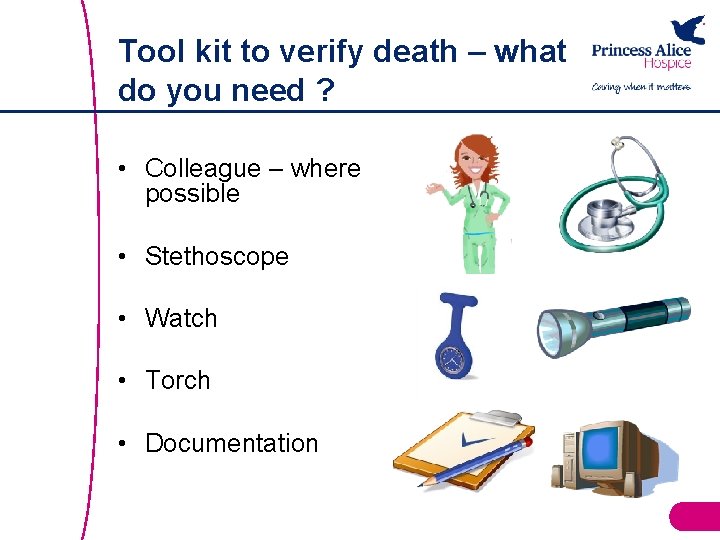
Tool kit to verify death – what do you need ? • Colleague – where possible • Stethoscope • Watch • Torch • Documentation
Physiological signs of death – absence of life • Absence of carotid pulse - 1 minute • Absence of heart sounds – minimum 1 minute • Absence of respirations checked by listening with stethoscope and observation - minimum 1 minute • Both pupils fixed and dilated, not responsive to light • (No response to painful stimuli – 10 sec sternal rub? ) • Repeat until satisfied…. .
Recording • Advance care plan • DNACPR • Verification of death checklist – Syringe pump medication record – Witnessing colleague • Patient electronic record
Case…… Mr Jones has end stage heart failure. The GP has said that he feels Mr Jones is entering the last part of his life and has discussed this with the patient & his wife. Mr Jones dies. Before verifying his death, is there anything else you would want to know? Julie is a community RN. She has been qualified for 4 years. She has read the trust policy and had a recent VOED update. She works nights & hasn’t met Mr Jones before. If you were Julie, would you verify?
Case…. . . Mrs Jones explains that the GP hadn’t seen Mr Jones for a few days. Julie is asked by the GP to verify Mr Jones’ death. Why is this important? Would you require any clarification? Julie listens for heart sounds, feels for a pulse but thinks she may have seen pupil reaction to light. Should she? What should she do next?
Signs that someone will die in the near future ?
Competency for nurses VOED • Local policy • Competency document
Care after death • Good end of life care doesn’t stop at the point of death • When someone dies all staff need to follow good practice which includes being responsive to family wishes • The support and care provided to relatives will help them cope with their loss
Care after death – ‘last offices’ • Initially – laid flat with one pillow, minimal wash, limbs placed as straight as possible, clean nightwear/bedding • Following care after death – arms placed on top of abdomen, palms down • Removal or taping of rings & jewellery • Removal of urinary catheter • Dentures in place or collected by undertaker/porter • Washed • Do not shave • If needed dressing over orifices • Dress broken skin • Own or hospital nightwear • Brush hair
Rigor mortis (Latin meaning "stiffness of death") • Commences after about three to four hours • Maximum stiffness after 12 hours • Gradually dissipates until approximately 48 to 60 hours after death • Warm conditions can speed up the process of rigor mortis
Any questions?