
Verification of Boson Sampling Devices Scott Aaronson MIT
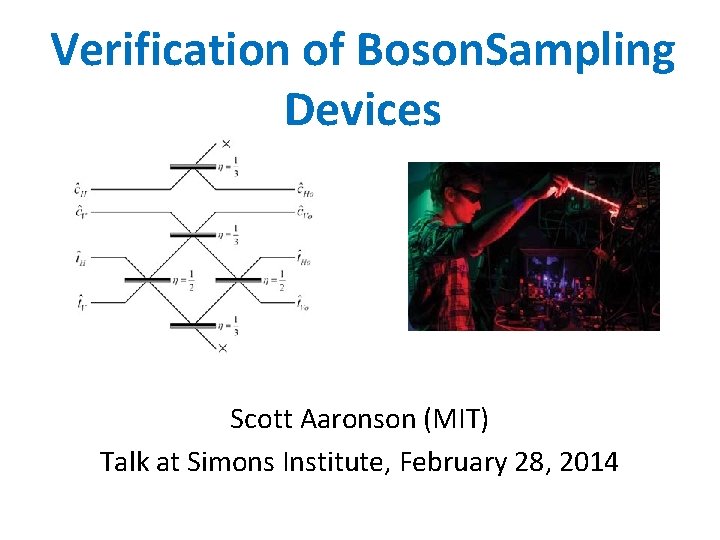
Verification of Boson. Sampling Devices Scott Aaronson (MIT) Talk at Simons Institute, February 28, 2014
The Extended Church. Turing Thesis (ECT) Everything feasibly computable in the physical world is feasibly computable by a (probabilistic) Turing machine Shor’s Theorem: QUANTUM SIMULATION has no efficient classical algorithm, unless FACTORING does
So the ECT is false … what more evidence could anyone want? Building a QC able to factor large numbers is damn hard! After 16 years, no fundamental obstacle has been found, but who knows? Can’t we “meet the physicists halfway, ” and show computational hardness for quantum systems closer to what they actually work with now? FACTORING might be have a fast classical algorithm! At any rate, it’s an extremely “special” problem Wouldn’t it be great to show that if, quantum computers can be simulated classically, then (say) P=NP?

Boson. Sampling (A. -Arkhipov 2011) A rudimentary type of quantum computing, involving only non-interacting photons Classical counterpart: Galton’s Board Replacing the balls by photons leads to famously counterintuitive phenomena, like the Hong-Ou-Mandel dip
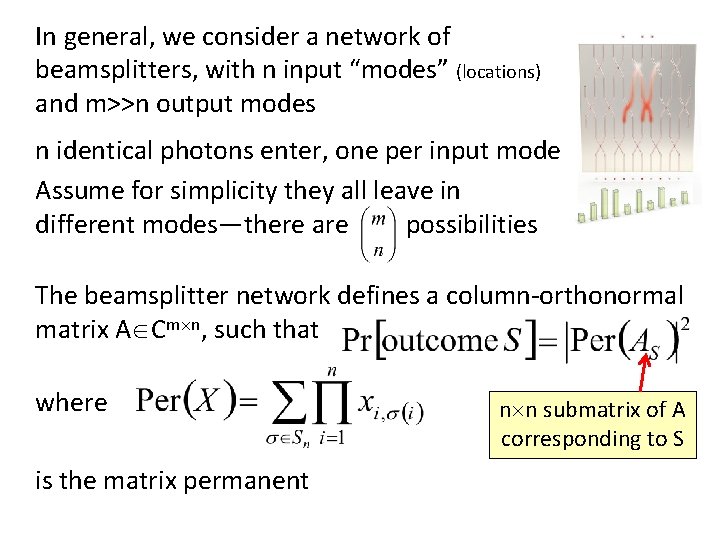
In general, we consider a network of beamsplitters, with n input “modes” (locations) and m>>n output modes n identical photons enter, one per input mode Assume for simplicity they all leave in different modes—there are possibilities The beamsplitter network defines a column-orthonormal matrix A Cm n, such that where is the matrix permanent n n submatrix of A corresponding to S
So, Can We Use Quantum Optics to Solve a #P-Complete Problem? That sounds way too good to be true… Explanation: If X is sub-unitary, then |Per(X)|2 will usually be exponentially small. So to get a reasonable estimate of |Per(X)|2 for a given X, we’d generally need to repeat the optical experiment exponentially many times
Better idea: Given A Cm n as input, let Boson. Sampling be the problem of merely sampling from the same distribution DA that the beamsplitter network samples from—the one defined by Pr[S]=|Per(AS)|2 Theorem (A. -Arkhipov 2011): Suppose Boson. Sampling is solvable in classical polynomial time. Then P#P=BPPNP Upshot: Compared to (say) Shor’s factoring Better Theorem: Suppose we can sample DA even algorithm, we get different/stronger evidence that a approximately in classical polynomial time. Then in weaker system can do something classically hard NP BPP , it’s possible to estimate Per(X), with high probability over a Gaussian random matrix We conjecture that the above problem is already #P-complete. If it is, then a fast classical algorithm for approximate Boson. Sampling would already have the consequence that P#P=BPPNP
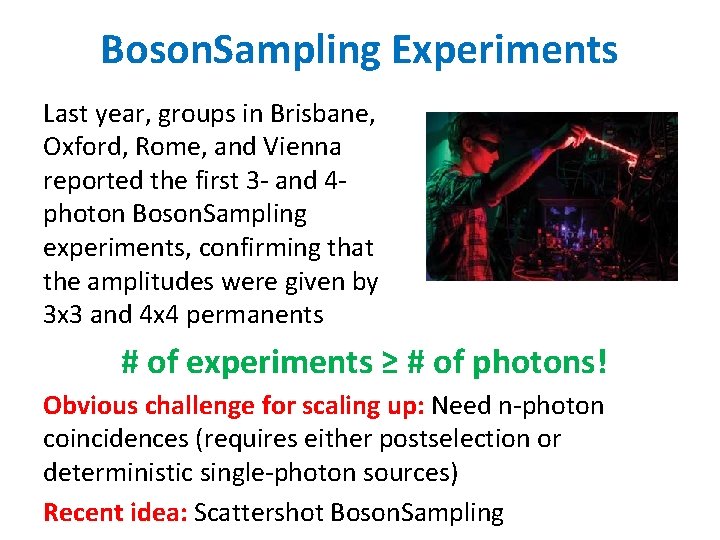
Boson. Sampling Experiments Last year, groups in Brisbane, Oxford, Rome, and Vienna reported the first 3 - and 4 photon Boson. Sampling experiments, confirming that the amplitudes were given by 3 x 3 and 4 x 4 permanents # of experiments ≥ # of photons! Obvious challenge for scaling up: Need n-photon coincidences (requires either postselection or deterministic single-photon sources) Recent idea: Scattershot Boson. Sampling

Verifying Boson. Sampling Devices Crucial difference from factoring: Even verifying the output of a claimed Boson. Sampling device would presumably take exp(n) time, in general! Recently underscored by [Gogolin et al. 2013] (alongside specious claims…) Our responses: (1) Who cares? Take n=30 (2) If you do care, we can show to distinguish the output of a Boson. Sampling device from all sorts of specific “null hypotheses”
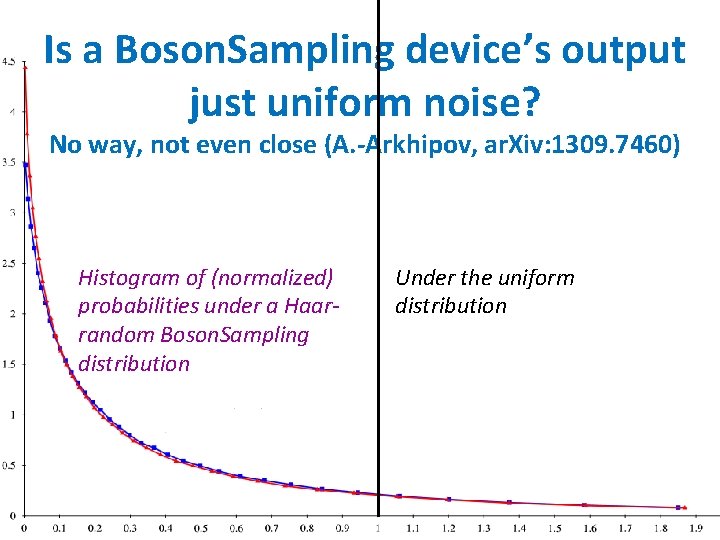
Is a Boson. Sampling device’s output just uniform noise? No way, not even close (A. -Arkhipov, ar. Xiv: 1309. 7460) Histogram of (normalized) probabilities under a Haarrandom Boson. Sampling distribution Under the uniform distribution
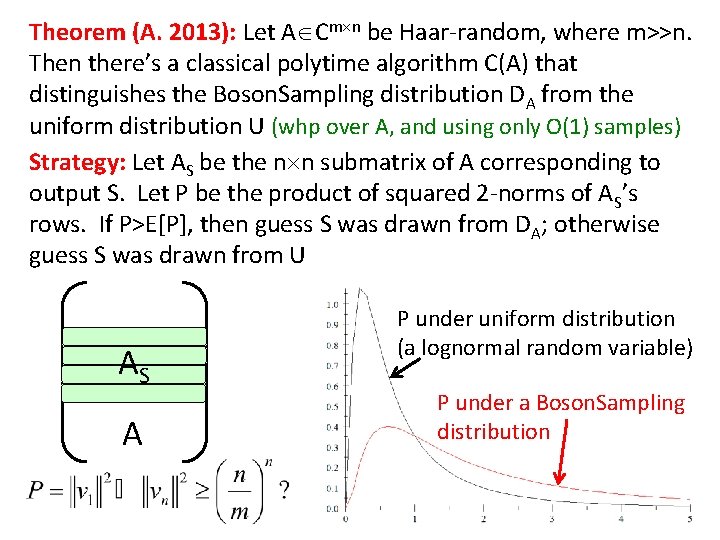
Theorem (A. 2013): Let A Cm n be Haar-random, where m>>n. Then there’s a classical polytime algorithm C(A) that distinguishes the Boson. Sampling distribution DA from the uniform distribution U (whp over A, and using only O(1) samples) Strategy: Let AS be the n n submatrix of A corresponding to output S. Let P be the product of squared 2 -norms of AS’s rows. If P>E[P], then guess S was drawn from DA; otherwise guess S was drawn from U AS A P under uniform distribution (a lognormal random variable) P under a Boson. Sampling distribution
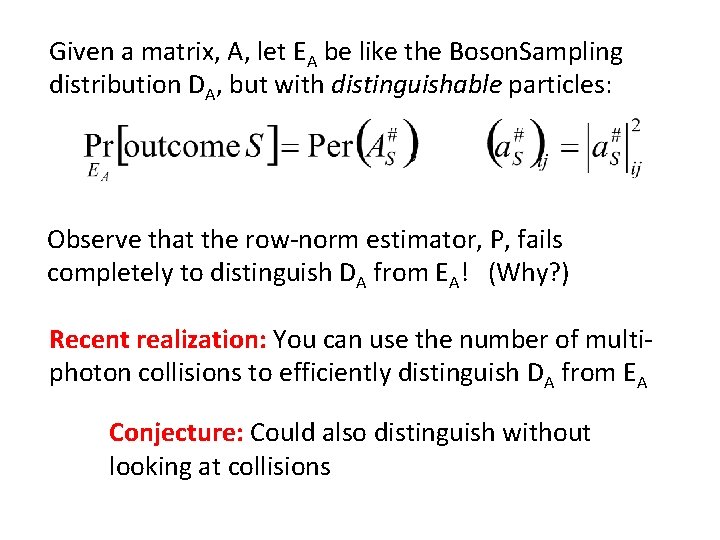
Given a matrix, A, let EA be like the Boson. Sampling distribution DA, but with distinguishable particles: Observe that the row-norm estimator, P, fails completely to distinguish DA from EA! (Why? ) Recent realization: You can use the number of multiphoton collisions to efficiently distinguish DA from EA Conjecture: Could also distinguish without looking at collisions
The Classical Mockup Challenge Given a matrix A Cm n, is there some classically efficiently-samplable distribution CA, which is indistinguishable from the Boson. Sampling distribution DA by any polynomial-time algorithm? Observation: If we just wanted an efficiently-samplable distribution that’s indistinguishable from DA by any (say) n 2 -time algorithm, that’s trivial to get! Brandao: We can even get such a mockup distribution with a large min-entropy, using Trevisan-Tulsiani-Vadhan
The NP Challenge Can our linear-optics model solve a classically-intractable problem (say, a search or decision problem) for which a classical computer can efficiently verify the answer? Given an n n matrix with large (1/poly(n)) permanent, can one “smuggle” it as a submatrix of a unitary matrix? What kinds of (sub)unitary matrices can have ≥ 1/poly(n) permanents? Must every such matrix be “close to the identity, ” in some sense? Arkhipov: Every unitary with permanent ≥ 1 -1/e has a “large” diagonal
The Interactive Protocol Challenge Can a Boson. Sampling device convince a classical skeptic of its post-classical powers via an interactive protocol? Arora et al. 2012: An oracle for Gaussian permanent estimation would be self-checkable. (But alas, a Boson. Sampling device is not such an oracle!)
- Slides: 15