
Verification Beyond the Basics Tonya Hsiung Senior Assistant
Verification: Beyond the Basics Tonya Hsiung Senior Assistant Director of Financial Aid Franklin & Marshall College
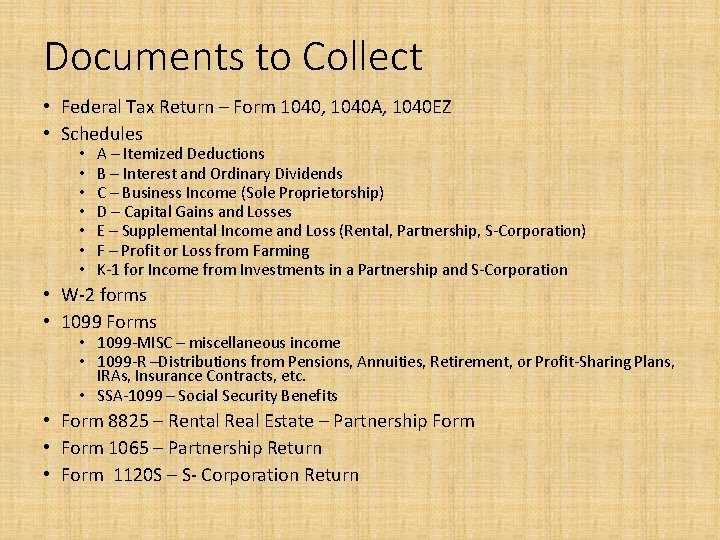
Documents to Collect • Federal Tax Return – Form 1040, 1040 A, 1040 EZ • Schedules • • A – Itemized Deductions B – Interest and Ordinary Dividends C – Business Income (Sole Proprietorship) D – Capital Gains and Losses E – Supplemental Income and Loss (Rental, Partnership, S-Corporation) F – Profit or Loss from Farming K-1 for Income from Investments in a Partnership and S-Corporation • W-2 forms • 1099 Forms • 1099 -MISC – miscellaneous income • 1099 -R –Distributions from Pensions, Annuities, Retirement, or Profit-Sharing Plans, IRAs, Insurance Contracts, etc. • SSA-1099 – Social Security Benefits • Form 8825 – Rental Real Estate – Partnership Form • Form 1065 – Partnership Return • Form 1120 S – S- Corporation Return
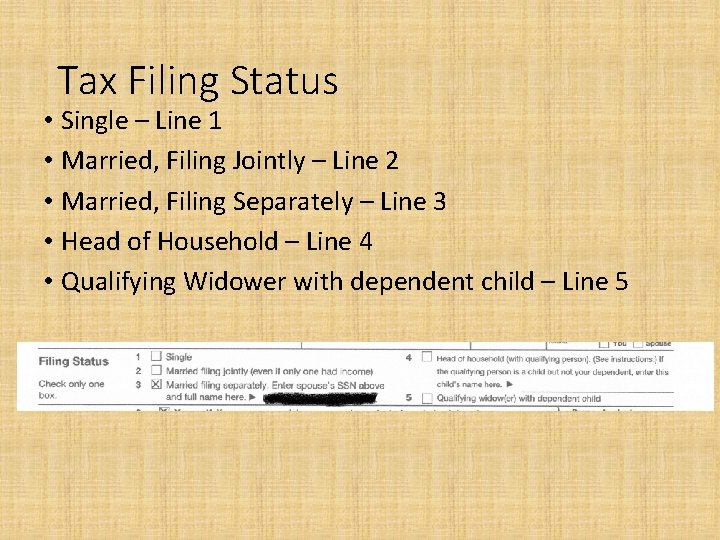
Tax Filing Status • Single – Line 1 • Married, Filing Jointly – Line 2 • Married, Filing Separately – Line 3 • Head of Household – Line 4 • Qualifying Widower with dependent child – Line 5
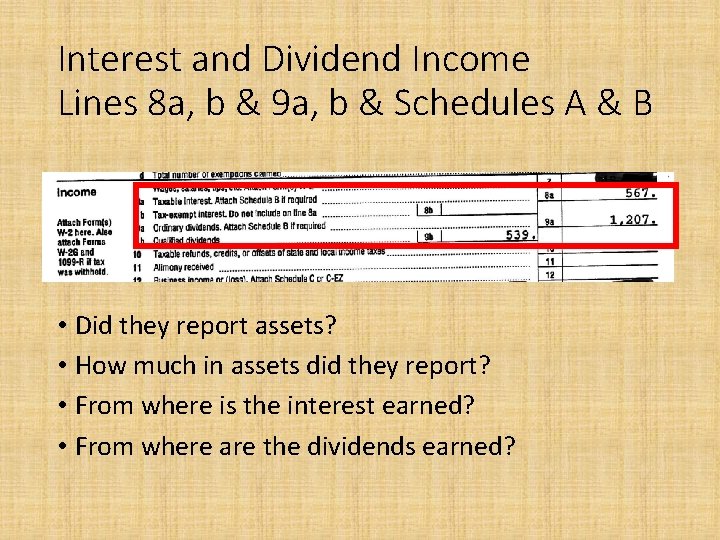
Interest and Dividend Income Lines 8 a, b & 9 a, b & Schedules A & B • Did they report assets? • How much in assets did they report? • From where is the interest earned? • From where are the dividends earned?
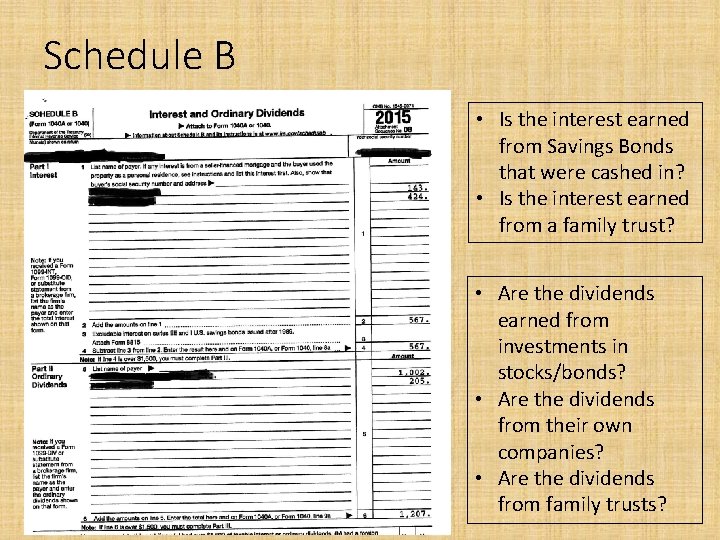
Schedule B • Is the interest earned from Savings Bonds that were cashed in? • Is the interest earned from a family trust? • Are the dividends earned from investments in stocks/bonds? • Are the dividends from their own companies? • Are the dividends from family trusts?
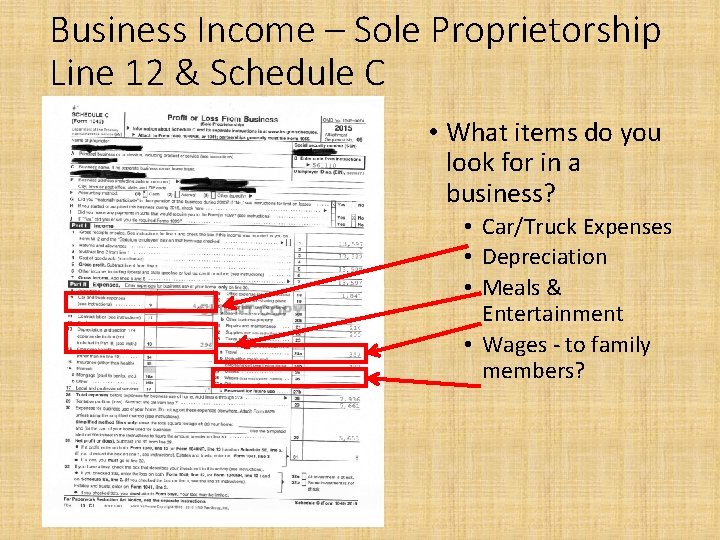
Business Income – Sole Proprietorship Line 12 & Schedule C • What items do you look for in a business? • Car/Truck Expenses • Depreciation • Meals & Entertainment • Wages - to family members?
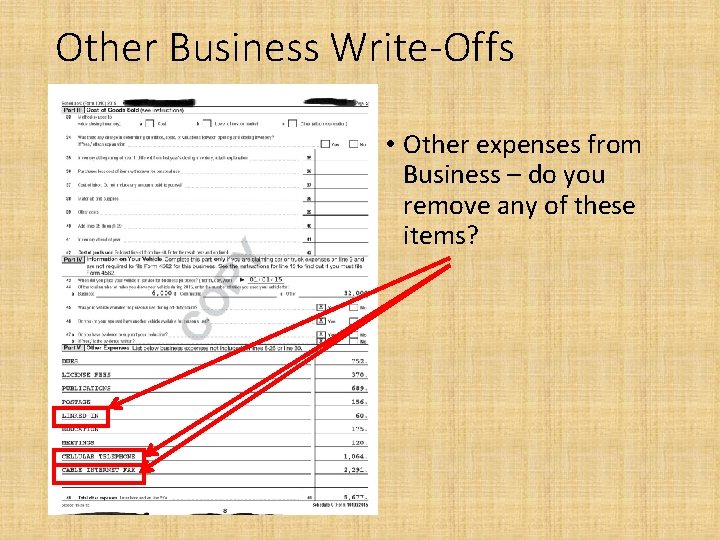
Other Business Write-Offs • Other expenses from Business – do you remove any of these items?
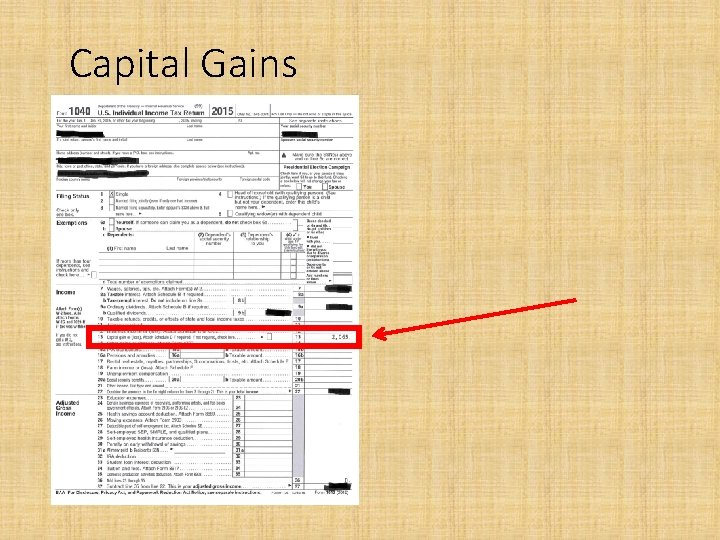
Capital Gains
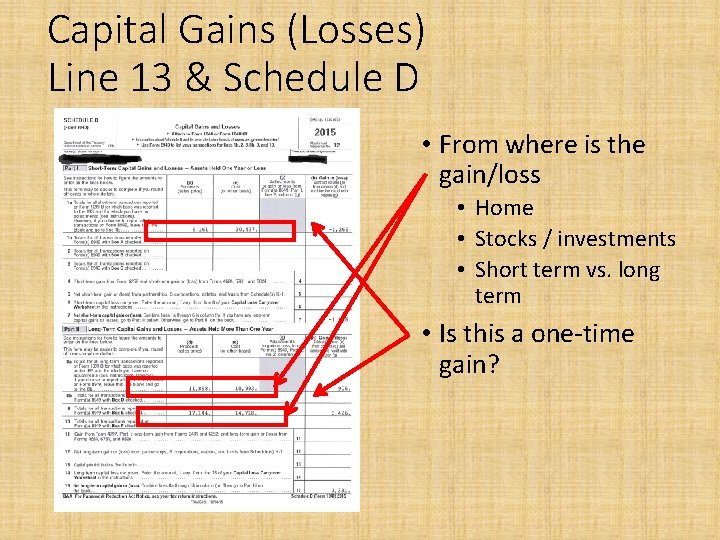
Capital Gains (Losses) Line 13 & Schedule D • From where is the gain/loss • Home • Stocks / investments • Short term vs. long term • Is this a one-time gain?
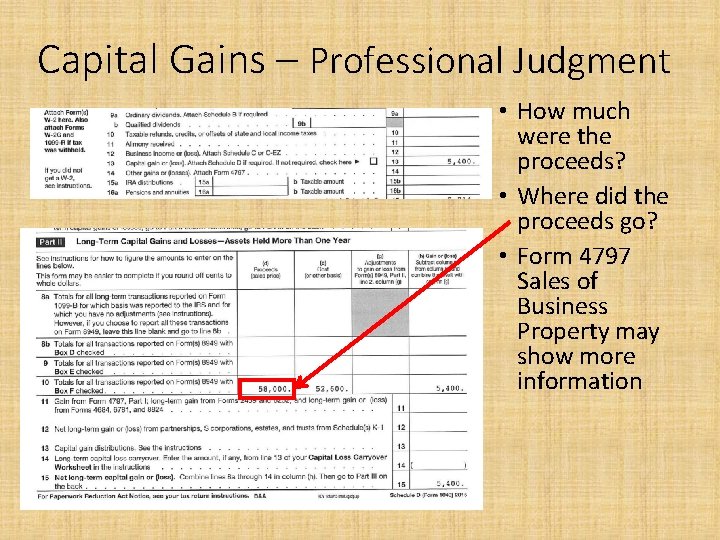
Capital Gains – Professional Judgment • How much were the proceeds? • Where did the proceeds go? • Form 4797 Sales of Business Property may show more information
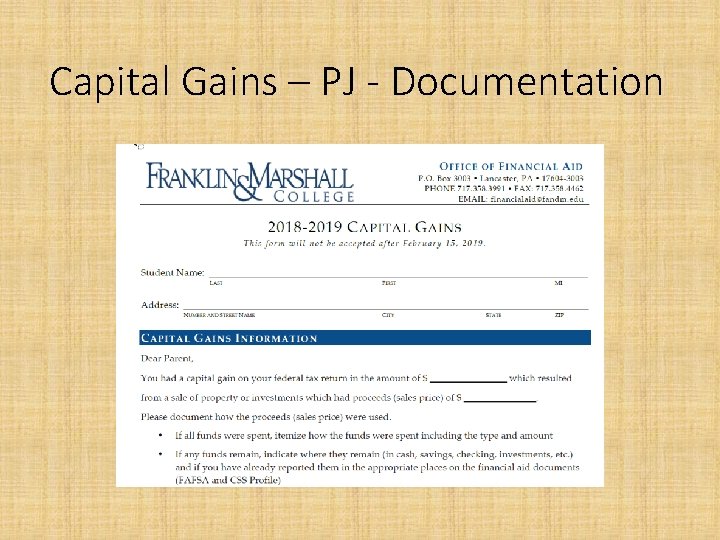
Capital Gains – PJ - Documentation
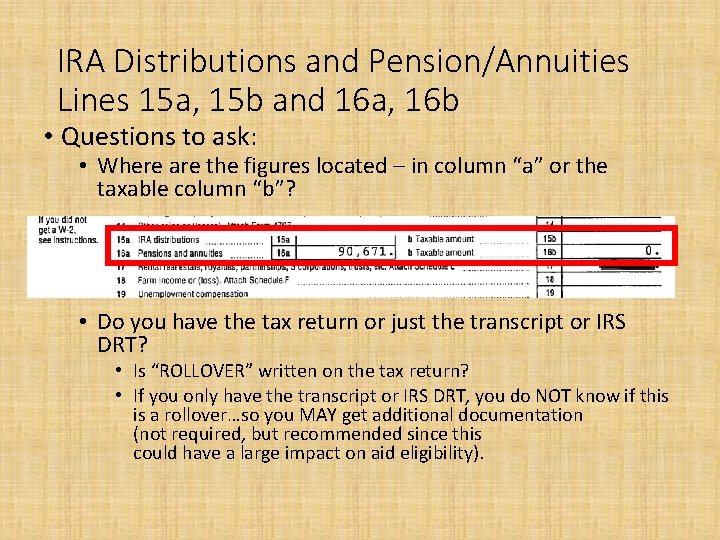
IRA Distributions and Pension/Annuities Lines 15 a, 15 b and 16 a, 16 b • Questions to ask: • Where are the figures located – in column “a” or the taxable column “b”? • • Do you have the tax return or just the transcript or IRS DRT? • Is “ROLLOVER” written on the tax return? • If you only have the transcript or IRS DRT, you do NOT know if this is a rollover…so you MAY get additional documentation (not required, but recommended since this could have a large impact on aid eligibility).
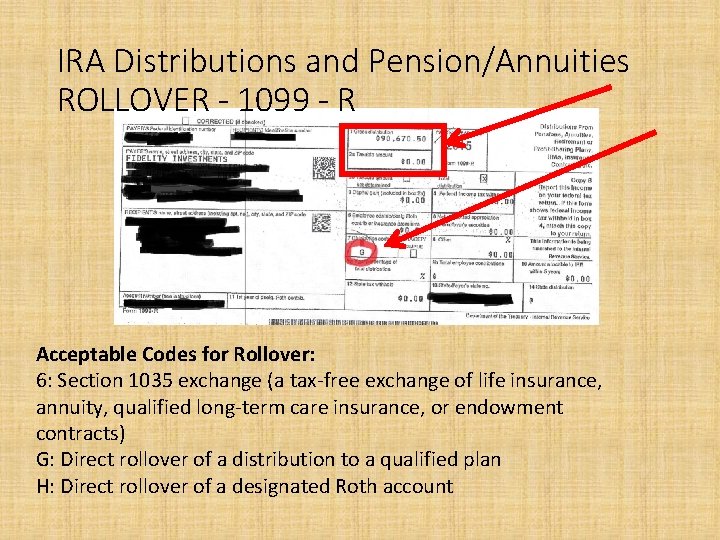
IRA Distributions and Pension/Annuities ROLLOVER - 1099 - R Acceptable Codes for Rollover: 6: Section 1035 exchange (a tax-free exchange of life insurance, annuity, qualified long-term care insurance, or endowment contracts) G: Direct rollover of a distribution to a qualified plan H: Direct rollover of a designated Roth account
IRA Distribution / Pensions and Annuities – Professional Judgment • Even if “ROLLOVER” is written on the return – there may be multiple 1099 -R forms and not all may be ROLLOVERS. You should collect ALL. • What were the funds used for? • Get an itemized list • Do you pick through the list? • Is this a one time occurrence?
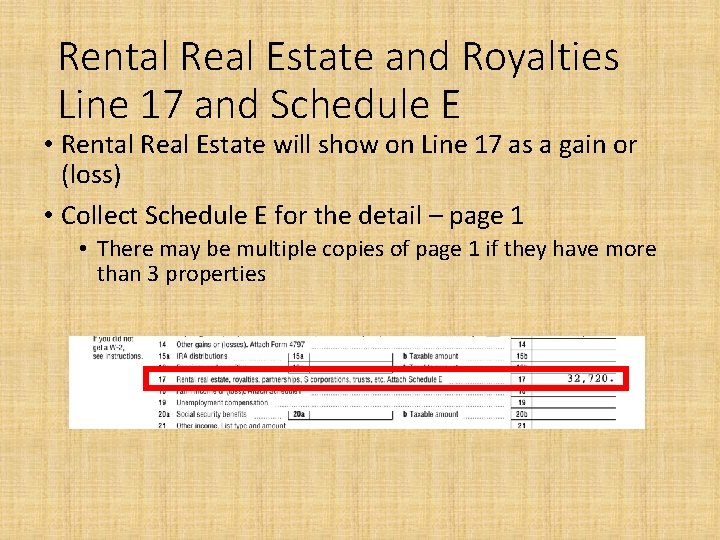
Rental Real Estate and Royalties Line 17 and Schedule E • Rental Real Estate will show on Line 17 as a gain or (loss) • Collect Schedule E for the detail – page 1 • There may be multiple copies of page 1 if they have more than 3 properties
Schedule E – Rental Real Estate • Can be from: • • Single family residence Multi-family residence Vacation/short-term rental Commercial property Land Royalties Self-rental Other
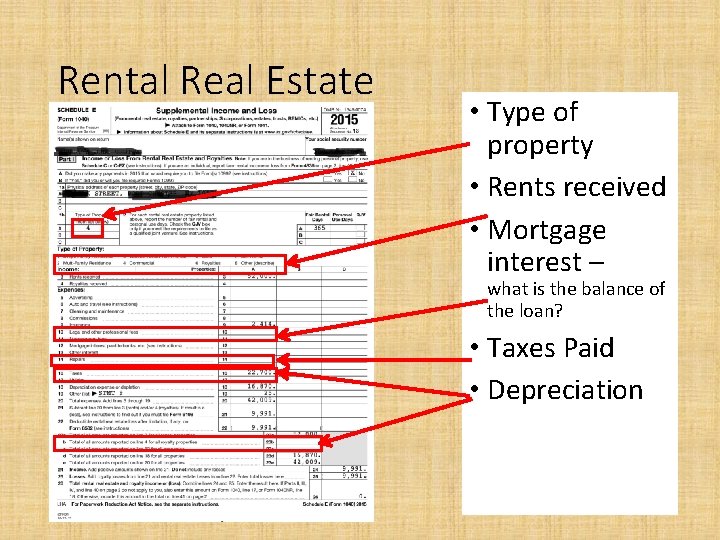
Rental Real Estate • Type of property • Rents received • Mortgage interest – what is the balance of the loan? • Taxes Paid • Depreciation
Schedule E – Rental Real Estate • Single Family Residence • I use http: //www. zillow. com to value a property • Multi-family residence • Is it the address in which they reside • Google Earth helps • www. zillow. com • Use Taxes and Line 16 of Schedule E to get percentage • Commercial Properties • https: //keyvon. com/ • Google Earth • Single member Limited Liability Company (LLC) are not treated as a separate entity for federal income tax purposes in most cases. A sole member of a domestic LLC needs to file a Schedule E (or they can elect to treat it as a corporation instead). • Why is this important? Because we can no longer assume that all properties listed on Schedule E are automatically personally owned. It is possible they are owned by a corporation the parents own.
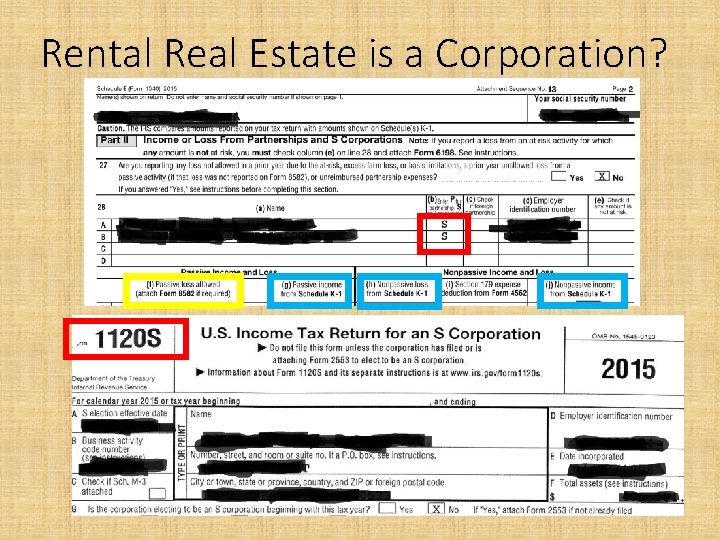
Rental Real Estate is a Corporation?
Commercial Buildings as Assets? Per NASFAA Ask Regs: Do You Report the Net Worth of a Commercial Building That the Family Owns and the Family Business Rents? • Scenario: We have a situation where the parents are self-employed and own a corporation. They are 100% owners and have less than 100 employees, so the net worth of the business itself does not have to reported on the FAFSA. However, the parents own a commercial building that is in their name. The family corporation pays them rent to lease the building. Answer: The building rented to the business is real estate owned by the parents individually; therefore, it should be reported as an asset on the FAFSA. Additionally, any income or loss from the rental property should have been reported on the parents' tax return using Schedule E and would be reflected in the adjusted gross income (AGI). See the sidebar on page AVG-18 of the 2018 -19 FSA Handbook regarding rental properties:
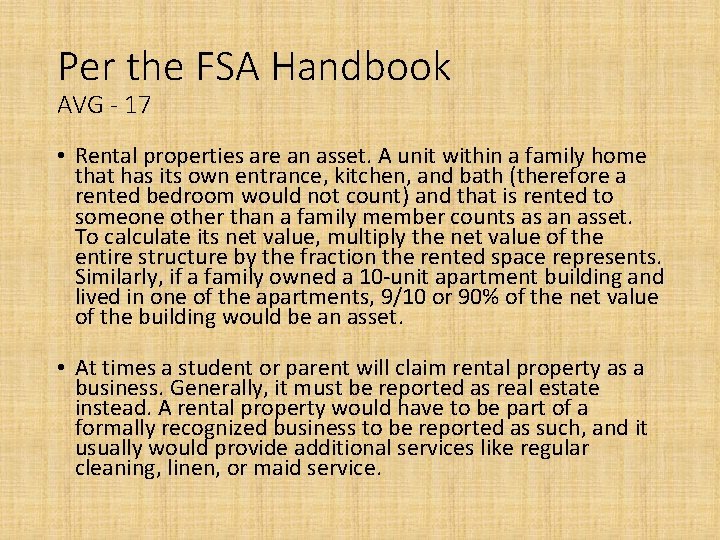
Per the FSA Handbook AVG - 17 • Rental properties are an asset. A unit within a family home that has its own entrance, kitchen, and bath (therefore a rented bedroom would not count) and that is rented to someone other than a family member counts as an asset. To calculate its net value, multiply the net value of the entire structure by the fraction the rented space represents. Similarly, if a family owned a 10 -unit apartment building and lived in one of the apartments, 9/10 or 90% of the net value of the building would be an asset. • At times a student or parent will claim rental property as a business. Generally, it must be reported as real estate instead. A rental property would have to be part of a formally recognized business to be reported as such, and it usually would provide additional services like regular cleaning, linen, or maid service.
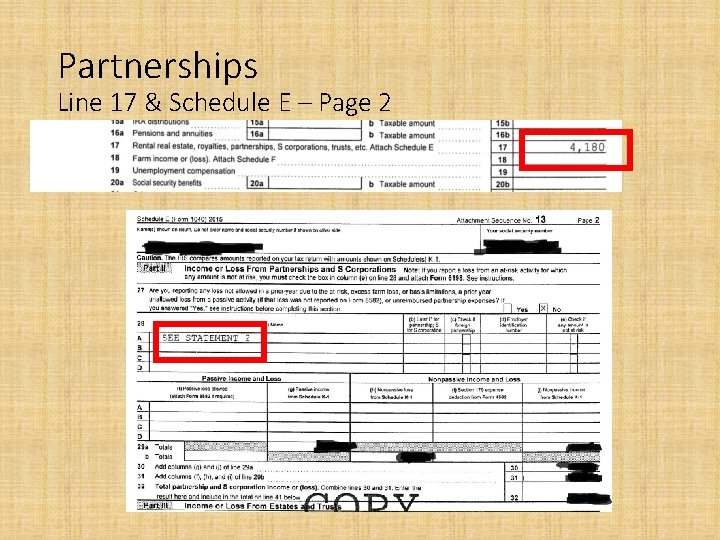
Partnerships Line 17 & Schedule E – Page 2
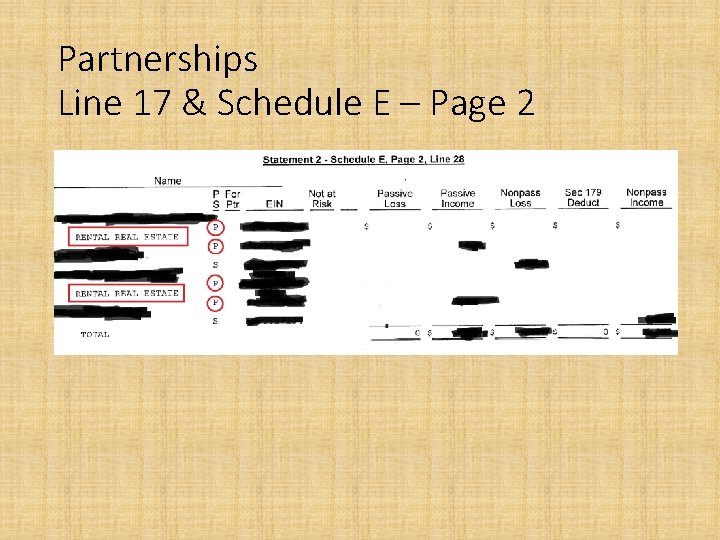
Partnerships Line 17 & Schedule E – Page 2
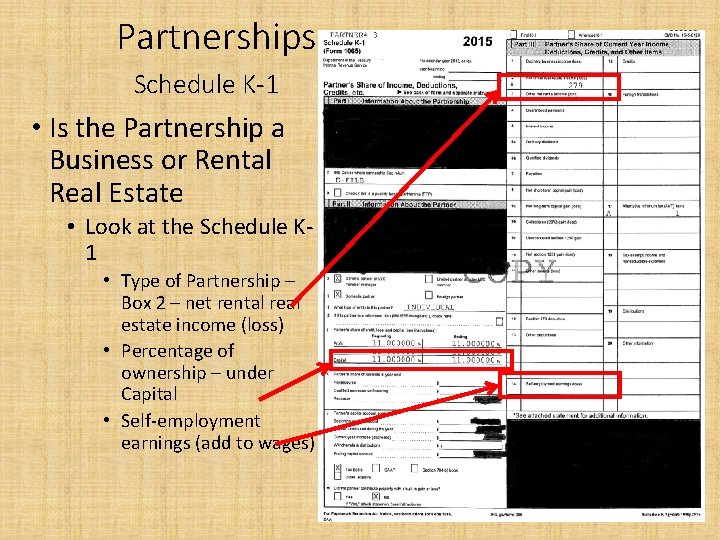
Partnerships Schedule K-1 • Is the Partnership a Business or Rental Real Estate • Look at the Schedule K 1 • Type of Partnership – Box 2 – net rental real estate income (loss) • Percentage of ownership – under Capital • Self-employment earnings (add to wages)
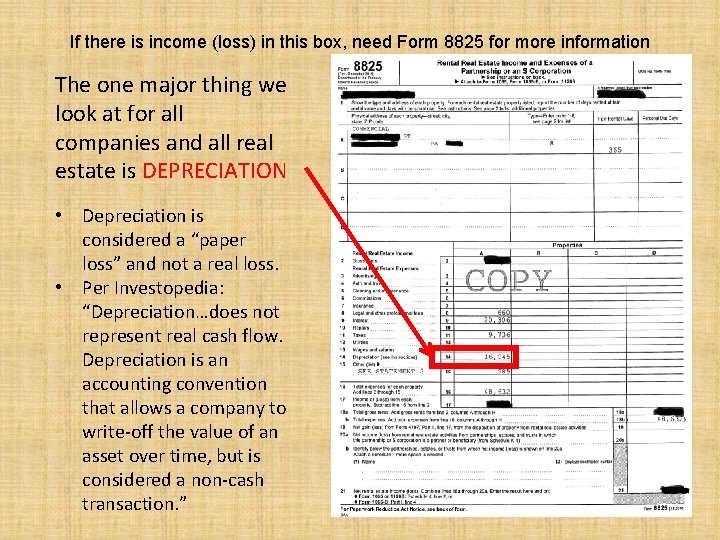
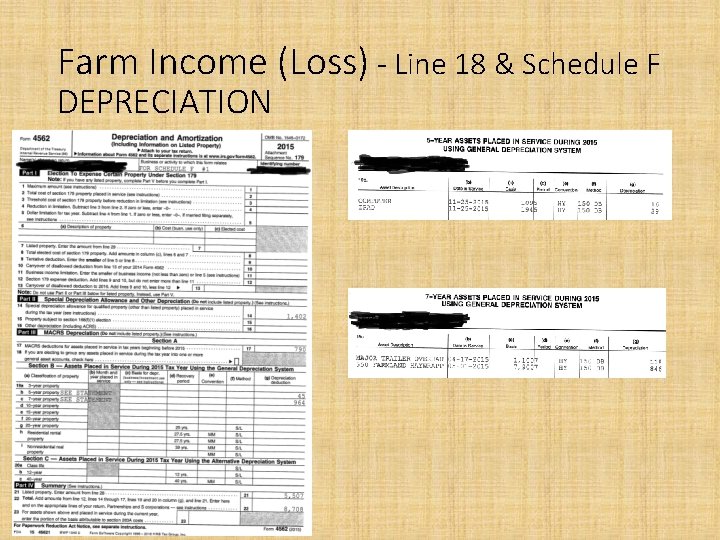
If there is income (loss) in this box, need Form 8825 for more information The one major thing we look at for all companies and all real estate is DEPRECIATION • Depreciation is considered a “paper loss” and not a real loss. • Per Investopedia: “Depreciation…does not represent real cash flow. Depreciation is an accounting convention that allows a company to write-off the value of an asset over time, but is considered a non-cash transaction. ”
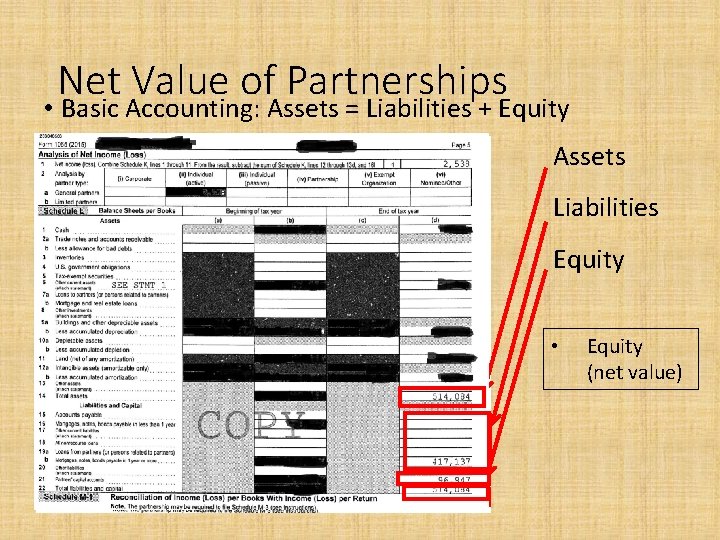
Net Value of Partnerships • Basic Accounting: Assets = Liabilities + Equity Assets Liabilities Equity • Equity (net value)
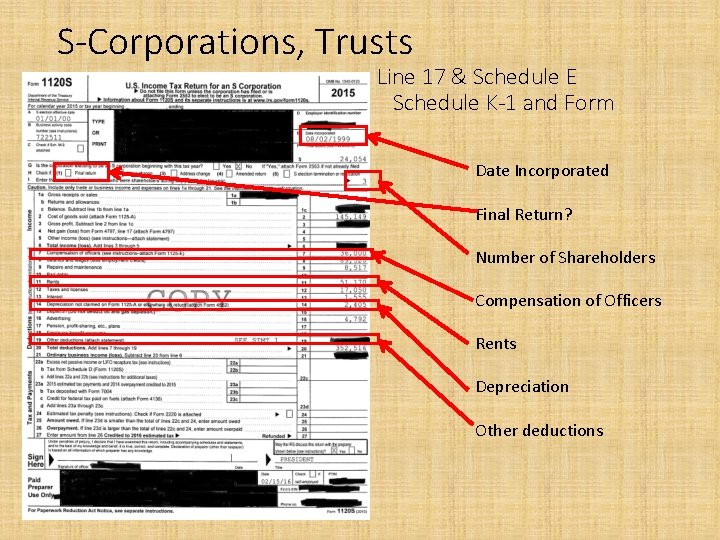
S-Corporations, Trusts 1120 -S Line 17 & Schedule E Schedule K-1 and Form Date Incorporated Final Return? Number of Shareholders Compensation of Officers Rents Depreciation Other deductions
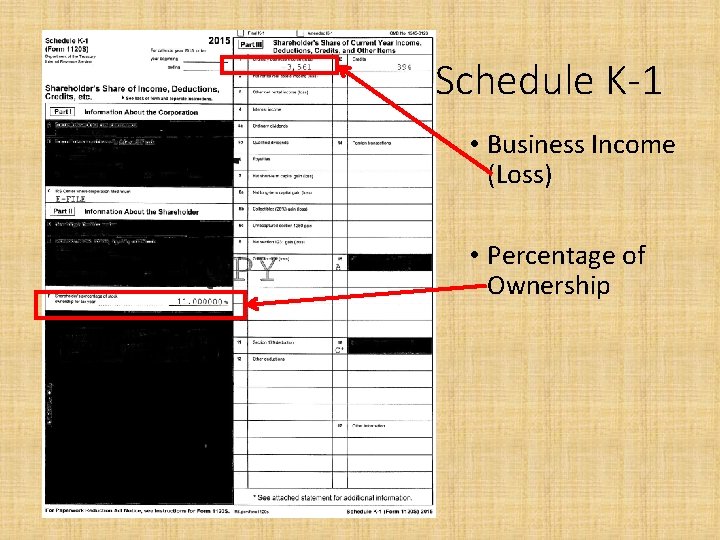
Schedule K-1 • Business Income (Loss) • Percentage of Ownership
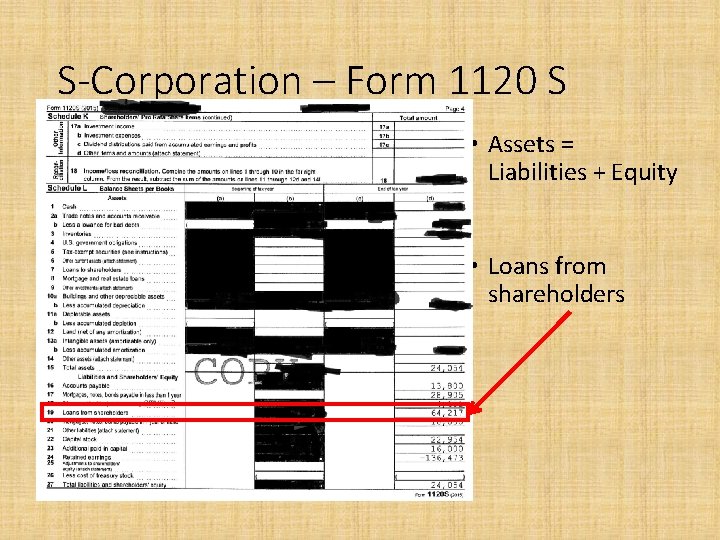
S-Corporation – Form 1120 S • Assets = Liabilities + Equity • Loans from shareholders
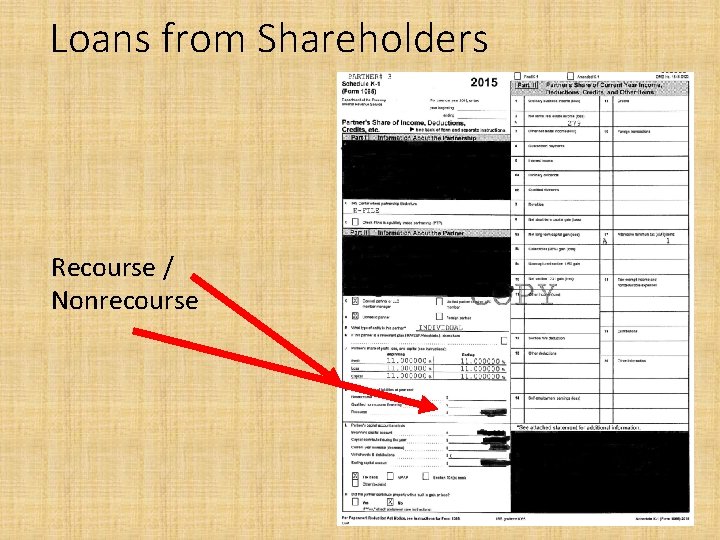
Loans from Shareholders Recourse / Nonrecourse
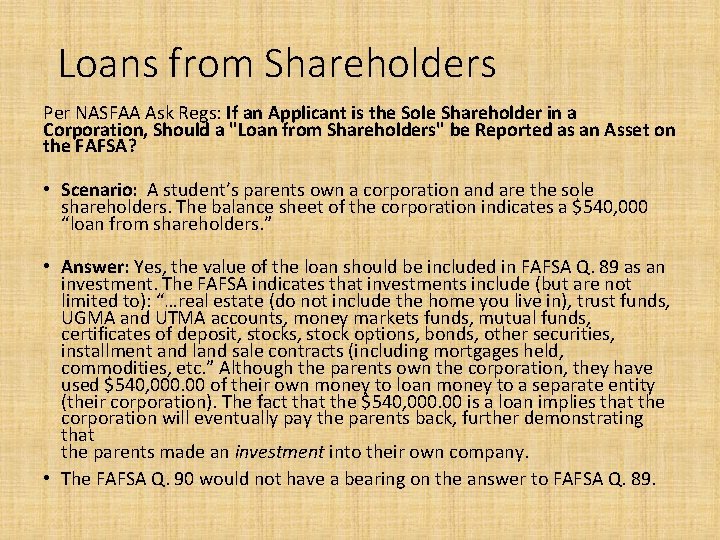
Loans from Shareholders Per NASFAA Ask Regs: If an Applicant is the Sole Shareholder in a Corporation, Should a "Loan from Shareholders" be Reported as an Asset on the FAFSA? • Scenario: A student’s parents own a corporation and are the sole shareholders. The balance sheet of the corporation indicates a $540, 000 “loan from shareholders. ” • Answer: Yes, the value of the loan should be included in FAFSA Q. 89 as an investment. The FAFSA indicates that investments include (but are not limited to): “…real estate (do not include the home you live in), trust funds, UGMA and UTMA accounts, money markets funds, mutual funds, certificates of deposit, stocks, stock options, bonds, other securities, installment and land sale contracts (including mortgages held, commodities, etc. ” Although the parents own the corporation, they have used $540, 000. 00 of their own money to loan money to a separate entity (their corporation). The fact that the $540, 000. 00 is a loan implies that the corporation will eventually pay the parents back, further demonstrating that the parents made an investment into their own company. • The FAFSA Q. 90 would not have a bearing on the answer to FAFSA Q. 89.

Compensation of Officers • % of time devoted to business vs. % of Stock Owned • Amount of Compensation
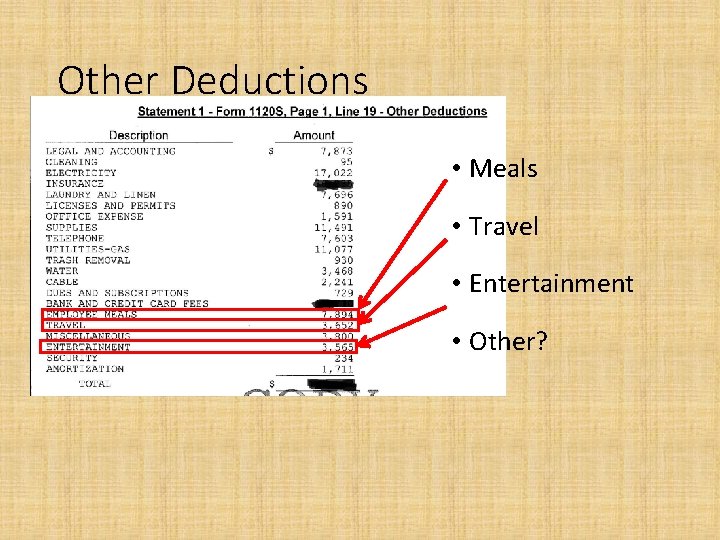
Other Deductions • Meals • Travel • Entertainment • Other?
NEW for 2018 TAX RETURNS!!!! • New Qualified Business Income (QBI) Deduction Introduced • A 20% deduction on business income that is taxed on the owner’s personal return • Effectively caps the tax rate on this business income at 29. 6% • Will Apply to • • • Sole proprietorships (Schedule C) Partnerships (Schedule E) S-Corporations (Schedule E) Real estate properties held in LLCs Potentially even some Schedule E rental properties Will Reduce AGIs for business owners • Gets complicated for taxpayers with taxable incomes greater than $315, 000 (joint filers) or $157, 500 (all other statuses) Information Provided regarding 2018 tax information provided on Webinar 4/11/18 and supplied here with permission: Robert Weinerman Director of Training Iron Bridge Resources http: //www. ironbridgeresources. com/financial-aid-training 617 -733 -0027
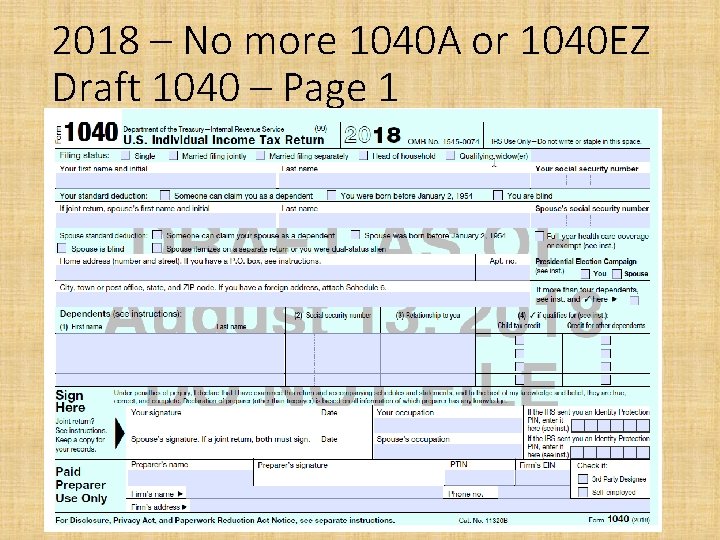
2018 – No more 1040 A or 1040 EZ Draft 1040 – Page 1
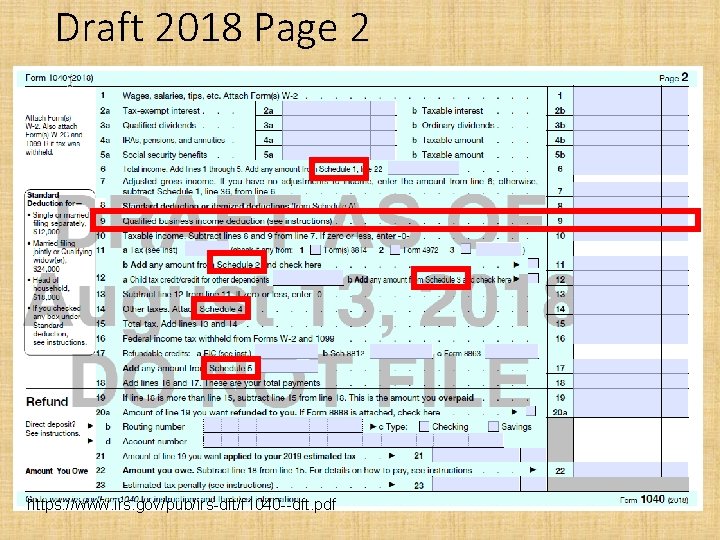
Draft 2018 Page 2 https: //www. irs. gov/pub/irs-dft/f 1040 --dft. pdf
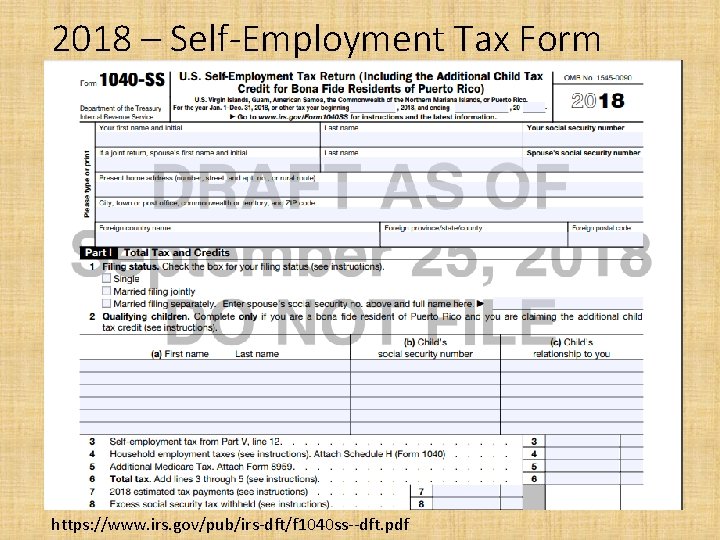
2018 – Self-Employment Tax Form https: //www. irs. gov/pub/irs-dft/f 1040 ss--dft. pdf
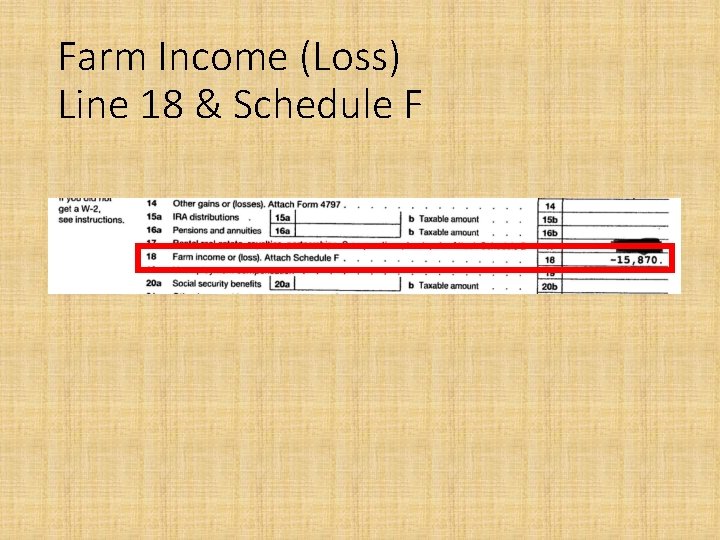
Farm Income (Loss) Line 18 & Schedule F
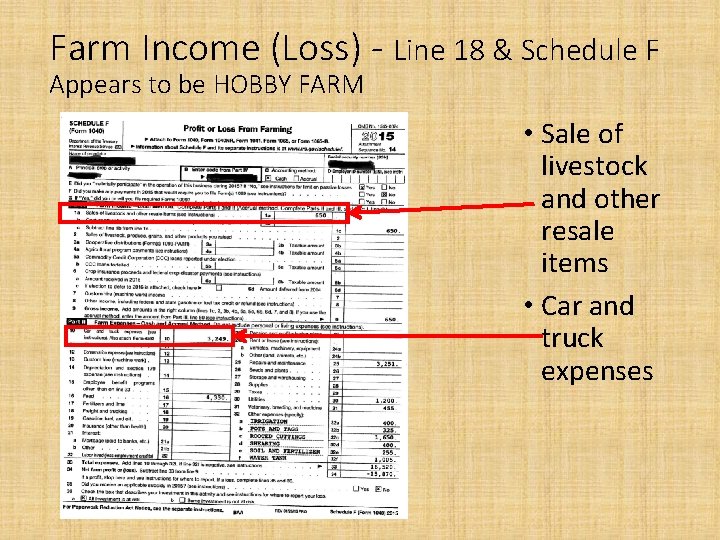
Farm Income (Loss) - Line 18 & Schedule F Appears to be HOBBY FARM • Sale of livestock and other resale items • Car and truck expenses
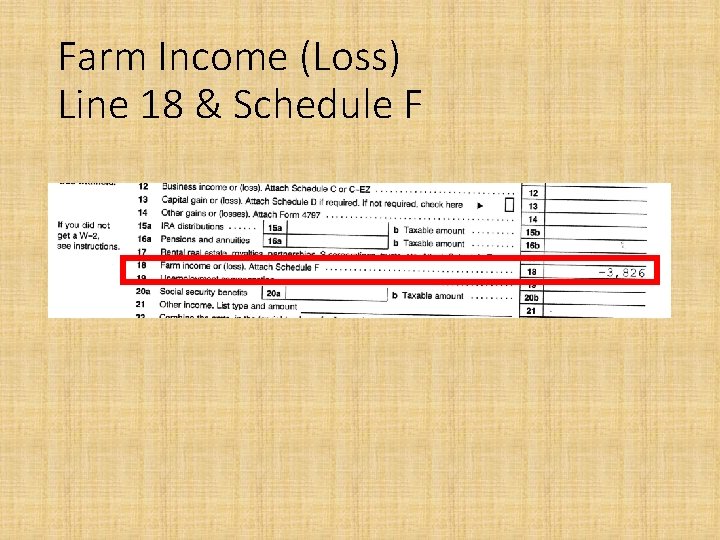
Farm Income (Loss) Line 18 & Schedule F
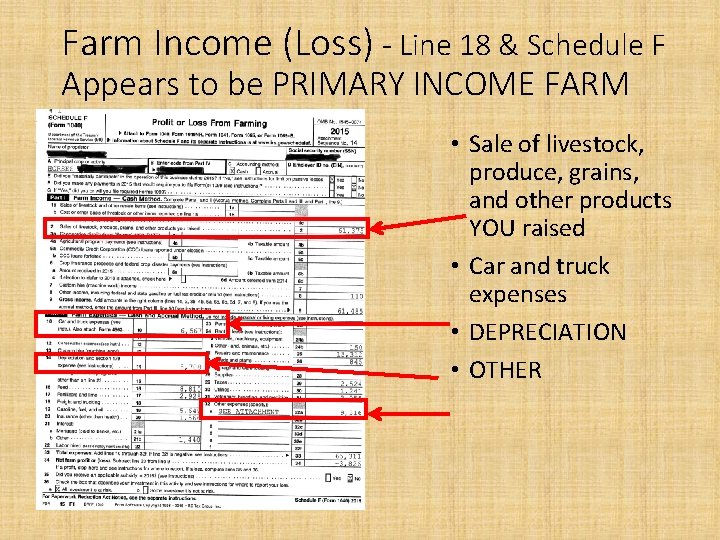
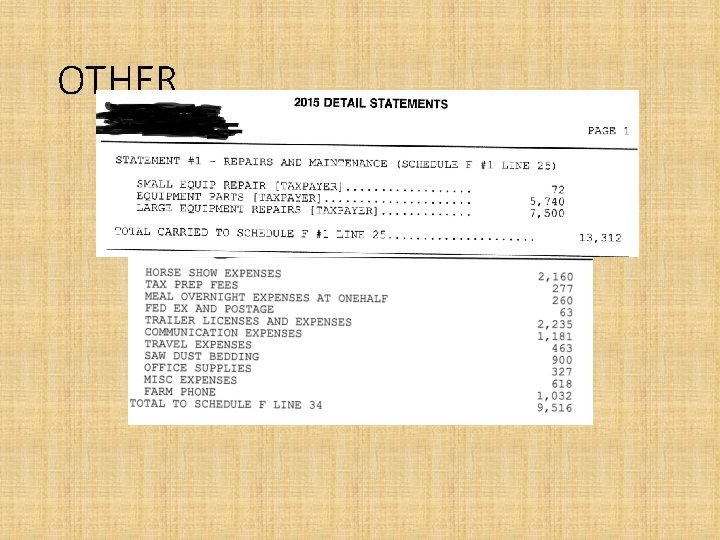
Farm Income (Loss) - Line 18 & Schedule F Appears to be PRIMARY INCOME FARM • Sale of livestock, produce, grains, and other products YOU raised • Car and truck expenses • DEPRECIATION • OTHER
OTHER
Farm Income (Loss) - Line 18 & Schedule F DEPRECIATION
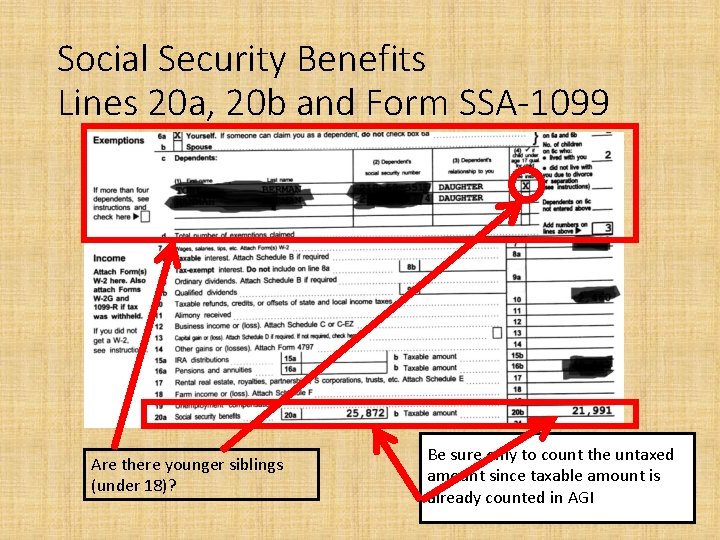
Social Security Benefits Lines 20 a, 20 b and Form SSA-1099 Are there younger siblings (under 18)? Be sure only to count the untaxed amount since taxable amount is already counted in AGI
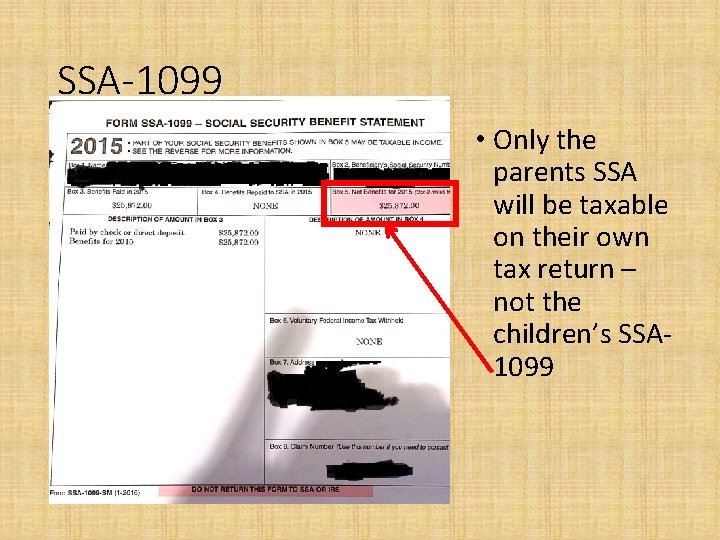
SSA-1099 • Only the parents SSA will be taxable on their own tax return – not the children’s SSA 1099
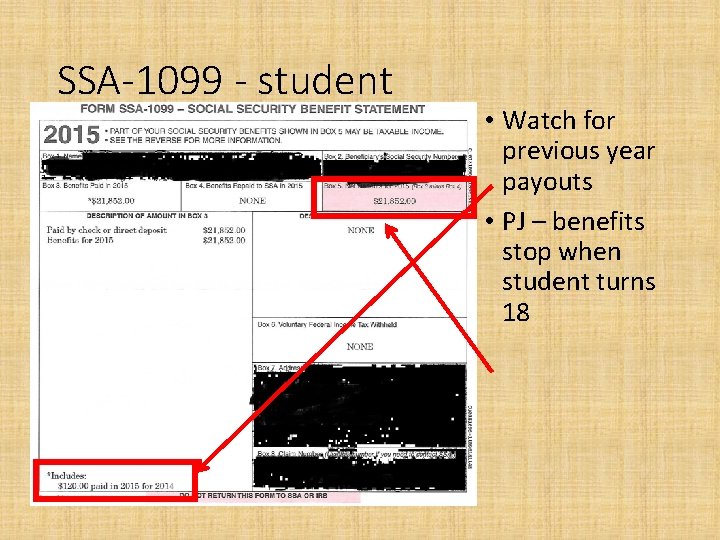
SSA-1099 - student • Watch for previous year payouts • PJ – benefits stop when student turns 18
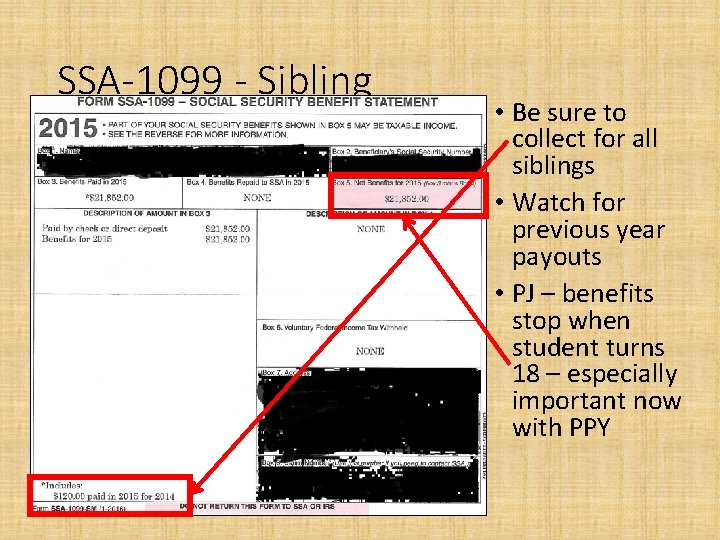
SSA-1099 - Sibling • Be sure to collect for all siblings • Watch for previous year payouts • PJ – benefits stop when student turns 18 – especially important now with PPY
No Questions and I’m bored… Questions are too hard and I’m stumped…

Contact Information Tonya R. Hsiung Senior Assistant Director of Financial Aid Franklin & Marshall College 717 -358 -4395 tonya. hsiung@fandm. edu
- Slides: 49