
Vergence Basics Basic Optics Chapter 1 2 Vergence
Vergence: Basics Basic Optics, Chapter 1
2 Vergence: Basics Is light composed of particles, or waves?
3 Vergence: Basics Is light composed of particles, or waves? l Question has vexed physicists for a long time
4 Vergence: Basics Is light composed of particles, or waves? l l Question has vexed physicists for a long time Fortunately, with respect to clinical optics, the particle vs wave issue is largely irrelevant, because for the purposes of clinical optics, the ‘wave conceptualization’ is employed
5 Vergence: Basics Is light composed of particles, or waves? l l l Question has vexed physicists for a long time Fortunately, with respect to clinical optics, the particle vs wave issue is largely irrelevant, because for the purposes of clinical optics, the ‘wave conceptualization’ is employed Why? Because the wave model allows us to describe the behavior of light in terms of rays
6 Vergence: Basics Is light composed of particles, or waves? l l l Question has physicists a longis time BTW, per the BCSCvexed Optics book, the answer tofor this question “Light is made of particles, [but] not in the ordinary sense…”. Fortunately, with respect to clinical optics, the particle vs wave issue is largely irrelevant, because for the purposes of clinical optics, the ‘wave conceptualization’ is employed Why? Because the wave model allows us to describe the behavior of light in terms of rays
7 Vergence: Basics l The light rays we encounter can emanate… l from a luminance source; or far more commonly…
8 Vergence: Basics l The light rays we encounter can emanate… l l from a luminance source; or far more commonly… via reflection off a surface
9 Vergence: Basics l The term vergence describes what light rays from a source are doing in relation to each other
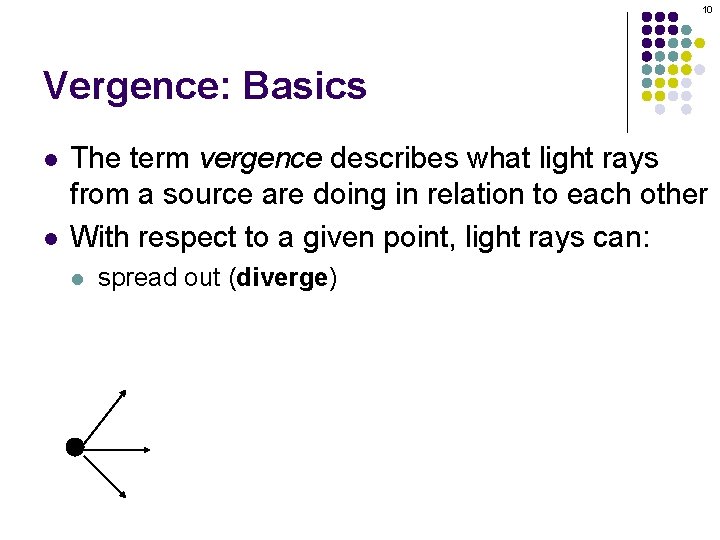
10 Vergence: Basics l l The term vergence describes what light rays from a source are doing in relation to each other With respect to a given point, light rays can: l spread out (diverge)
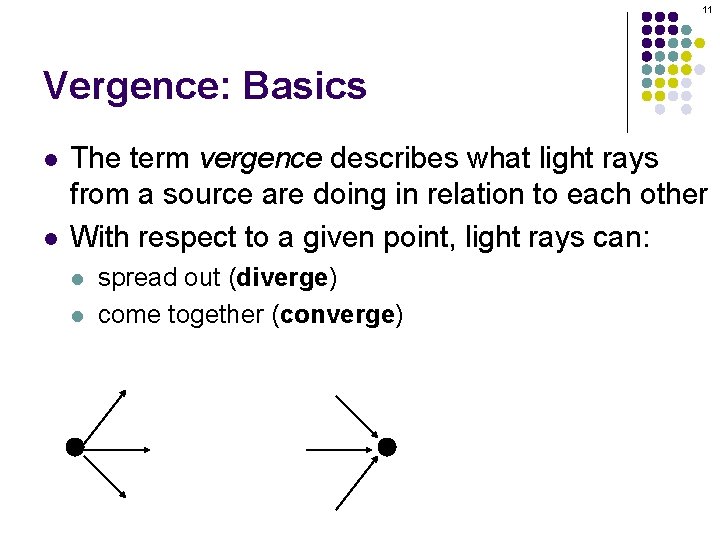
11 Vergence: Basics l l The term vergence describes what light rays from a source are doing in relation to each other With respect to a given point, light rays can: l l spread out (diverge) come together (converge)
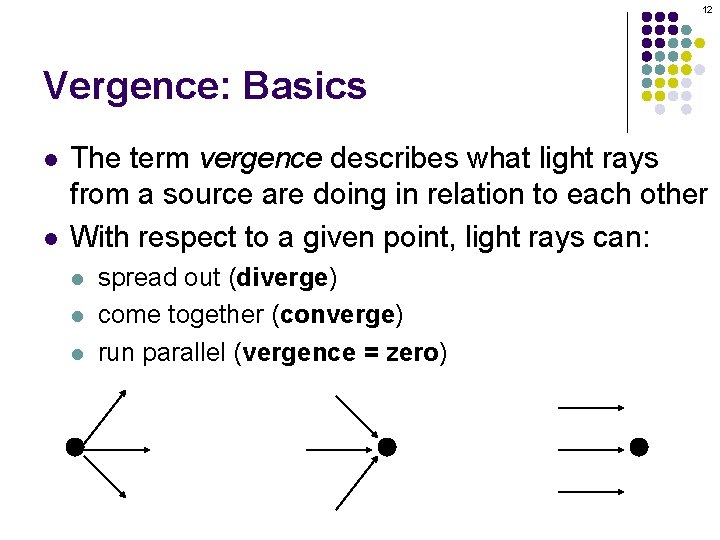
12 Vergence: Basics l l The term vergence describes what light rays from a source are doing in relation to each other With respect to a given point, light rays can: l l l spread out (diverge) come together (converge) run parallel (vergence = zero)
13 Vergence: Basics l l Vergence is measured in diopters (D) Dioptric power is defined as the reciprocal of the distance (in meters) to the point where light rays would intersect
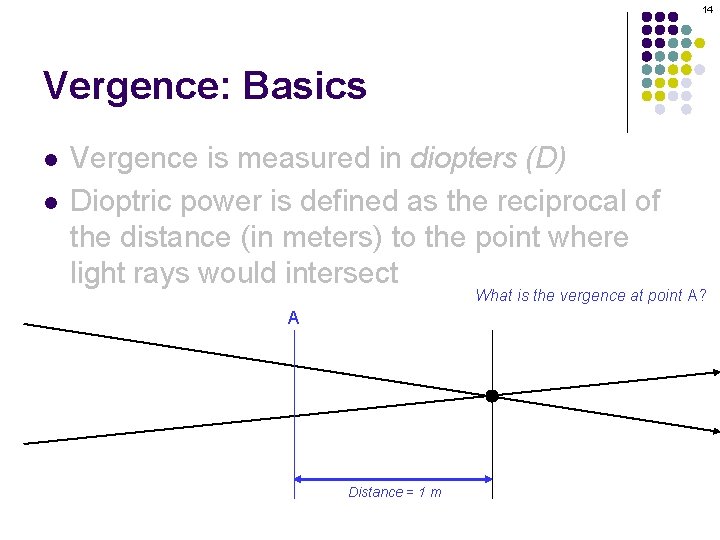
14 Vergence: Basics l l Vergence is measured in diopters (D) Dioptric power is defined as the reciprocal of the distance (in meters) to the point where light rays would intersect What is the vergence at point A? A Distance = 1 m
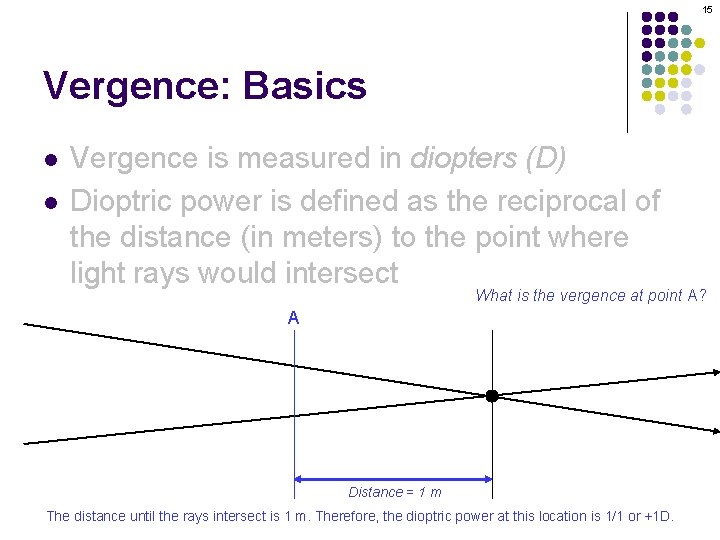
15 Vergence: Basics l l Vergence is measured in diopters (D) Dioptric power is defined as the reciprocal of the distance (in meters) to the point where light rays would intersect What is the vergence at point A? A Distance = 1 m The distance until the rays intersect is 1 m. Therefore, the dioptric power at this location is 1/1 or +1 D.
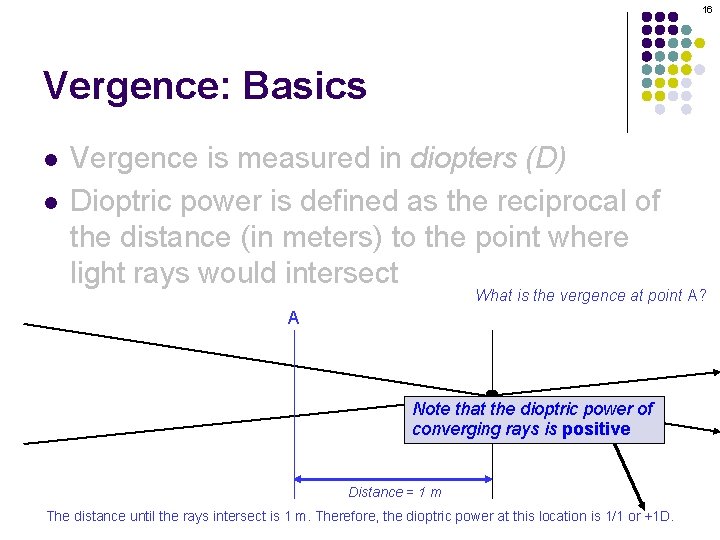
16 Vergence: Basics l l Vergence is measured in diopters (D) Dioptric power is defined as the reciprocal of the distance (in meters) to the point where light rays would intersect What is the vergence at point A? A Note that the dioptric power of converging rays is positive Distance = 1 m The distance until the rays intersect is 1 m. Therefore, the dioptric power at this location is 1/1 or +1 D.
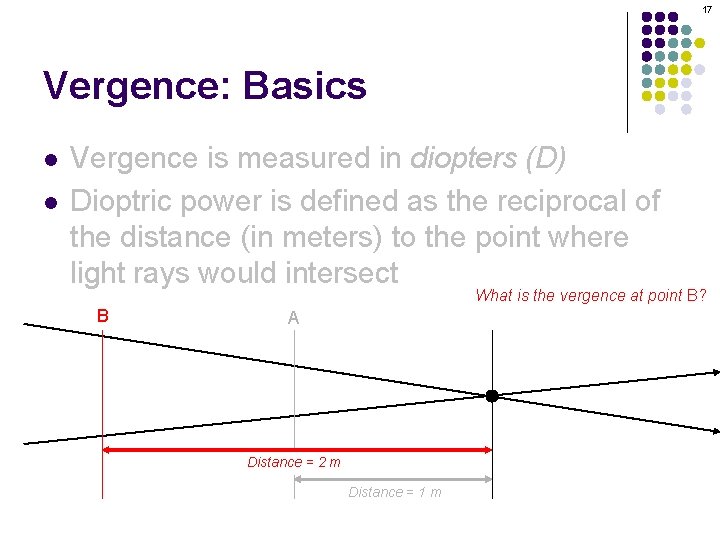
17 Vergence: Basics l l Vergence is measured in diopters (D) Dioptric power is defined as the reciprocal of the distance (in meters) to the point where light rays would intersect What is the vergence at point B? B A Distance = 2 m Distance = 1 m
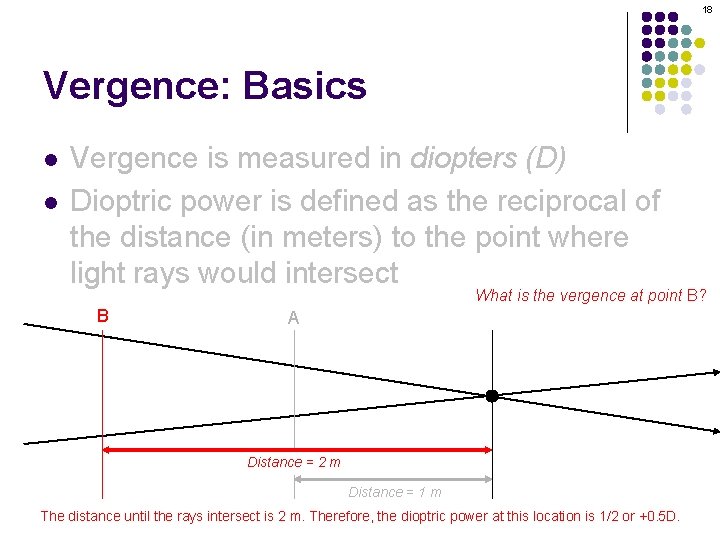
18 Vergence: Basics l l Vergence is measured in diopters (D) Dioptric power is defined as the reciprocal of the distance (in meters) to the point where light rays would intersect What is the vergence at point B? B A Distance = 2 m Distance = 1 m The distance until the rays intersect is 2 m. Therefore, the dioptric power at this location is 1/2 or +0. 5 D.
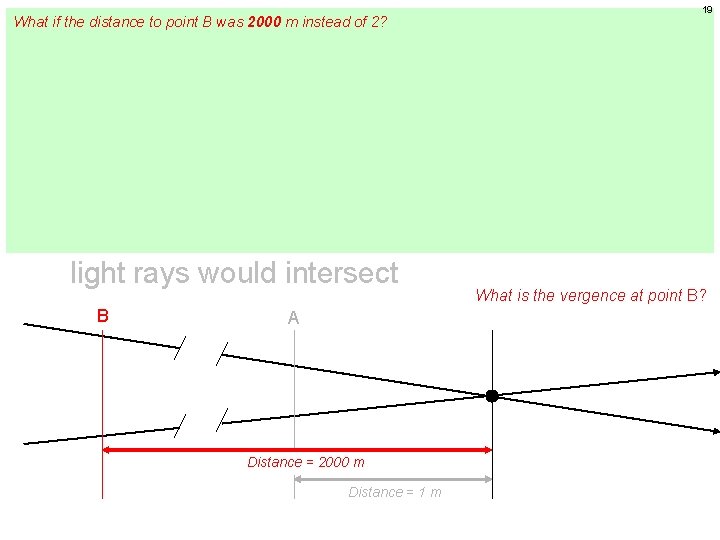
What if the distance to point B was 2000 m instead of 2? The vergence would be 1/2000 = 0. 0005 D—a value not meaningfully different from zero for most purposes. 19 Vergence The point: As distance approaches infinity, the vergence of light approaches zero. For the purposes of clinical optics, at what distance can we consider the vergence to be zero? There’s no definitive answer to this. However, consider that we refract patients at 6 m (20 feet) for their l prescription. In essence, we are treating 6 m as if it equals infinity. The vergence at 6 m is 1/6 = distance 0. 17 D. This means that a patient with a perfect ‘lane refraction’ is actually overplussed by 0. 17 D (i. e. , at a distance l of 6 meters the light from the acuity chart is diverging to the tune of -0. 17 D, which must be neutralized by an extra +0. 17 D in the phoropter). This overcorrection is usually—but not always!--of no consequence. (More on this in a later chapter. ) Vergence is measured in diopters (D) Dioptric power is defined as the reciprocal of the distance (in meters) to the point where light rays would intersect What is the vergence at point B? B A Distance = 2000 m Distance = 1 m
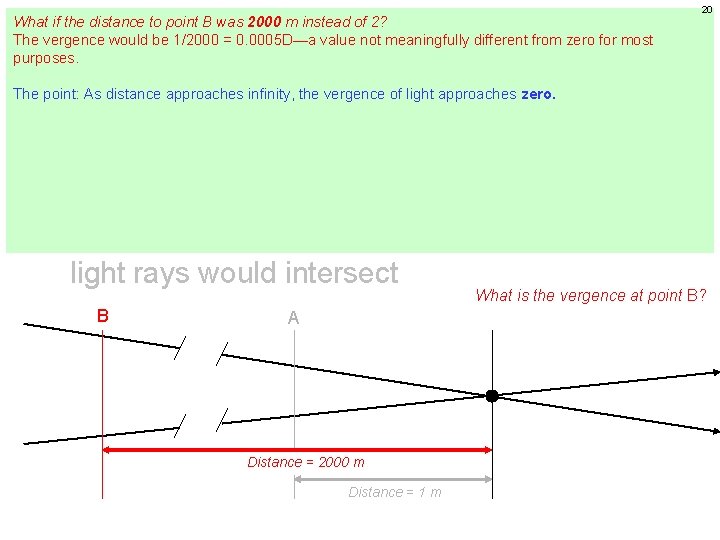
What if the distance to point B was 2000 m instead of 2? The vergence would be 1/2000 = 0. 0005 D—a value not meaningfully different from zero for most purposes. 20 Vergence The point: As distance approaches infinity, the vergence of light approaches zero. For the purposes of clinical optics, at what distance can we consider the vergence to be zero? There’s no definitive answer to this. However, consider that we refract patients at 6 m (20 feet) for their l prescription. In essence, we are treating 6 m as if it equals infinity. The vergence at 6 m is 1/6 = distance 0. 17 D. This means that a patient with a perfect ‘lane refraction’ is actually overplussed by 0. 17 D (i. e. , at a distance l of 6 meters the light from the acuity chart is diverging to the tune of -0. 17 D, which must be neutralized by an extra +0. 17 D in the phoropter). This overcorrection is usually—but not always!--of no consequence. (More on this in a later chapter. ) Vergence is measured in diopters (D) Dioptric power is defined as the reciprocal of the distance (in meters) to the point where light rays would intersect What is the vergence at point B? B A Distance = 2000 m Distance = 1 m
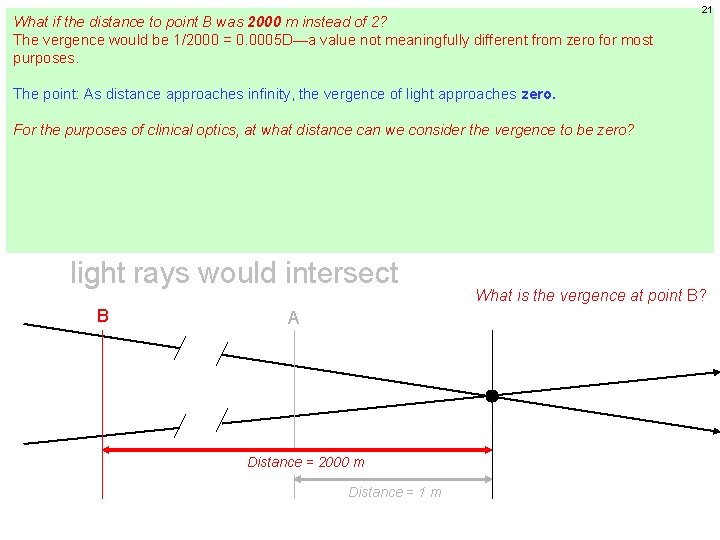
What if the distance to point B was 2000 m instead of 2? The vergence would be 1/2000 = 0. 0005 D—a value not meaningfully different from zero for most purposes. 21 Vergence The point: As distance approaches infinity, the vergence of light approaches zero. For the purposes of clinical optics, at what distance can we consider the vergence to be zero? There’s no definitive answer to this. However, consider that we refract patients at 6 m (20 feet) for their l prescription. In essence, we are treating 6 m as if it equals infinity. The vergence at 6 m is 1/6 = distance 0. 17 D. This means that a patient with a perfect ‘lane refraction’ is actually overplussed by 0. 17 D (i. e. , at a distance l of 6 meters the light from the acuity chart is diverging to the tune of -0. 17 D, which must be neutralized by an extra +0. 17 D in the phoropter). This overcorrection is usually—but not always!--of no consequence. (More on this in a later chapter. ) Vergence is measured in diopters (D) Dioptric power is defined as the reciprocal of the distance (in meters) to the point where light rays would intersect What is the vergence at point B? B A Distance = 2000 m Distance = 1 m
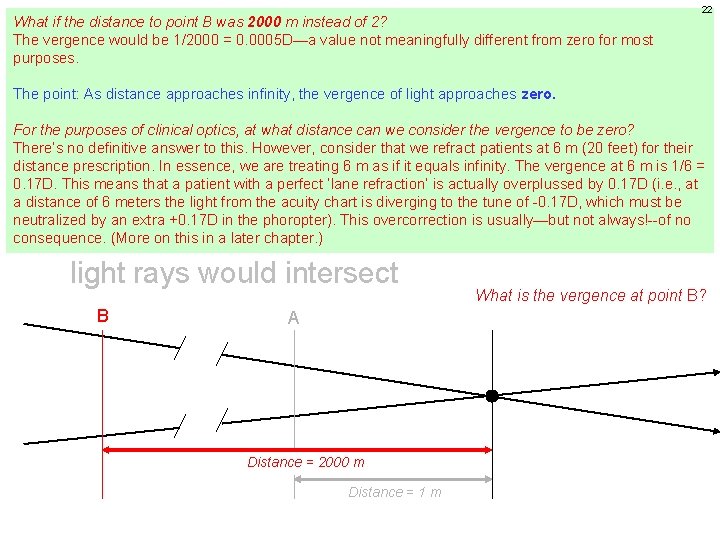
What if the distance to point B was 2000 m instead of 2? The vergence would be 1/2000 = 0. 0005 D—a value not meaningfully different from zero for most purposes. 22 Vergence The point: As distance approaches infinity, the vergence of light approaches zero. For the purposes of clinical optics, at what distance can we consider the vergence to be zero? There’s no definitive answer to this. However, consider that we refract patients at 6 m (20 feet) for their l prescription. In essence, we are treating 6 m as if it equals infinity. The vergence at 6 m is 1/6 = distance 0. 17 D. This means that a patient with a perfect ‘lane refraction’ is actually overplussed by 0. 17 D (i. e. , at a distance l of 6 meters the light from the acuity chart is diverging to the tune of -0. 17 D, which must be neutralized by an extra +0. 17 D in the phoropter). This overcorrection is usually—but not always!--of no consequence. (More on this in a later chapter. ) Vergence is measured in diopters (D) Dioptric power is defined as the reciprocal of the distance (in meters) to the point where light rays would intersect What is the vergence at point B? B A Distance = 2000 m Distance = 1 m
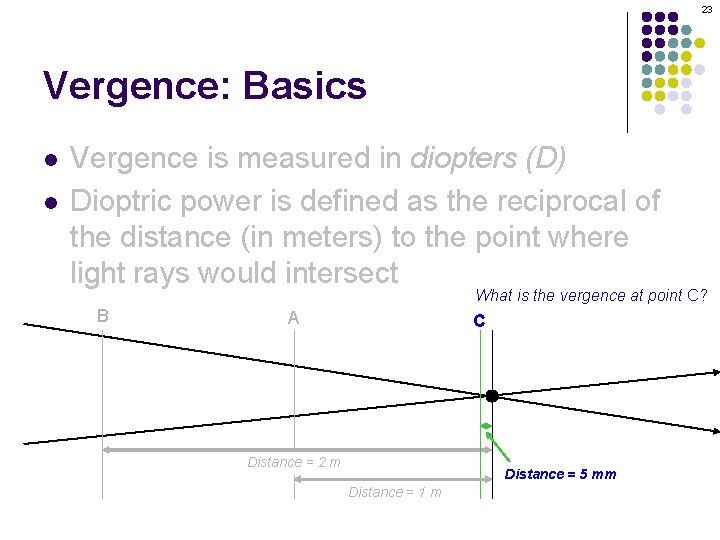
23 Vergence: Basics l l Vergence is measured in diopters (D) Dioptric power is defined as the reciprocal of the distance (in meters) to the point where light rays would intersect What is the vergence at point C? B A C Distance = 2 m Distance = 5 mm Distance = 1 m
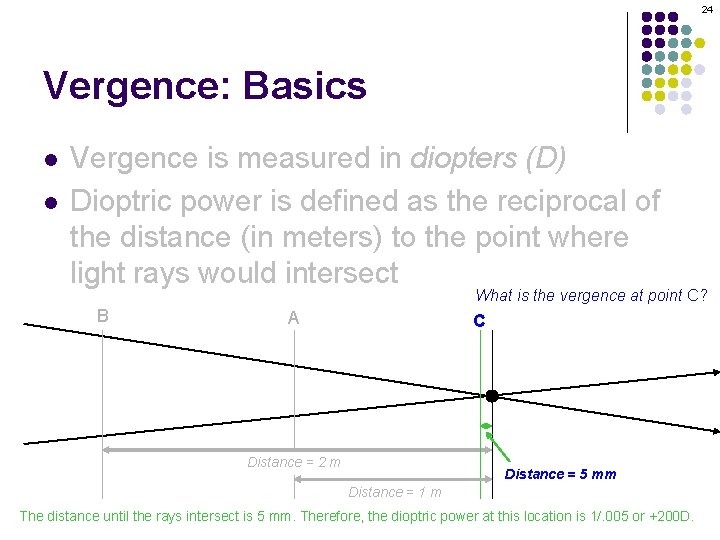
24 Vergence: Basics l l Vergence is measured in diopters (D) Dioptric power is defined as the reciprocal of the distance (in meters) to the point where light rays would intersect What is the vergence at point C? B A C Distance = 2 m Distance = 5 mm Distance = 1 m The distance until the rays intersect is 5 mm. Therefore, the dioptric power at this location is 1/. 005 or +200 D.
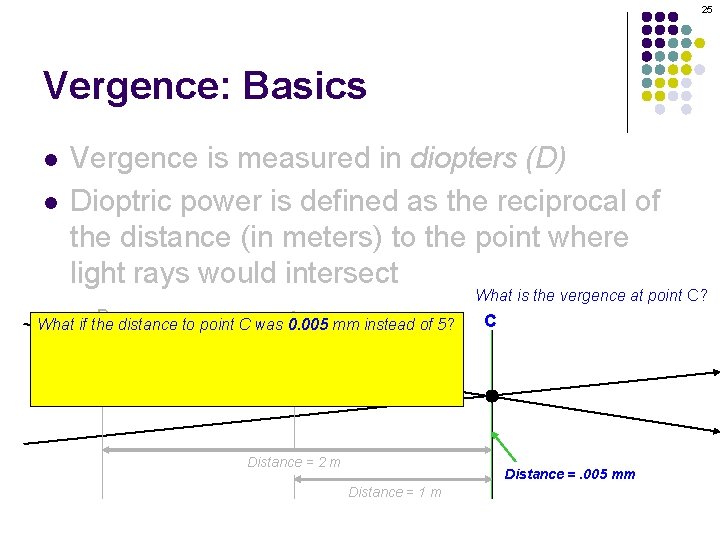
25 Vergence: Basics l l Vergence is measured in diopters (D) Dioptric power is defined as the reciprocal of the distance (in meters) to the point where light rays would intersect What is the vergence at point C? B distance to point C was A What if the 0. 005 mm instead of 5? The vergence would be 1/. 000005 = 200, 000 D. C The point: As the distance approaches zero, the dioptric power (i. e. , the vergence) approaches infinity. Distance = 2 m Distance =. 005 mm Distance = 1 m
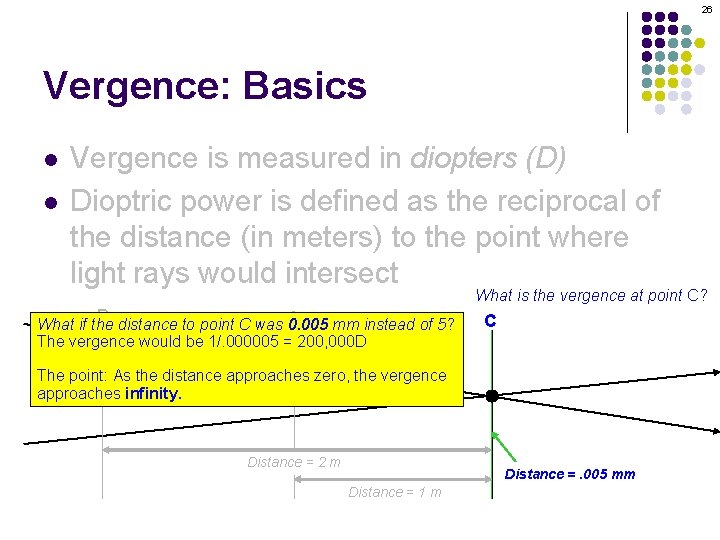
26 Vergence: Basics l l Vergence is measured in diopters (D) Dioptric power is defined as the reciprocal of the distance (in meters) to the point where light rays would intersect What is the vergence at point C? B distance to point C was A What if the 0. 005 mm instead of 5? The vergence would be 1/. 000005 = 200, 000 D C The point: As the distance approaches zero, the vergence approaches infinity. Distance = 2 m Distance =. 005 mm Distance = 1 m
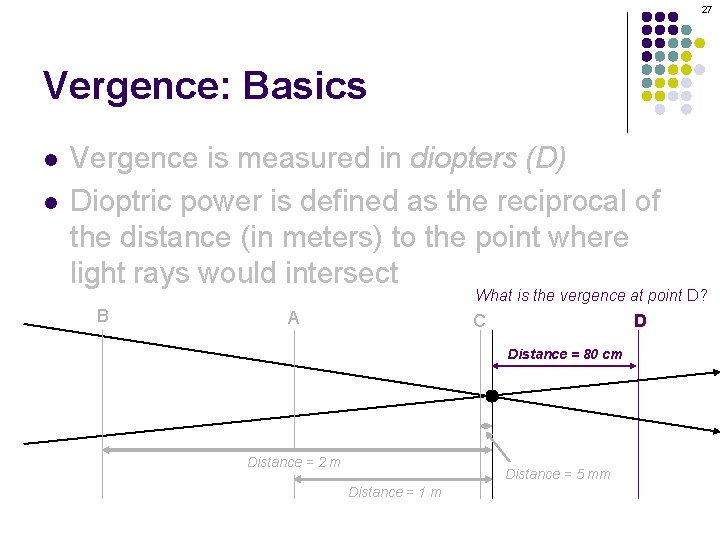
27 Vergence: Basics l l Vergence is measured in diopters (D) Dioptric power is defined as the reciprocal of the distance (in meters) to the point where light rays would intersect What is the vergence at point D? B A C D Distance = 80 cm Distance = 2 m Distance = 5 mm Distance = 1 m
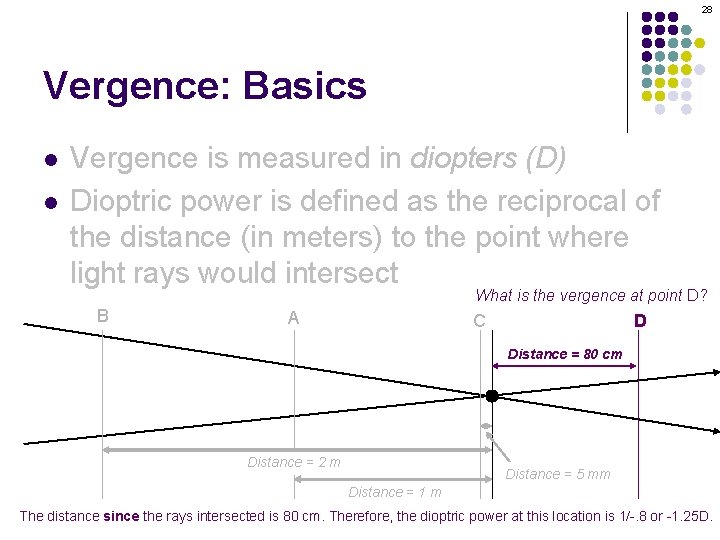
28 Vergence: Basics l l Vergence is measured in diopters (D) Dioptric power is defined as the reciprocal of the distance (in meters) to the point where light rays would intersect What is the vergence at point D? B A C D Distance = 80 cm Distance = 2 m Distance = 5 mm Distance = 1 m The distance since the rays intersected is 80 cm. Therefore, the dioptric power at this location is 1/-. 8 or -1. 25 D.
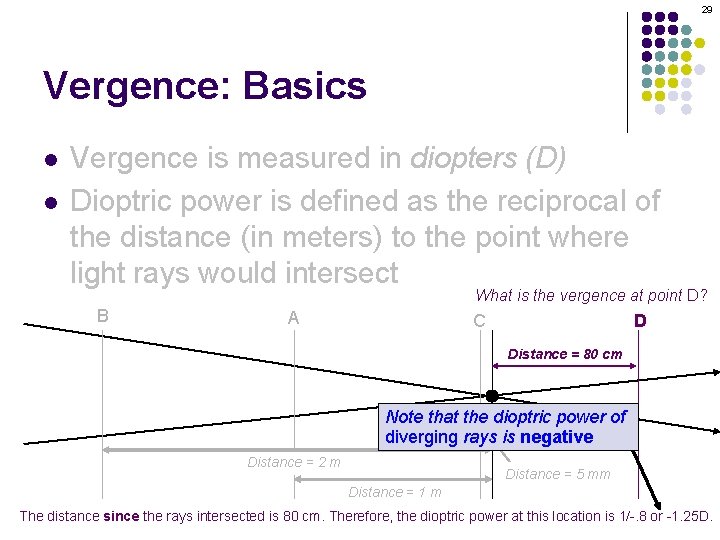
29 Vergence: Basics l l Vergence is measured in diopters (D) Dioptric power is defined as the reciprocal of the distance (in meters) to the point where light rays would intersect What is the vergence at point D? B A C D Distance = 80 cm Note that the dioptric power of diverging rays is negative Distance = 2 m Distance = 5 mm Distance = 1 m The distance since the rays intersected is 80 cm. Therefore, the dioptric power at this location is 1/-. 8 or -1. 25 D.
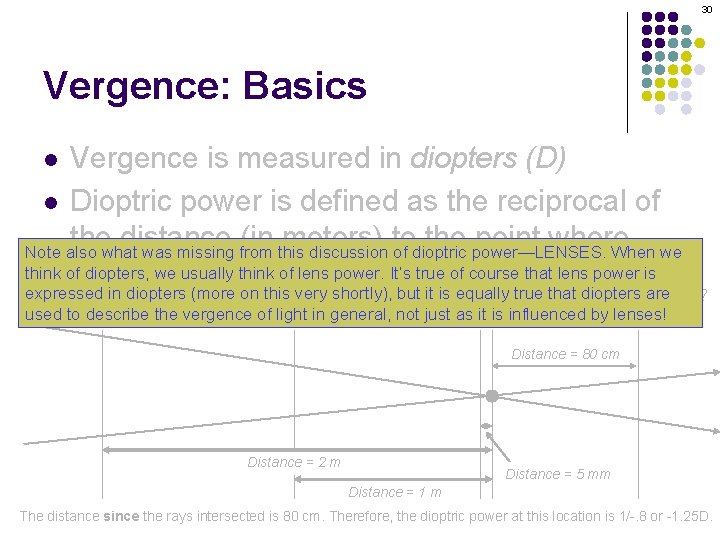
30 Vergence: Basics Vergence is measured in diopters (D) l Dioptric power is defined as the reciprocal of the distance (in meters) to the point where Note also what was missing from this discussion of dioptric power—LENSES. When we think of diopters, we usually think ofintersect lens power. It’s true of course that lens power is light rays would l expressed in diopters (more on this very shortly), but it is equally diopters What true is thethat vergence at are point D? used to describe the vergence of light B A in general, not just as. Cit is influenced by lenses! D Distance = 80 cm Distance = 2 m Distance = 5 mm Distance = 1 m The distance since the rays intersected is 80 cm. Therefore, the dioptric power at this location is 1/-. 8 or -1. 25 D.
- Slides: 30