
Verbsecond expletives and the Minimalist Program Elly van
Verb-second, expletives, and the Minimalist Program Elly van Gelderen Arizona State University ICEHL 11 June 2021 www. public. asu. edu/~gelderen/ICEHL 2021. pptx
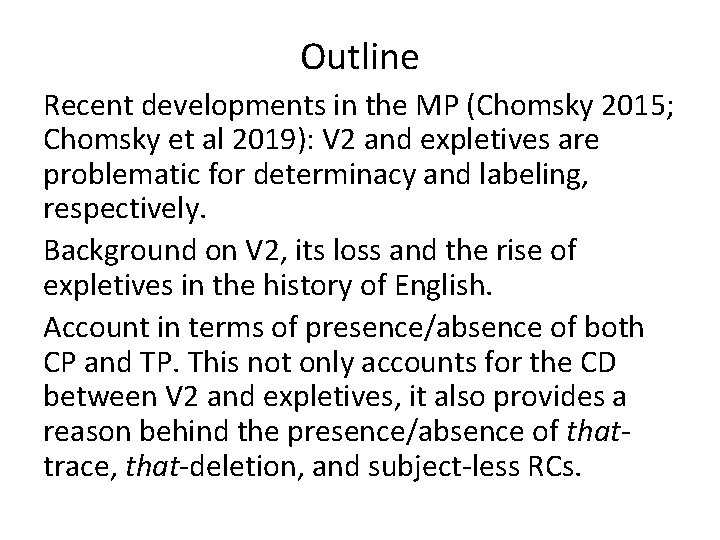
Outline Recent developments in the MP (Chomsky 2015; Chomsky et al 2019): V 2 and expletives are problematic for determinacy and labeling, respectively. Background on V 2, its loss and the rise of expletives in the history of English. Account in terms of presence/absence of both CP and TP. This not only accounts for the CD between V 2 and expletives, it also provides a reason behind the presence/absence of thattrace, that-deletion, and subject-less RCs.
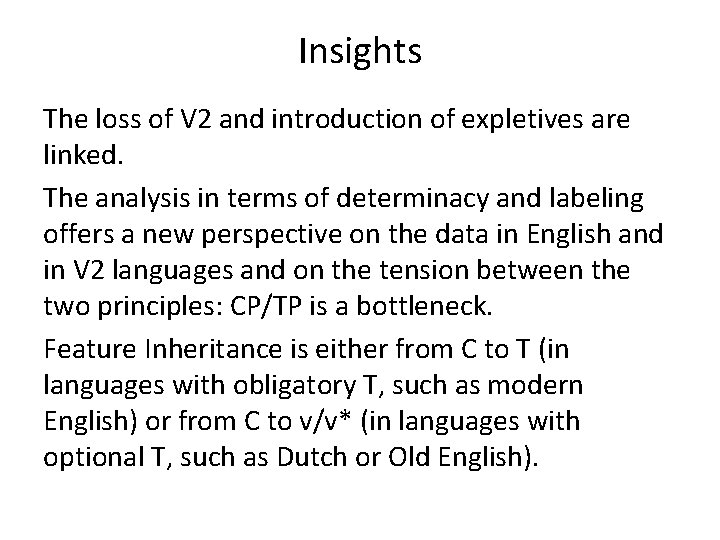
Insights The loss of V 2 and introduction of expletives are linked. The analysis in terms of determinacy and labeling offers a new perspective on the data in English and in V 2 languages and on the tension between the two principles: CP/TP is a bottleneck. Feature Inheritance is either from C to T (in languages with obligatory T, such as modern English) or from C to v/v* (in languages with optional T, such as Dutch or Old English).
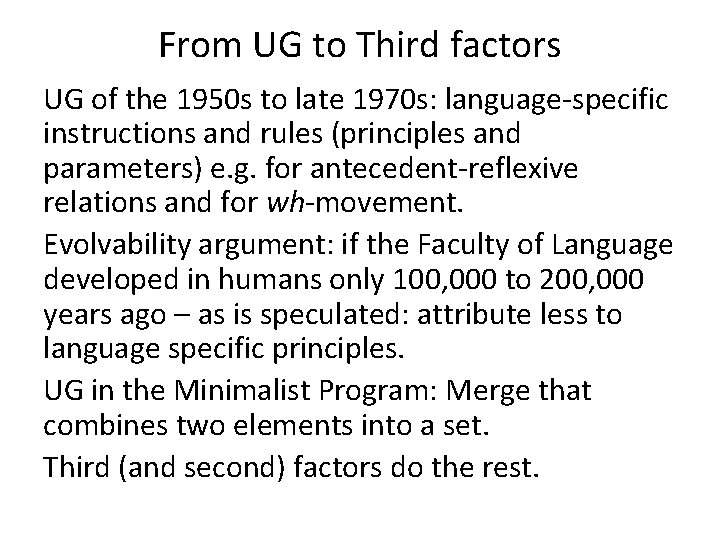
From UG to Third factors UG of the 1950 s to late 1970 s: language-specific instructions and rules (principles and parameters) e. g. for antecedent-reflexive relations and for wh-movement. Evolvability argument: if the Faculty of Language developed in humans only 100, 000 to 200, 000 years ago – as is speculated: attribute less to language specific principles. UG in the Minimalist Program: Merge that combines two elements into a set. Third (and second) factors do the rest.
Third factors Principles not specific to the faculty of language. (a) principles of data analysis that might be used in language acquisition and other domains; (b) principles of structural architecture and developmental constraints that enter into canalization, organic form, and action over a wide range, including principles of efficient computation, which would be expected to be of particular significance for computational systems such as language.
Examples of Third Factors (1) Minimal Search A head finds a lower head or phrase in a set/workspace. (2) Phase Impenetrability Principle (PIC) “The domain of H [v or C] is not accessibe to operations, but only the edge of HP[the head and specifiers]. ” (Chomsky 2004: 108) (3) Inclusiveness Condition (IC) “[N]o new objects are added in the course of computation. ” (Chomsky 1995: 228) (4) Extension Condition (EC) “Merge always applies in the simplest possible form: at the root” (Chomsky 1995: 254). (5) The No Tampering Condition (NTC) Merge cannot make changes to the objects it affects.
and Labelling is done at the interfaces (Chomsky 2013; 2015) using Minimal Search, a 3 rd factor. XP, YP labeling paradoxes are resolved in two ways: movement and feature sharing. -Phrase to Head reanalysis is a third way -Larger questions: Feature sharing vs MS Determinacy (Chomsky et al 2019), another 3 rd factor principle, requires anti-local movement. -Explains reanalysis of topic as subject -D as copula, and changes in AUX
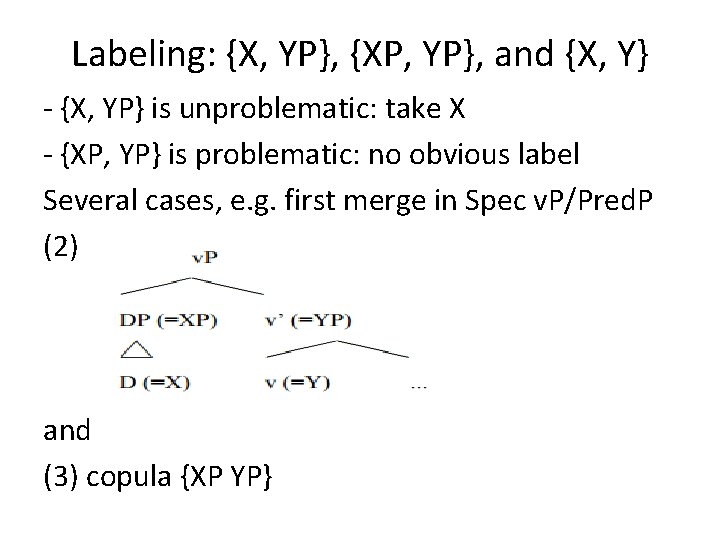
Labeling: {X, YP}, {XP, YP}, and {X, Y} - {X, YP} is unproblematic: take X - {XP, YP} is problematic: no obvious label Several cases, e. g. first merge in Spec v. P/Pred. P (2) and (3) copula {XP YP}
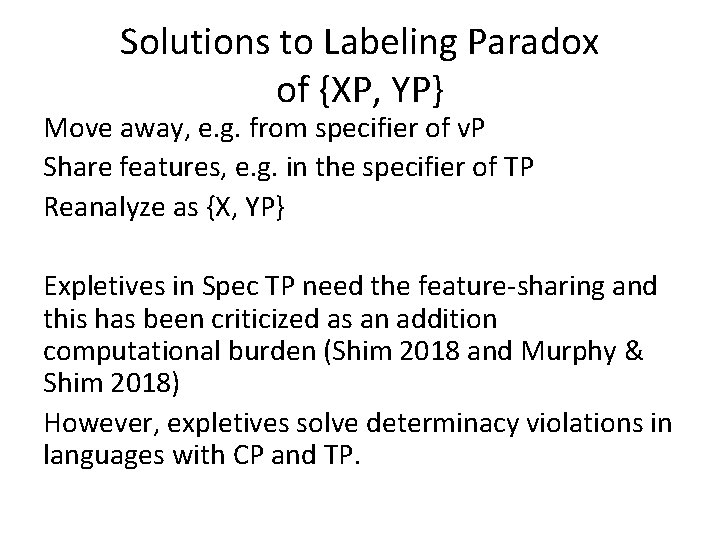
Solutions to Labeling Paradox of {XP, YP} Move away, e. g. from specifier of v. P Share features, e. g. in the specifier of TP Reanalyze as {X, YP} Expletives in Spec TP need the feature-sharing and this has been criticized as an addition computational burden (Shim 2018 and Murphy & Shim 2018) However, expletives solve determinacy violations in languages with CP and TP.
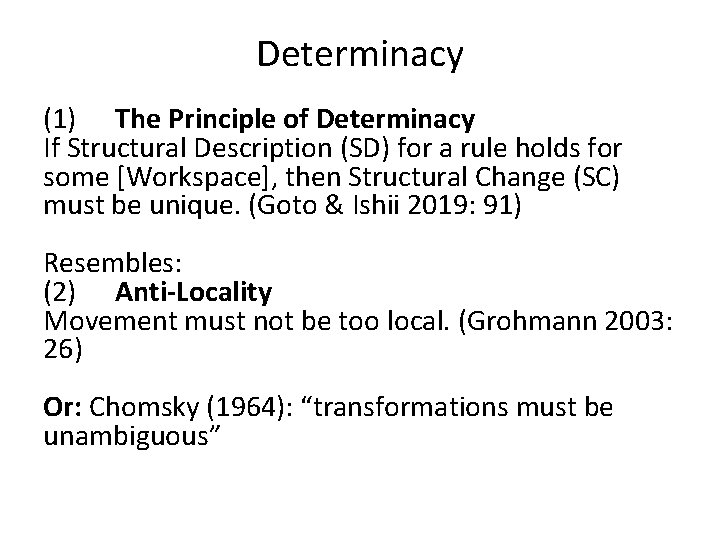
Determinacy (1) The Principle of Determinacy If Structural Description (SD) for a rule holds for some [Workspace], then Structural Change (SC) must be unique. (Goto & Ishii 2019: 91) Resembles: (2) Anti-Locality Movement must not be too local. (Grohmann 2003: 26) Or: Chomsky (1964): “transformations must be unambiguous”
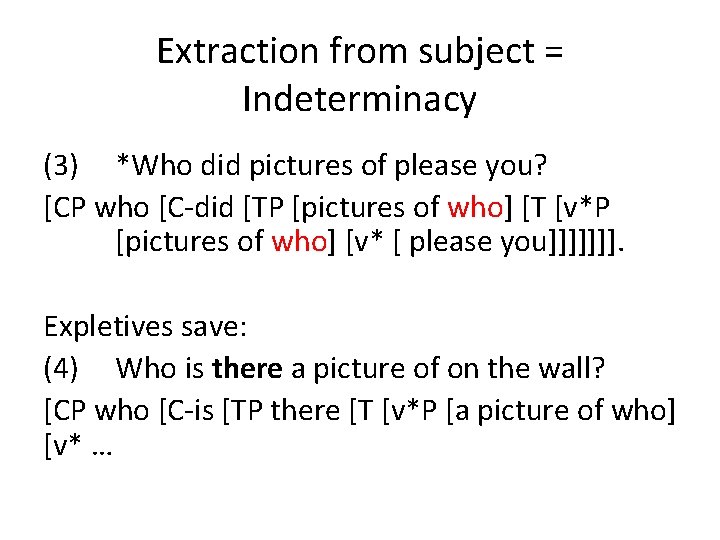
Extraction from subject = Indeterminacy (3) *Who did pictures of please you? [CP who [C-did [TP [pictures of who] [T [v*P [pictures of who] [v* [ please you]]]]]]]. Expletives save: (4) Who is there a picture of on the wall? [CP who [C-is [TP there [T [v*P [a picture of who] [v* …
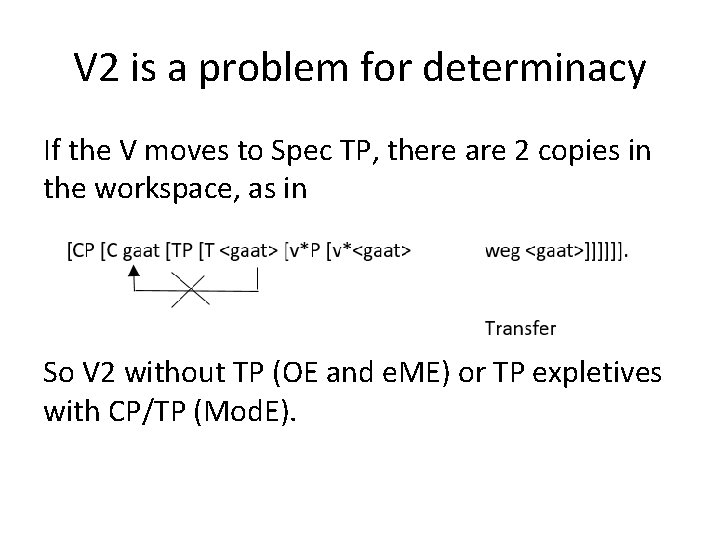
V 2 is a problem for determinacy If the V moves to Spec TP, there are 2 copies in the workspace, as in So V 2 without TP (OE and e. ME) or TP expletives with CP/TP (Mod. E).
Interim summary Shift from UG to 3 rd factors, e. g. labeling and determinacy V 2 with a CP and TP is a problem for determinacy TP expletives need the special mechanism of feature sharing to label what was the TP Next: history of English shows a loss of V 2 and introduction of TP expletives
Middle English: loss of V 2 and intro of expletives V 2 loss: 1300 -1600. Fischer et al (2000: 132) put the “sharp decline” of V 2 in the mid and late 14 th and early 15 th centuries. They identify the decline in the writing of Richard Rolle and Wycliffe. Chaucer can be added (late 14 th century). No link between the loss of V 2 and the introduction of expletives in overview studies of early English syntax, e. g. Fischer et al 2000, Los 2015, Fischer et al. 2017.
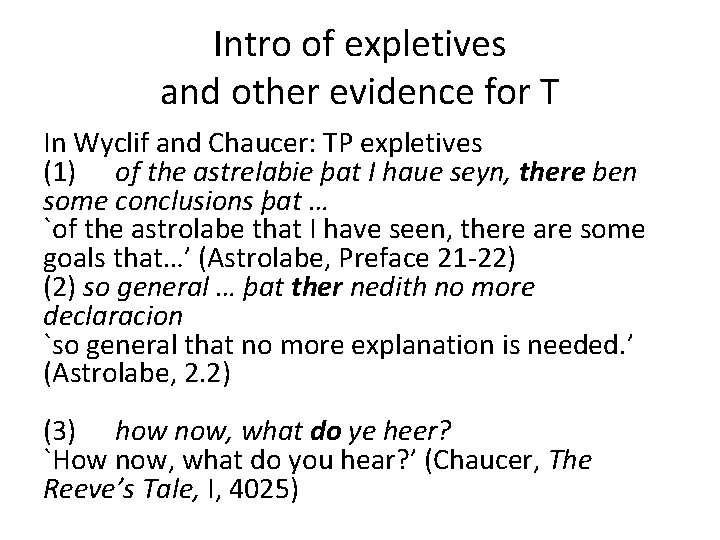
Intro of expletives and other evidence for T In Wyclif and Chaucer: TP expletives (1) of the astrelabie þat I haue seyn, there ben some conclusions þat … `of the astrolabe that I have seen, there are some goals that…’ (Astrolabe, Preface 21 -22) (2) so general … þat ther nedith no more declaracion `so general that no more explanation is needed. ’ (Astrolabe, 2. 2) (3) how now, what do ye heer? `How now, what do you hear? ’ (Chaucer, The Reeve’s Tale, I, 4025)
Why would the TP need an expletive? There could just be the merge of a T and no specifier. This presence only makes sense if, like regular DPs, expletives move to avoid labeling conflicts in the specifier of v. P. Old English demonstratives and adverbs are CP expletives and others are v. P expletives, as in Richards & Biberauer (2005) for German. Once the verb moves to T in Middle English, the v. P expletives are reanalyzed as moving to the specifier of the TP.
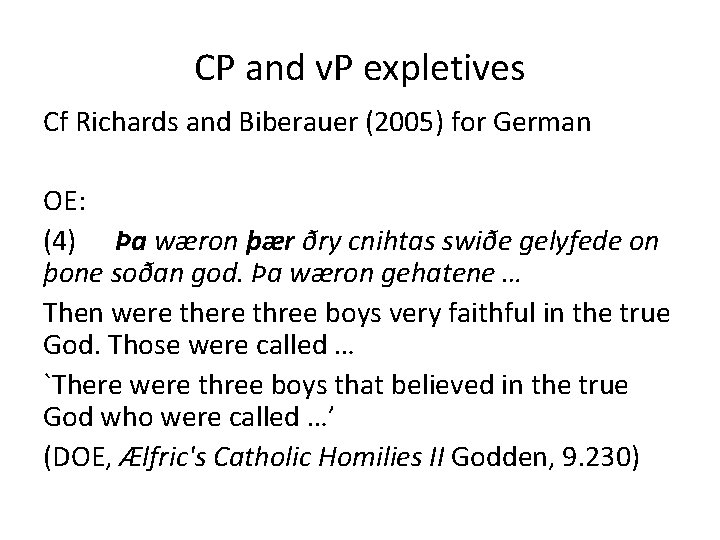
CP and v. P expletives Cf Richards and Biberauer (2005) for German OE: (4) Þa wæron þær ðry cnihtas swiðe gelyfede on þone soðan god. Þa wæron gehatene … Then were three boys very faithful in the true God. Those were called … `There were three boys that believed in the true God who were called …’ (DOE, Ælfric's Catholic Homilies II Godden, 9. 230)
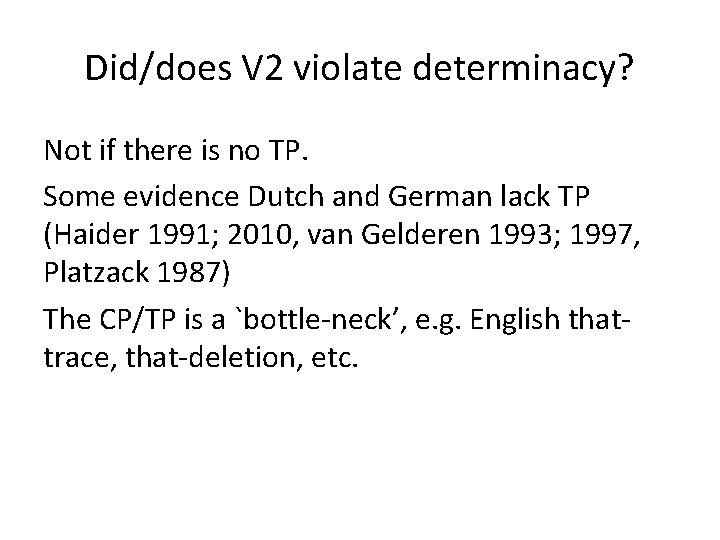
Did/does V 2 violate determinacy? Not if there is no TP. Some evidence Dutch and German lack TP (Haider 1991; 2010, van Gelderen 1993; 1997, Platzack 1987) The CP/TP is a `bottle-neck’, e. g. English thattrace, that-deletion, etc.
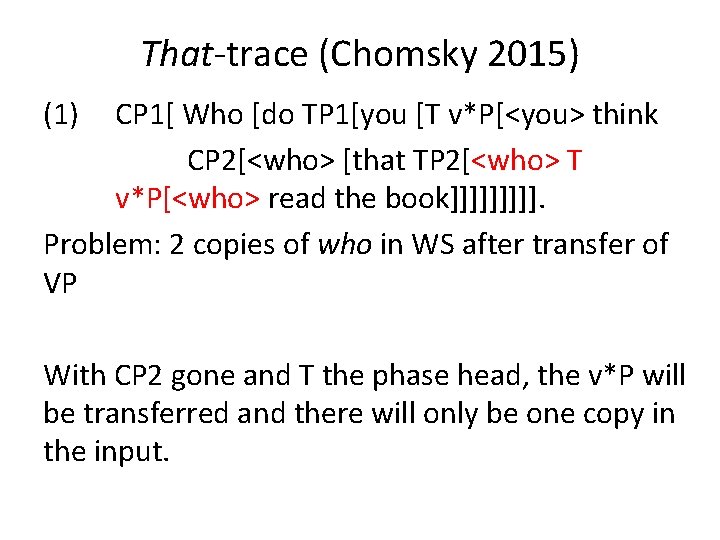
That-trace (Chomsky 2015) (1) CP 1[ Who [do TP 1[you [T v*P[<you> think CP 2[<who> [that TP 2[<who> T v*P[<who> read the book]]]]]. Problem: 2 copies of who in WS after transfer of VP With CP 2 gone and T the phase head, the v*P will be transferred and there will only be one copy in the input.
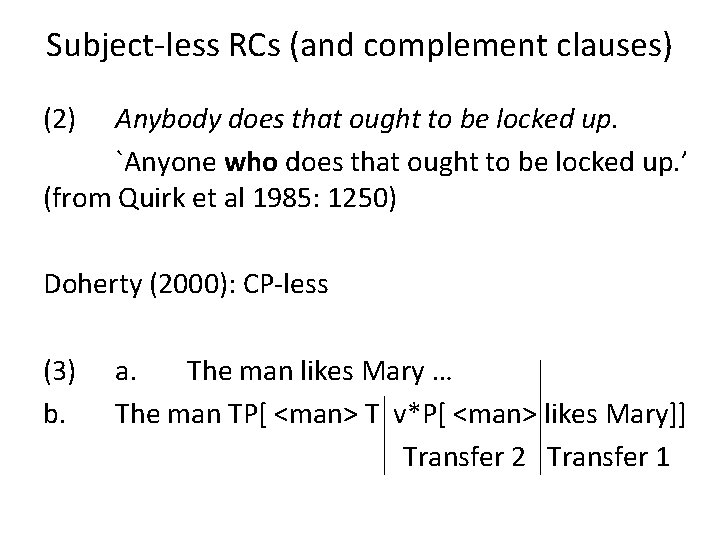
Subject-less RCs (and complement clauses) (2) Anybody does that ought to be locked up. `Anyone who does that ought to be locked up. ’ (from Quirk et al 1985: 1250) Doherty (2000): CP-less (3) b. a. The man likes Mary … The man TP[ <man> T v*P[ <man> likes Mary]] Transfer 2 Transfer 1
![C-deletion in complement clauses Evidence: (4) I hope that [this book] you will read.](http://slidetodoc.com/presentation_image_h2/3e276042cbd789e9f3e3e9983097accb/image-21.jpg "C-deletion in complement clauses Evidence: (4) I hope that [this book] you will read.")
C-deletion in complement clauses Evidence: (4) I hope that [this book] you will read. (5) *I hope [this book] you will read. (Doherty 2000: 13; Rizzi & Shlonsky 2007: 151 citing Grimshaw 1997).
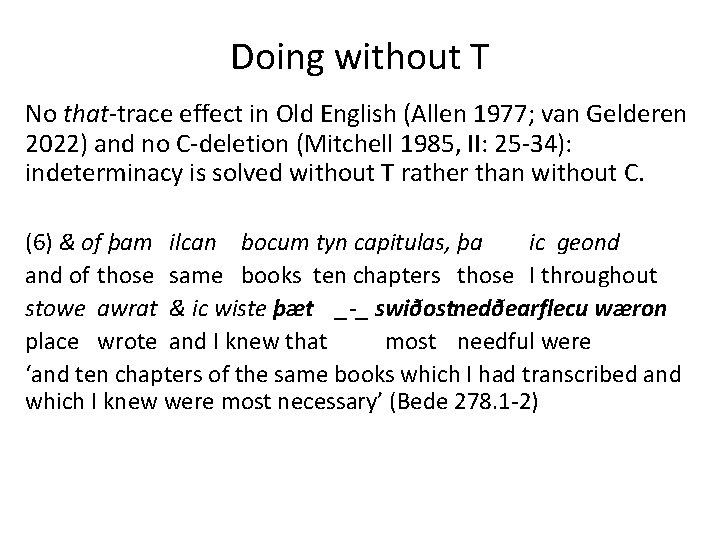
Doing without T No that-trace effect in Old English (Allen 1977; van Gelderen 2022) and no C-deletion (Mitchell 1985, II: 25 -34): indeterminacy is solved without T rather than without C. (6) & of þam ilcan bocum tyn capitulas, þa ic geond and of those same books ten chapters those I throughout stowe awrat & ic wiste þæt _ _ swiðostnedðearflecu wæron place wrote and I knew that most needful were ‘and ten chapters of the same books which I had transcribed and which I knew were most necessary’ (Bede 278. 1 -2)
A note on feature inheritance Feature Inheritance is either from C to T (in languages with obligatory T, such as modern English) or from C to v/v* (in languages with optional T, such as Dutch or Old English).
Conclusion V 2 and lack of TP expletives are linked under a determinacy view: determinacy rules out movement of v(P) to T(P) to C(P). This TP/CP bottleneck is solved: (a) no TP but V 2, or (b) no CP in certain cases. The loss of V 2, intro of TP, and intro of TP expletives are linked. Causality? ?
References Chomsky, Noam 2015. Problems of Projection: Extensions. In: Structures, Strategies, and Beyond, ed. Elisa Di Domenico et al, 3 -16. Amsterdam: John Benjamins. Chomsky, Noam 2019. https: //linguistics. ucla. edu/noam-chomsky/ Chomsky, Noam, Ángel J. Gallego, and Dennis Ott. 2019. Generative grammar and the faculty of language: Insights, questions, and challenges. CJL. lingbuzz/003507. Fischer, Olga, Ans van Kemenade, Willem Koopman and Wim van der Wurff 2000. The Syntax of Early English. Cambridge: Cambridge University Press Gelderen, Elly van 1997. Verbal Agreement and the Grammar behind its Breakdown. Tübingen: Niemeyer. Gelderen, Elly van forthc. Third factor principles in variation and language change. CUP. Goto, Nobu & Toru Ishii 2018 Some Consequences of MERGE and Determinacy. https: //ling. auf. net/lingbuzz/004108 Haider, Hubert 2010. The Syntax of German. Cambridge: Cambridge University Press. Nevalainen, Terttu 1997. Recycling Inversion. Studia Anglica Posnaniensia 31: 203 -214.
- Slides: 25