
Verbs What is a Verb a word which
Verbs
What is a Verb? �a word which tells what the subject has, does, is, or feels �expressed action or state of being
Action �Expresses action �Run, jump, play, lean, write, laugh, love, remember
Where would I place my line? �The strange cat meowed and hissed loudly an incessantly. �Black is my most favorite color.
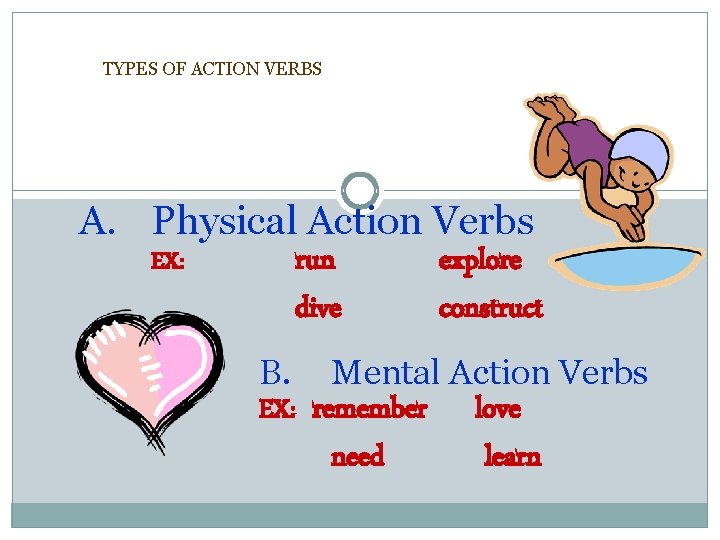
TYPES OF ACTION VERBS A. Physical Action Verbs EX: run explore dive construct B. Mental Action Verbs EX: remember love need learn
Action Verbs �Tells what the subject does. �The action may be physical or mental. �EXAMPLES: �The fish swam in the murky water. �I believe in the power of positive thinking.
Directions: Locate the action verb in each sentence. �Helen enjoys having pets in her home. �She fed two crazy cats and a cute dog named Gino. �Her cat attacks when he is upset. � She appreciates it when her husband walks the pets.
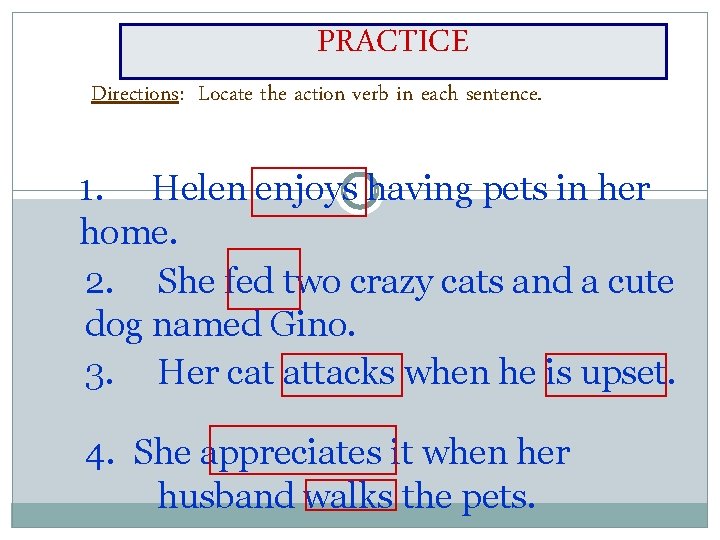
PRACTICE Directions: Locate the action verb in each sentence. 1. Helen enjoys having pets in her home. 2. She fed two crazy cats and a cute dog named Gino. 3. Her cat attacks when he is upset. 4. She appreciates it when her husband walks the pets.
More Action Verb examples �The dog jumped high and caught the ball in the air. �The i. Pad shut down in the middle of the teacher’s lesson. �The three girls put their makeup on and headed to the movies.
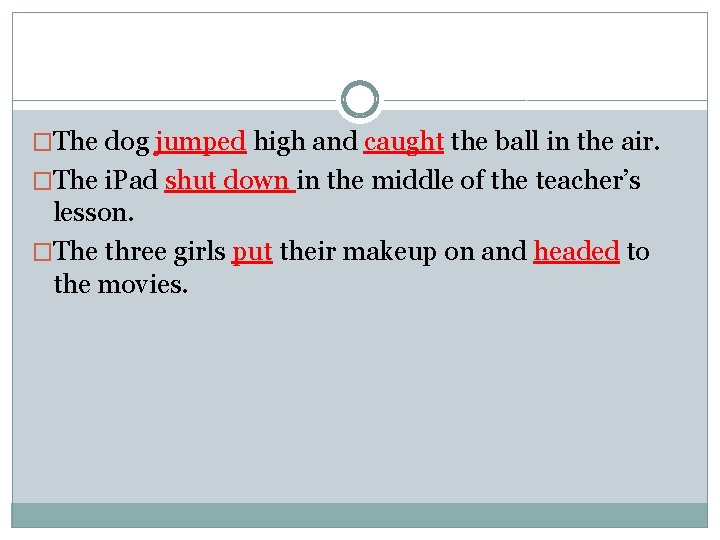
�The dog jumped high and caught the ball in the air. �The i. Pad shut down in the middle of the teacher’s lesson. �The three girls put their makeup on and headed to the movies.
Being Verbs �Being verbs can be linking verbs or helping verbs. �The most common linking verbs are forms of the verb be. � Used as a linking verb: The smart young lady is always early to class. � Used as a helping verb: The smart young lady is working hard in school. �am �is �are was were be being been
Linking Verbs �Links the subject to a word in the predicate. �Verbs which express condition: �Common Linking Verbs �appear �become �feel grow look taste seem smell sound
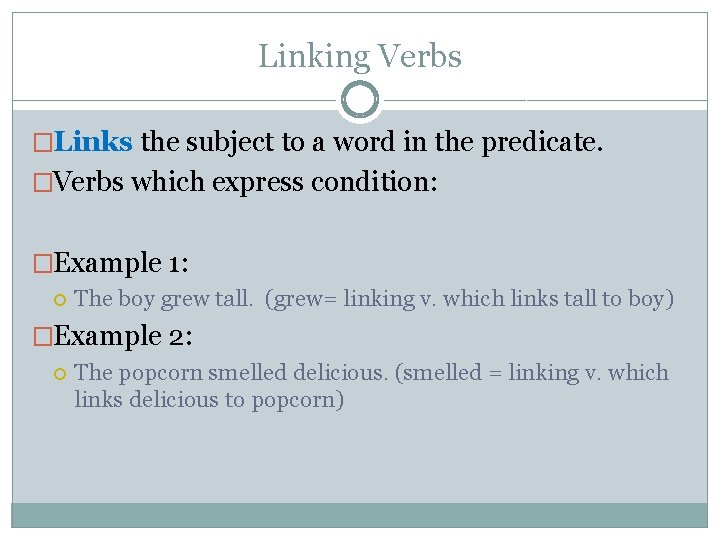
Linking Verbs �Links the subject to a word in the predicate. �Verbs which express condition: �Example 1: The boy grew tall. (grew= linking v. which links tall to boy) �Example 2: The popcorn smelled delicious. (smelled = linking v. which links delicious to popcorn)
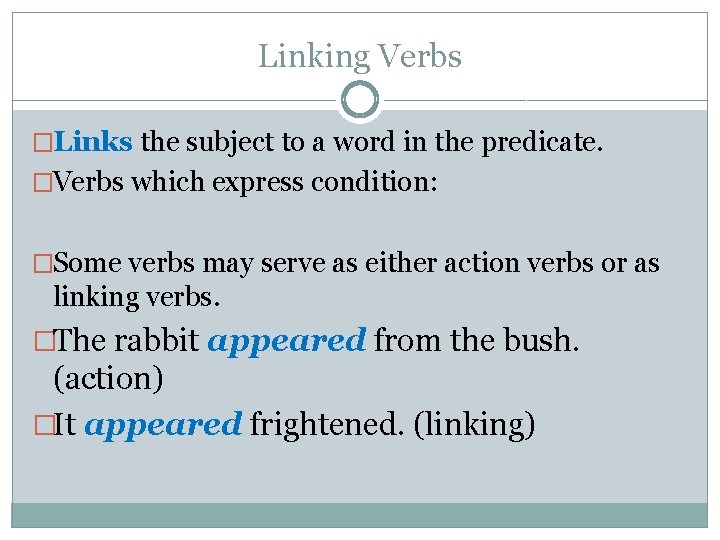
Linking Verbs �Links the subject to a word in the predicate. �Verbs which express condition: �Some verbs may serve as either action verbs or as linking verbs. �The rabbit appeared from the bush. (action) �It appeared frightened. (linking)
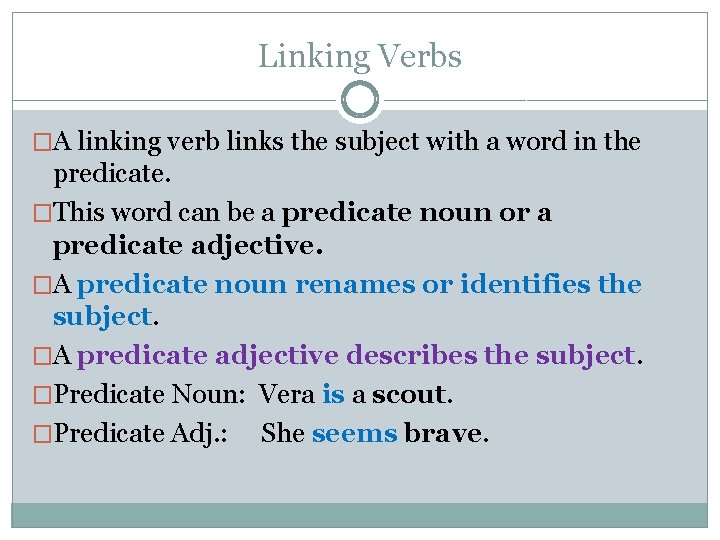
Linking Verbs �A linking verb links the subject with a word in the predicate. �This word can be a predicate noun or a predicate adjective. �A predicate noun renames or identifies the subject. �A predicate adjective describes the subject. �Predicate Noun: Vera is a scout. �Predicate Adj. : She seems brave.
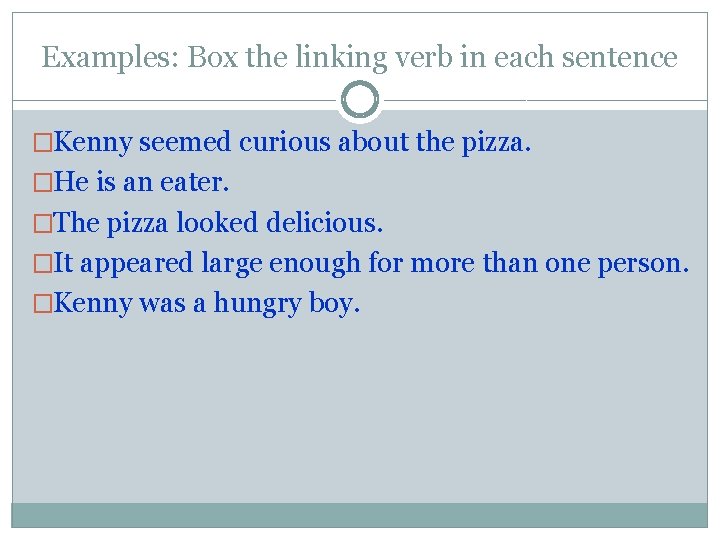
Examples: Box the linking verb in each sentence �Kenny seemed curious about the pizza. �He is an eater. �The pizza looked delicious. �It appeared large enough for more than one person. �Kenny was a hungry boy.
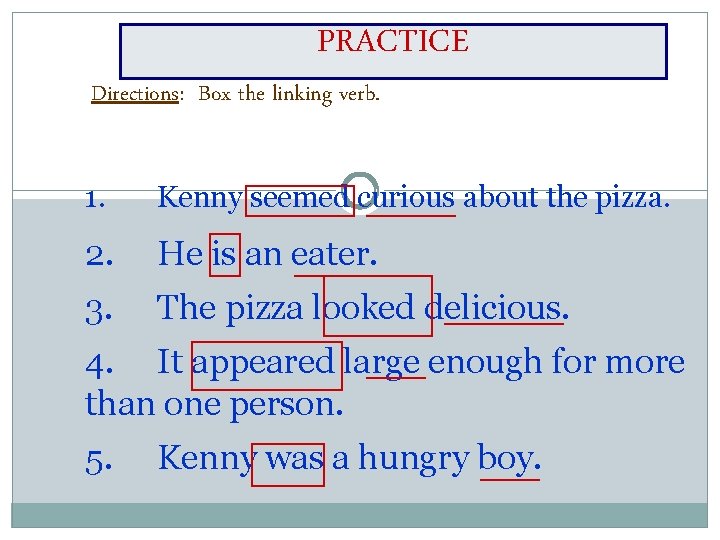
PRACTICE Directions: Box the linking verb. 1. Kenny seemed curious about the pizza. 2. He is an eater. 3. The pizza looked delicious. 4. It appeared large enough for more than one person. 5. Kenny was a hungry boy.
More linking verb practice �The teachers at our school are so kind and caring. �Our student council members were hard-working and efficient this school year. �My little brother is such an annoying pest.
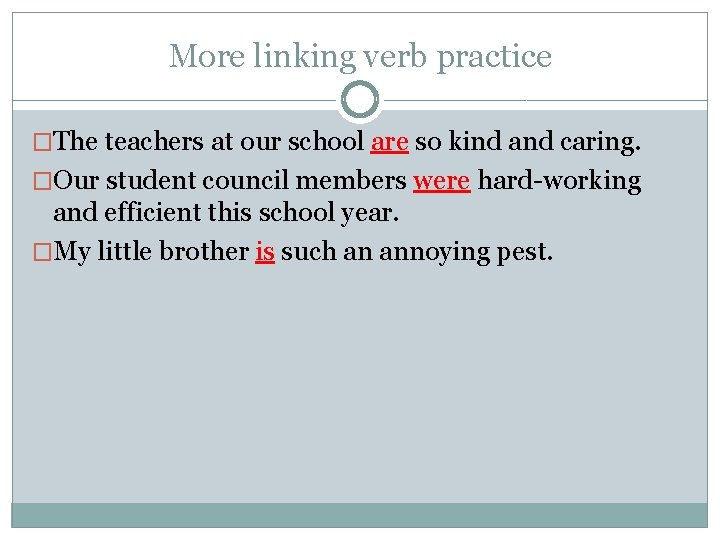
More linking verb practice �The teachers at our school are so kind and caring. �Our student council members were hard-working and efficient this school year. �My little brother is such an annoying pest.
Linking Verbs �Are the verbs action or linking? � 1. The girls became curious.
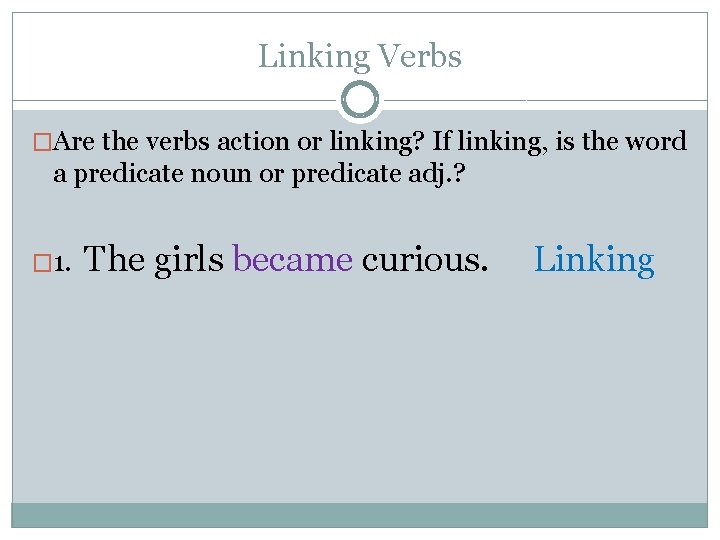
Linking Verbs �Are the verbs action or linking? If linking, is the word a predicate noun or predicate adj. ? � 1. The girls became curious. Linking
Linking Verbs �Are the verbs action or linking? � 2. Vera sounded nervous.
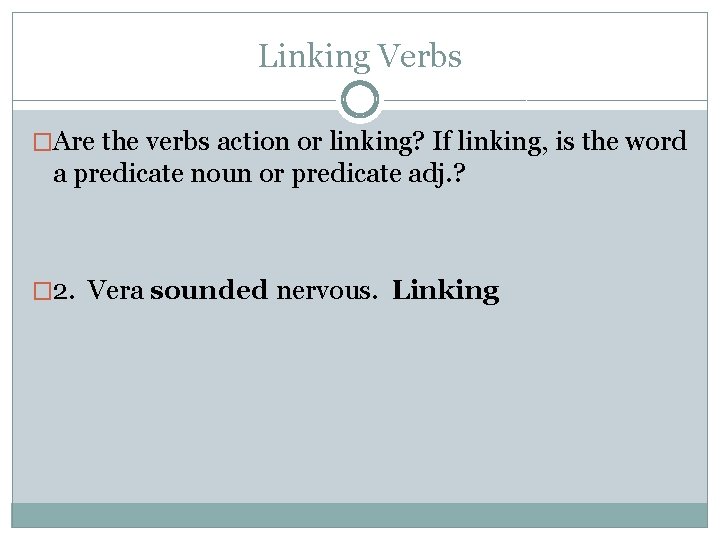
Linking Verbs �Are the verbs action or linking? If linking, is the word a predicate noun or predicate adj. ? � 2. Vera sounded nervous. Linking
Linking Verbs �Are the verbs action or linking? � 3. She sounded the alarm.
Linking Verbs �Are the verbs action or linking? If linking, is the word a predicate noun or predicate adj. ? � 3. She sounded the alarm. Action
Let’s Review �What is a verb? �What are the being verbs? When can they be used? �What are the common linking verbs? (9)
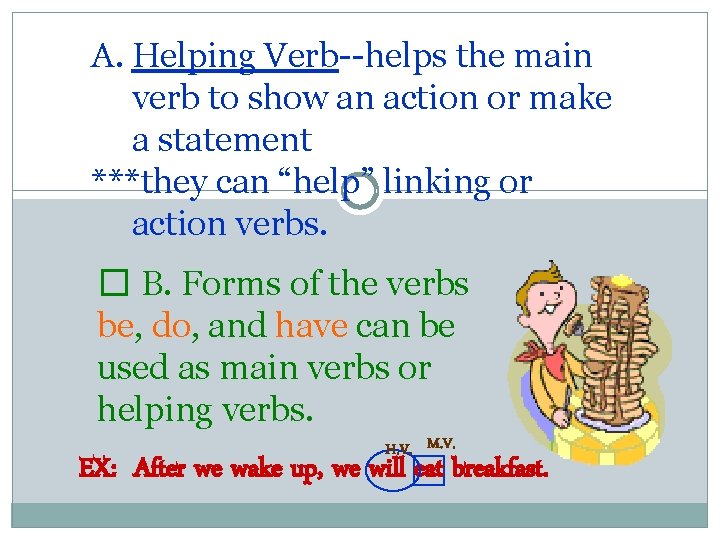
A. Helping Verb--helps the main verb to show an action or make a statement ***they can “help” linking or action verbs. � B. Forms of the verbs be, do, and have can be used as main verbs or helping verbs. H. V. M. V. EX: After we wake up, we will eat breakfast.
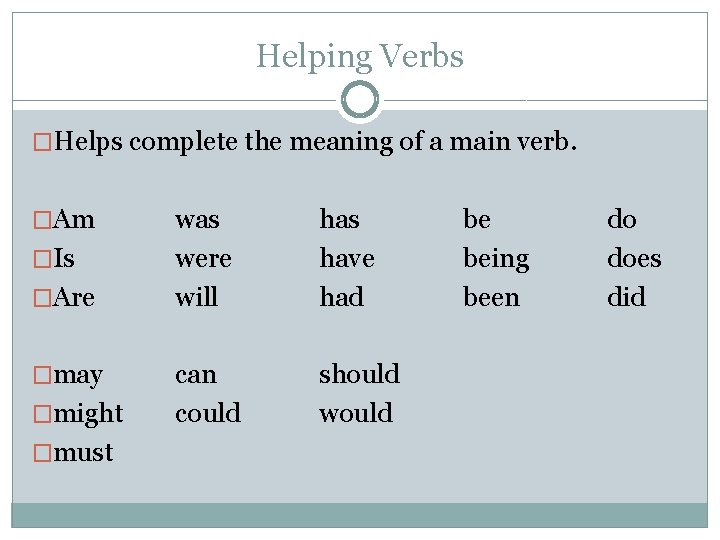
Helping Verbs �Helps complete the meaning of a main verb. �Am �Is �Are �may �might �must was were will has have had can could should would be being been do does did
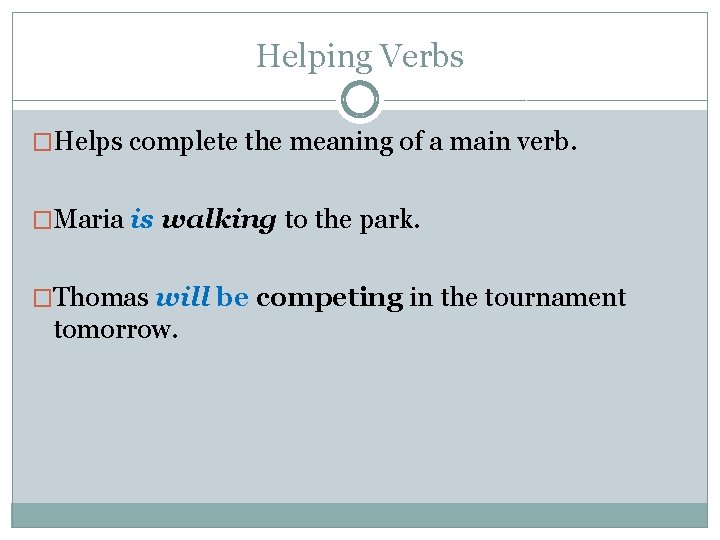
Helping Verbs �Helps complete the meaning of a main verb. �Maria is walking to the park. �Thomas will be competing in the tournament tomorrow.
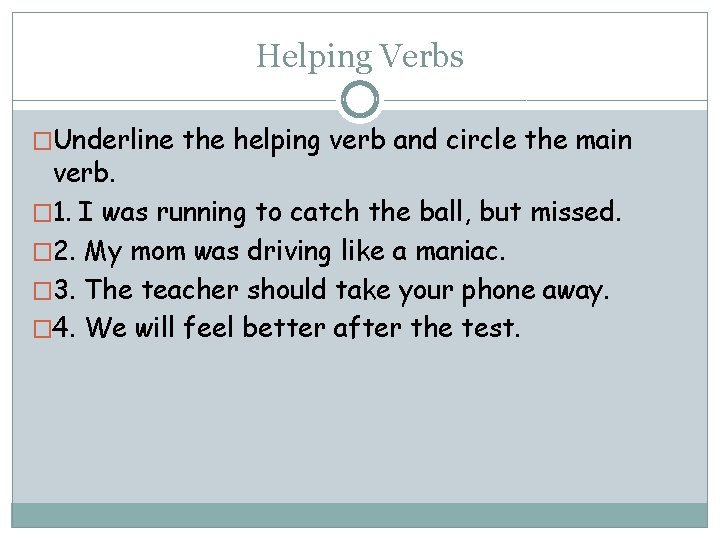
Helping Verbs �Underline the helping verb and circle the main verb. � 1. I was running to catch the ball, but missed. � 2. My mom was driving like a maniac. � 3. The teacher should take your phone away. � 4. We will feel better after the test.
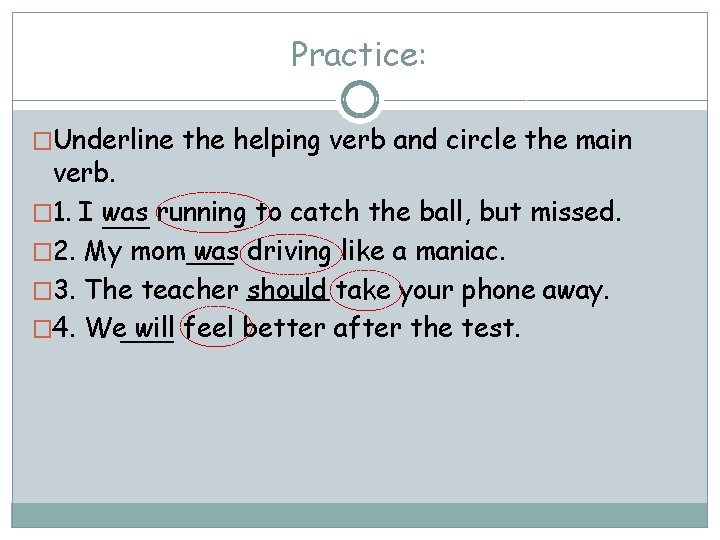
Practice: �Underline the helping verb and circle the main verb. � 1. I was running to catch the ball, but missed. � 2. My mom was driving like a maniac. � 3. The teacher should take your phone away. � 4. We will feel better after the test.
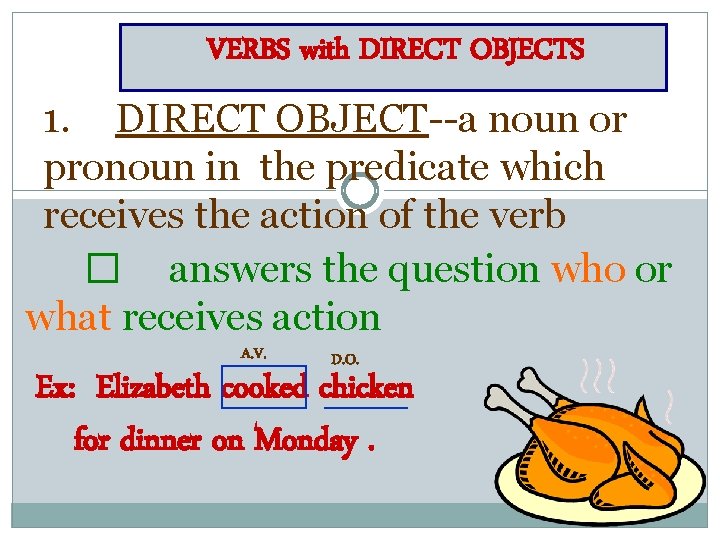
VERBS with DIRECT OBJECTS 1. DIRECT OBJECT--a noun or pronoun in the predicate which receives the action of the verb � answers the question who or what receives action A. V. D. O. Ex: Elizabeth cooked chicken for dinner on Monday.
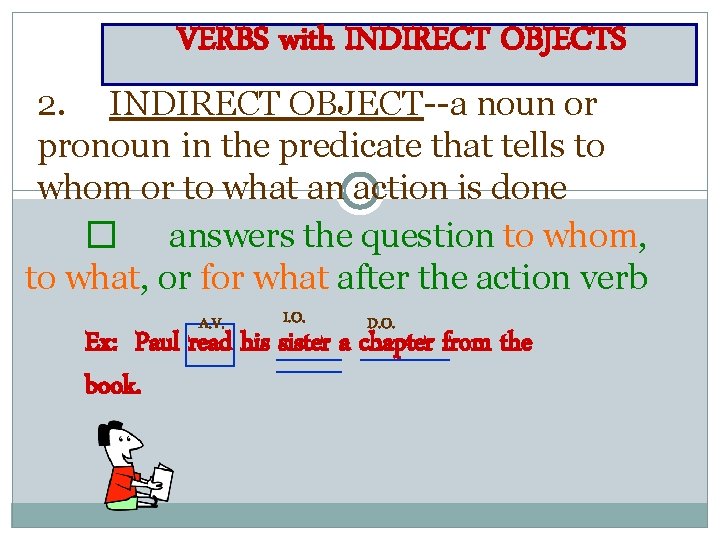
VERBS with INDIRECT OBJECTS 2. INDIRECT OBJECT--a noun or pronoun in the predicate that tells to whom or to what an action is done � answers the question to whom, to what, or for what after the action verb A. V. I. O. D. O. Ex: Paul read his sister a chapter from the book.
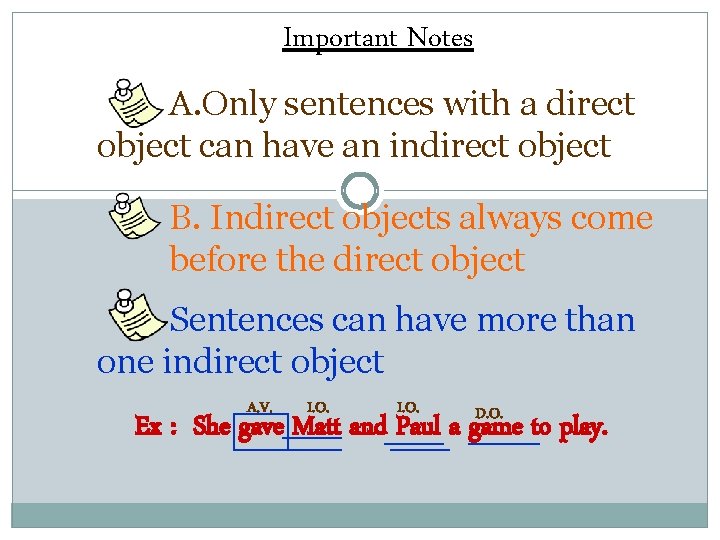
Important Notes A. Only sentences with a direct object can have an indirect object B. Indirect objects always come before the direct object Sentences can have more than one indirect object A. V. I. O. D. O. Ex : She gave Matt and Paul a game to play.
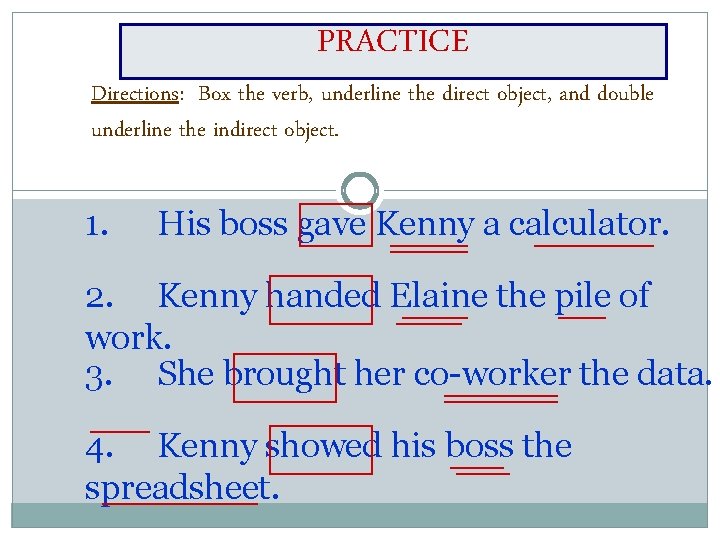
PRACTICE Directions: Box the verb, underline the direct object, and double underline the indirect object. 1. His boss gave Kenny a calculator. 2. Kenny handed Elaine the pile of work. 3. She brought her co-worker the data. 4. Kenny showed his boss the spreadsheet.
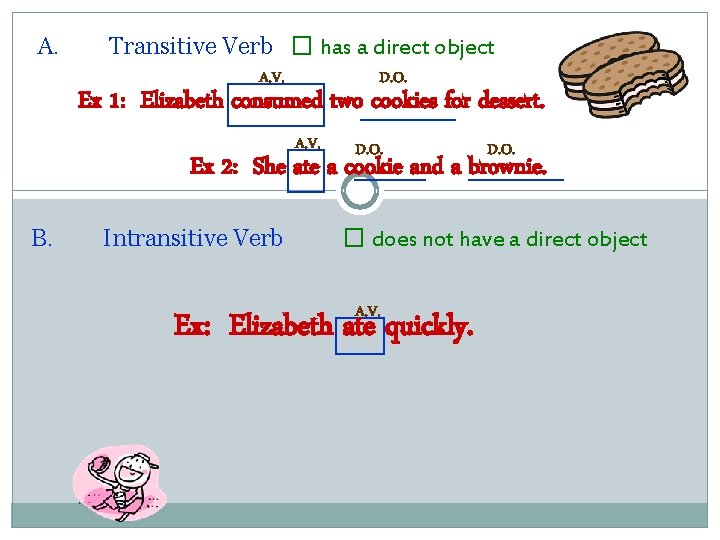
A. Transitive Verb � has a direct object A. V. D. O. Ex 1: Elizabeth consumed two cookies for dessert. A. V. D. O. Ex 2: She ate a cookie and a brownie. B. Intransitive Verb � does not have a direct object A. V. Ex: Elizabeth ate quickly.
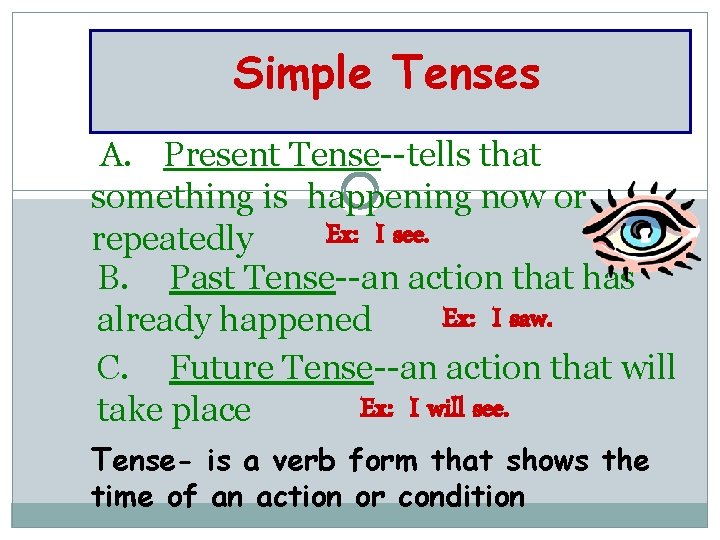
Simple Tenses A. Present Tense--tells that something is happening now or Ex: I see. repeatedly B. Past Tense--an action that has Ex: I saw. already happened C. Future Tense--an action that will Ex: I will see. take place Tense- is a verb form that shows the time of an action or condition
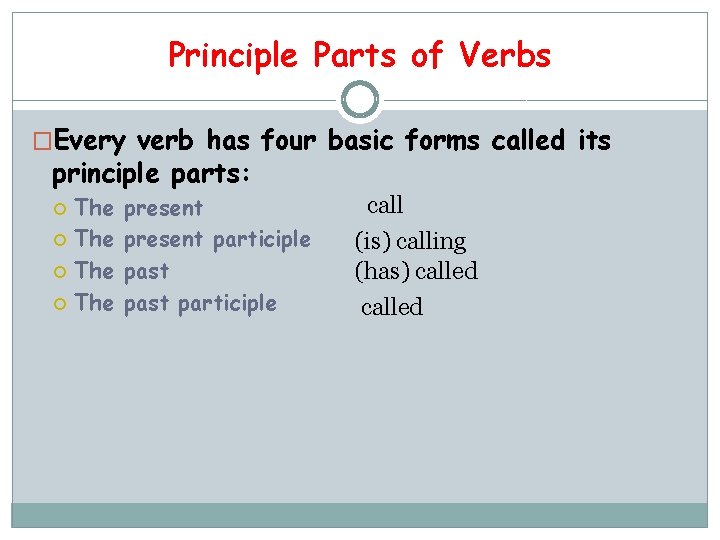
Principle Parts of Verbs �Every verb has four basic forms called its principle parts: The The present participle past participle call (is) calling (has) called
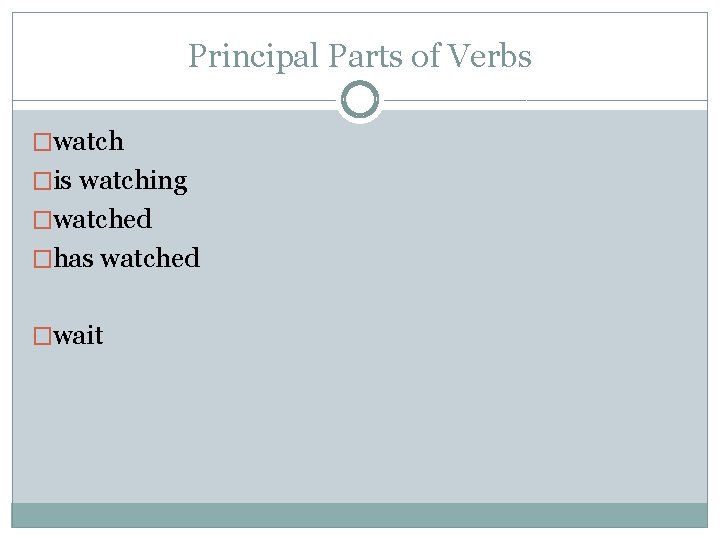
Principal Parts of Verbs �watch �is watching �watched �has watched �wait
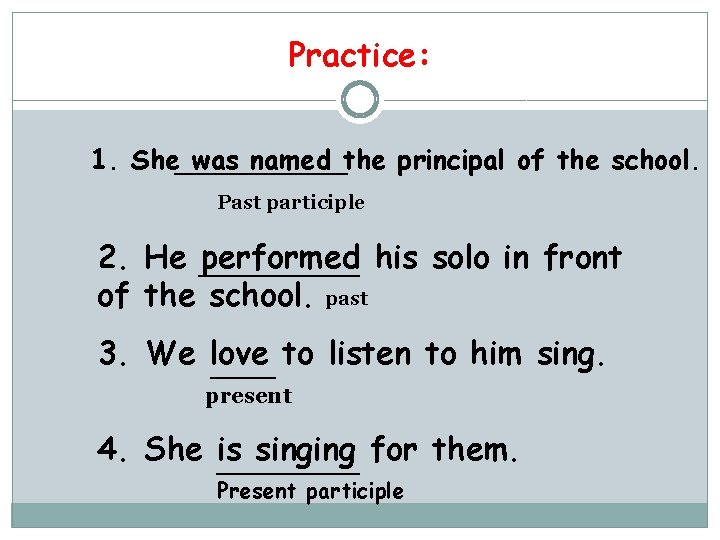
Practice: 1. She was named the principal of the school. Past participle 2. He performed his solo in front of the school. past 3. We love to listen to him sing. present 4. She is singing for them. Present participle
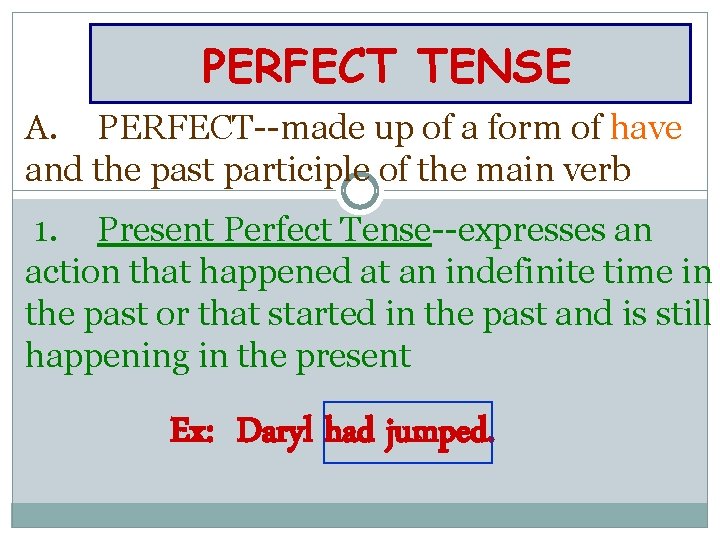
PERFECT TENSE A. PERFECT--made up of a form of have and the past participle of the main verb 1. Present Perfect Tense--expresses an action that happened at an indefinite time in the past or that started in the past and is still happening in the present Ex: Daryl had jumped.
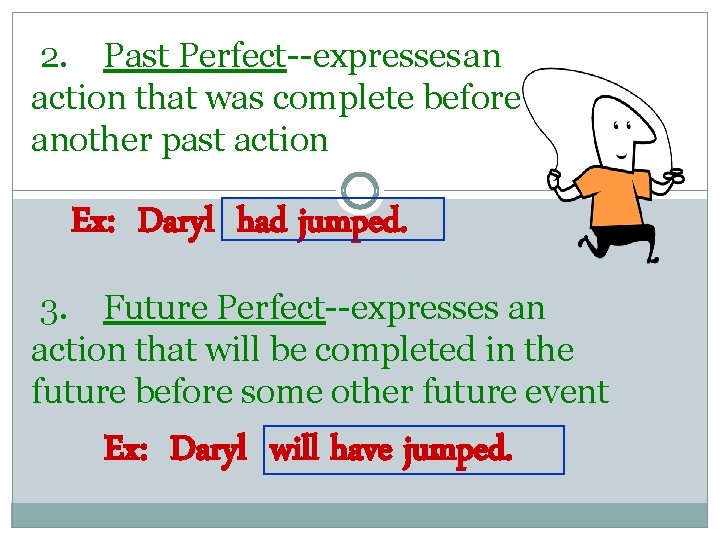
2. Past Perfect--expressesan action that was complete before another past action Ex: Daryl had jumped. 3. Future Perfect--expresses an action that will be completed in the future before some other future event Ex: Daryl will have jumped.
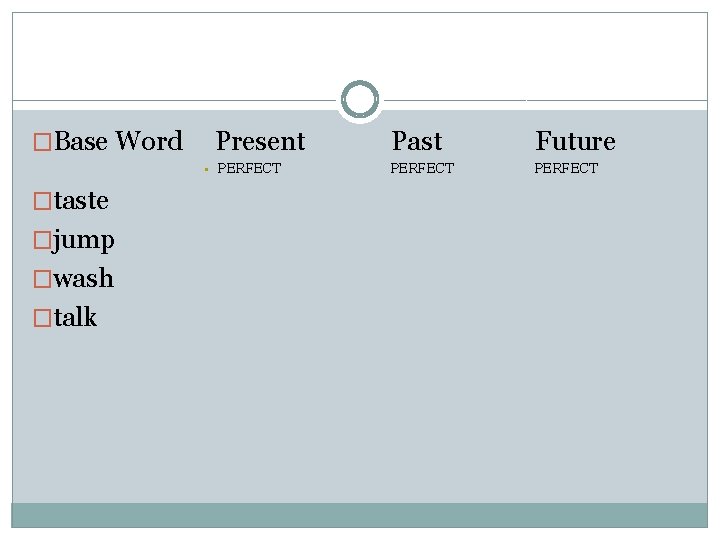
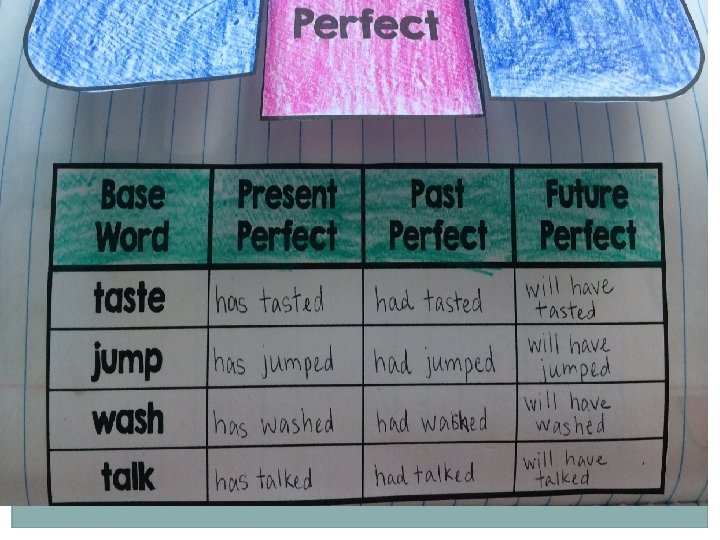
�Base Word Present • PERFECT �taste �jump �wash �talk Past Future PERFECT
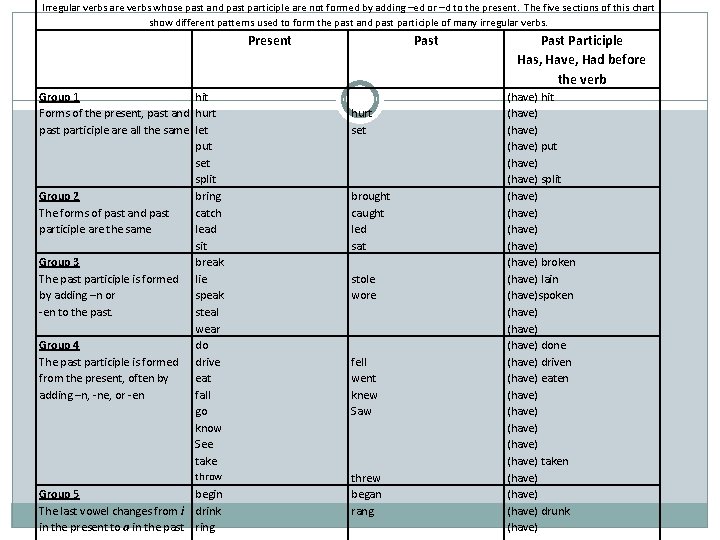
Irregular verbs are verbs whose past and past participle are not formed by adding –ed or –d to the present. The five sections of this chart show different patterns used to form the past and past participle of many irregular verbs. Present Group 1 hit Forms of the present, past and hurt past participle are all the same let put set split Group 2 bring The forms of past and past catch participle are the same lead sit Group 3 break The past participle is formed lie by adding –n or speak -en to the past. steal wear Group 4 do The past participle is formed drive from the present, often by eat adding –n, -ne, or -en fall go know See take throw Group 5 begin The last vowel changes from i drink in the present to a in the past ring Past hurt set brought caught led sat stole wore fell went knew Saw threw began rang Past Participle Has, Have, Had before the verb (have) hit (have) put (have) split (have) (have) broken (have) lain (have)spoken (have) done (have) driven (have) eaten (have) (have) taken (have) drunk (have)
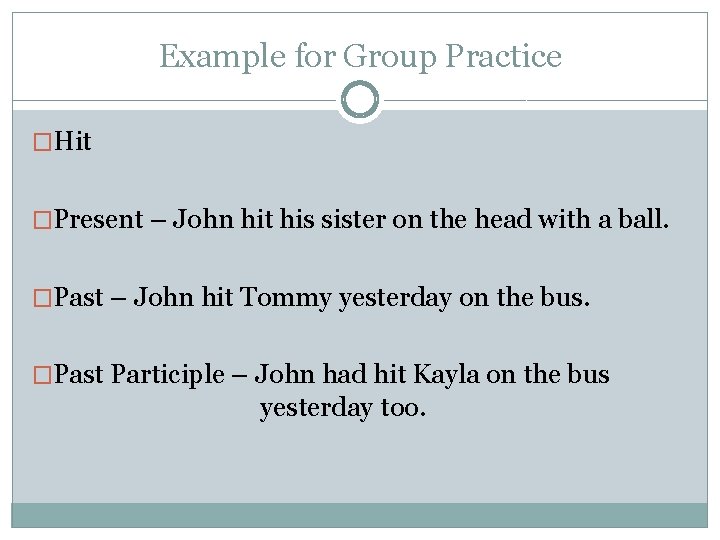
Example for Group Practice �Hit �Present – John hit his sister on the head with a ball. �Past – John hit Tommy yesterday on the bus. �Past Participle – John had hit Kayla on the bus yesterday too.
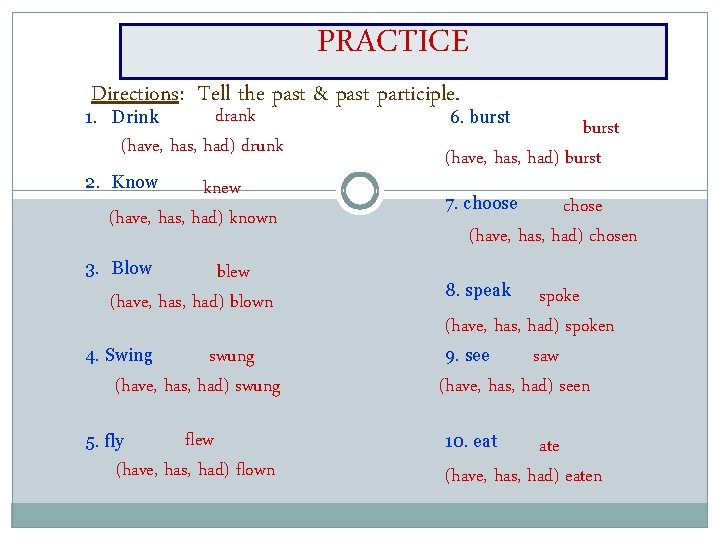
PRACTICE Directions: Tell the past & past participle. drank (have, has, had) drunk 1. Drink 2. Know knew (have, has, had) known 3. Blow blew (have, has, had) blown swung (have, has, had) swung 4. Swing flew (have, has, had) flown 5. fly 6. burst (have, has, had) burst 7. choose chose (have, has, had) chosen 8. speak spoke (have, has, had) spoken 9. see saw (have, has, had) seen 10. eat ate (have, has, had) eaten
- Slides: 47