
Verbals Grammar Lesson Is it a VERB or
Verbals Grammar Lesson
Is it a VERB or a VERBAL? ? • Telling the difference between a verb and a verbal is not done by looking only at the word itself. • You have to see how the word is being used. • In both cases, the word looks like a verb, but if it’s used as something other than a verb…it’s a VERBAL
Is it a VERB or a VERBAL? ? • Examples: – – Waxed Flowing Playing Sleeping • These can be verbs or verbals depending upon how they are used in the sentence.
Is it a VERB or a VERBAL? ? • Examples: – Our butler waxed the floors. – The waxed floors were slippery and dangerous. • In the first sentence, the word is being used as a verb to tell what action is being done. • In the other one, the word still looks like a verb, but it is being used as an adjective
Is it a VERB or a VERBAL? ? • Examples: – Water was flowing over the rocks in the stream. – Flowing water carries a great deal of potential energy. • The same thing is true here as in the other example. • The second sentences shows the verb working as an adjective instead of a verb.
Basic Information on Verbals • Verbals are verb forms (words that look like verbs or could be verbs in other sentences) that are used as one of the following: – Noun – Adjective – Adverb • A verbal can never be the verb of the sentence.
Basic Information on Verbals • There are three different kinds of verbals: – Infinitive – Participle – Gerund • Each verbal has a specific purpose and use in a sentence.
Infinitives • An infinitive is a verb form that is proceeded by the word “to. ” – – – To play To sleep To be seen To steal To have been stolen To speak
Infinitives • In some sentences (following certain verbs), the “sign of the infinitive” (the word “to) is omitted. • This is done for clarity. – Help him (to) move the sofa. – Watch the fish (to) snap at the hook. – Can you feel the floor (to) move?
Infinitives • The verbs which call for an omitted “to” are: – – – – See Hear Feel Help Let Make Watch
Infinitives • An infinitive has three possible functions: – As a noun – As an adjective – As an adverb • Knowing where an infinitive should go helps make the structure of the sentence more clear.
Infinitives • As a noun: – I hate to go. (direct object) – To steal is a crime. (subject) • As an adjective: – It’s time to go. (modify time) – There are jobs to be done (modify jobs) • As an adverb: – He always plays to win. (modify plays)
Infinitives • Infinitives can also have modifiers or complements. • This can be done because there is a verb form in the infinitive that (if being used as a verb in another sentence) could take a complement such as an indirect or direct object or a predicate complement.
Participles • Verb forms that are used as adjectives are called participles. • They will have two forms: – Present (ending in “-ing”) – Past (ending in “-ed” or “-en”) • These contain action, but they are not used as verbs in the sentence.
Participles • Examples: – – – – Smoking gun Snoring spouse Broken window Elected official Streaming video Buzzing noise Winning touchdown Walking track
Participles • Participles can appear in several places in the sentence, but they are most commonly found describing / modifying the subject. • Participle phrases can also be made from single participles – Running along the path
Participles • Most participle phrases will have commas setting them off. This is especially true when they open a sentence and modify the subject. – Running at full speed, the back raced twenty yards for a score. – Crying loudly, the baby wanted some attention.
Gerunds • A gerund looks a lot like a participle because it ends in “ing. ” • However, the gerund is going to be used as a noun. • Gerunds will show up as subjects, direct or indirect objects or objects of prepositions.
Gerunds • Examples: – Chewing gum in class is not allowed. (subject) – I liked eating at the new restaurant. (direct object) – Without running very hard I won the race. – Abusing the warm fuzzy kitten is not allowed in this class. (subject)
Practice: • You will be shown ten sentences with a word or phrase underlined. • Identify the word or phrases as: – Infinitive – Participle – Gerund
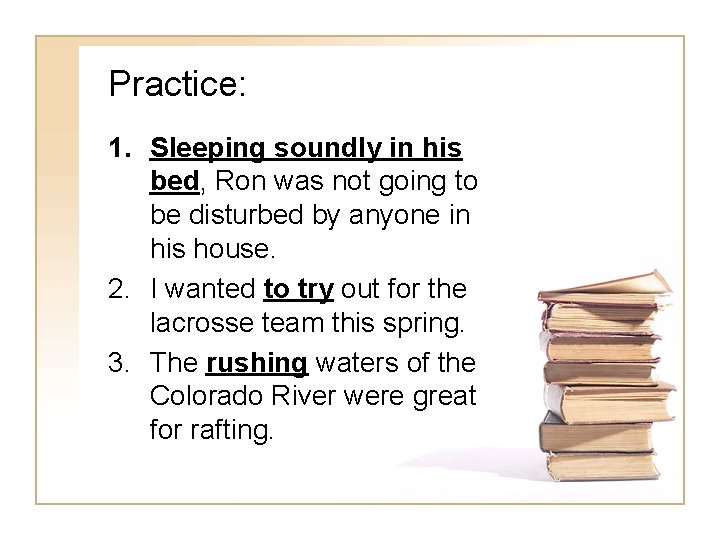
Practice: 1. Sleeping soundly in his bed, Ron was not going to be disturbed by anyone in his house. 2. I wanted to try out for the lacrosse team this spring. 3. The rushing waters of the Colorado River were great for rafting.
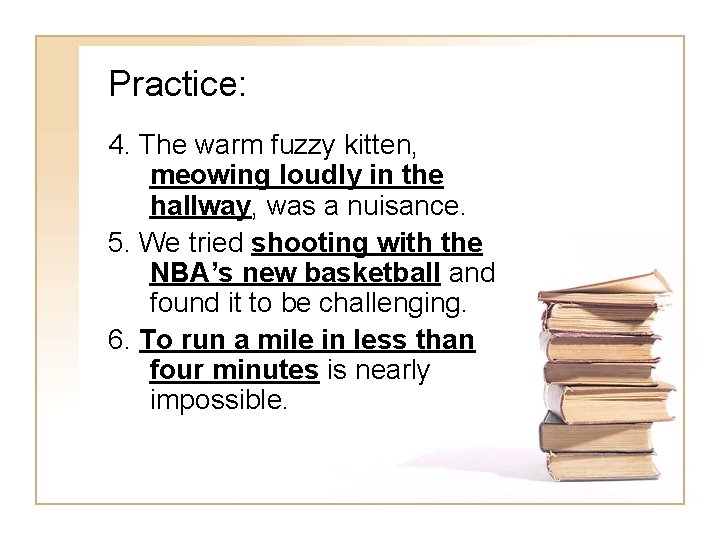
Practice: 4. The warm fuzzy kitten, meowing loudly in the hallway, was a nuisance. 5. We tried shooting with the NBA’s new basketball and found it to be challenging. 6. To run a mile in less than four minutes is nearly impossible.
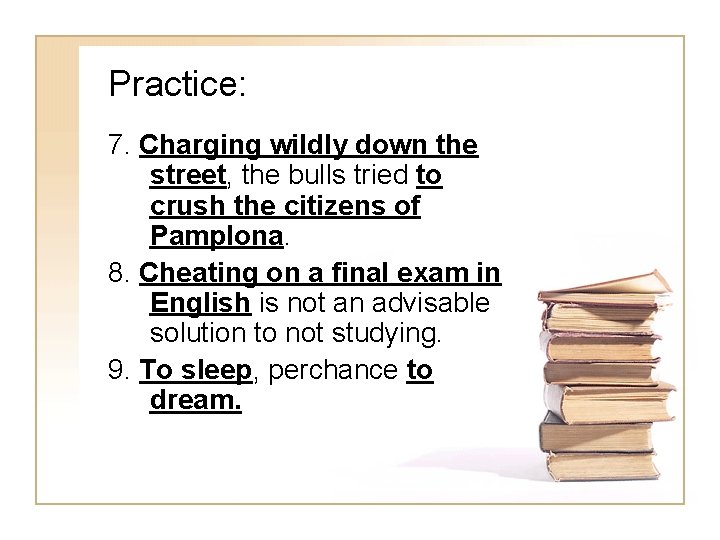
Practice: 7. Charging wildly down the street, the bulls tried to crush the citizens of Pamplona. 8. Cheating on a final exam in English is not an advisable solution to not studying. 9. To sleep, perchance to dream.
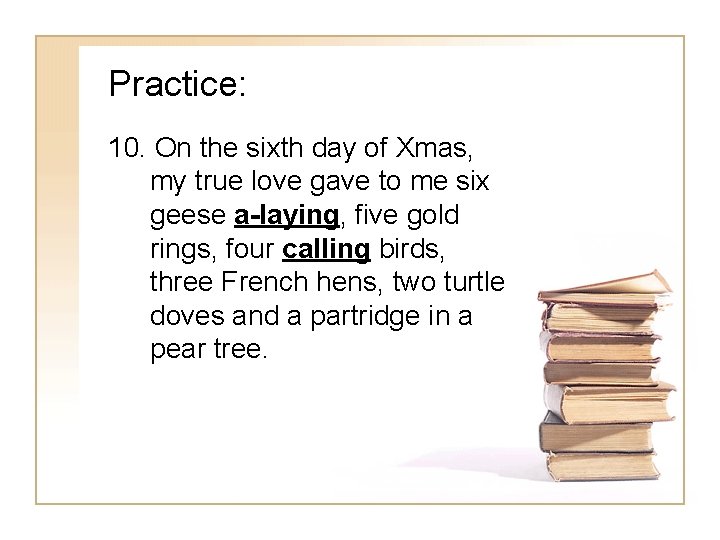
Practice: 10. On the sixth day of Xmas, my true love gave to me six geese a-laying, five gold rings, four calling birds, three French hens, two turtle doves and a partridge in a pear tree.
- Slides: 24