
VERBAL PHRASES REVIEW With a small writing assignment
VERBAL PHRASES REVIEW (With a small writing assignment at the end)
What is a verbal phrase? ◦ A verbal phrase is a phrase the begins with a participle, gerund, or infinitive and functions as a single part of speech within the sentence. ◦ Remember that a verbal is always marked with a . ◦ Each phrase follows the function of the verbal that begins it. ◦ Participle phrases act as adjectives. ◦ Gerund phrases act as nouns. ◦ Infinitive phrases act as nouns, adjectives, or adverbs.
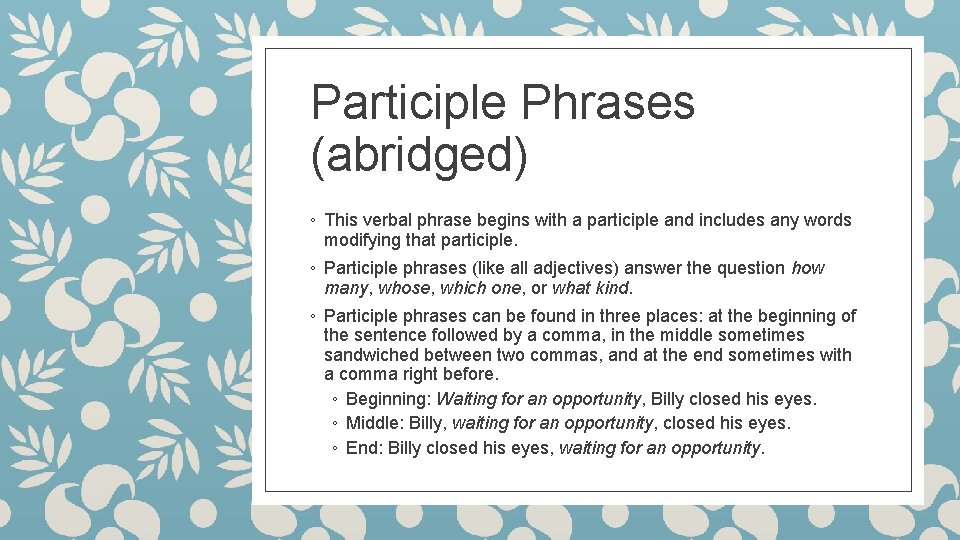
Participle Phrases (abridged) ◦ This verbal phrase begins with a participle and includes any words modifying that participle. ◦ Participle phrases (like all adjectives) answer the question how many, whose, which one, or what kind. ◦ Participle phrases can be found in three places: at the beginning of the sentence followed by a comma, in the middle sometimes sandwiched between two commas, and at the end sometimes with a comma right before. ◦ Beginning: Waiting for an opportunity, Billy closed his eyes. ◦ Middle: Billy, waiting for an opportunity, closed his eyes. ◦ End: Billy closed his eyes, waiting for an opportunity.
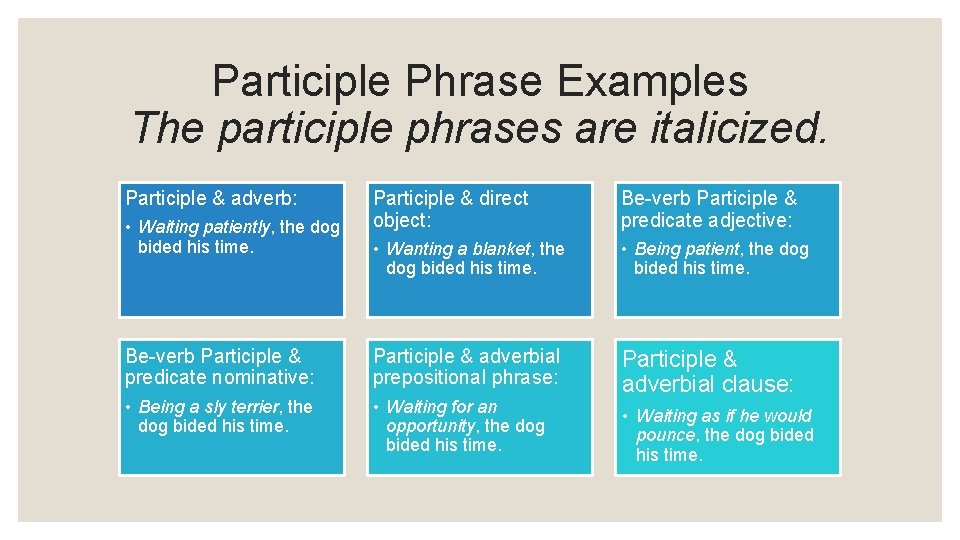
Participle Phrase Examples The participle phrases are italicized. Participle & adverb: Participle & direct object: Be-verb Participle & predicate adjective: • Wanting a blanket, the dog bided his time. • Being patient, the dog bided his time. Be-verb Participle & predicate nominative: Participle & adverbial prepositional phrase: • Being a sly terrier, the dog bided his time. • Waiting for an opportunity, the dog bided his time. Participle & adverbial clause: • Waiting patiently, the dog bided his time. • Waiting as if he would pounce, the dog bided his time.
Participle Phrase Sentence Writing Assignment ◦ Directions: Rewrite the following sentences, replacing the clause (principal or subordinate clauses) with a participle phrase while keeping the same basic meaning of the sentence. 1. The elephants waved trunks and flapped ears as they crossed in silence. 2. The lion lounged while he flicked flies and ignored the others. 3. As soon as they departed, the ones who were seated in the jeep saw the hyenas.
Gerund Phrases ◦ This verbal phrase begins with a gerund and includes any words modifying that gerund. ◦ All the words in the gerund phrase work together to act as a noun. ◦ Gerund phrases can be subjects, direct objects, indirect objects, predicate nominatives, and objects of the preposition. ◦ Gerund phrases can be found anywhere in the sentence. ◦ Remember that all the words in a verbal phrase relate to the verbal as if it were actually a verb. ◦ Adjectives can also modify gerunds [violent is modifying flapping]. ◦ The violent flapping of his hands made the hobbit nervous. ◦ Gerunds are singular [the singular verb is matches the singular noun surviving]. ◦ Surviving many dangers is an adventurer’s challenge.
Gerund Phrase Examples The gerund phrases are italicized. ◦ Subject: ◦ Flapping his hands in front of his face did not work for Bilbo. ◦ Direct object: ◦ Bilbo tried flapping his hands in front of his face. ◦ Indirect object: ◦ Bilbo gave flapping his hands in front of his face a new flair. ◦ Object of the preposition: ◦ After flapping his hands in front of his face, Bilbo became frustrated. ◦ Predicate nominative: ◦ An unsuccessful activity for Bilbo was flapping his hands in front of his face.
Gerund Phrase Sentence Writing Assignment ◦ Directions: Rewrite the following sentences by changing the participial phrase into a gerund phrase. You may add onto the sentence as needed. 1. Catching insects for their dinner, spiders must wait patiently in their webs. 2. Spinning threadlike traps, shrewd spiders fulfill their needs. 3. The helpless bug was unfortunate, becoming a meal for a spider.
Infinitive Phrases (abridged) ◦ This verbal phrase begins with an infinitive and includes any words modifying that infinitive (like adverbial elements or direct objects). ◦ Within the phrase the infinitive can also act like a linking verb, having its own predicate nominative or predicate adjective. ◦ Ex: To be a sister and to be cruel can cause a tragedy. ◦ All the words in the infinitive phrase work together as an adjective, a noun, or an adverb (just like the infinitive itself). ◦ When the phrase answers which one or what kind it is acting as an adjective. ◦ When the phrase answers how or why it is acting as an adverb. ◦ If you can move the infinitive phrase to a different part of the sentence, and the sentence still makes sense, then the phrase is probably adverbial.

Infinitive Phrase Examples The infinitive phrases are italicized. ◦ Subject: ◦ To sit at the round table was an honor. ◦ Predicate nominative: ◦ Her goal was to avenge the knight’s death. ◦ Direct object: ◦ The king failed to protect Camelot. ◦ Object of the preposition: ◦ Guinevere had no choice except to give permission. ◦ Appositive: ◦ My homework, to read the Arthurian legends, is intriguing.
Infinitive Phrase Sentence Writing Assignment ◦ Directions: Rewrite the following sentences by changing the gerund phrase into an infinitive phrase. You may add onto the sentence as needed. 1. By munching veggies throughout the day, Fran is stopping her hunger pains. 2. Clayton and Oliver like eating carrots with ranch salad dressing. 3. Use a sharp knife for cutting vegetables into small pieces.
- Slides: 11