
Verbal Learning in Alzheimers disease and Mild Cognitive
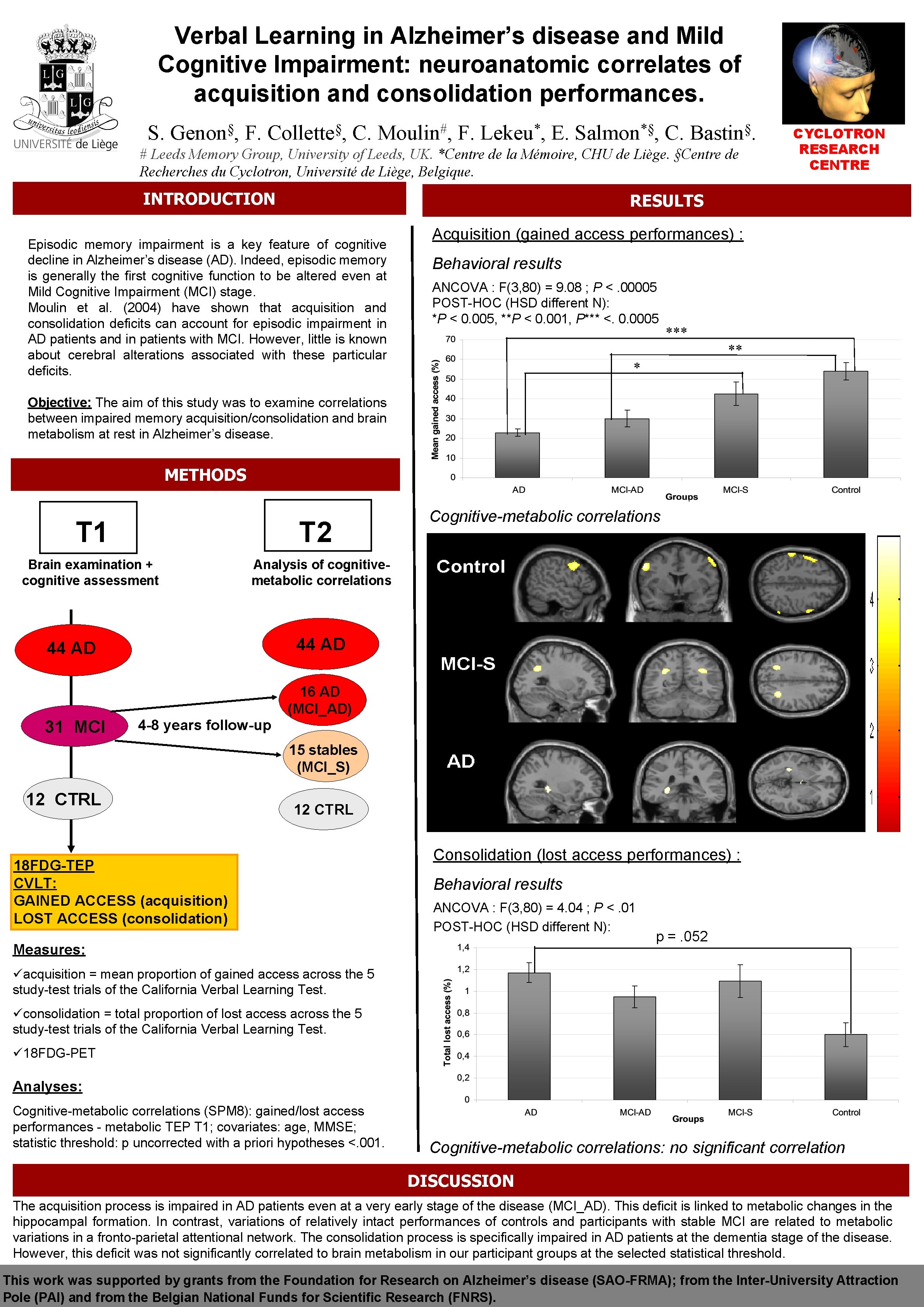
Verbal Learning in Alzheimer’s disease and Mild Cognitive Impairment: neuroanatomic correlates of acquisition and consolidation performances. S. § Genon , F. § Collette , C. # Moulin , F. * Lekeu , E. *§ Salmon , C. § Bastin. # Leeds Memory Group, University of Leeds, UK. *Centre de la Mémoire, CHU de Liège. §Centre de Recherches du Cyclotron, Université de Liège, Belgique. INTRODUCTION CYCLOTRON RESEARCH CENTRE RESULTS Episodic memory impairment is a key feature of cognitive decline in Alzheimer’s disease (AD). Indeed, episodic memory is generally the first cognitive function to be altered even at Mild Cognitive Impairment (MCI) stage. Moulin et al. (2004) have shown that acquisition and consolidation deficits can account for episodic impairment in AD patients and in patients with MCI. However, little is known about cerebral alterations associated with these particular deficits. Acquisition (gained access performances) : Behavioral results ANCOVA : F(3, 80) = 9. 08 ; P <. 00005 POST-HOC (HSD different N): *P < 0. 005, **P < 0. 001, P*** <. 0. 0005 *** ** * Objective: The aim of this study was to examine correlations between impaired memory acquisition/consolidation and brain metabolism at rest in Alzheimer’s disease. METHODS T 1 T 2 Brain examination + cognitive assessment Cognitive-metabolic correlations Analysis of cognitivemetabolic correlations 44 AD 16 AD (MCI_AD) 31 MCI 4 -8 years follow-up 15 stables (MCI_S) 12 CTRL 18 FDG-TEP CVLT: GAINED ACCESS (acquisition) LOST ACCESS (consolidation) Consolidation (lost access performances) : Behavioral results ANCOVA : F(3, 80) = 4. 04 ; P <. 01 POST-HOC (HSD different N): Measures: p =. 052 üacquisition = mean proportion of gained access across the 5 study-test trials of the California Verbal Learning Test. üconsolidation = total proportion of lost access across the 5 study-test trials of the California Verbal Learning Test. ü 18 FDG-PET Analyses: Cognitive-metabolic correlations (SPM 8): gained/lost access performances - metabolic TEP T 1; covariates: age, MMSE; statistic threshold: p uncorrected with a priori hypotheses <. 001. Cognitive-metabolic correlations: no significant correlation DISCUSSION The acquisition process is impaired in AD patients even at a very early stage of the disease (MCI_AD). This deficit is linked to metabolic changes in the hippocampal formation. In contrast, variations of relatively intact performances of controls and participants with stable MCI are related to metabolic variations in a fronto-parietal attentional network. The consolidation process is specifically impaired in AD patients at the dementia stage of the disease. However, this deficit was not significantly correlated to brain metabolism in our participant groups at the selected statistical threshold. This work was supported by grants from the Foundation for Research on Alzheimer’s disease (SAO-FRMA); from the Inter-University Attraction Pole (PAI) and from the Belgian National Funds for Scientific Research (FNRS).
- Slides: 1