
Verbal Deescalation Techniques Grace Park Elementary School Emotional
Verbal De-escalation Techniques Grace Park Elementary School Emotional Support Mike Pagano
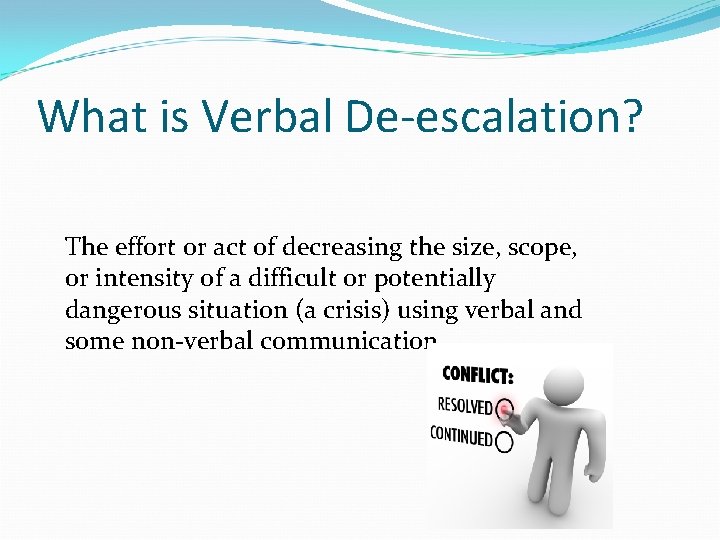
What is Verbal De-escalation? The effort or act of decreasing the size, scope, or intensity of a difficult or potentially dangerous situation (a crisis) using verbal and some non-verbal communication.
A Crisis Situation? What constitutes a crisis? This is any situation that leads to, or is expected to lead to, an unstable/dangerous situation that affects an individual or a group. What does this mean for us? This leads to concerns about safety for our students, our staff, and possibly others.

A Crisis Situation? How does a crisis develop? 4 Stages: Prodromal- cues that a crisis may be close at hand. Crisis Breakout- the event (trigger) that causes the crisis to happen. Chronic- the lingering effects of the crisis. Resolution- crisis is no longer a concern.
Behavioral Cues Verbal: What is being said Para-verbal: How something is expressed Volume of speech- loud or quiet Rapid speech Not talking- silent Who is being addressed- Self, others, imaginary person.

Behavioral Cues Physical Cues: What are they doing? Pacing Fidgeting Yelling Cursing Name Calling Posturing Sweating
De-Escalation Techniques To be used during a potential crisis or escalated anger situation in an attempt to prevent; harm, damage, or further escalation. This is NOT: A teaching opportunity (although it is a chance to learn) A guarantee that the bad behavior will cease Something that you will only ever have to do once.
Techniques Three main factors to consider when confronted with a de-escalation situation Self control – being aware of your own responses Physical presence – stance, distance, position. The de-escalating conversation- the strategies you employ
Techniques: Self-Control Appear calm, centered, and self-assured - even if you don’t feel it Anxiety can make the student feel anxious and unsafe which can escalate aggression Use a modulated, low, monotonous tone of voice Do not be defensive Even if the comments or insults are directed at you, they are not about you Be respectful even when firmly setting limits or calling for help The agitated person is still sensitive to feeling shamed and disrespected
Techniques: Stance Try not to turn you back. Try to position yourself between door and the individualallow for about 3 -5 feet of space between. But don’t prevent egression Stay at the same eye level Encourage a seated position, but if they stand you should be standing too. Stand at an angle- incase you need to side step. Control eye contact Allow yourself and the individual to look down or away for a moment.
Techniques: Stance Be aware of facial expressions: Smiling, eye-rolling, etc. Try not to touch- This can be misinterpreted by an agitated person Don’t point your finger Give choices and empower the individual: Phrases like “ would your rather_____? ” OR “which sounds better to you _____ or _____? ”
Techniques: Conversation Always remember that the intent is to calmly bring level of arousal to a safer place (from a red zone to a green zone) Do not try to be louder or yell over the individual Wait until they take a breath, then talk. Speak calmly and at an average volume. Selective responses are your friend! Answer informational questions, even if asked rudely. Do NOT answer abusive questions.
Techniques: Conversation Explain limits and rules in a firm but respectful tone Set choices where possible, fix so that both options are safe ones. Empathize with feelings, but NOT with behaviors. “It’s ok to be angry, but not mean” Do not argue, and avoid power struggle. Suggest Alternative behaviors when appropriate. Explain consequences of inapropria- but do so without threats or anger. “I’ll wait until your done yelling at me to continue this conversation”
What to avoid… T. A. C. O. S If Goal is to de-escalate, Do Not: Threaten the individual Argue or contradict the individual Challenge the individual Order or command the individual Shame or disrespect the individual
Proximity as a Behavior Strategy What? Proximity control is a frequently used strategy where the teacher (or other adults in the room) make a meaningful effort to be physically close to problem areas or a target student. Research has shown that the mere physical presence of a teacher/adult does have an impact on student behavior and attention.
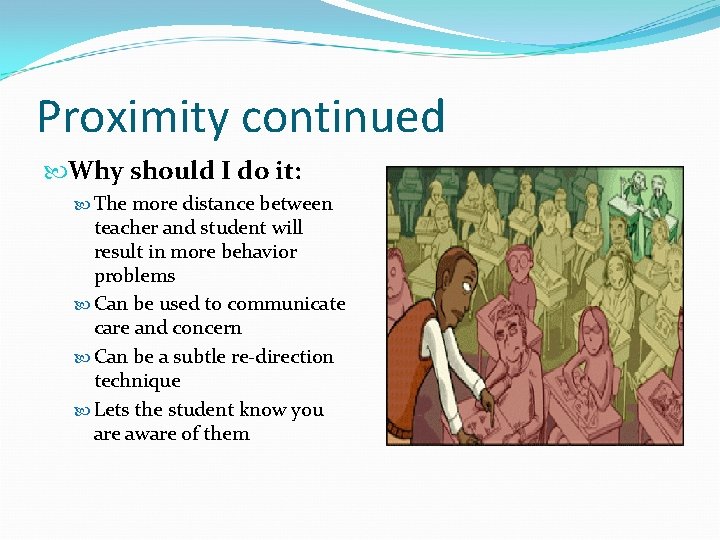
Proximity continued Why should I do it: The more distance between teacher and student will result in more behavior problems Can be used to communicate care and concern Can be a subtle re-direction technique Lets the student know you are aware of them
Proximity continued When should I do it: When a student gets off task When you know a student has the ability to lose focus often When a student is showing signs of disruption but hasn’t become problematic yet
Proximity continued How do I do it: Pay attention to your natural movements and determine areas you can change your style to increase proximity to many students at once When giving directions, maintain proximity to at risk students Refrain from giving instructions the same way every time Vary your teaching that will allow you to walk around the classroom Place a student close to you in seating arrangements “Proximity control can work to manage some behavior if it is used preventively or early. The main idea behind this technique is to put a teacher in close proximity to students who are showing signs of getting off task. If you know that a student is likely to disrupt class, standing or sitting close to them while you lead an activity or give directions will quell a fair amount of the unwanted behavior. ”
Remember You are better at this than you may think! Trust your instincts You will know fairly quickly if your efforts are working SAFETY is always # 1 concern for everyone involved.
- Slides: 19