
Verbal DeEscalation For DCS Contracted Service Providers 1
Verbal De-Escalation For DCS Contracted Service Providers 1
Course Competencies At the end of this course, participants will be able to: 1. Acknowledge one’s own Conflict Management Style 2. Recognize the Stages of Escalation, and common triggers of agitation and aggression 3. Intervene with escalating clients using verbal de-escalation techniques. 2
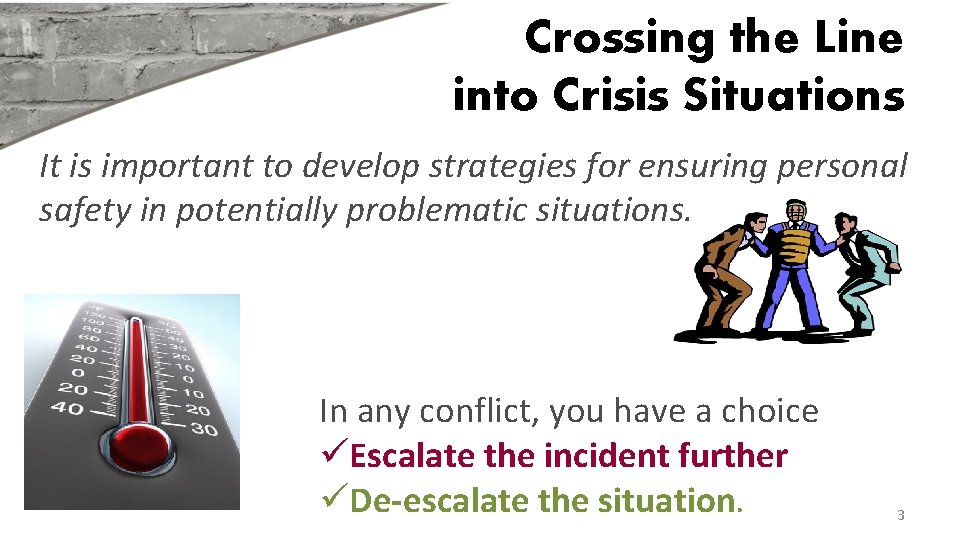
Crossing the Line into Crisis Situations It is important to develop strategies for ensuring personal safety in potentially problematic situations. In any conflict, you have a choice üEscalate the incident further üDe-escalate the situation. 3
How do you manage conflict? Personal strategy for managing conflict: • Is learned in childhood • Functions automatically • Defaults to doing what comes naturally Your safety may depend on your conflict management style. 4
Your Personal Conflict Management Style Activity 1. Access the University of Minnesota’s Department of Family Social Science website: http: //www. cehd. umn. edu/fsos/projects/ruralmnlife/conf lict. asp 2. Take the Conflict Management Styles Assessment 3. Watch the Interpreting Conflict Management Styles Assessment video *The next slide shows which links to click on for the assessment and video 5
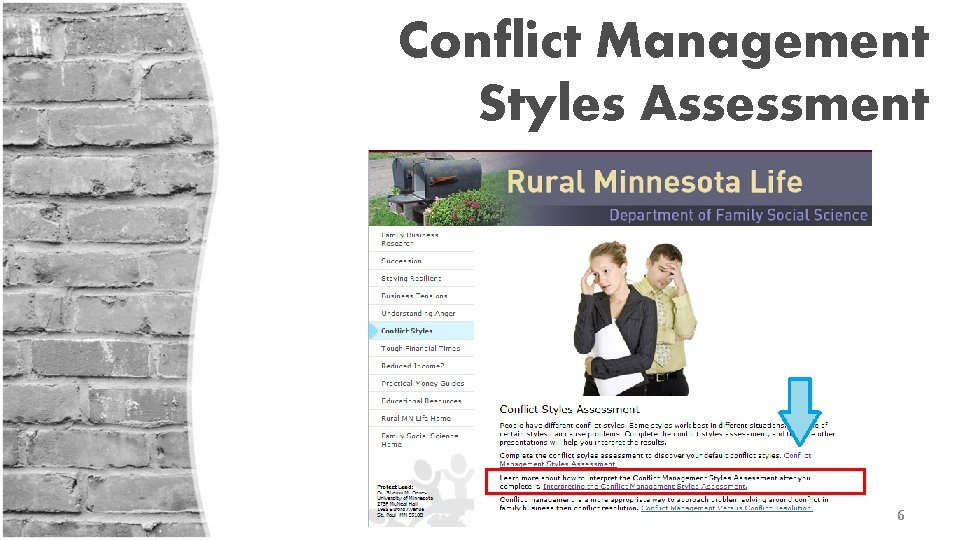
Conflict Management Styles Assessment 6
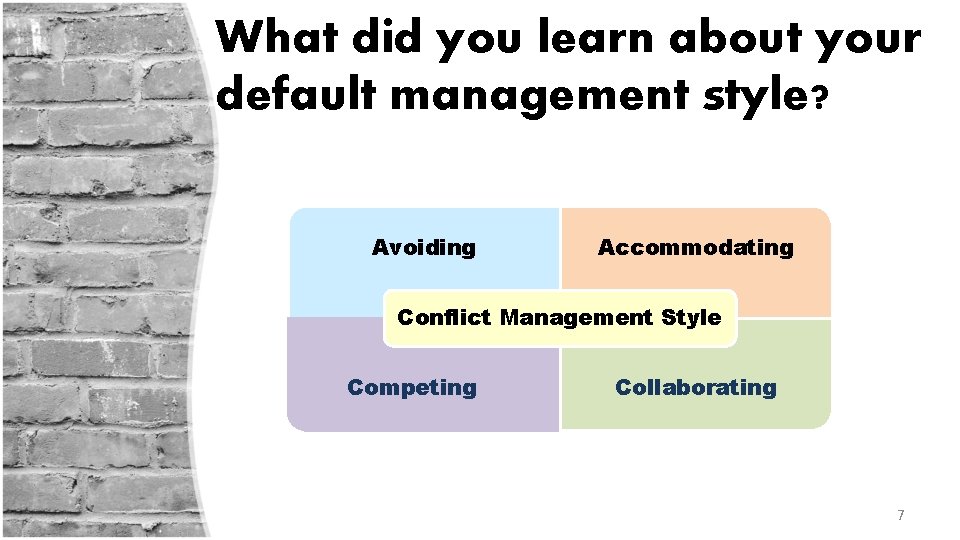
What did you learn about your default management style? Avoiding Accommodating Conflict Management Style Competing Collaborating 7
Reflection Question What efforts might you need to make to adjust your default Conflict Management style in order to engage clients? 8
7 Stages of Behavior Escalation 1. Calm – Person relatively calm / cooperative. 2. Trigger - Person experiences unresolved conflicts. This triggers the person’s behavior to escalate. 3. Agitation – Person increasingly unfocused / upset. 4. Acceleration - Conflict remains unresolved. Person FOCUSES on the conflict. 5. Peak - Person out of control / exhibits severe behavior. 6. De-escalation – Vents in the peak stage, person displays confusion. Severity of peak behavior subsides. 7. Recovery - Person displays willingness to participate in activities. Colvin, G. , & Sugai, G. (1989). Understanding and Managing Escalating Behavior (ppt). Retrieved 22 January 2012 from http: //www. pbis. org/common/pbisresources.
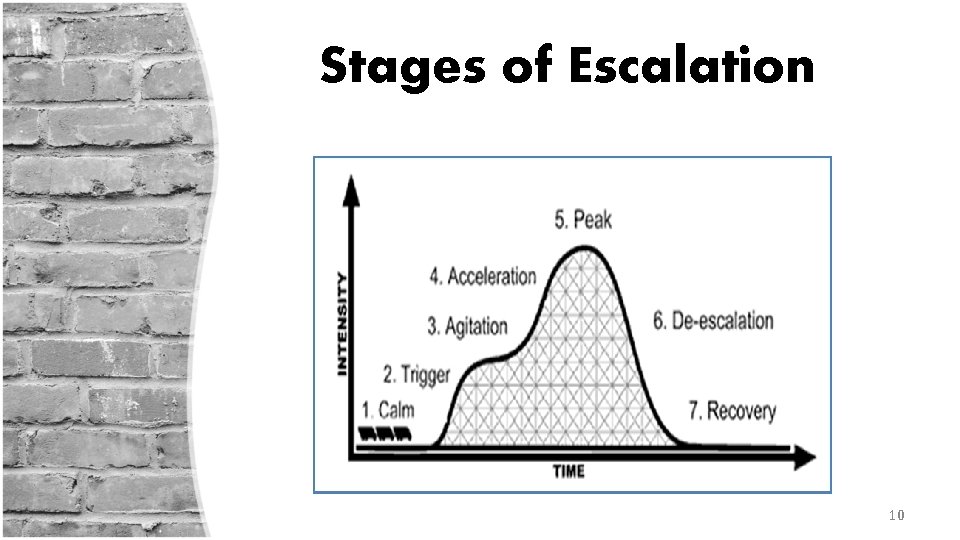
Stages of Escalation 10
Traits and Factors That May Trigger Aggression • • Psychiatric illness Substance abuse Prior history of violence Highly stressful situations – – – Removal of children Involvement with DCS Court proceedings Compliance with services Termination of parental rights • Ages 15 -40, esp. males • Certain feelings – – – Powerlessness Fear Grief Feeling of injustice Boredom Humiliation • Access to weapons • Physical disability or chronic pain • Personal history of child abuse 11
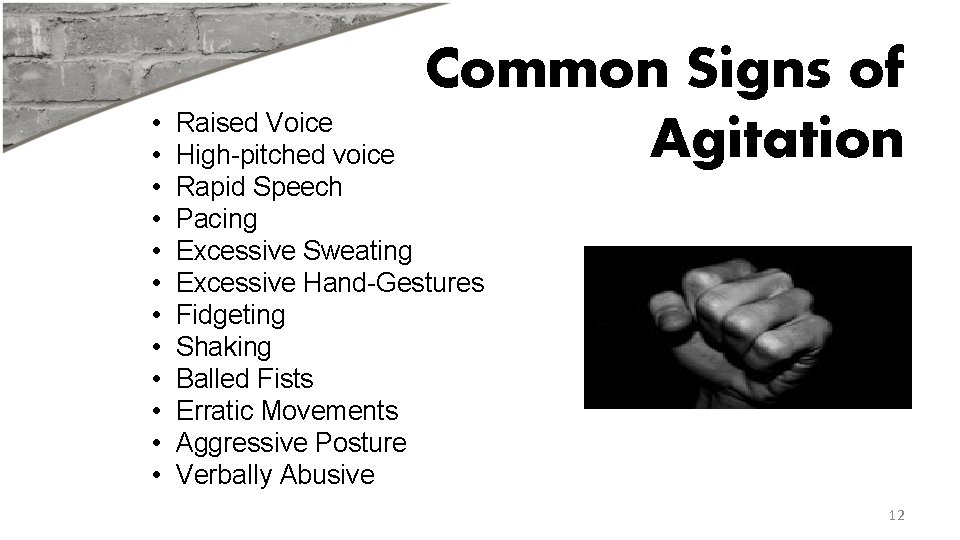
• • • Common Signs of Agitation Raised Voice High-pitched voice Rapid Speech Pacing Excessive Sweating Excessive Hand-Gestures Fidgeting Shaking Balled Fists Erratic Movements Aggressive Posture Verbally Abusive 12
What is Verbal De-escalation? Verbal De-Escalation is an intervention for use with people who are at risk for aggression. It is basically using calm language, along with other communication techniques, to diffuse, redirect, or de-escalate a conflicting situation. Mary M. Kerr & C. M. Nelson: Strategies for Addressing Behavior Problems in the Classroom, 2010. 13
Physical Force in De-Escalation Never consider the use of physical force as your first response. • Physical force is a last resort to prevent injury to yourself or to another person. • Use of physical force usually results in someone (you? ) getting hurt. 14
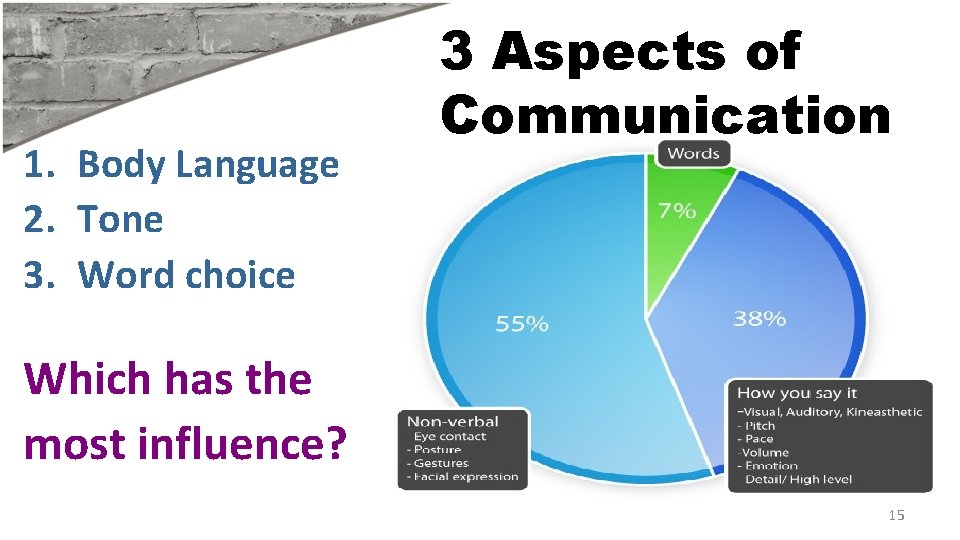
1. Body Language 2. Tone 3. Word choice 3 Aspects of Communication Which has the most influence? 15
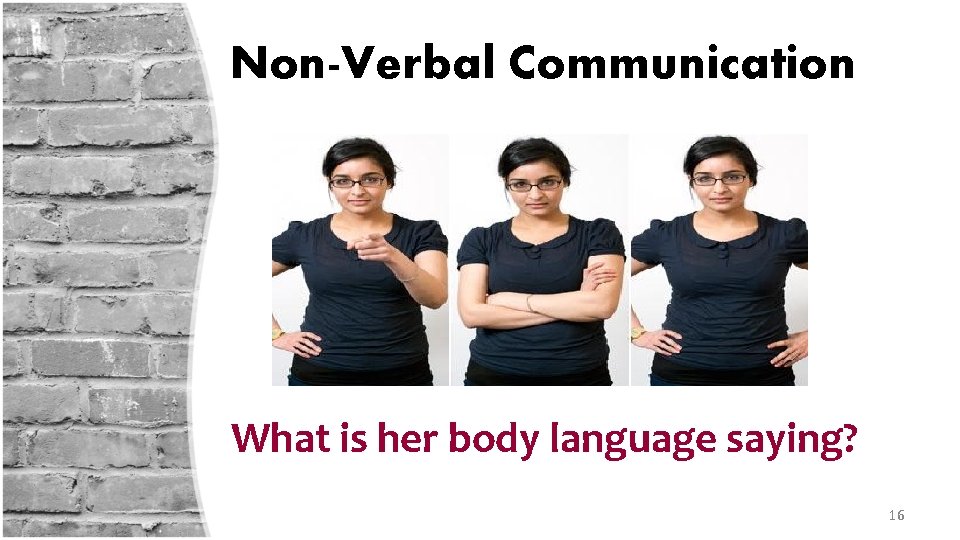
Non-Verbal Communication What is her body language saying? 16
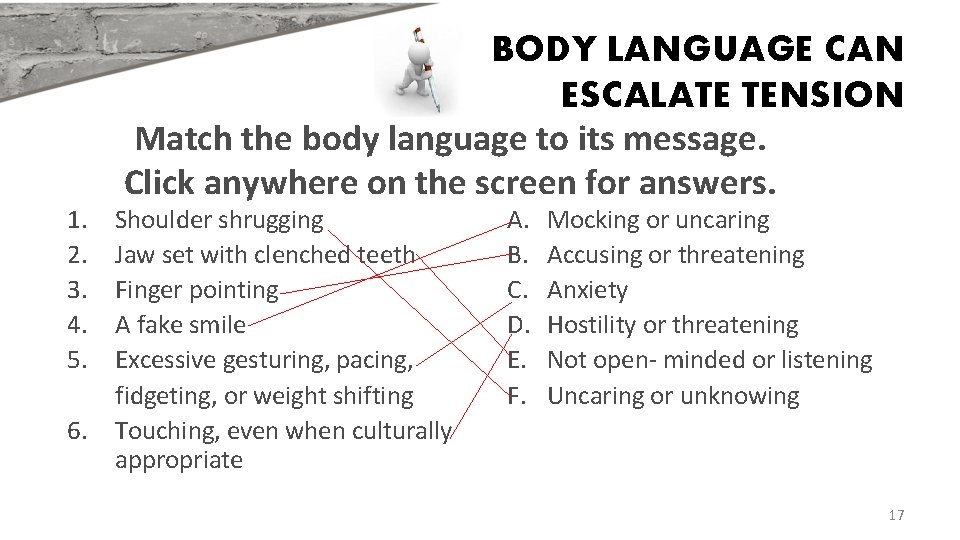
BODY LANGUAGE CAN ESCALATE TENSION Match the body language to its message. Click anywhere on the screen for answers. 1. Shoulder shrugging 2. Jaw set with clenched teeth 3. Finger pointing 4. A fake smile 5. Excessive gesturing, pacing, fidgeting, or weight shifting 6. Touching, even when culturally appropriate A. B. C. D. E. F. Mocking or uncaring Accusing or threatening Anxiety Hostility or threatening Not open- minded or listening Uncaring or unknowing 17
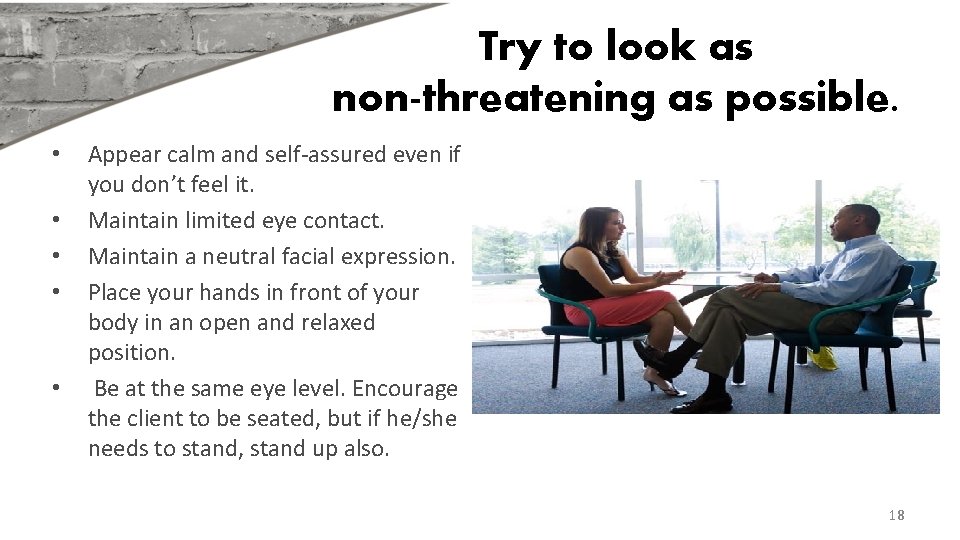
Try to look as non-threatening as possible. • • • Appear calm and self-assured even if you don’t feel it. Maintain limited eye contact. Maintain a neutral facial expression. Place your hands in front of your body in an open and relaxed position. Be at the same eye level. Encourage the client to be seated, but if he/she needs to stand, stand up also. 18
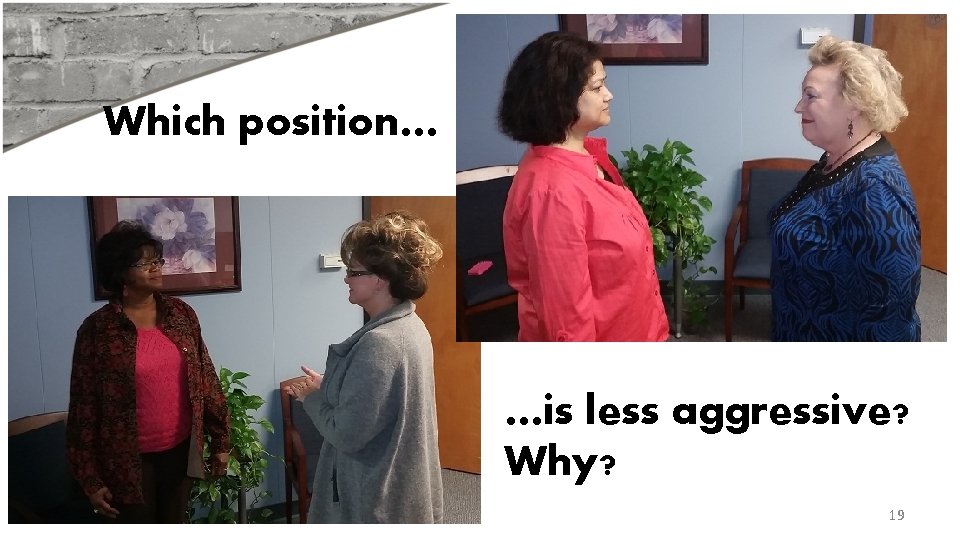
Which position… …is less aggressive? Why? 19
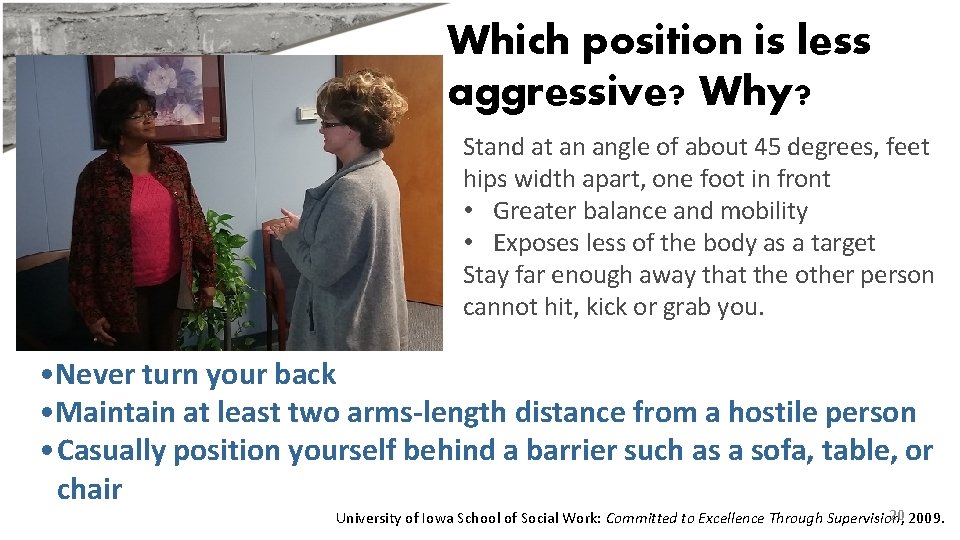
Which position is less aggressive? Why? Stand at an angle of about 45 degrees, feet hips width apart, one foot in front • Greater balance and mobility • Exposes less of the body as a target Stay far enough away that the other person cannot hit, kick or grab you. • Never turn your back • Maintain at least two arms-length distance from a hostile person • Casually position yourself behind a barrier such as a sofa, table, or chair 20 University of Iowa School of Social Work: Committed to Excellence Through Supervision, 2009.
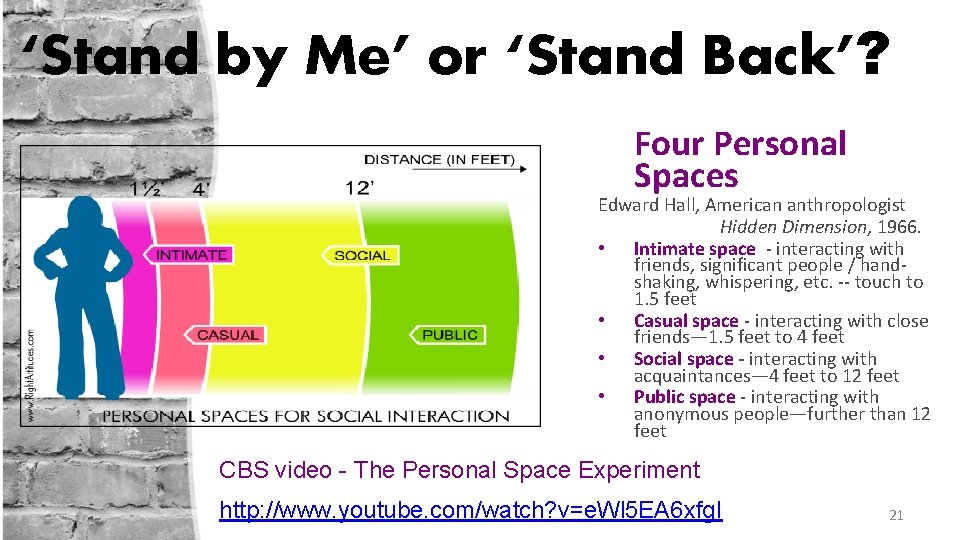
‘Stand by Me’ or ‘Stand Back’? Four Personal Spaces Edward Hall, American anthropologist Hidden Dimension, 1966. • Intimate space - interacting with friends, significant people / handshaking, whispering, etc. -- touch to 1. 5 feet • Casual space - interacting with close friends— 1. 5 feet to 4 feet • Social space - interacting with acquaintances— 4 feet to 12 feet • Public space - interacting with anonymous people—further than 12 feet CBS video - The Personal Space Experiment http: //www. youtube. com/watch? v=e. Wl 5 EA 6 xfg. I 21
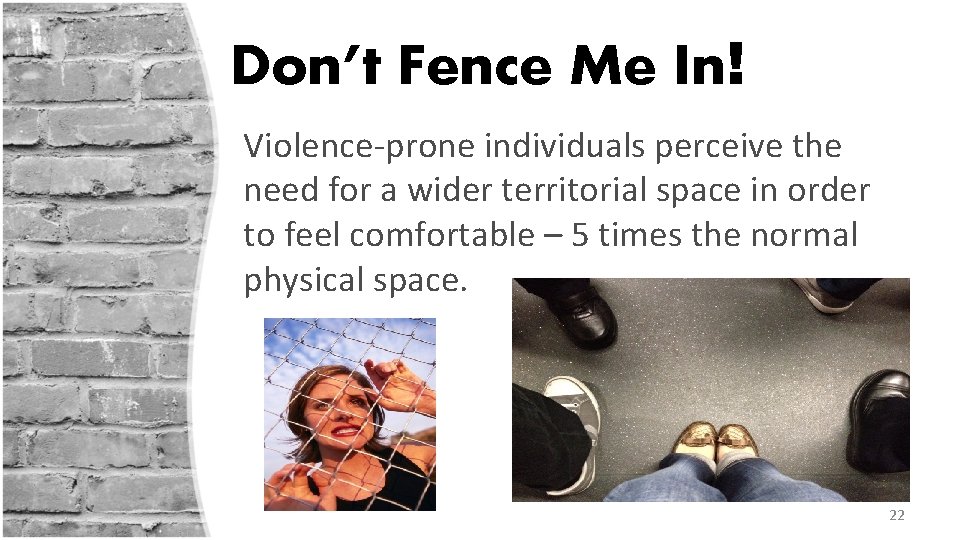
Don’t Fence Me In! Violence-prone individuals perceive the need for a wider territorial space in order to feel comfortable – 5 times the normal physical space. 22
Reflection Question How might you feel when another person (client, family member, etc. ) has different spatial boundaries than you do? How will you address your own spatial boundaries? 23
It’s not what you say, but how you say it. Tone expresses speaker’s feelings or attitudes. Listener interprets speaker’s message through tone. 38% of communication depends on tone Try it! Say the following sentence with different tones. “You made it here on time!” 1. in a suspicious tone 2. in a happy tone 3. in a patronizing tone 4. in an irritable tone 24
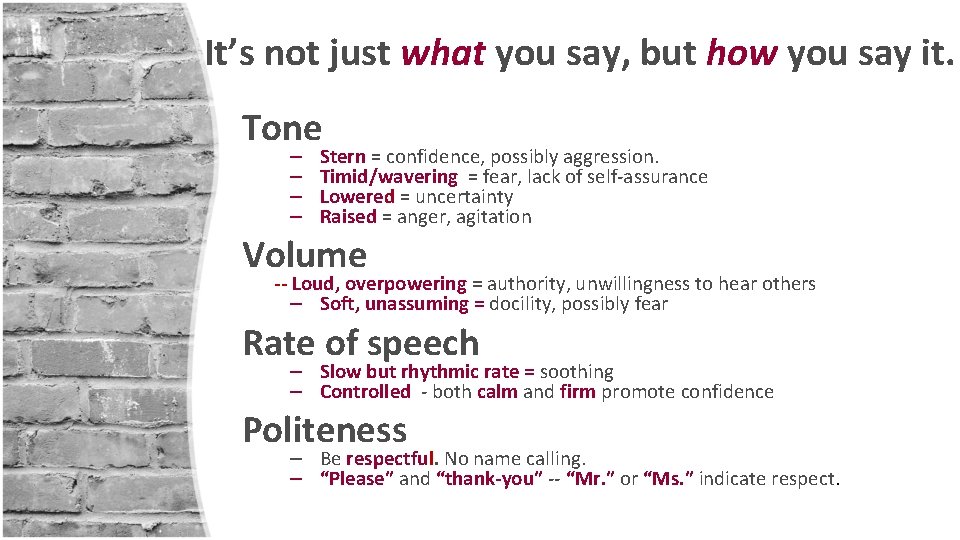
It’s not just what you say, but how you say it. Tone – – Stern = confidence, possibly aggression. Timid/wavering = fear, lack of self-assurance Lowered = uncertainty Raised = anger, agitation Volume -- Loud, overpowering = authority, unwillingness to hear others – Soft, unassuming = docility, possibly fear Rate of speech – Slow but rhythmic rate = soothing – Controlled - both calm and firm promote confidence Politeness – Be respectful. No name calling. – “Please” and “thank-you” -- “Mr. ” or “Ms. ” indicate respect.
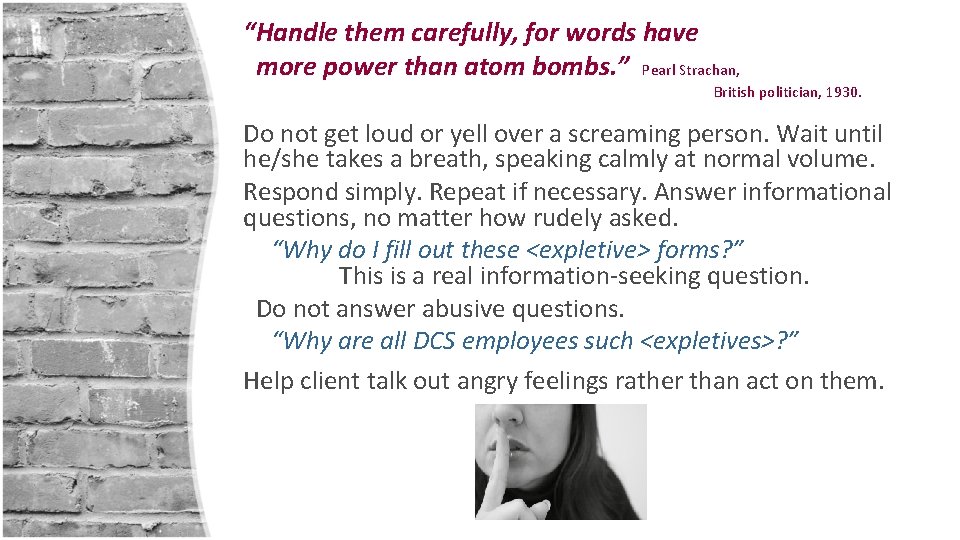
“Handle them carefully, for words have more power than atom bombs. ” Pearl Strachan, British politician, 1930. Do not get loud or yell over a screaming person. Wait until he/she takes a breath, speaking calmly at normal volume. Respond simply. Repeat if necessary. Answer informational questions, no matter how rudely asked. “Why do I fill out these <expletive> forms? ” This is a real information-seeking question. Do not answer abusive questions. “Why are all DCS employees such <expletives>? ” Help client talk out angry feelings rather than act on them.
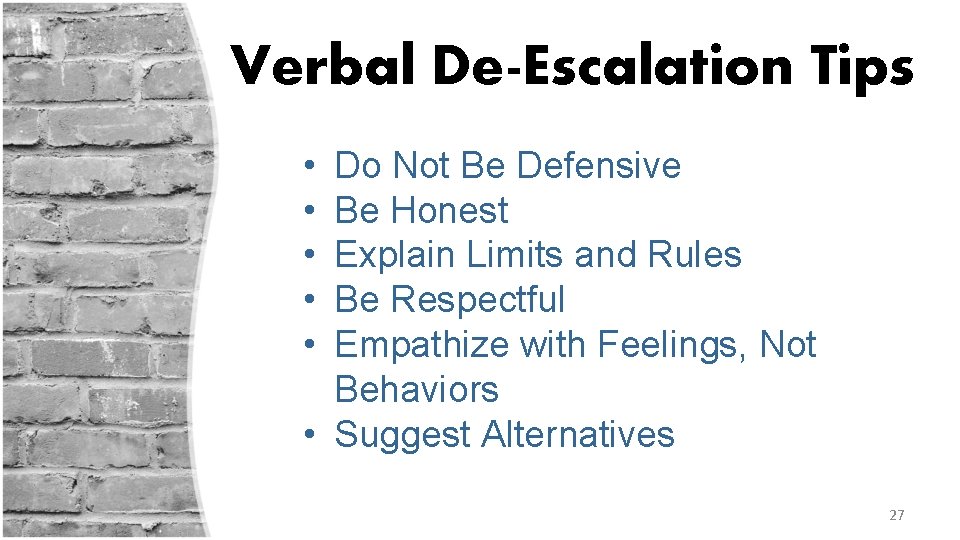
Verbal De-Escalation Tips • • • Do Not Be Defensive Be Honest Explain Limits and Rules Be Respectful Empathize with Feelings, Not Behaviors • Suggest Alternatives 27
The First and Only De-Escalation Objective Reduce the level of anxiety to encourage the possibility for discussion. Reasoning with an enraged person is not possible. 28
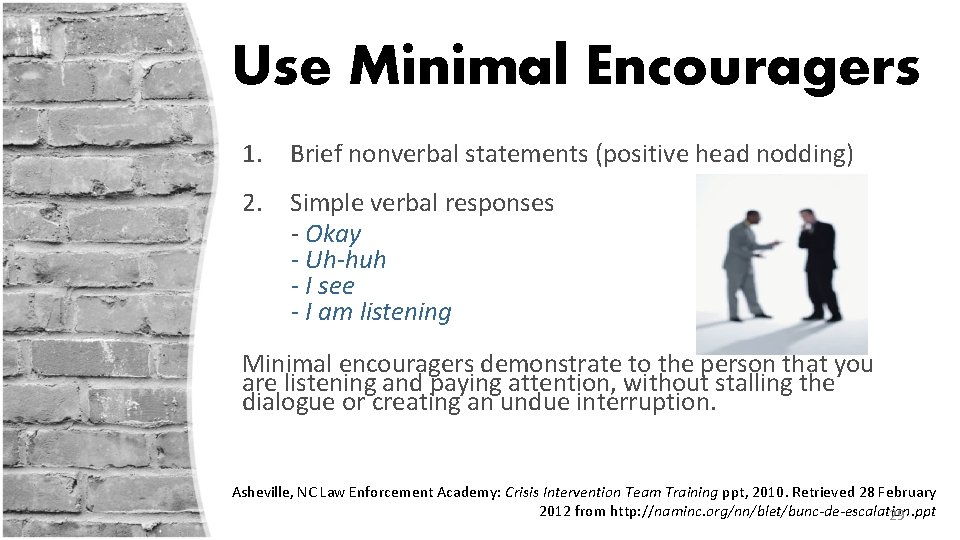
Use Minimal Encouragers 1. Brief nonverbal statements (positive head nodding) 2. Simple verbal responses - Okay - Uh-huh - I see - I am listening Minimal encouragers demonstrate to the person that you are listening and paying attention, without stalling the dialogue or creating an undue interruption. Asheville, NC Law Enforcement Academy: Crisis Intervention Team Training ppt, 2010. Retrieved 28 February 2012 from http: //naminc. org/nn/blet/bunc-de-escalation. ppt 29
Demonstrate Reflecting Show evidence of active listening by repeating what the person has said. These statements should be brief. Do not interrupt the agitated person. 30
Open-Ended Questions • Use phrases like ‘Tell me about’ or ‘What do you think’ • Allow you to get more information • Allow you to assess whether the situation is potentially dangerous to you • Allow you to assess whether the person is rational 31
Reflection Question Can you think of a time when someone supported you by asking these types of questions? 32
Verbal De-Escalation Thank you for participating! 33
- Slides: 33