
Verb to be is are am Kaka is
Verb to be (is, are, am) Kaka ____is_____ a soccer player. He ___is_ an � ﺗﺴﺘﺨﺪﻡ ﻟﻠﻤﻔﺮﺩ attacking midfielder Angelina Jolie and Brad Pitt __are__ both American. � In your opinion, _are_ they a perfect couple? � � ﺗﺴﺘﺨﺪﻡ ﻟﻠﺠﻤﻊ � ﺍﻟﻤﺴﺎﻓﺮﺓ
Subject Verb Agreement, Going ﺗﻌﺎﻣﻞ ﻣﻌﺎﻣﻠﺔ ﺍﻟﻤﻔﺮﺩ Everyone) isgoing to the park. � ﺍﻟﻔﻌﻞ Tonight, R(is/arealph and I (is/are) hanging out. � ﻫﻨﺎ ﺟﻤﻊ (Is/Are) the jury going to decide on the case � ﺟﻮﺭﻱ ﻣﻔﺮﺩ ﻧﺴﺘﺨﺪﻡ tomorrow? is Should we watch the news for three (hour/hours) or � not? � ﺍﻟﻤﺴﺎﻓﺮﺓ
Preposition of Place, The teacher is writing_ on _ the blackboard. � I am a student ___ at __ king Faisal University � ﺍﻟﻤﺴﺎﻓﺮﺓ �
Using Have, Has, Had we ﺟﻤﻊ We ___ have ___ a beautiful house. = � She ﻣﻔﺮﺩ She __has_____ a very good English accent. � ﻣﻨﺬ ﻋﺎﻣﻴﻦ ﺍﺫﺍ ﻫﻴﺎ I __had____ a classic car two years ago. � ﻣﺎﺿﻲ � ﺍﻟﻤﺴﺎﻓﺮﺓ
Verb to be (is, are, am) Kaka ____is_____ a soccer player. He ___is_ an � ﺗﺴﺘﺨﺪﻡ ﻟﻠﻤﻔﺮﺩ attacking midfielder Angelina Jolie and Brad Pitt __are__ both American. � In your opinion, _are_ they a perfect couple? � � ﺗﺴﺘﺨﺪﻡ ﻟﻠﺠﻤﻊ � ﺍﻟﻤﺴﺎﻓﺮﺓ
ﺍﻟﻤﺴﺢ ﻭﺍﻟﻘﺸﻂ SCANNING & SKIMMING Skimming refers to the process of reading only main � ideas within a passage to get an overall impression of the content of a reading selection. Scanning is a reading technique to be used when you � want to find specific information quickly. In scanning you have a question in your mind and you read a passage only to find the answer, ignoring unrelated mation.
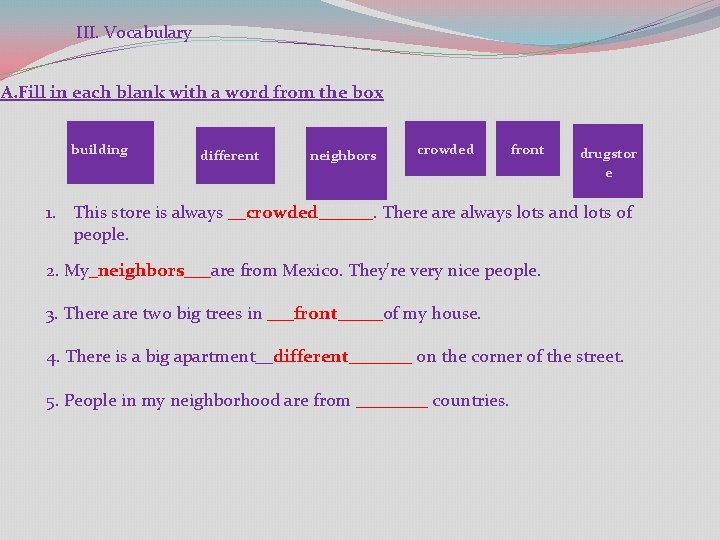
III. Vocabulary A. Fill in each blank with a word from the box building different neighbors crowded front drugstor e 1. This store is always __crowded______. There always lots and lots of people. 2. My_neighbors___are from Mexico. They're very nice people. 3. There are two big trees in ___front_____of my house. 4. There is a big apartment__different_______ on the corner of the street. 5. People in my neighborhood are from ____ countries.
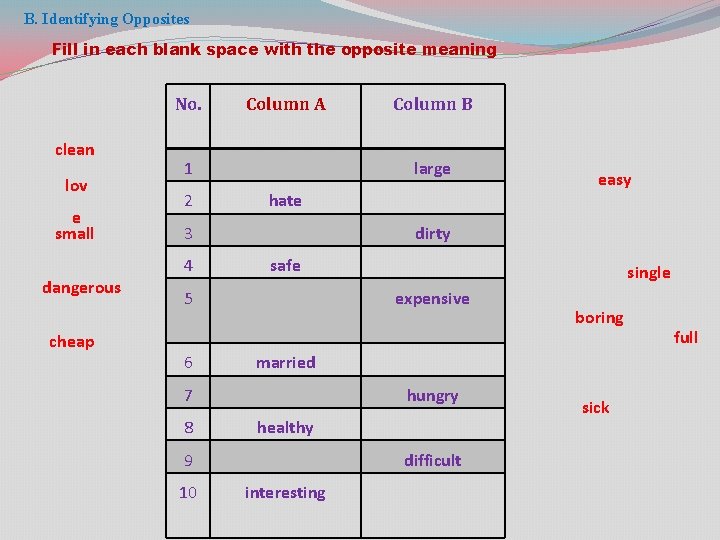
B. Identifying Opposites Fill in each blank space with the opposite meaning No. clean lov e small dangerous cheap Column A 1 2 large hate 3 4 safe boring married hungry healthy 9 10 single expensive 7 8 easy dirty 5 6 Column B difficult interesting sick full
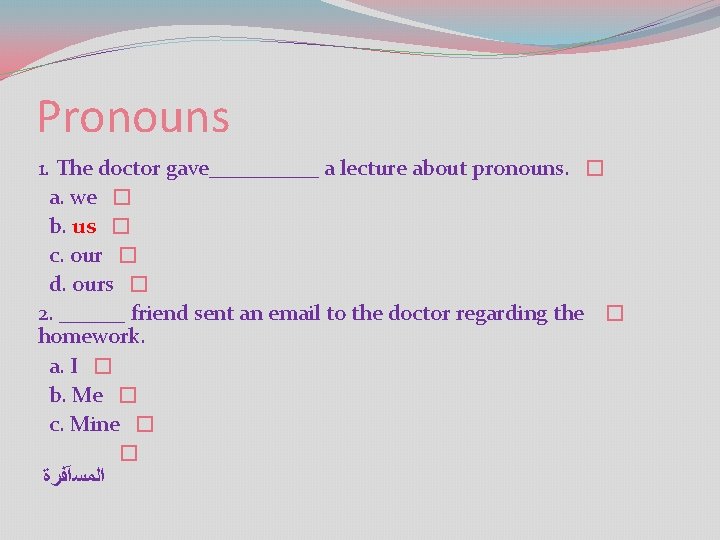
Pronouns 1. The doctor gave_____ a lecture about pronouns. � a. we � b. us � c. our � d. ours � 2. ______ friend sent an email to the doctor regarding the � homework. a. I � b. Me � c. Mine � � ﺍﻟﻤﺴآﻔﺮﺓ
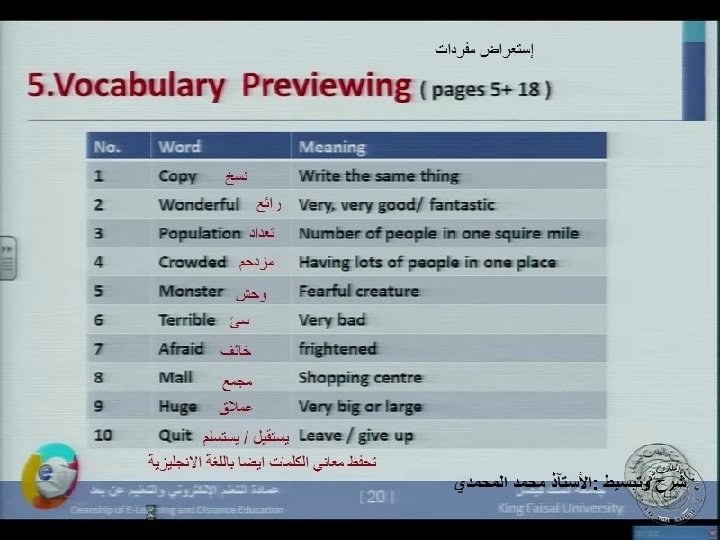
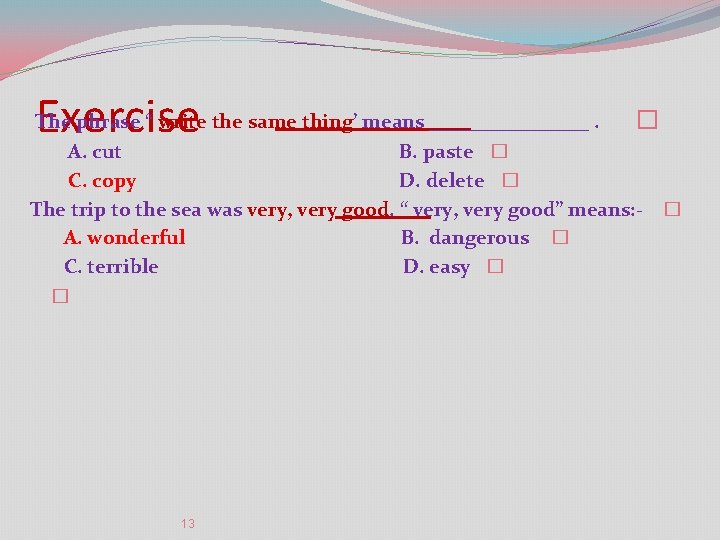
Exercise The phrase “ write the same thing’ means ________. � A. cut B. paste � C. copy D. delete � The trip to the sea was very, very good. “ very, very good” means: - � A. wonderful B. dangerous � C. terrible D. easy � � 13
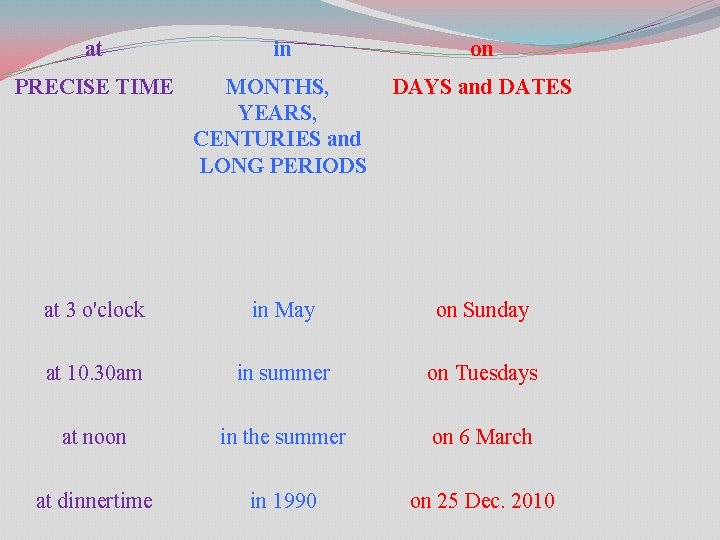
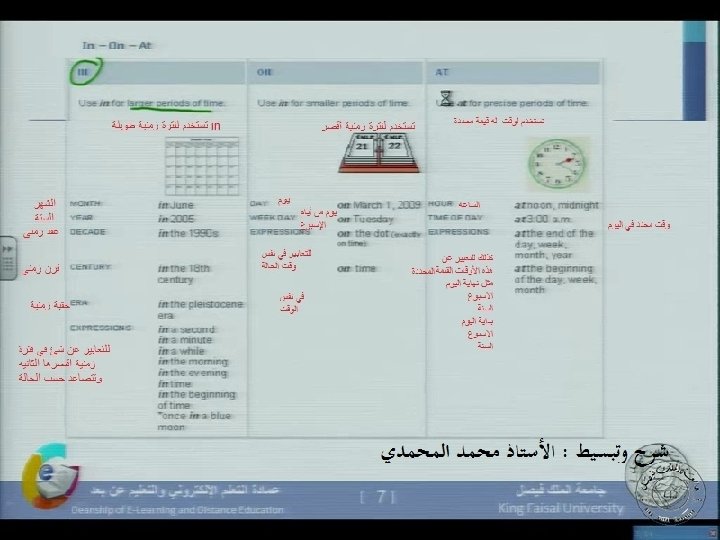
at in on PRECISE TIME MONTHS, YEARS, CENTURIES and LONG PERIODS DAYS and DATES at 3 o'clock in May on Sunday at 10. 30 am in summer on Tuesdays at noon in the summer on 6 March at dinnertime in 1990 on 25 Dec. 2010
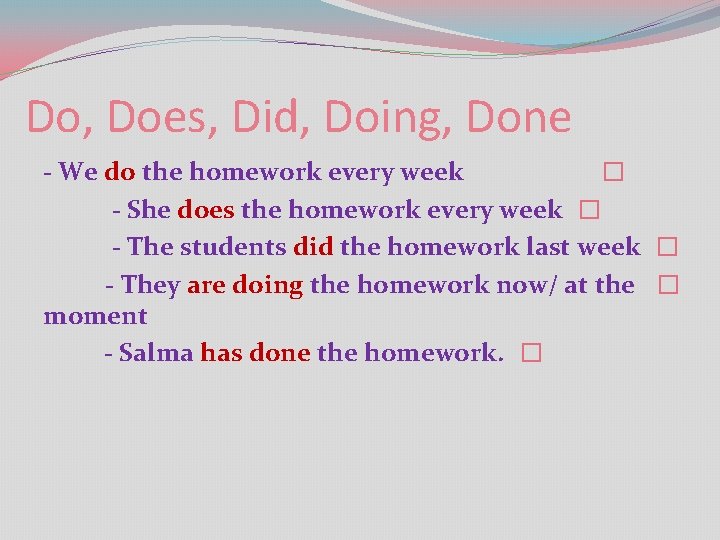
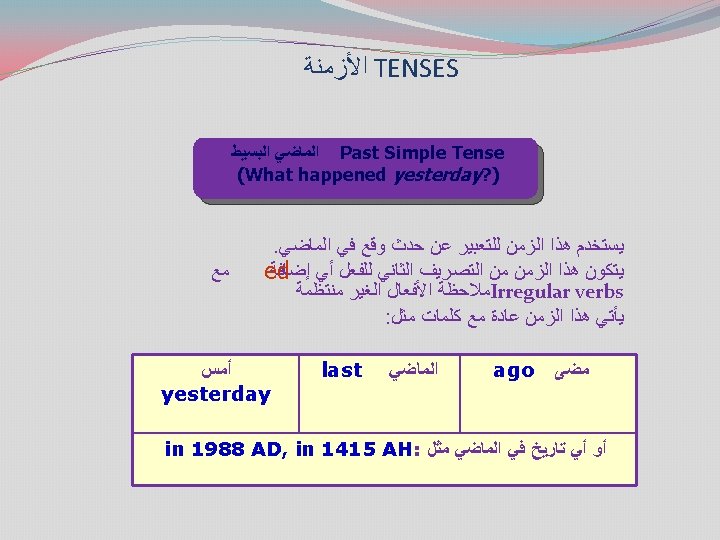
Do, Does, Did, Doing, Done - We do the homework every week � - She does the homework every week � - The students did the homework last week � - They are doing the homework now/ at the � moment - Salma has done the homework. �
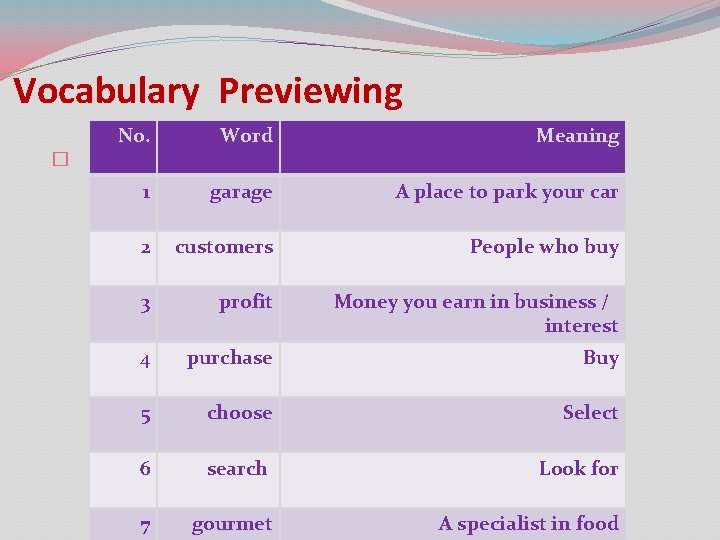
Vocabulary Previewing No. Word Meaning 1 garage A place to park your car 2 customers People who buy 3 profit Money you earn in business / interest 4 purchase Buy 5 choose Select 6 search Look for 7 gourmet A specialist in food �
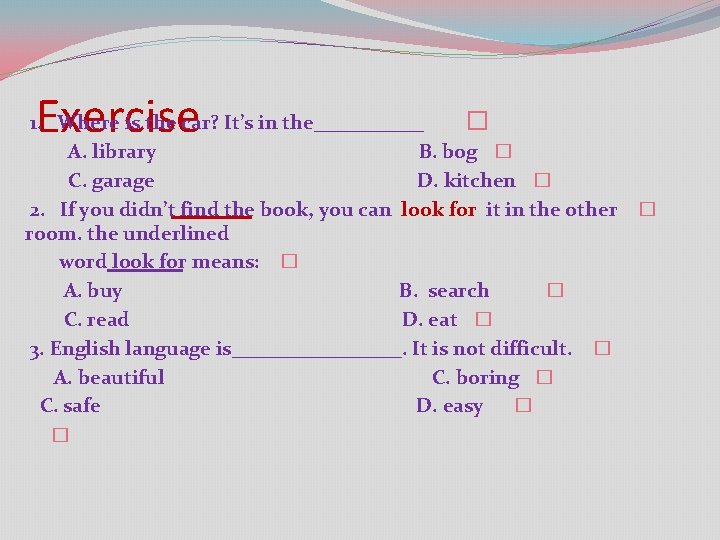
Exercise 1. Where is the car? It’s in the______ � A. library B. bog � C. garage D. kitchen � 2. If you didn’t find the book, you can look for it in the other � room. the underlined word look for means: � A. buy B. search � C. read D. eat � 3. English language is_________. It is not difficult. � A. beautiful C. boring � C. safe D. easy � �
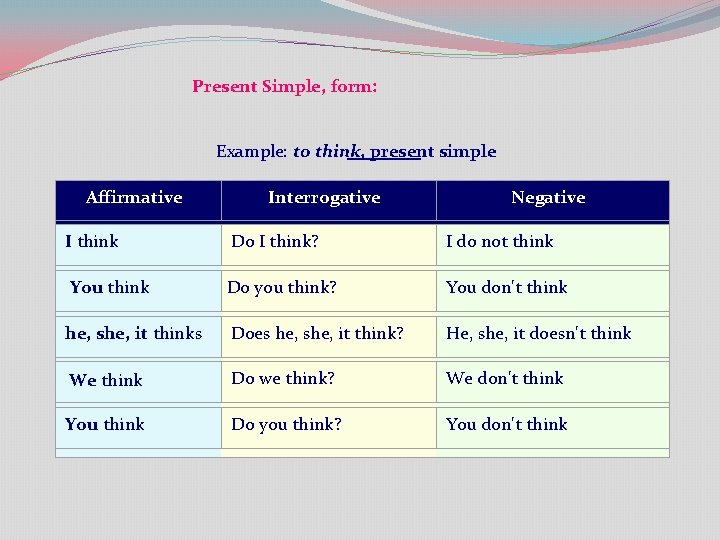
Present Simple, form: Example: to think, present simple Affirmative Interrogative Negative I think Do I think? I do not think You think Do you think? You don't think he, she, it thinks Does he, she, it think? He, she, it doesn't think We think Do we think? We don't think You think Do you think? You don't think
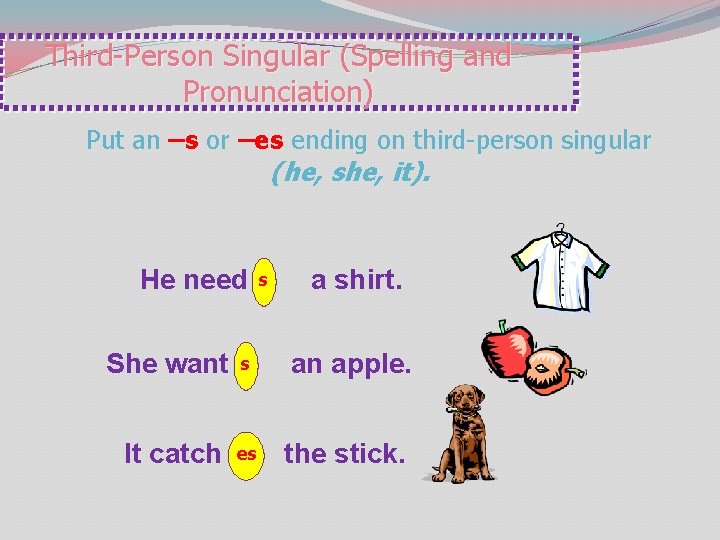
Third-Person Singular (Spelling and Pronunciation) Put an –s or –es ending on third-person singular (he, she, it). He need She want It catch s es s a shirt. an apple. the stick.
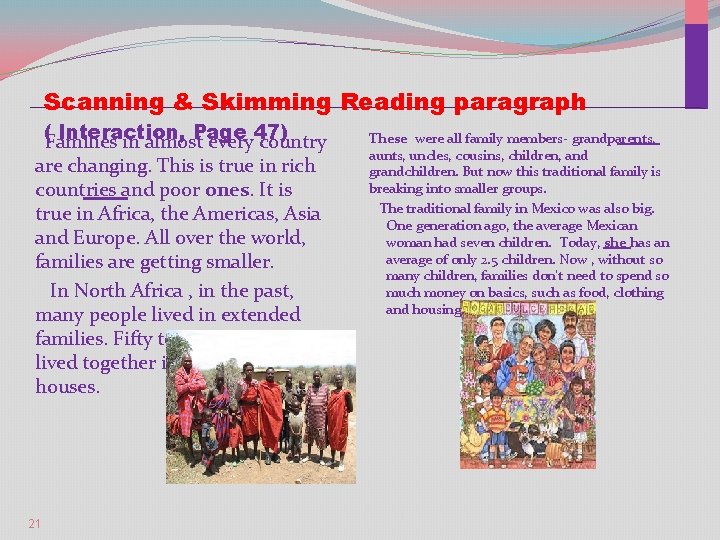
Scanning & Skimming Reading paragraph Interaction, Page 47) (Families in almost every country are changing. This is true in rich countries and poor ones. It is true in Africa, the Americas, Asia and Europe. All over the world, families are getting smaller. In North Africa , in the past, many people lived in extended families. Fifty to hundred people lived together in a group of houses. These were all family members- grandparents, aunts, uncles, cousins, children, and grandchildren. But now this traditional family is breaking into smaller groups. The traditional family in Mexico was also big. One generation ago, the average Mexican woman had seven children. Today, she has an average of only 2. 5 children. Now , without so many children, families don’t need to spend so much money on basics, such as food, clothing and housing. 21 [ ]
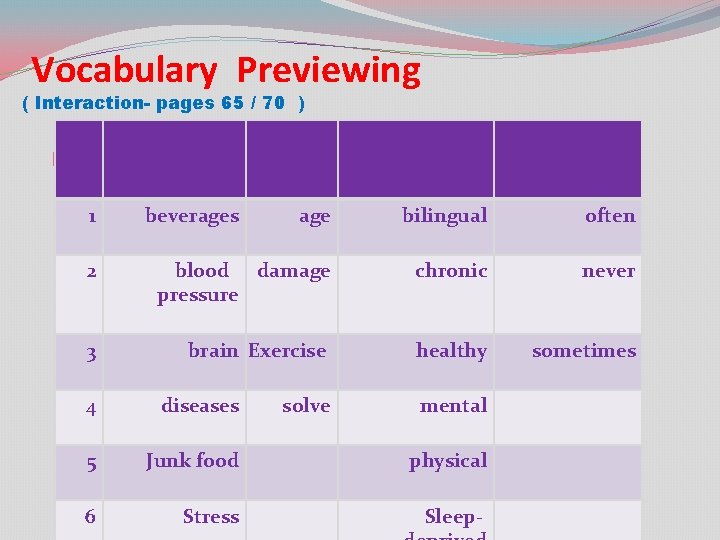
Vocabulary Previewing ( Interaction- pages 65 / 70 ) No. � Nouns Verbs Adjectives Adverbs 1 beverages age bilingual often 2 blood damage pressure chronic never 3 brain Exercise healthy sometimes 4 diseases 5 Junk food physical Stress Sleep- 6 22 solve mental
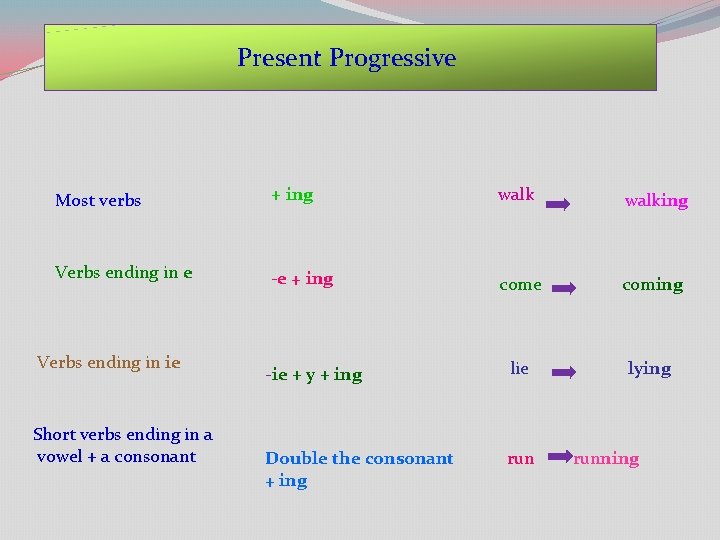
Present Progressive Most verbs + ing walking Verbs ending in e -e + ing come coming -ie + y + ing lie lying Double the consonant + ing run Verbs ending in ie Short verbs ending in a vowel + a consonant running
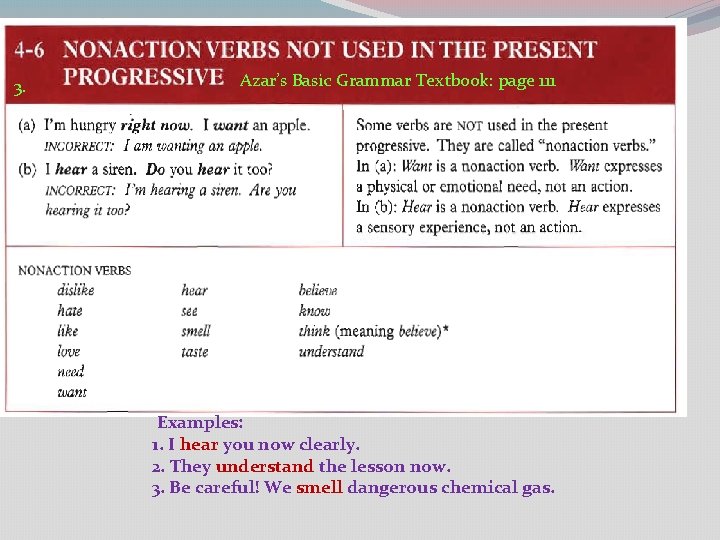
3. Azar’s Basic Grammar Textbook: page 111 Examples: 1. I hear you now clearly. 2. They understand the lesson now. 3. Be careful! We smell dangerous chemical gas.
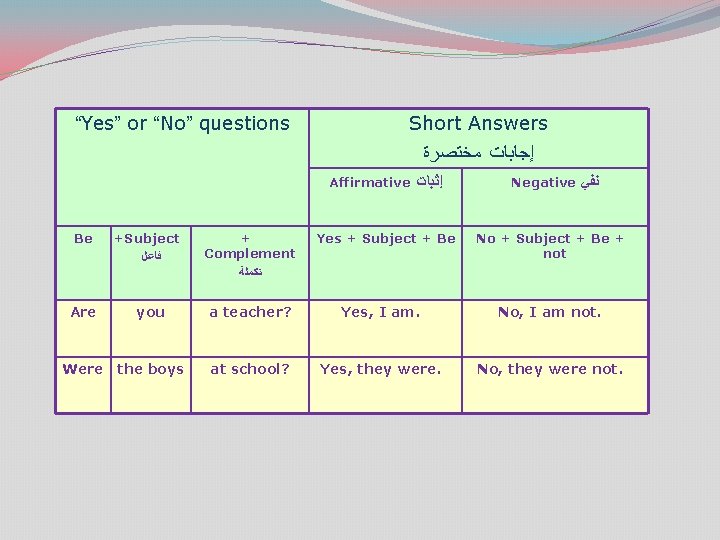
“Yes” or “No” questions Short Answers ﺇﺟﺎﺑﺎﺕ ﻣﺨﺘﺼﺮﺓ Affirmative Be Are +Subject ﻓﺎﻋﻞ you Were the boys + Complement ﺗﻜﻤﻠﺔ ﺇﺛﺒﺎﺕ Yes + Subject + Be Negative ﻧﻔﻲ No + Subject + Be + not a teacher? Yes, I am. No, I am not. at school? Yes, they were. No, they were not.
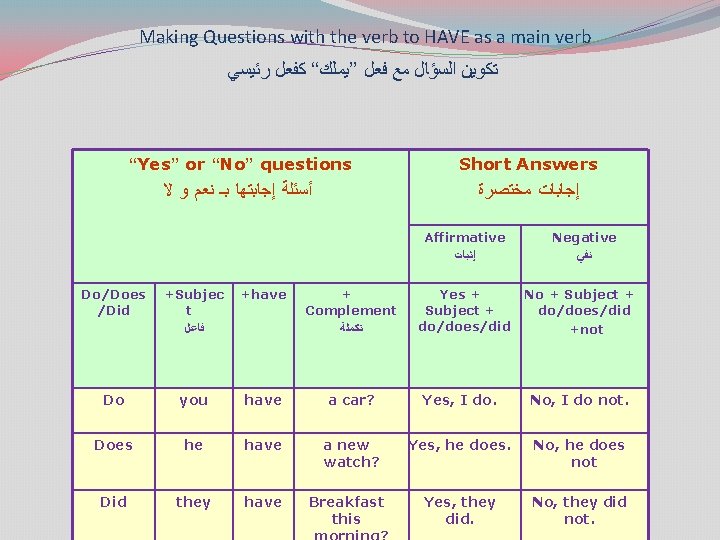
Making Questions with the verb to HAVE as a main verb ﺗﻜﻮﻳﻦ ﺍﻟﺴﺆﺎﻝ ﻣﻊ ﻓﻌﻞ ”ﻳﻤﻠﻚ“ ﻛﻔﻌﻞ ﺭﺋﻴﺴﻲ “Yes” or “No” questions Short Answers ﺃﺴﺌﻠﺔ ﺇﺟﺎﺑﺘﻬﺎ ﺑـ ﻧﻌﻢ ﻭ ﻻ ﺇﺟﺎﺑﺎﺕ ﻣﺨﺘﺼﺮﺓ Affirmative ﺇﺛﺒﺎﺕ Do/Does /Did +Subjec t ﻓﺎﻋﻞ +have + Complement ﺗﻜﻤﻠﺔ Do you have a car? Yes, I do. No, I do not. Does he have a new watch? Yes, he does. No, he does not Did they have Yes, they did. No, they did not. Breakfast this Yes + Subject + do/does/did Negative ﻧﻔﻲ No + Subject + do/does/did +not
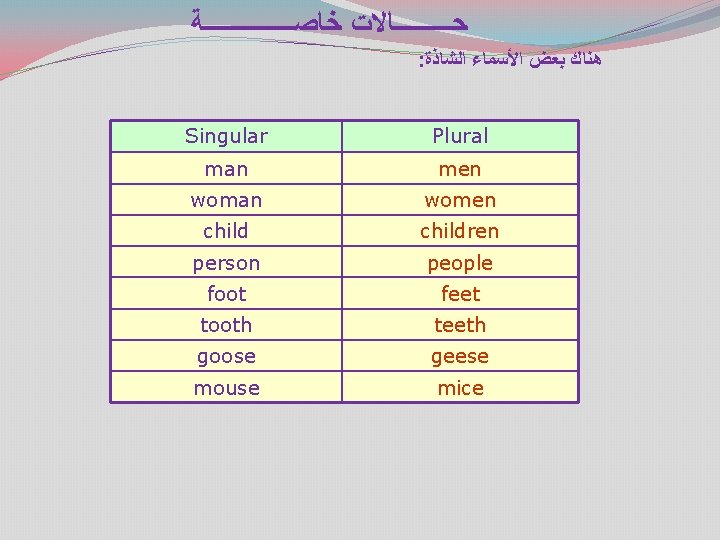
ﺣـــــﺎﻻﺕ ﺧﺎﺻـــــــﺔ : ﻫﻨﺎﻙ ﺑﻌﺾ ﺍﻷﺴﻤﺎﺀ ﺍﻟﺸﺎﺫﺓ Singular Plural man men woman women children person people foot feet tooth teeth goose geese mouse mice
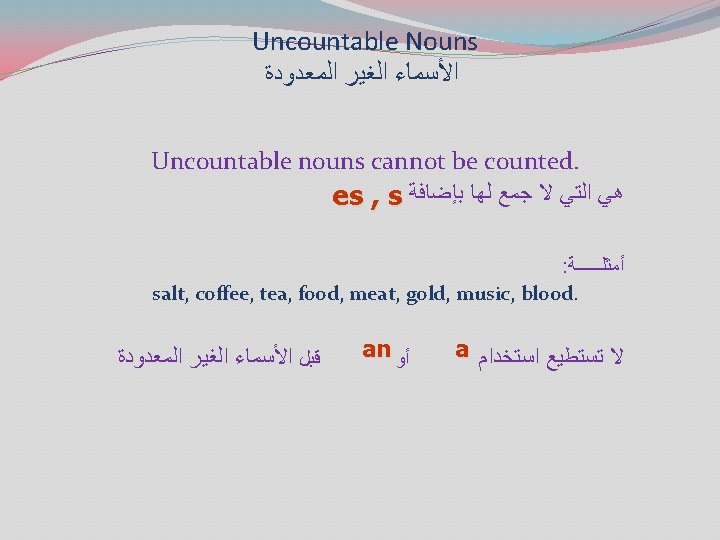
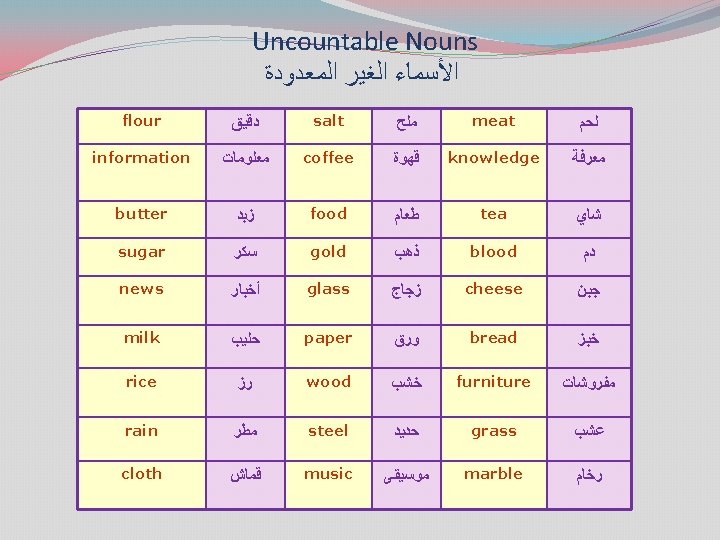
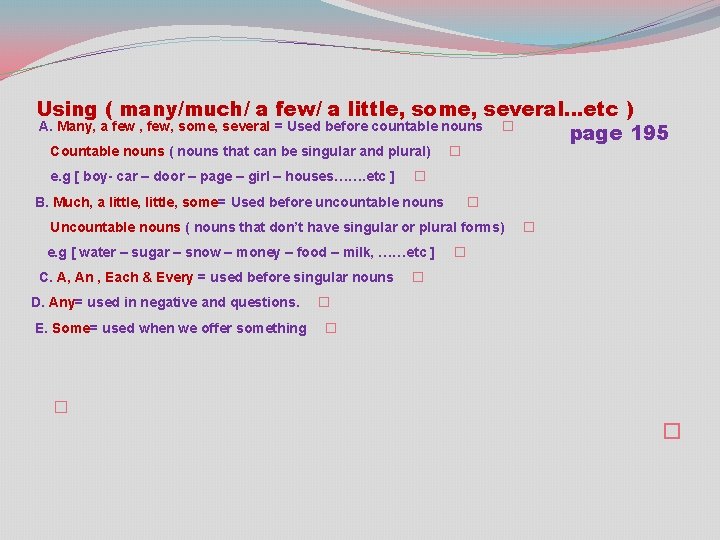
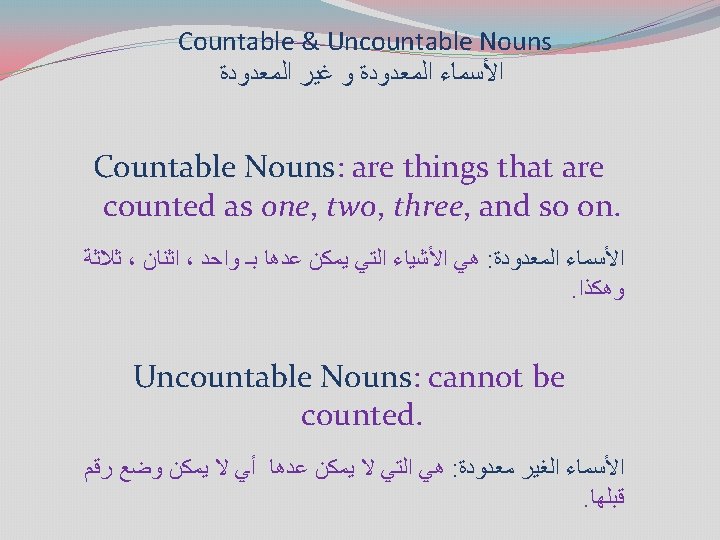
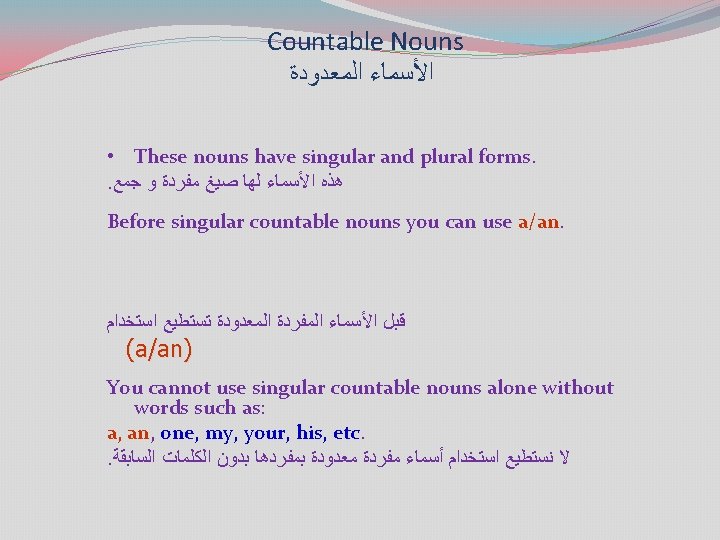
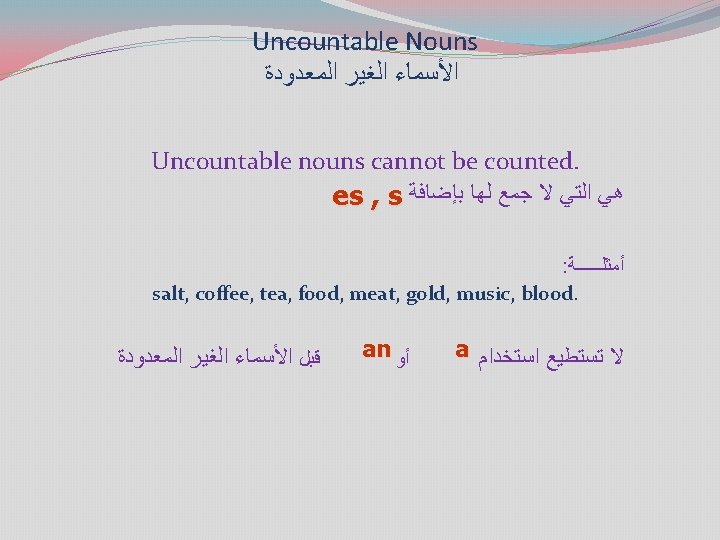
Using ( many/much/ a few/ a little, some, several…etc ) A. Many, a few , few, some, several = Used before countable nouns � page 195 Countable nouns ( nouns that can be singular and plural) e. g [ boy- car – door – page – girl – houses……. etc ] � � B. Much, a little, some= Used before uncountable nouns � Uncountable nouns ( nouns that don’t have singular or plural forms) e. g [ water – sugar – snow – money – food – milk, ……etc ] C. A, An , Each & Every = used before singular nouns D. Any= used in negative and questions. E. Some= used when we offer something � � � �
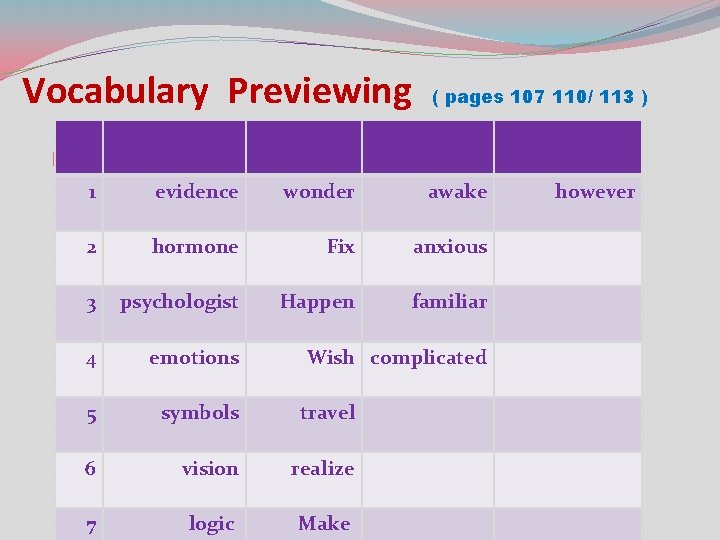
Vocabulary Previewing ( pages 107 110/ 113 ) No. � Nouns Verbs Adjectives Adverbs 1 evidence wonder awake however 2 hormone Fix anxious 3 psychologist Happen familiar 4 emotions 5 symbols travel 6 vision realize 7 logic Make Wish complicated
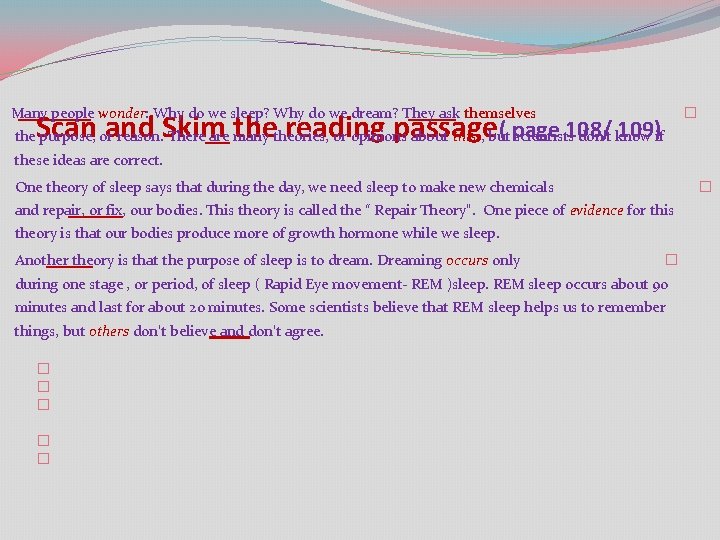
Many people wonder: Why do we sleep? Why do we dream? They ask themselves � Scan and Skim the reading passage( page 108/ 109) the purpose, or reason. There are many theories, or opinions about this , but scientists don’t know if these ideas are correct. One theory of sleep says that during the day, we need sleep to make new chemicals � and repair, or fix, our bodies. This theory is called the “ Repair Theory”. One piece of evidence for this theory is that our bodies produce more of growth hormone while we sleep. Another theory is that the purpose of sleep is to dream. Dreaming occurs only � during one stage , or period, of sleep ( Rapid Eye movement- REM )sleep. REM sleep occurs about 90 minutes and last for about 20 minutes. Some scientists believe that REM sleep helps us to remember things, but others don’t believe and don’t agree. � � �
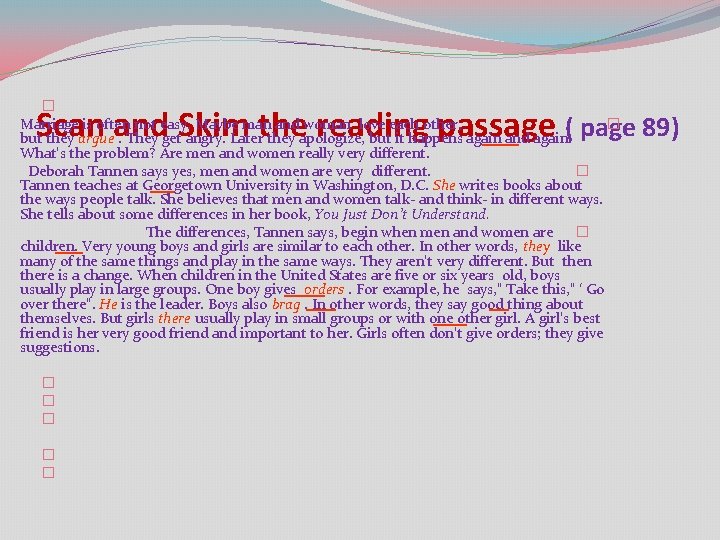
� Marriage is often not easy. Maybe man and woman love each other, � but they argue. They get angry. Later they apologize, but it happens again and again. What’s the problem? Are men and women really very different. Deborah Tannen says yes, men and women are very different. � Tannen teaches at Georgetown University in Washington, D. C. She writes books about the ways people talk. She believes that men and women talk- and think- in different ways. She tells about some differences in her book, You Just Don’t Understand. The differences, Tannen says, begin when men and women are � children. Very young boys and girls are similar to each other. In other words, they like many of the same things and play in the same ways. They aren’t very different. But then there is a change. When children in the United States are five or six years old, boys usually play in large groups. One boy gives orders. For example, he says, ” Take this, ” ‘ Go over there”. He is the leader. Boys also brag. In other words, they say good thing about themselves. But girls there usually play in small groups or with one other girl. A girl’s best friend is her very good friend and important to her. Girls often don’t give orders; they give suggestions. Scan and Skim the reading passage ( page 89) � � �
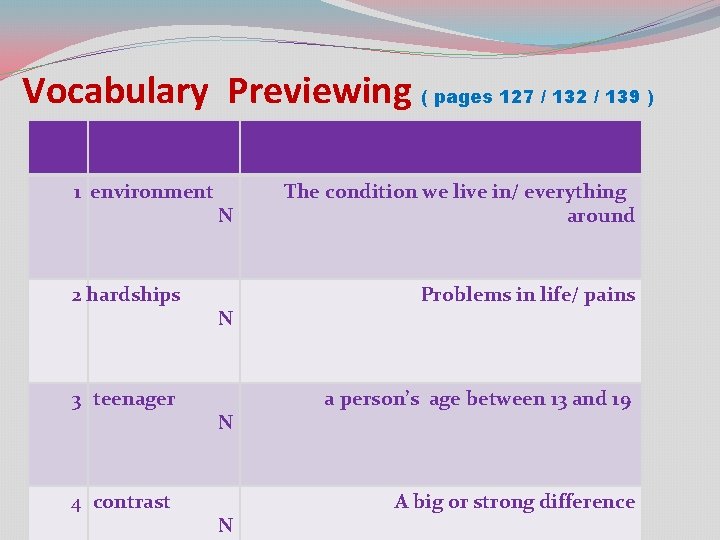
Vocabulary Previewing ( pages 127 / 132 / 139 ) No. � New words meanings 1 environment N The condition we live in/ everything around 2 hardships N Problems in life/ pains 3 teenager N a person’s age between 13 and 19 4 contrast 38 N A big or strong difference
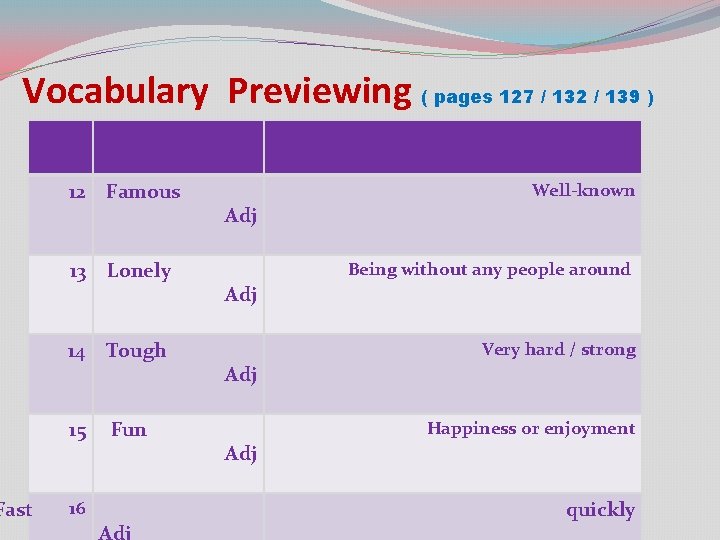
Vocabulary Previewing ( pages 127 / 132 / 139 ) No. � New words Meanings 12 Famous Adj Well-known 13 Lonely Adj Being without any people around 14 Tough Adj Very hard / strong 15 Fun Adj 16 Fast Adj 39 Happiness or enjoyment quickly
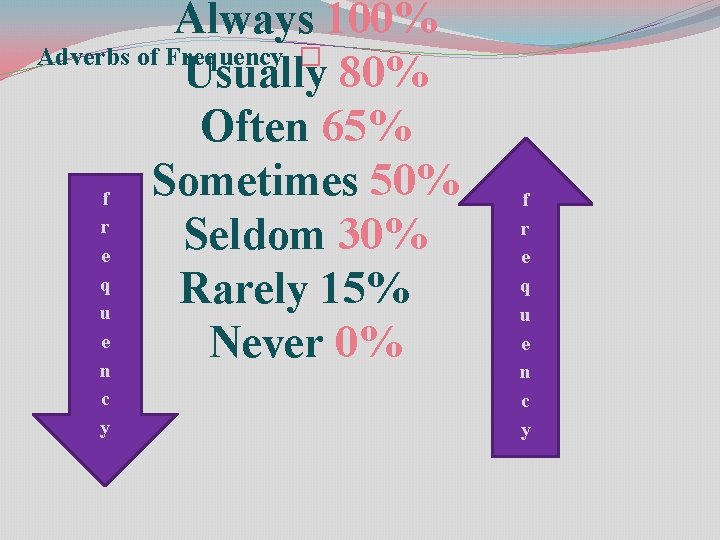
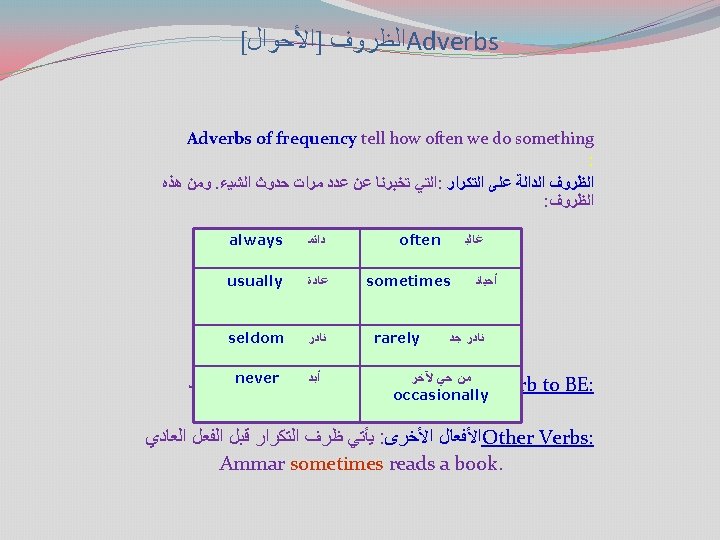
Always 100% Adverbs of Frequency � Usually 80% Often 65% Sometimes 50% f r Seldom 30% e q Rarely 15% u e Never 0% n c y f r e q u e n c y
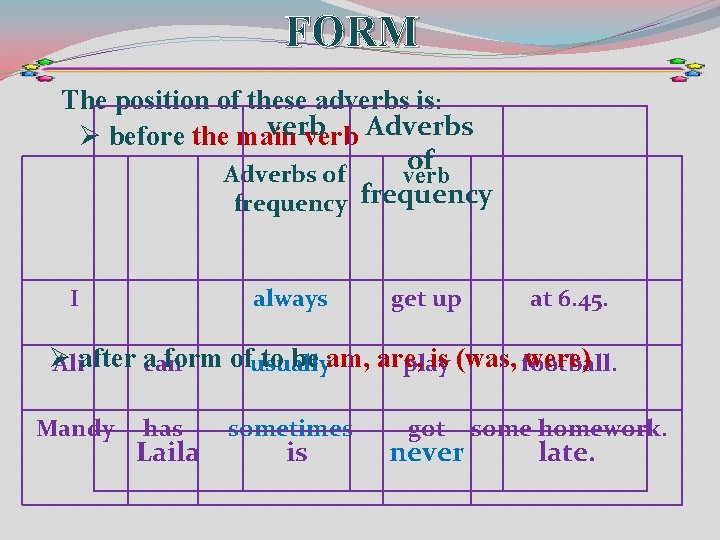
FORM The position of these adverbs is: verb Ø before the main verb Adverbs of verb frequency always I get up at 6. 45. Ø after can a form ofusually to be am, are, is (was, football. were) Ali play Mandy has Laila sometimes is got never some homework. late.
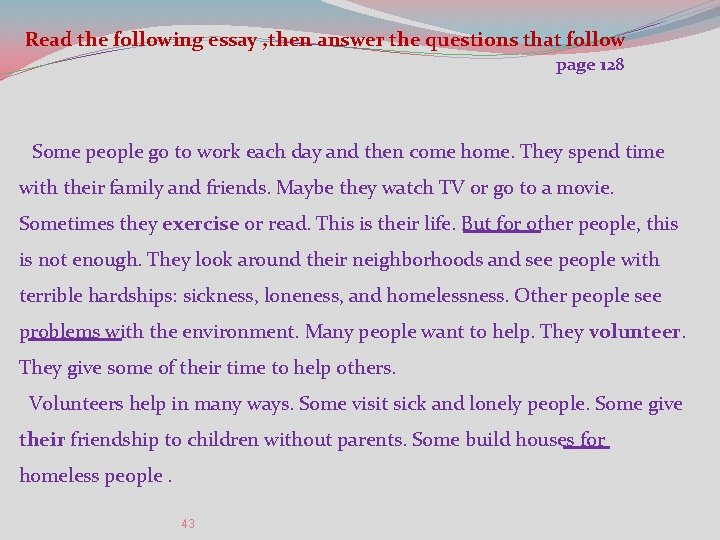
Read the following essay , then answer the questions that follow page 128 Some people go to work each day and then come home. They spend time with their family and friends. Maybe they watch TV or go to a movie. Sometimes they exercise or read. This is their life. But for other people, this is not enough. They look around their neighborhoods and see people with terrible hardships: sickness, loneness, and homelessness. Other people see problems with the environment. Many people want to help. They volunteer. They give some of their time to help others. Volunteers help in many ways. Some visit sick and lonely people. Some give their friendship to children without parents. Some build houses for homeless people. 43
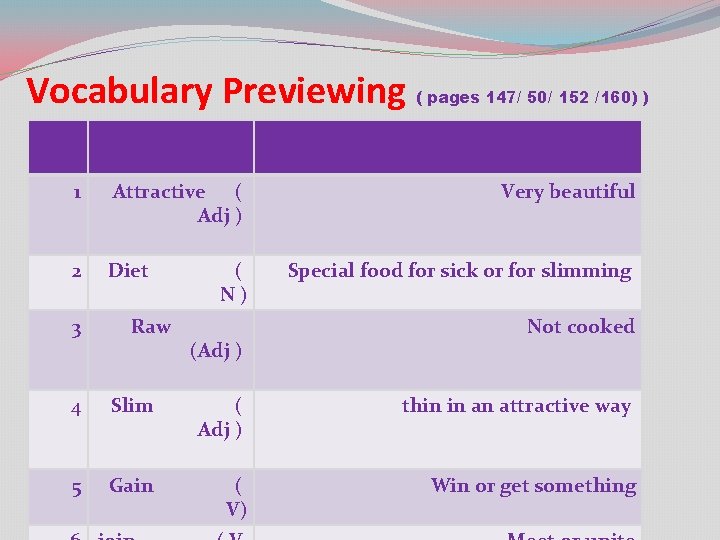
Vocabulary Previewing ( pages 147/ 50/ 152 /160) ) No. � New words meanings 1 Attractive ( Adj ) Very beautiful 2 Diet ( N ) Special food for sick or for slimming 3 Raw (Adj ) Not cooked 4 Slim ( Adj ) thin in an attractive way 5 Gain ( V) Win or get something 46
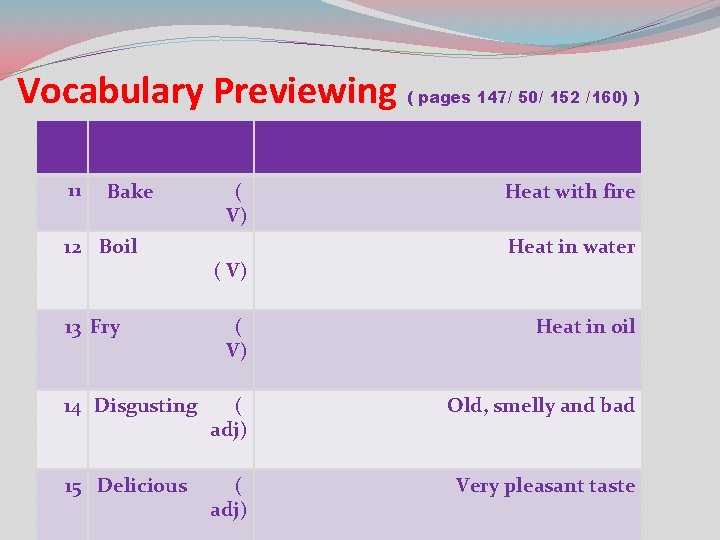
Vocabulary Previewing ( pages 147/ 50/ 152 /160) ) No. � New words meanings 11 Bake ( V) Heat with fire 12 Boil ( V) Heat in water 13 Fry ( V) Heat in oil 14 Disgusting ( adj) Old, smelly and bad 15 Delicious ( adj) Very pleasant taste 47
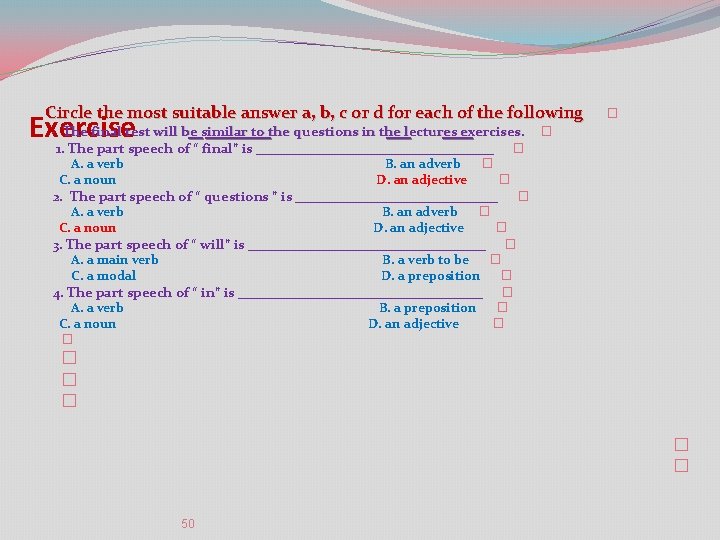
Circle the most suitable answer a, b, c or d for each of the following - The final test will be similar to the questions in the lectures exercises. � 1. The part speech of “ final” is _________________ � A. a verb B. an adverb � C. a noun D. an adjective � 2. The part speech of “ questions ” is _______________ � A. a verb B. an adverb � C. a noun D. an adjective � 3. The part speech of “ will” is _________________ � A. a main verb B. a verb to be � C. a modal D. a preposition � 4. The part speech of “ in” is __________________ � A. a verb B. a preposition � C. a noun D. an adjective � � Exercise � � � � 50
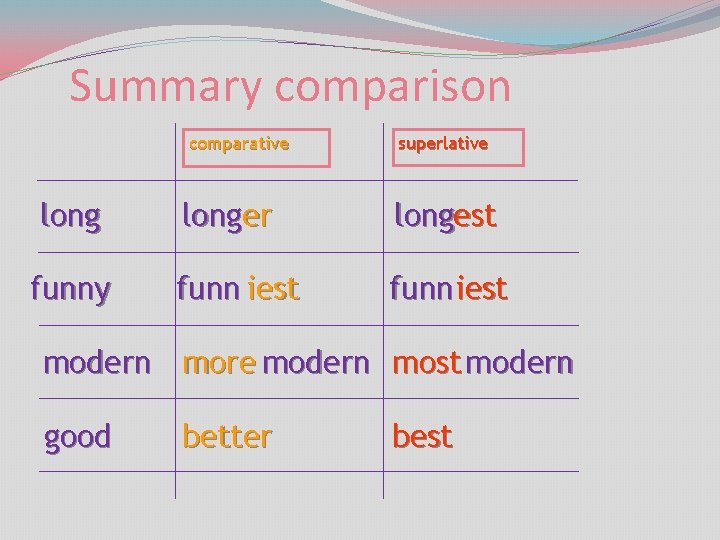
Summary comparison comparative long funny superlative longer longest funn iest modern more modern most modern good better best
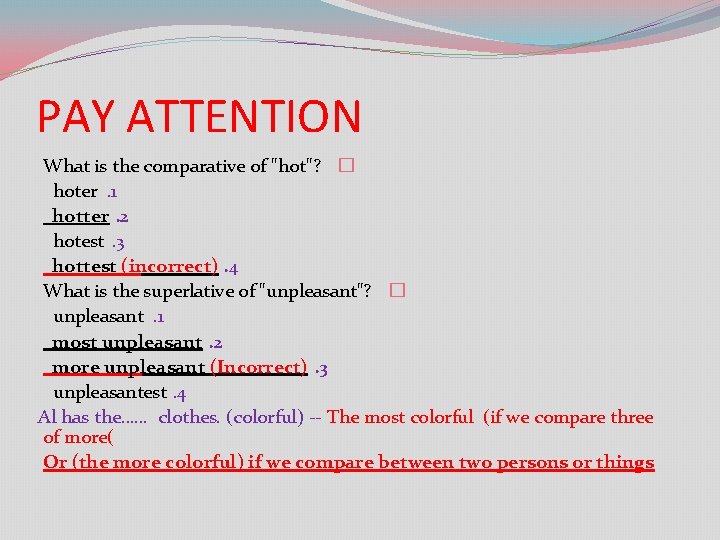
PAY ATTENTION What is the comparative of "hot"? � hoter. 1 hotter. 2 hotest. 3 hottest (incorrect). 4 What is the superlative of "unpleasant"? � unpleasant. 1 most unpleasant. 2 more unpleasant (Incorrect). 3 unpleasantest. 4 Al has the…… clothes. (colorful) -- The most colorful (if we compare three of more( Or (the more colorful) if we compare between two persons or things
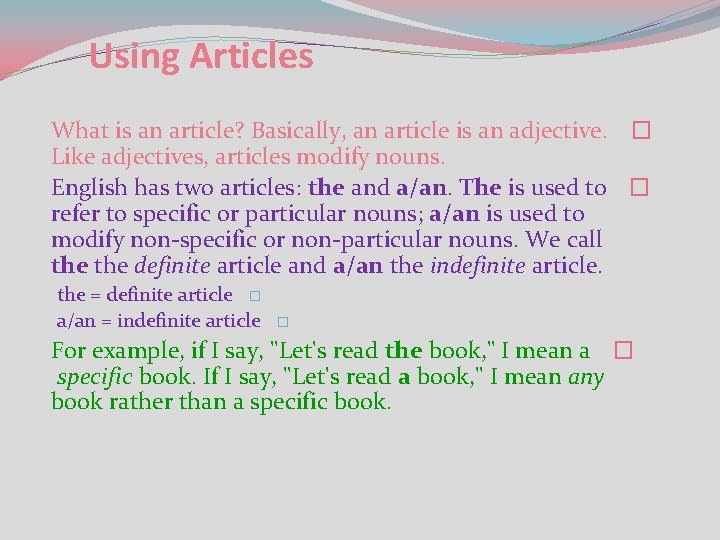
Using Articles What is an article? Basically, an article is an adjective. � Like adjectives, articles modify nouns. English has two articles: the and a/an. The is used to � refer to specific or particular nouns; a/an is used to modify non-specific or non-particular nouns. We call the definite article and a/an the indefinite article. the = definite article � a/an = indefinite article � For example, if I say, "Let's read the book, " I mean a � specific book. If I say, "Let's read a book, " I mean any book rather than a specific book.
- Slides: 55