
Verb Tenses simple perfect emphatic and progressive Simple
Verb Tenses simple, perfect, emphatic, and progressive
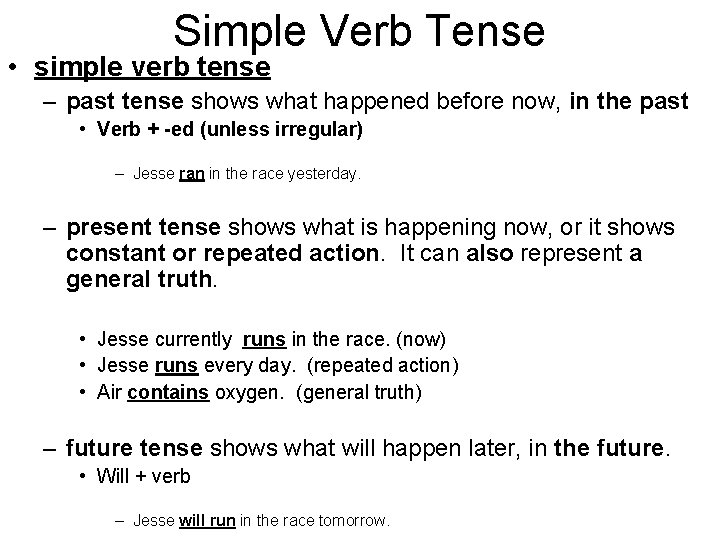
Simple Verb Tense • simple verb tense – past tense shows what happened before now, in the past • Verb + -ed (unless irregular) – Jesse ran in the race yesterday. – present tense shows what is happening now, or it shows constant or repeated action. It can also represent a general truth. • Jesse currently runs in the race. (now) • Jesse runs every day. (repeated action) • Air contains oxygen. (general truth) – future tense shows what will happen later, in the future. • Will + verb – Jesse will run in the race tomorrow.
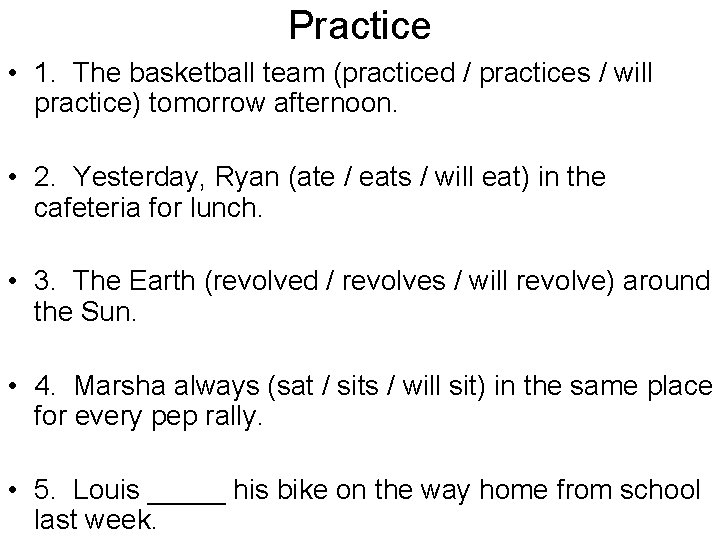
Practice • 1. The basketball team (practiced / practices / will practice) tomorrow afternoon. • 2. Yesterday, Ryan (ate / eats / will eat) in the cafeteria for lunch. • 3. The Earth (revolved / revolves / will revolve) around the Sun. • 4. Marsha always (sat / sits / will sit) in the same place for every pep rally. • 5. Louis _____ his bike on the way home from school last week.
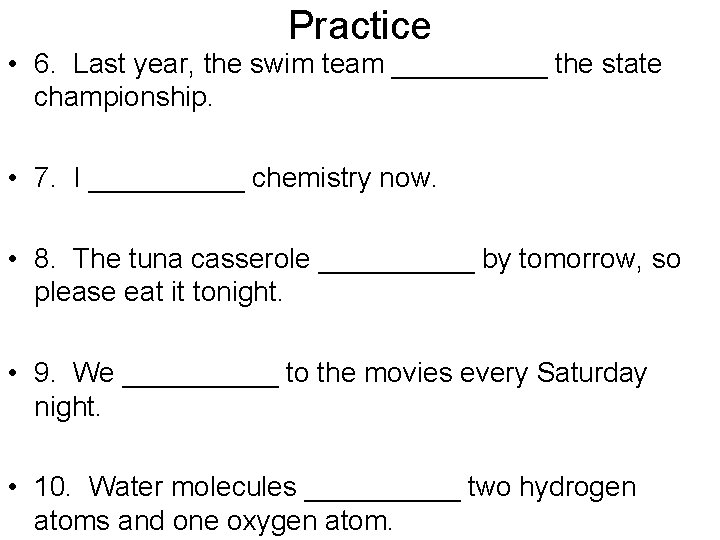
Practice • 6. Last year, the swim team _____ the state championship. • 7. I _____ chemistry now. • 8. The tuna casserole _____ by tomorrow, so please eat it tonight. • 9. We _____ to the movies every Saturday night. • 10. Water molecules _____ two hydrogen atoms and one oxygen atom.
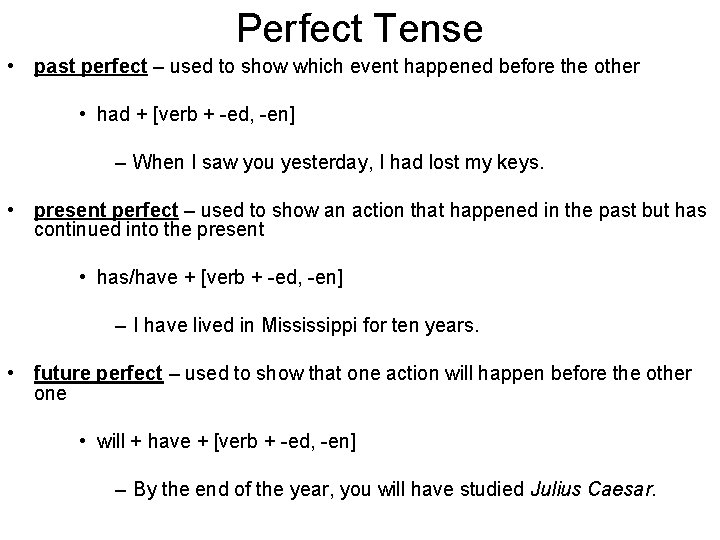
Perfect Tense • past perfect – used to show which event happened before the other • had + [verb + -ed, -en] – When I saw you yesterday, I had lost my keys. • present perfect – used to show an action that happened in the past but has continued into the present • has/have + [verb + -ed, -en] – I have lived in Mississippi for ten years. • future perfect – used to show that one action will happen before the other one • will + have + [verb + -ed, -en] – By the end of the year, you will have studied Julius Caesar.
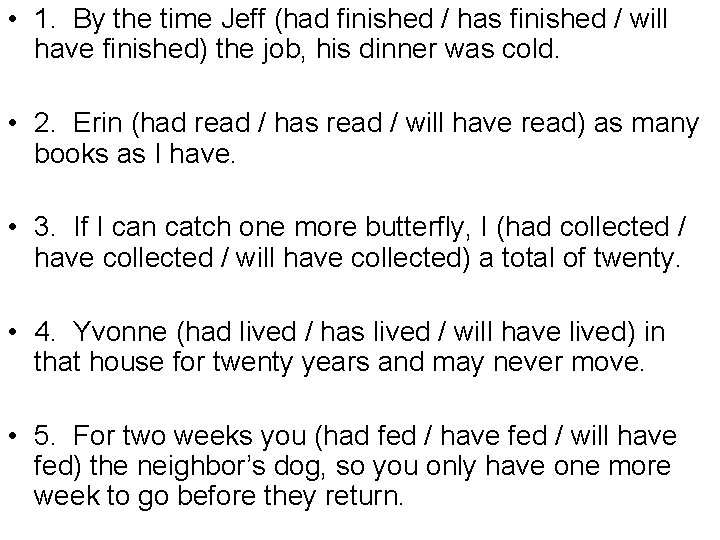
• 1. By the time Jeff (had finished / has finished / will have finished) the job, his dinner was cold. • 2. Erin (had read / has read / will have read) as many books as I have. • 3. If I can catch one more butterfly, I (had collected / have collected / will have collected) a total of twenty. • 4. Yvonne (had lived / has lived / will have lived) in that house for twenty years and may never move. • 5. For two weeks you (had fed / have fed / will have fed) the neighbor’s dog, so you only have one more week to go before they return.
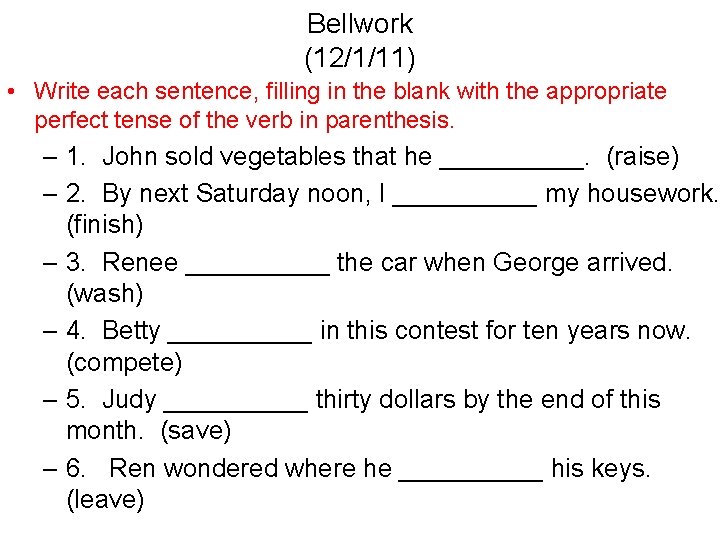
Bellwork (12/1/11) • Write each sentence, filling in the blank with the appropriate perfect tense of the verb in parenthesis. – 1. John sold vegetables that he _____. (raise) – 2. By next Saturday noon, I _____ my housework. (finish) – 3. Renee _____ the car when George arrived. (wash) – 4. Betty _____ in this contest for ten years now. (compete) – 5. Judy _____ thirty dollars by the end of this month. (save) – 6. Ren wondered where he _____ his keys. (leave)
Bellringer 12/2/11 • Perfect Tense Quiz – You may use your own notes.
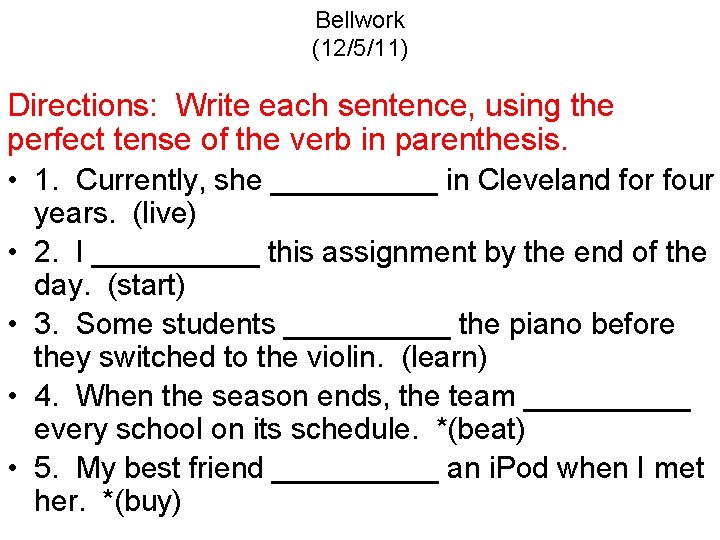
Bellwork (12/5/11) Directions: Write each sentence, using the perfect tense of the verb in parenthesis. • 1. Currently, she _____ in Cleveland for four • • years. (live) 2. I _____ this assignment by the end of the day. (start) 3. Some students _____ the piano before they switched to the violin. (learn) 4. When the season ends, the team _____ every school on its schedule. *(beat) 5. My best friend _____ an i. Pod when I met her. *(buy)
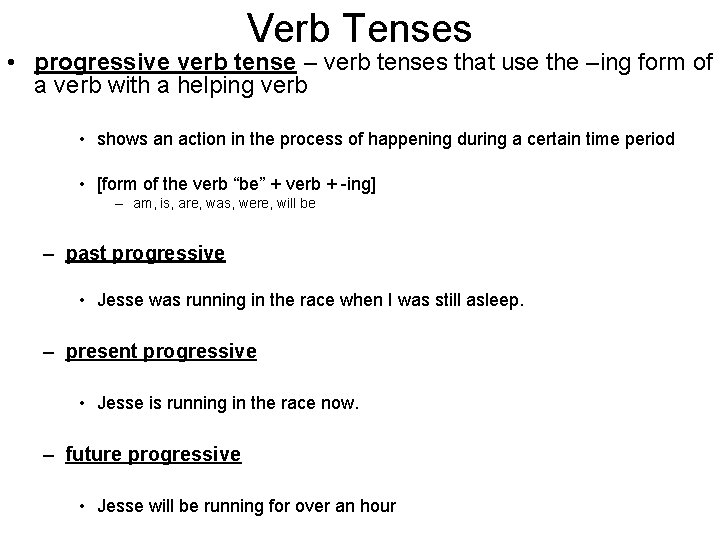
Verb Tenses • progressive verb tense – verb tenses that use the –ing form of a verb with a helping verb • shows an action in the process of happening during a certain time period • [form of the verb “be” + verb + -ing] – am, is, are, was, were, will be – past progressive • Jesse was running in the race when I was still asleep. – present progressive • Jesse is running in the race now. – future progressive • Jesse will be running for over an hour
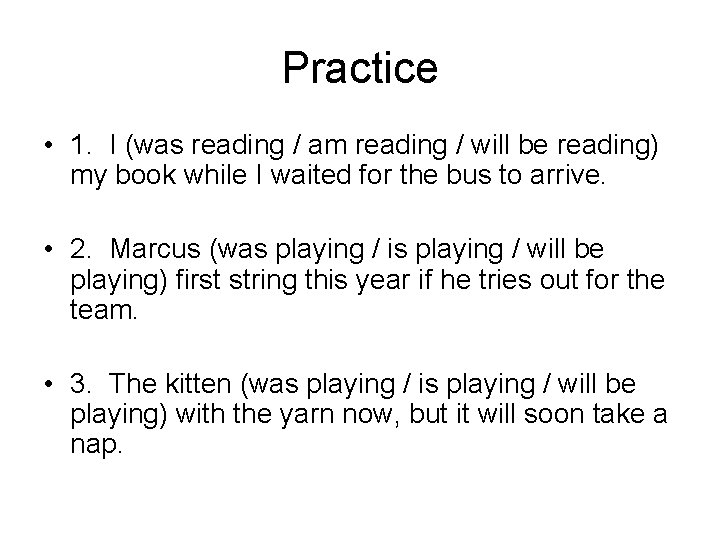
Practice • 1. I (was reading / am reading / will be reading) my book while I waited for the bus to arrive. • 2. Marcus (was playing / is playing / will be playing) first string this year if he tries out for the team. • 3. The kitten (was playing / is playing / will be playing) with the yarn now, but it will soon take a nap.
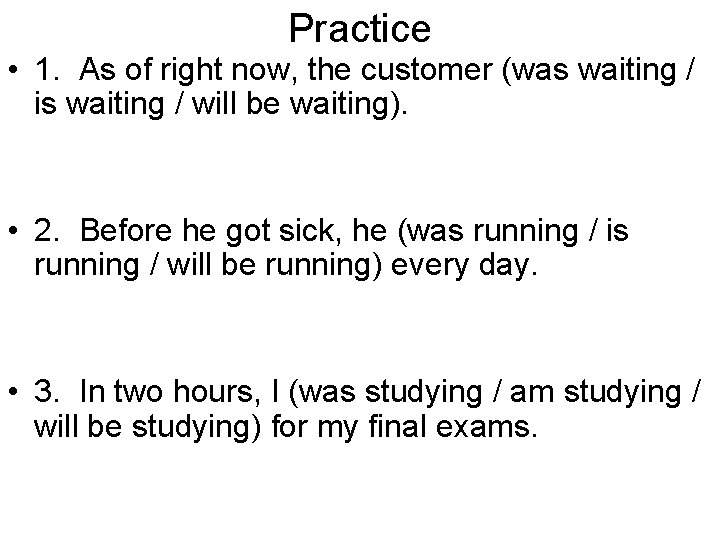
Practice • 1. As of right now, the customer (was waiting / is waiting / will be waiting). • 2. Before he got sick, he (was running / is running / will be running) every day. • 3. In two hours, I (was studying / am studying / will be studying) for my final exams.
Bellwork (12/6/11) Write each sentence, completing the blank with the progressive tense of the verb in parenthesis. Use your notes from yesterday. • 1. KPLA __________ the hits of the 1970 s on the radio this moment. (broadcast) • 2. When the recess bell rang, Jesse __________ a long division problem on the blackboard. (write) • 3. Ian __________ on the computer system for the next two weeks. (work) • 4. Between 1942 and 1944 the Frank and Van Damm families __________ in a Amsterdam office building. (hide) • 5. Presently, I __________ for the first paperback editions of all of Raymond Chandler's books. (look)
Bellringer (12/12/11) • Write each sentence, using the progressive tense of the verb in parentheses. – 1. You ________ for school at this very moment. (leave) – 2. The band ________ for an hour last weekend before it finally took a break. (play) – 3. The students ________ to read Thomas Sowell’s how-to book next semester. (plan)
Perfect Progressive Tense • The perfect and progressive verb tenses can be combined into the perfect progressive tense. – “to have” + been + main verb + -ing • past perfect progressive – Jesse had been running in the race when Carl arrived. • present perfect progressive – Jesse has been running for over an hour. • future perfect progressive – In ten minutes, Jesse will have been running for an hour and a half.
• 1. They (had been talk, had been talking, have been talking) before the teacher entered the classroom. • 2. She (had been working, has been working) at the coffee shop for two years now. • 3. Sam gained weight because he (had overeating, had been overeating, has been overeating) • 4. James (been teaching, will be teaching, will have been teaching) at the university for more than a year by the time he leaves for Asia. • 5. The cargo ships (be dock, has been docking, have been docking) in the port this morning.
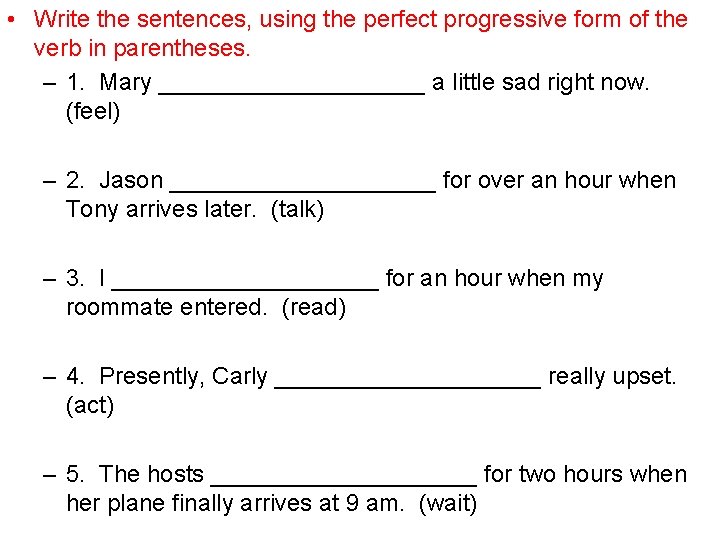
• Write the sentences, using the perfect progressive form of the verb in parentheses. – 1. Mary __________ a little sad right now. (feel) – 2. Jason __________ for over an hour when Tony arrives later. (talk) – 3. I __________ for an hour when my roommate entered. (read) – 4. Presently, Carly __________ really upset. (act) – 5. The hosts __________ for two hours when her plane finally arrives at 9 am. (wait)
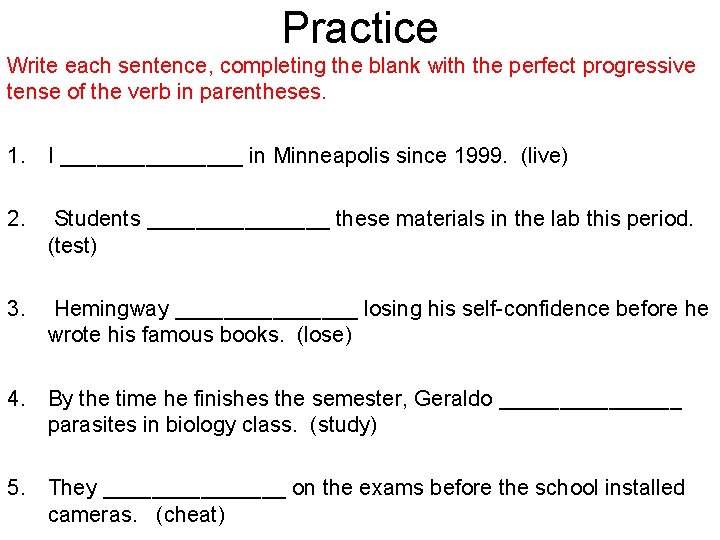
Practice Write each sentence, completing the blank with the perfect progressive tense of the verb in parentheses. 1. I ________ in Minneapolis since 1999. (live) 2. Students ________ these materials in the lab this period. (test) 3. Hemingway ________ losing his self-confidence before he wrote his famous books. (lose) 4. By the time he finishes the semester, Geraldo ________ parasites in biology class. (study) 5. They ________ on the exams before the school installed cameras. (cheat)
Practice • English I: workbook page 145 • English II: workbook pages 176
Bellringer (12/7/11) • Get your workbook and complete the following review page: – You may want to use your class notes for help. • English I: workbook page 145 • English II: workbook page 177
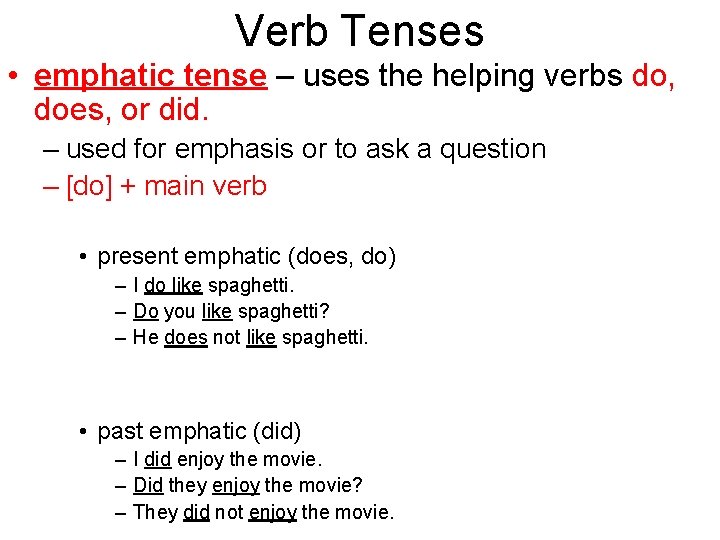
Verb Tenses • emphatic tense – uses the helping verbs do, does, or did. – used for emphasis or to ask a question – [do] + main verb • present emphatic (does, do) – I do like spaghetti. – Do you like spaghetti? – He does not like spaghetti. • past emphatic (did) – I did enjoy the movie. – Did they enjoy the movie? – They did not enjoy the movie.
• Which of the following sentences use the emphatic verb tense? – 1. She does like classical music – 2. I do my homework after class. – 3. He does a good job every day. – 4. Larry did enjoy the book he read last month. – 5. We did our best work today. – 6. Do you own your own bicycle?
• Write the following sentences using the emphatic form of the verb in parentheses. – 1. Sheila _________ a picture today. (draw) – 2. We ________ our homework. now (finish) – 3. I ________ a bicycle currently. (own) – 4. We are ________ coffee. (to drink) – 5. ____ they _____ the book in the past? (enjoy) – 6. Today, you ________ for an opportunity. (wait)
Practice • Write each sentence, completing the blank with the progressive tense (“be”) of the verb in parentheses. – 1. I _____ more macaroni now, please. (want) – 2. She _____ to the park yesterday. (go) – 3. We _____ all of our allowance on candy last summer. (spend) – 4. Robert _____ permission to go to his locker in the future. (need) – 5. My father _____ I should go to Harvard, but now is changing his mind. (think)
- Slides: 24