
Verb Tense denotes the time of the action
Verb Tense denotes the time of the action indicated by a verb. The time is not always the same as that indicated by the name of the tense.
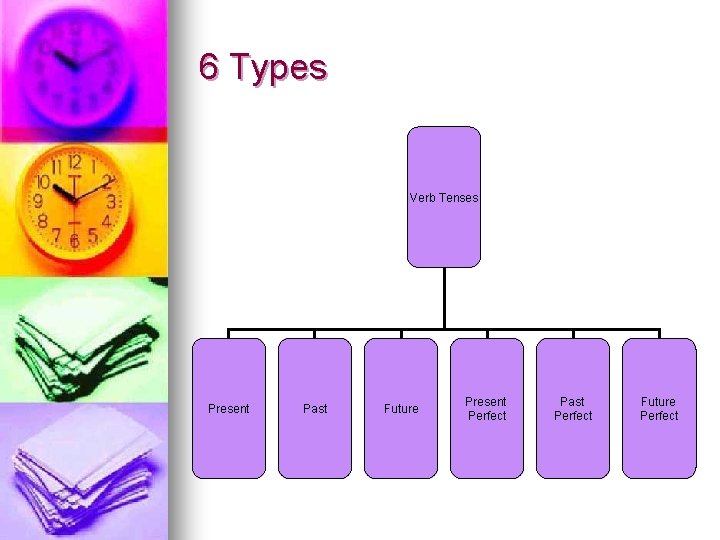
6 Types Verb Tenses Present Past Future Present Perfect Past Perfect Future Perfect
Present Tense Present tense may express action which is going on at the present time or which occurs always, repeatedly, or habitually. n Examples: He sees the train. He eats cereal for breakfast every day. n
Past Tense Past tense expresses action completed at a definite time in the past. n Examples: He wrote the letter yesterday. She lived to be 90 years old. n
Future Tense Future tense expresses action which will take place in the future. n It uses the helping verbs will or shall* and the present tense form of the verb). n Examples: He will send the letter tomorrow. I shall wait here until you return. n * Traditionally, shall is used for 1 st person and will for 2 nd and 3 rd persons. n
Present Perfect Tense n n n Present perfect tense expresses action completed at the present time (perfect means complete) or begun in the past and continuing into the present. This tense uses the helping verbs has and have and the past participle of the verb. Examples: l l He has written a letter to his uncle. (completed action) The Waltons have lived here for seven years. (continuing)
![Principal Parts of Verbs Base Form Present Participle Past Participle Talk [is] talking Talked](http://slidetodoc.com/presentation_image_h2/1043bc4287c1cd9cee1b86cd1451ab20/image-7.jpg "Principal Parts of Verbs Base Form Present Participle Past Participle Talk [is] talking Talked")
Principal Parts of Verbs Base Form Present Participle Past Participle Talk [is] talking Talked [have] talked Draw [is] drawing Drew [have] drawn Present time– He draws excellent pictures Past Time- Last week they drew two maps. Future Time- Perhaps she will draw one for you.
Past Perfect Tense Past perfect tense expresses action completed before certain time in the past. (This is the before-past tense. ) n It uses the helping verb had and the past participle of the verb. n Example: She had written the letter before I saw her. n
Future Perfect Tense Future perfect tense expresses action which will be completed before a certain time in the future. (This is the before-future tense) n It uses the helping verbs will have or shall have and the past participle of the verb. n Example: He will have finished the paper before next Friday. n
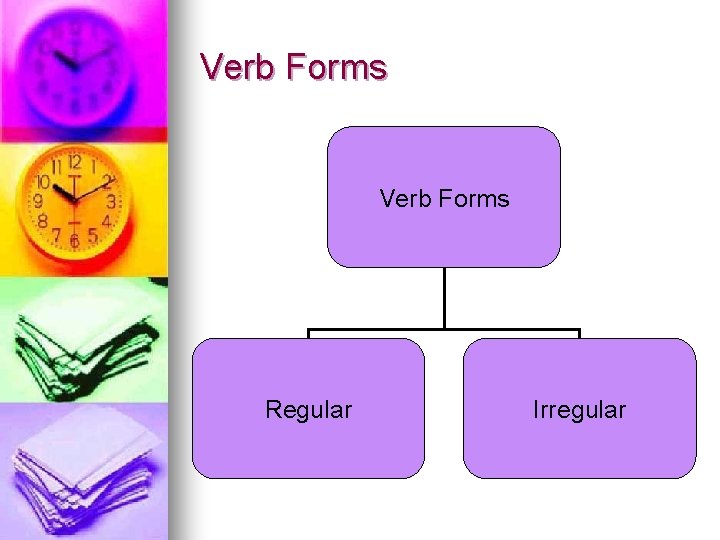
Verb Forms Regular Irregular
Regular Verbs Regular verbs form their past tense and past participle by adding –ed or –d to their present tense form. n More than 95% of all English verbs are regular. n Regular verbs cause few problems in speaking and writing. n
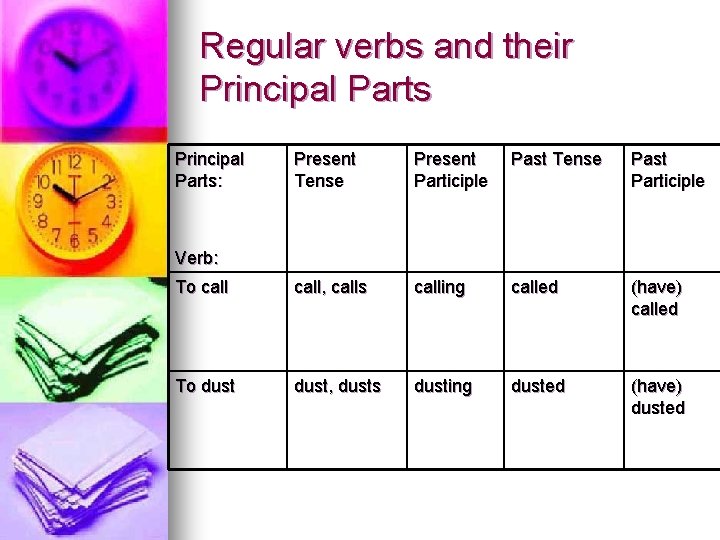
Regular verbs and their Principal Parts: Present Tense Present Participle Past Tense Past Participle To call, calls calling called (have) called To dust, dusts dusting dusted (have) dusted Verb:
You try it! Elements of Language n Page 487 n Write sentence 1 -6 use the correct form of the verb. n Underline the VERB n You have 15 minutes to complete! n
Irregular Verbs Irregular verbs can form their past tense and past participle forms in various way. n These forms cause even native speakers innumerable problems. n The most irregular verb of all is the verb to be. n Another irregular verb that is important for its use with other verbs is the verb to have. n
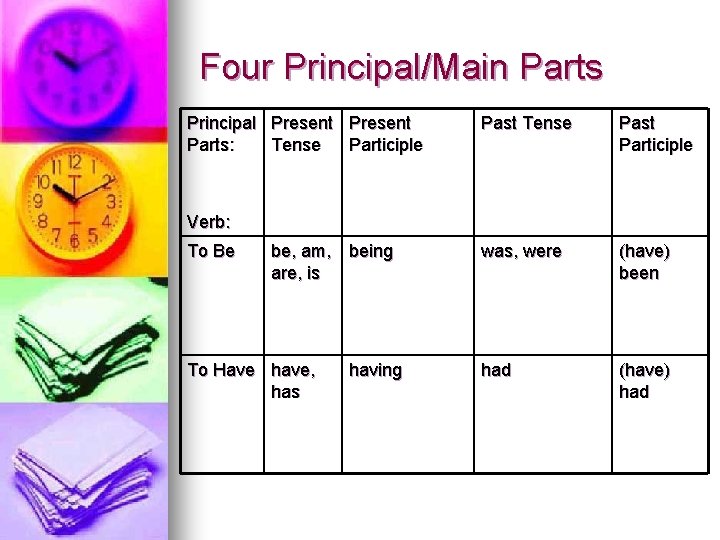
Four Principal/Main Parts Principal Present Parts: Tense Participle Past Tense Past Participle was, were (have) been had (have) had Verb: To Be be, am, being are, is To Have have, has having
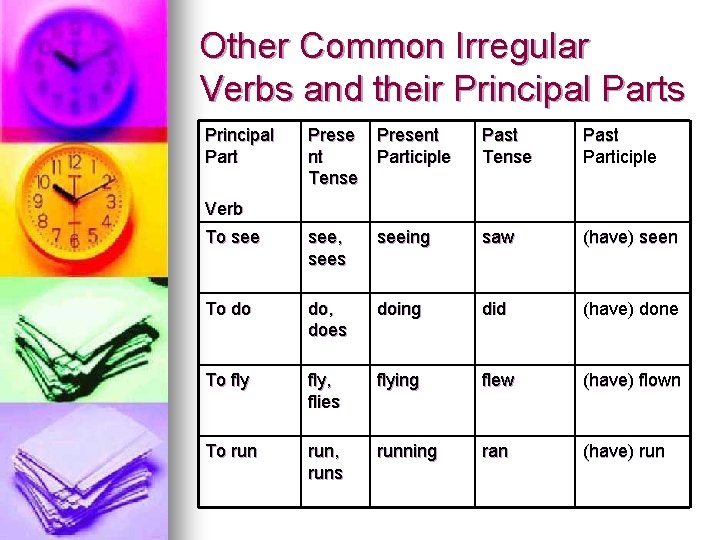
Other Common Irregular Verbs and their Principal Parts Principal Part Prese nt Tense Present Participle Past Tense Past Participle To see, sees seeing saw (have) seen To do do, does doing did (have) done To fly, flies flying flew (have) flown To run, runs running ran (have) run Verb
![Six troublesome Verbs Base Form Present Participle Past Participle Sit [is] sitting Sat [have]](http://slidetodoc.com/presentation_image_h2/1043bc4287c1cd9cee1b86cd1451ab20/image-17.jpg "Six troublesome Verbs Base Form Present Participle Past Participle Sit [is] sitting Sat [have]")
Six troublesome Verbs Base Form Present Participle Past Participle Sit [is] sitting Sat [have] sat Set [is] setting Set [have] set Rise [is] rising Rose [have] risen Raise [is] raising Raised [have] raised Lie [is] lying Lay [have] lain Lay [is] laying Laid [have] laid
Try it Language of Elements n Page 505 n Sentences 1 -11 n Write your answers only. n You have 10 minutes to complete. n
Conjugation A conjugation of a verb is the correct arrangement of its form through its tenses, persons, and numbers. n Person means the speaker, the person spoken to, and the person or thing spoken of. n Number means singular or plural. n
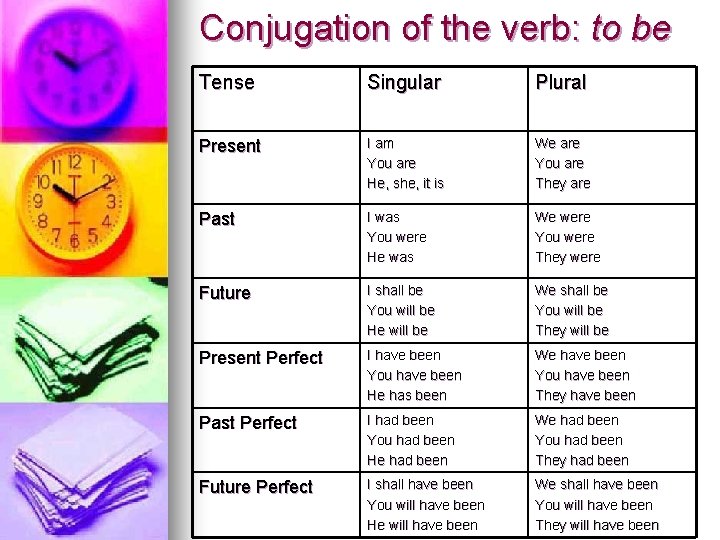
Conjugation of the verb: to be Tense Singular Plural Present I am You are He, she, it is We are You are They are Past I was You were He was We were You were They were Future I shall be You will be He will be We shall be You will be They will be Present Perfect I have been You have been He has been We have been You have been They have been Past Perfect I had been You had been He had been We had been You had been They had been Future Perfect I shall have been You will have been He will have been We shall have been You will have been They will have been
You try it! Elements of Language n Page 507 n Write sentence 1 -6 use the correct form of the verb. n Underline the VERB. n You have 10 minutes to complete. n
- Slides: 21