
VERA VERA http veraserver mtk nao ac jprestrictedCFP



- Slides: 22
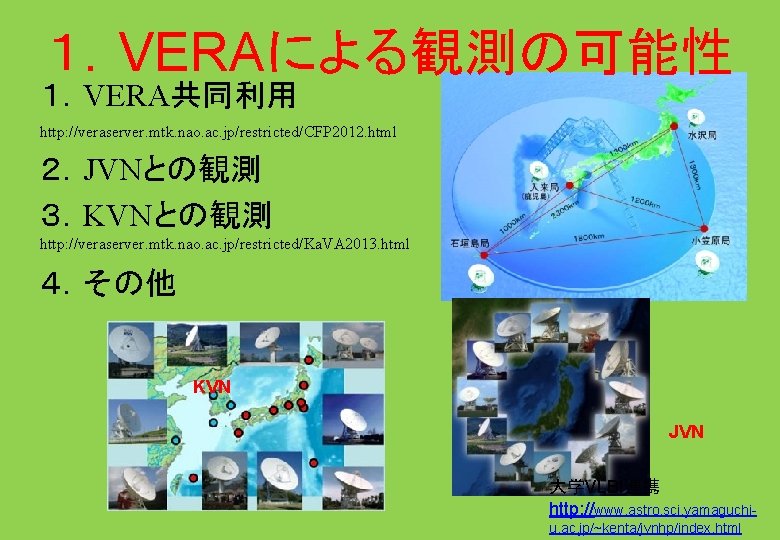
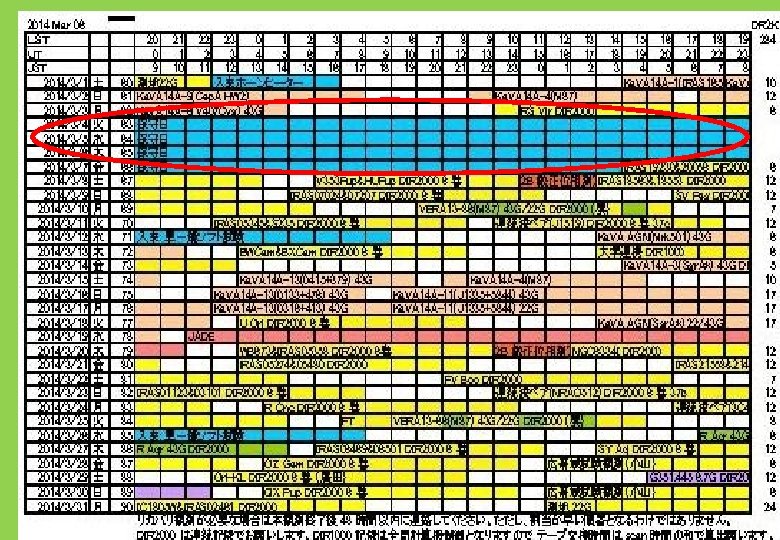
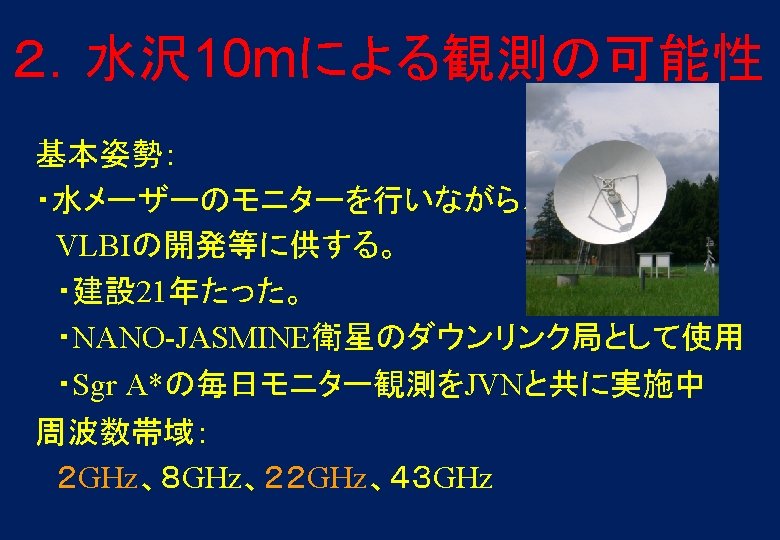
1.VERAによる観測の可能性 1.VERA共同利用 http: //veraserver. mtk. nao. ac. jp/restricted/CFP 2012. html 2.JVNとの観測 3.KVNとの観測 http: //veraserver. mtk. nao. ac. jp/restricted/Ka. VA 2013. html 4.その他 KVN JVN 大学VLBI連携 http: //www. astro. sci. yamaguchiu. ac. jp/~kenta/jvnhp/index. html
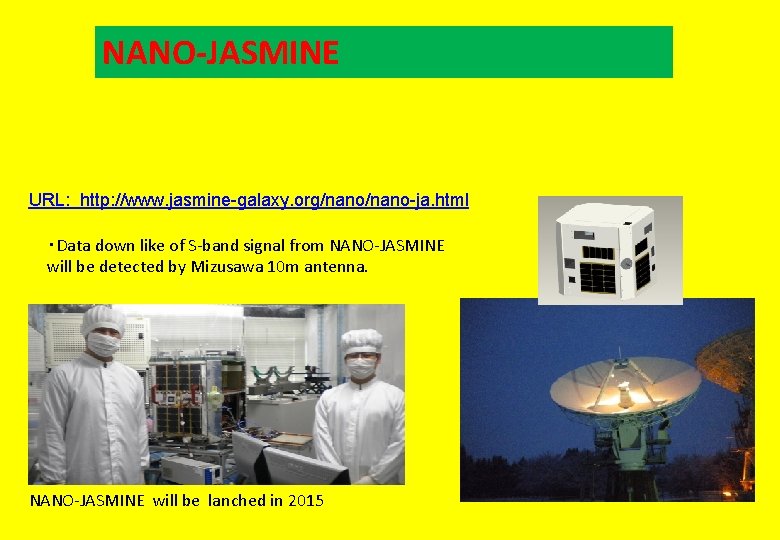
NANO-JASMINE URL: http: //www. jasmine-galaxy. org/nano-ja. html ・Data down like of S-band signal from NANO-JASMINE will be detected by Mizusawa 10 m antenna. NANO-JASMINE will be lanched in 2015
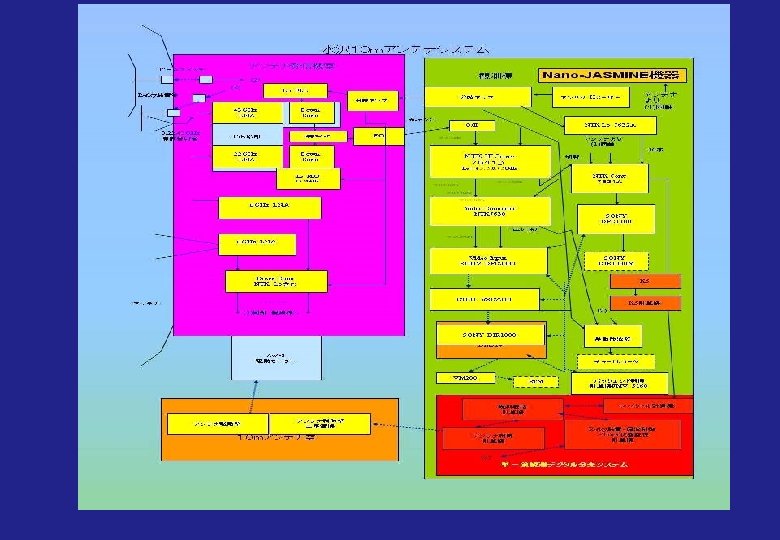
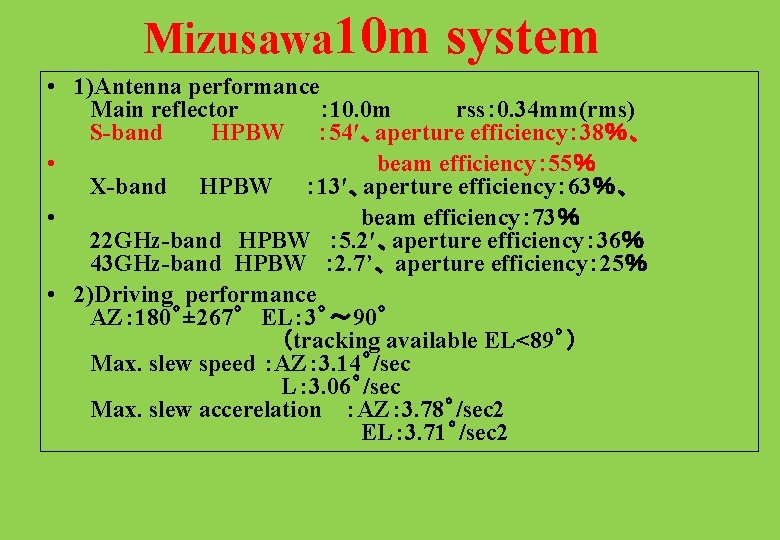
Mizusawa 10 m system • 1)Antenna performance Main reflector : 10. 0 m rss: 0. 34 mm(rms) S-band HPBW : 54′、aperture efficiency: 38%、 • beam efficiency: 55% X-band HPBW : 13′、aperture efficiency: 63%、 • beam efficiency: 73% 22 GHz-band HPBW : 5. 2′、aperture efficiency: 36% 43 GHz-band HPBW : 2. 7’、 aperture efficiency: 25% • 2)Driving performance AZ: 180゜± 267゜ EL: 3゜~ 90゜ (tracking available EL<89゜) Max. slew speed :AZ: 3. 14゜/sec L: 3. 06゜/sec Max. slew accerelation :AZ: 3. 78゜/sec 2 EL: 3. 71゜/sec 2
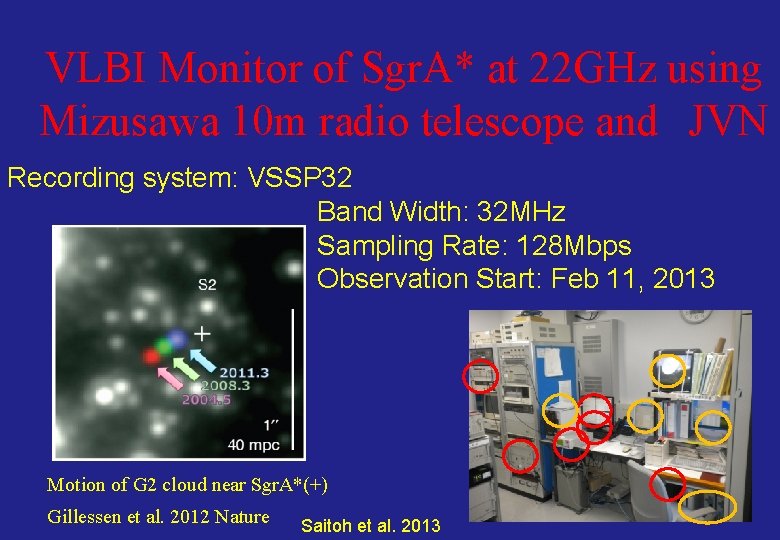
VLBI Monitor of Sgr. A* at 22 GHz using Mizusawa 10 m radio telescope and JVN Recording system: VSSP 32 Band Width: 32 MHz Sampling Rate: 128 Mbps Observation Start: Feb 11, 2013 Motion of G 2 cloud near Sgr. A*(+) Gillessen et al. 2012 Nature Saitoh et al. 2013
Japanese VLBI daily monitoring of our galactic center < Sgr. A* Daily Monitoring Team > M. Tsuboi, Y. Asaki (ISAS/JAXA), Y. Yonekura (Ibaraki Univ. ), H. Kaneko, Y. Miyamoto, M. Seta, N. Nakai (Tsukuba Univ), O. Kameya, M. Miyoshi (NAOJ), H. Takaba, K. Wakamatsu (Gifu Univ. ), M. Sekido (NICT), Y. Fukuzaki(GSI), T. Morimitsu (Univ. of Tokyo), T. Oka, S. Takekawa (Keio Univ. ), T. Omodaka, T. Handa (Kagoshima Univ. ), and A. Takumi(OUJ)
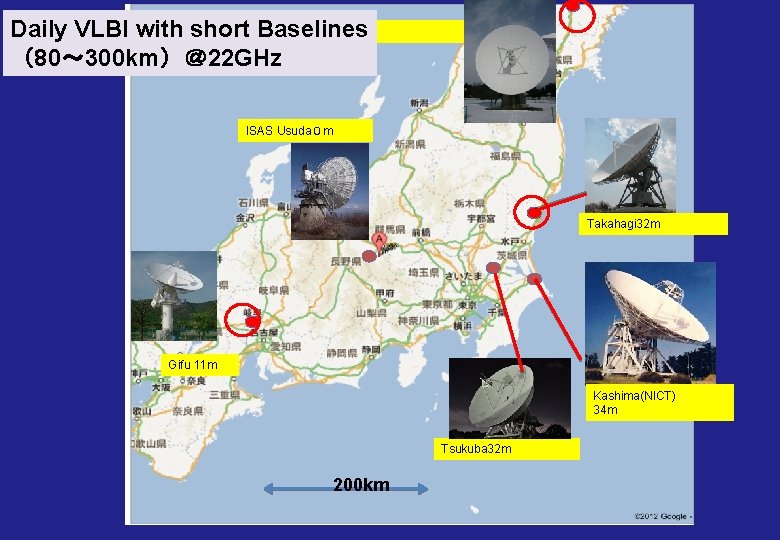
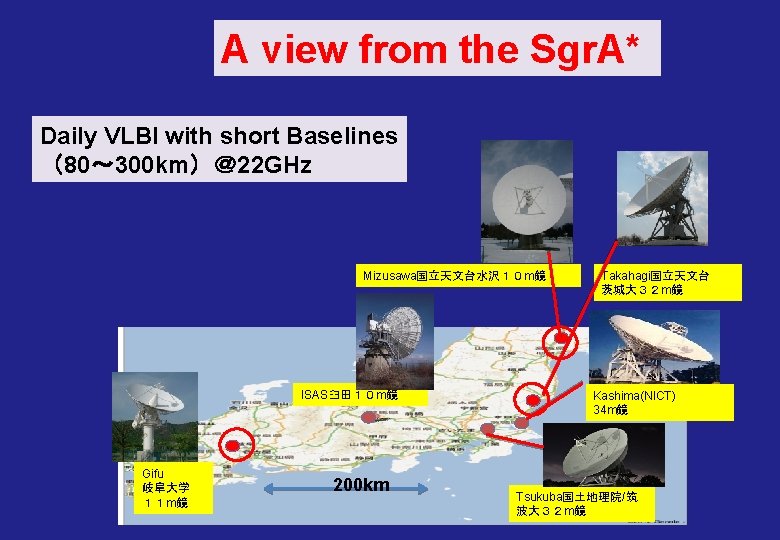
Daily VLBI with short. Mizusawa 10 m Baselines (80~ 300 km)@ 22 GHz ISAS Usuda0 m Takahagi 32 m Gifu 11 m Kashima(NICT) 34 m Tsukuba 32 m 200 km
A view from the Sgr. A* Daily VLBI with short Baselines (80~ 300 km)@ 22 GHz Mizusawa国立天文台水沢10 m鏡 ISAS臼田10 m鏡 Gifu 岐阜大学 11 m鏡 200 km Takahagi国立天文台 茨城大32 m鏡 Kashima(NICT) 34 m鏡 Tsukuba国土地理院/筑 波大32 m鏡
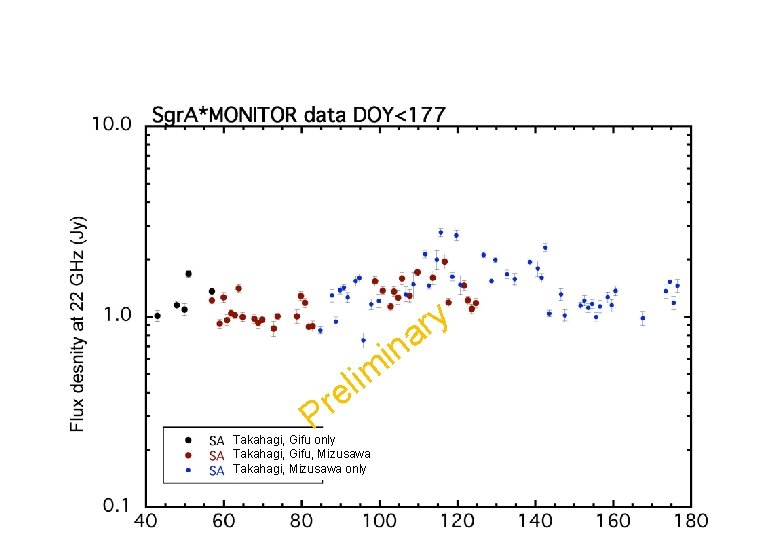
y r a n i m i l e r P Takahagi, Gifu only Takahagi, Gifu, Mizusawa Takahagi, Mizusawa only
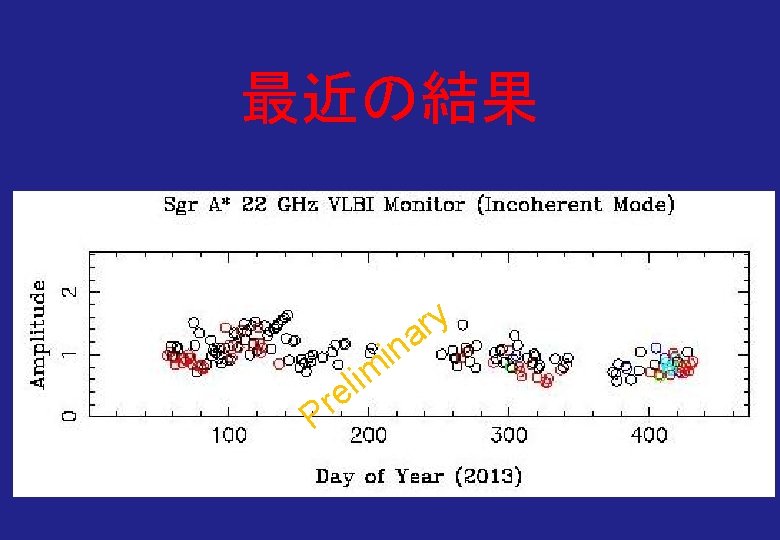
Possible brightening at 22 GHz of Sgr A* • ATel #5013; M. Tsuboi, Y. Asaki(ISAS/JAXA), Y. Yonekura(Ibaraki Univ. ), H. Kaneko, Y. Miyamoto, M. Seta, N. Nakai(Univ. of Tsukuba), O. Kameya, M. Miyoshi(NAOJ), H. Takaba, K. Wakamatsu(Gifu Univ. ), Y. Fukuzaki(GSI), T. Morimitsu(Univ. of Tokyo), M. Sekido(NICT), T. Oka, S. Takekawa (Keio Univ. ), T. Omodaka, T. Handa(Kagoshima Univ. ), and A. Takumi(OUJ) on 26 Apr 2013; 13: 00 UT Credential Certification: Masato TSUBOI (tsuboi@vsop. isas. jaxa. jp) • Subjects: Radio, Black Hole, Transient • Referred to by ATel #: 5014, 5016, 5020, 5025 • We report a possible brightening at 22 GHz of Sgr A* during daily monitoring observations with a short-baseline VLBI (Mizusawa 10 -m RT, Takahagi 32 -m RT, Tsukuba 32 -m RT, and Gifu 11 -m RT) which is a subset of the Japanese VLBI Network. This purpose of the monitor is to search the increase of 22 -GHz emission from Sgr A* induced by the interaction of the G 2 cloud with the accretion disk (Gillessen et al. 2012, Nature, 481, 51). The average flux density at 22 GHz of Sgr A* was 1. 05+-0. 16 Jy (preliminary) in the observing period in February and March 2013 (ATel #4923). The error is scattering of the data in the period. The flux density was gradually increased. The average flux density in DOY=105 -113 d is 1. 55+-0. 18 Jy (preliminary). Because the amplitude of the brightening can be still explained by usual variability of Sgr A*, the relationship between the brightening and the X-ray flare detected by Swift (ATel #5006, #5008) is not clear for the present. We will continue the daily monitoring observations of Sgr A*.