
Venus Express Dr Jerry Bolter EADS Astrium Ltd
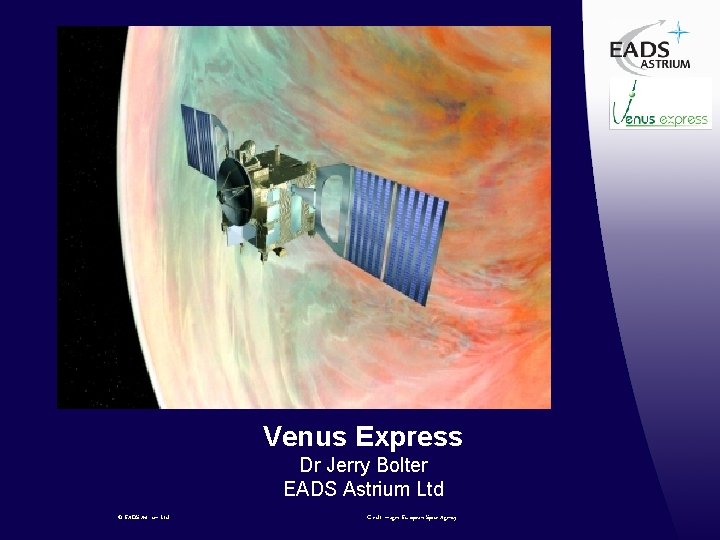
Venus Express Dr Jerry Bolter EADS Astrium Ltd © EADS Astrium Ltd Credit images: European Space Agency
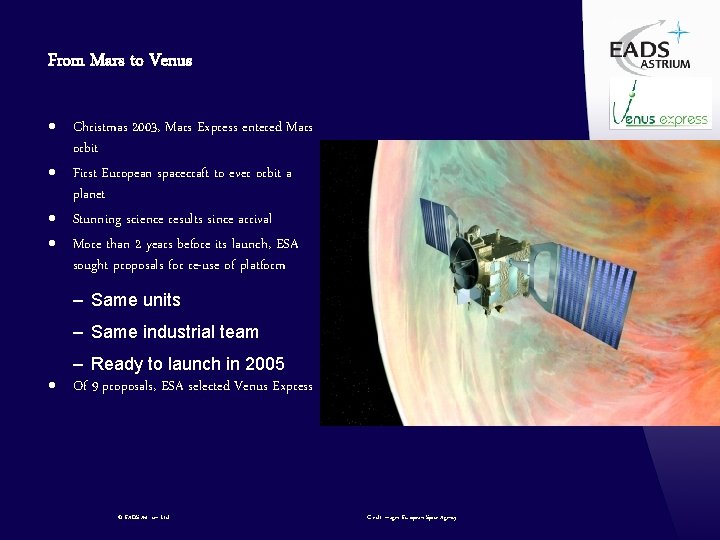
From Mars to Venus · Christmas 2003, Mars Express entered Mars orbit · First European spacecraft to ever orbit a planet · Stunning science results since arrival · More than 2 years before its launch, ESA sought proposals for re-use of platform – Same units – Same industrial team – Ready to launch in 2005 · Of 9 proposals, ESA selected Venus Express © EADS Astrium Ltd Credit images: European Space Agency
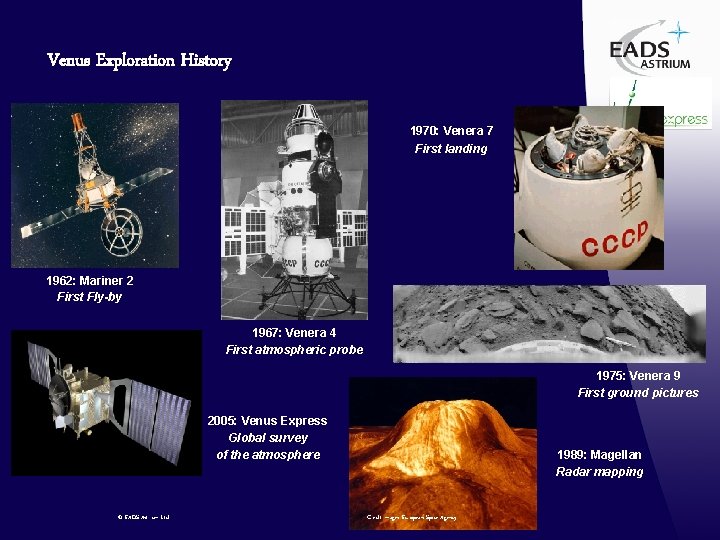
Venus Exploration History 1970: Venera 7 First landing 1962: Mariner 2 First Fly-by 1967: Venera 4 First atmospheric probe 1975: Venera 9 First ground pictures 2005: Venus Express Global survey of the atmosphere © EADS Astrium Ltd 1989: Magellan Radar mapping Credit images: European Space Agency
© EADS Astrium Ltd Credit images: European Space Agency
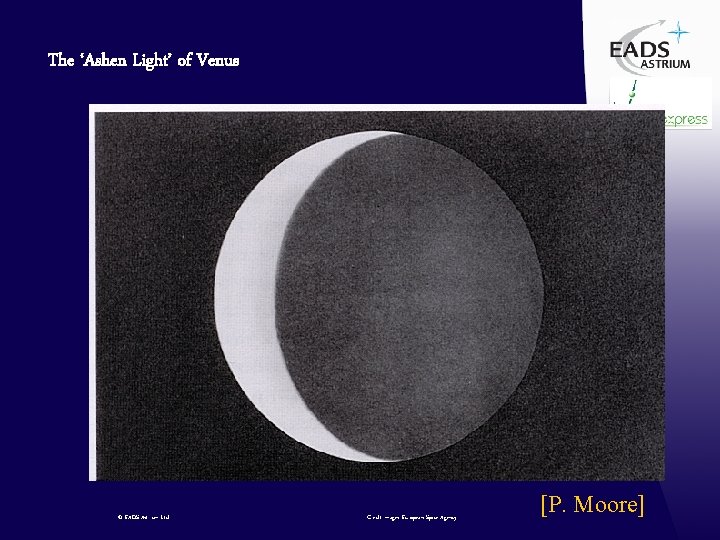
The ‘Ashen Light’ of Venus © EADS Astrium Ltd Credit images: European Space Agency [P. Moore]
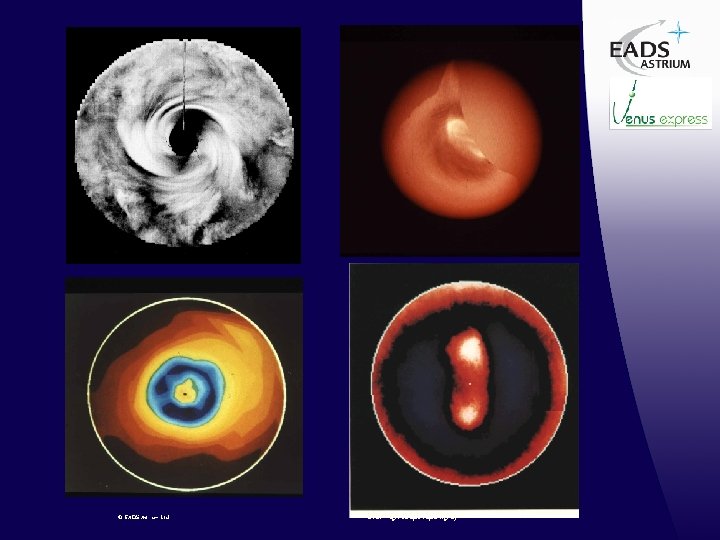
© EADS Astrium Ltd Credit images: European Space Agency
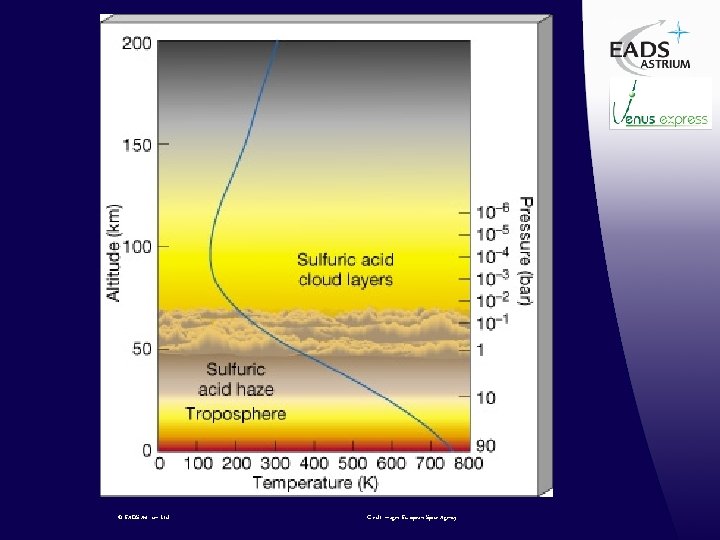
Why Venus Express? · Venus is the nearest planetary neighbour to Earth – A solid planet, the same size as Earth and yet …. – Very high surface temperatures (470 deg. C) and pressures (90 bar) – Highly sulphurous clouds – Believed to be highly volcanic – Absorbs less solar energy than the Earth and only slightly more than distant, frozen Mars – Venus rotation is very slow yet suffers hurricane-force winds and storms with giant vortices · over the poles Strong concerns about the Earth’s climate – Reduction in ice-fields leading to changes in ocean current circulations and global warming whilst · · – Scientists cannot explain even the basic features on the nearest and most Earth-like planet Planetary alignments necessitated a very short-duration programme if the scientific opportunities were not to be missed ESA mission based on re-use of its Mars Express spacecraft © EADS Astrium Ltd Credit images: European Space Agency
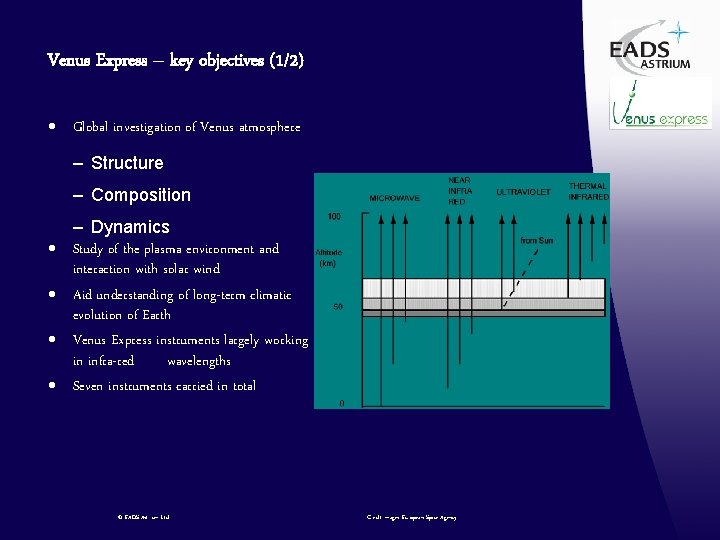
Venus Express – key objectives (1/2) · Global investigation of Venus atmosphere – Structure – Composition · · – Dynamics Study of the plasma environment and interaction with solar wind Aid understanding of long-term climatic evolution of Earth Venus Express instruments largely working in infra-red wavelengths Seven instruments carried in total © EADS Astrium Ltd Credit images: European Space Agency
Venus Express – key objectives (2/2) First European mission to Venus Other firsts: ØFirst global monitoring of the composition of the lower atmosphere in near IR range ØFirst coherent study of the atmospheric temperature and dynamics at different levels from the surface to 200 km ØFirst measurement of the global temperature distribution from orbit ØFirst study of the middle and upper atmosphere dynamics from O 2, O and NO emissions ØFirst measurements of the non-thermal atmosphere escape ØFirst coherent observations of Venus in the spectral range from UV to Thermal IR ØFirst application of the solar/stellar occultation technique at Venus ØFirst use of 3 D ion analyser, high energy resolution electron spectrometer and energetic neutral atom imager © EADS Astrium Ltd Credit images: European Space Agency
Science mission Venus Express Instrument · Major objectives: – Global survey of atmosphere composition, – Measurements of temperature distribution, – Study of atmosphere dynamics, – Study of interaction between atmosphere and solar wind. · Mission duration: – Nominal mission: 2 Venus days (about 500 days), – Possible extension of 2 Venus days, pending on spacecraft resources. © EADS Astrium Ltd Objective Heritage ASPERA Analyser of Space Plasmas and Energetic Atoms Mars Express MAG Magnetometer Rosetta PFS High-resolution IR Fourier spectrometer Mars Express SPICAV UV and IR Atmospheric Spectrometer Mars Express Ve. RA Radio Science Experiment Rosetta VIRTIS UV Visible Near IR Mapping Spectrometer Rosetta VMC Venus Monitoring Camera Credit images: European Space Agency
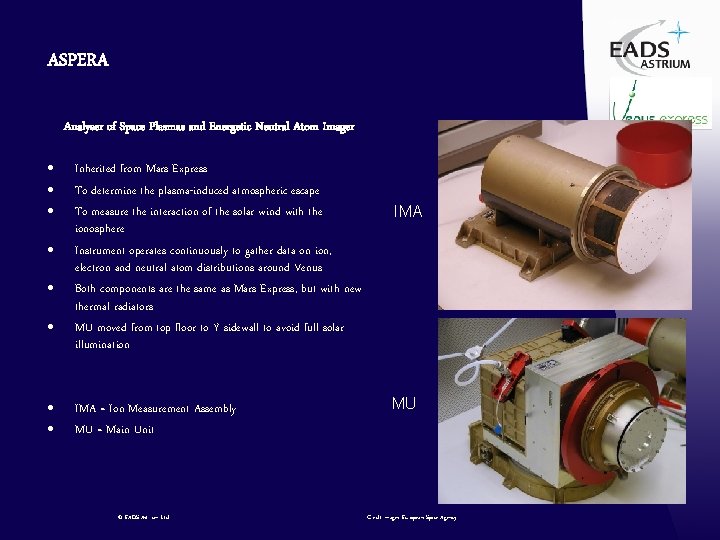
ASPERA Analyser of Space Plasmas and Energetic Neutral Atom Imager · · · · Inherited from Mars Express To determine the plasma-induced atmospheric escape To measure the interaction of the solar wind with the ionosphere Instrument operates continuously to gather data on ion, electron and neutral atom distributions around Venus Both components are the same as Mars Express, but with new thermal radiators MU moved from top floor to Y sidewall to avoid full solar illumination IMA = Ion Measurement Assembly MU = Main Unit © EADS Astrium Ltd IMA MU Credit images: European Space Agency
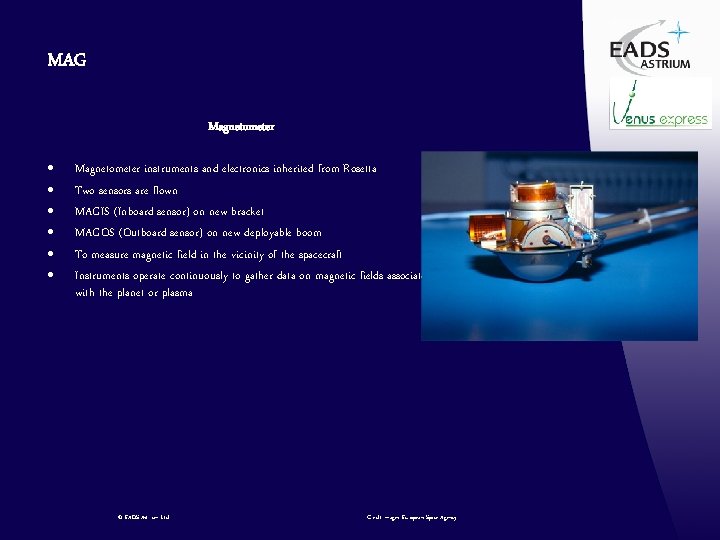
MAG Magnetometer · · · Magnetometer instruments and electronics inherited from Rosetta Two sensors are flown MAGIS (Inboard sensor) on new bracket MAGOS (Outboard sensor) on new deployable boom To measure magnetic field in the vicinity of the spacecraft Instruments operate continuously to gather data on magnetic fields associated with the planet or plasma © EADS Astrium Ltd Credit images: European Space Agency
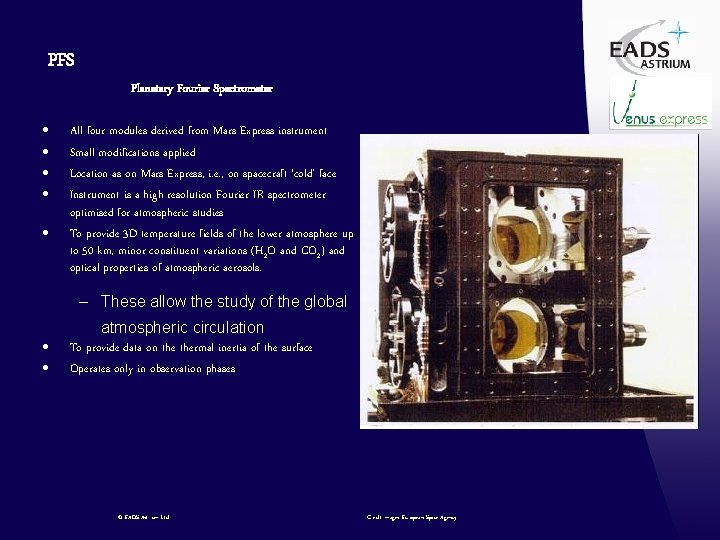
PFS · · · Planetary Fourier Spectrometer All four modules derived from Mars Express instrument Small modifications applied Location as on Mars Express, i. e. , on spacecraft ‘cold’ face Instrument is a high resolution Fourier IR spectrometer optimised for atmospheric studies To provide 3 D temperature fields of the lower atmosphere up to 50 km, minor constituent variations (H 2 O and CO 2) and optical properties of atmospheric aerosols. – These allow the study of the global · · atmospheric circulation To provide data on thermal inertia of the surface Operates only in observation phases © EADS Astrium Ltd Credit images: European Space Agency
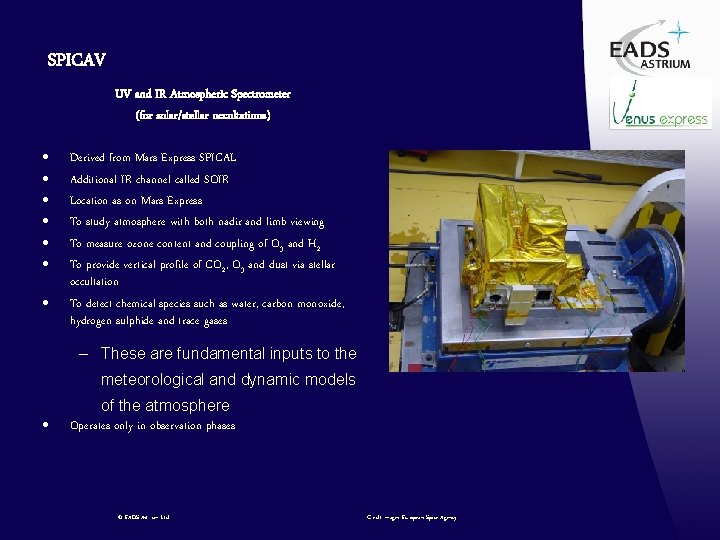
SPICAV UV and IR Atmospheric Spectrometer (for solar/stellar occultations) · · · · Derived from Mars Express SPICAL Additional IR channel called SOIR Location as on Mars Express To study atmosphere with both nadir and limb viewing To measure ozone content and coupling of O 3 and H 2 To provide vertical profile of CO 2, O 3 and dust via stellar occultation To detect chemical species such as water, carbon monoxide, hydrogen sulphide and trace gases – These are fundamental inputs to the meteorological and dynamic models · of the atmosphere Operates only in observation phases © EADS Astrium Ltd Credit images: European Space Agency
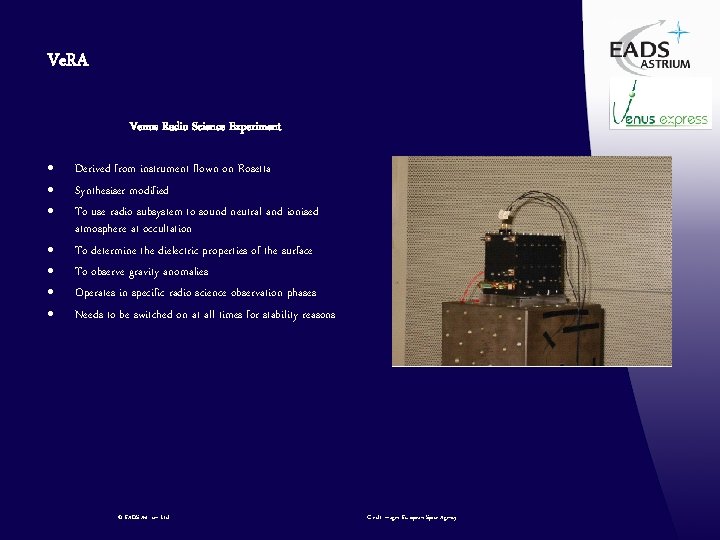
Ve. RA Venus Radio Science Experiment · · · · Derived from instrument flown on Rosetta Synthesiser modified To use radio subsystem to sound neutral and ionised atmosphere at occultation To determine the dielectric properties of the surface To observe gravity anomalies Operates in specific radio science observation phases Needs to be switched on at all times for stability reasons © EADS Astrium Ltd Credit images: European Space Agency
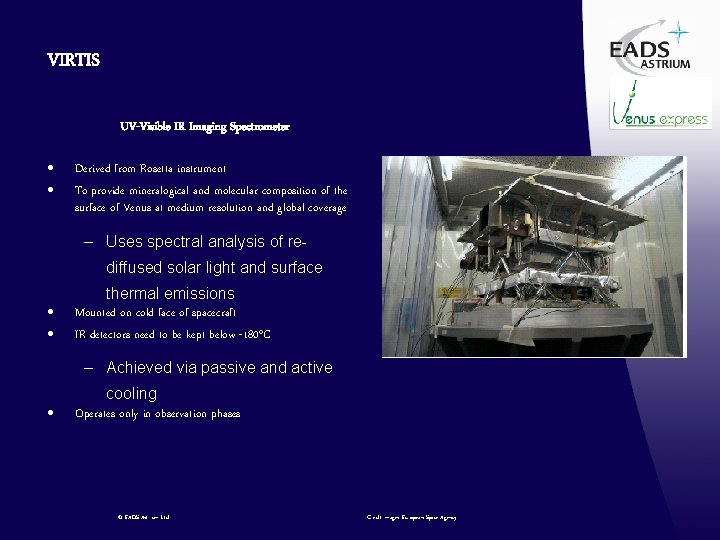
VIRTIS UV-Visible IR Imaging Spectrometer · · Derived from Rosetta instrument To provide mineralogical and molecular composition of the surface of Venus at medium resolution and global coverage – Uses spectral analysis of rediffused solar light and surface · · thermal emissions Mounted on cold face of spacecraft IR detectors need to be kept below -180°C – Achieved via passive and active · cooling Operates only in observation phases © EADS Astrium Ltd Credit images: European Space Agency
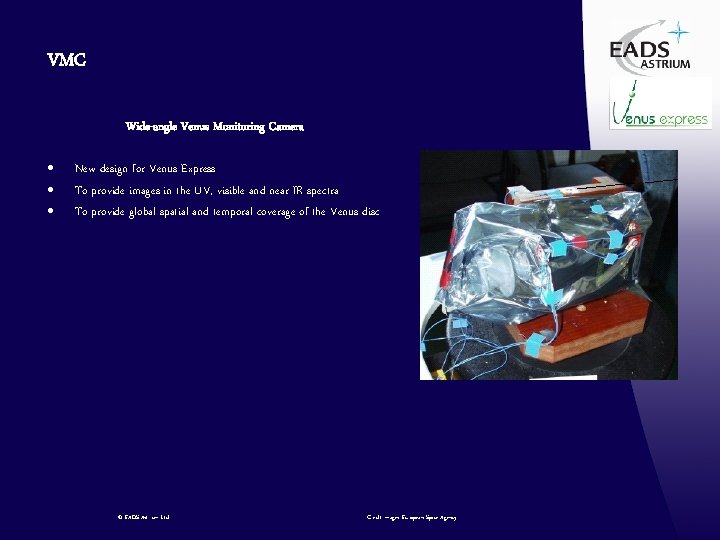
VMC Wide-angle Venus Monitoring Camera · · · New design for Venus Express To provide images in the UV, visible and near IR spectra To provide global spatial and temporal coverage of the Venus disc © EADS Astrium Ltd Credit images: European Space Agency
Venus Express Program · ESA programme, dedicated to the observation of Venus – Prime contractor: EADS Astrium SAS – UK major contractors: EADS Astrium Ltd - Mechanical Bus (structure and propulsion) Sci. Sys – Ground station (ESOC) – Other UK contractors: AEA Battery Systems Ltd - Batteries MT Satellite Products - Propellant Tanks Ampac-ISP (UK) Ltd - Propellant processing · Major steps: – Programme Kick-off November 2002 – Launch (Soyuz/Fregat) November 9 th, 2005 – Venus rendezvous 11 th April, 2006 – Spacecraft now in cruise to Venus · Three main challenges: – Maximum re-use of Mars Express/Rosetta (platform and instruments) – Delivery in 3 years – Meet stringent science requirements in Venus’ severe environment © EADS Astrium Ltd Credit images: European Space Agency
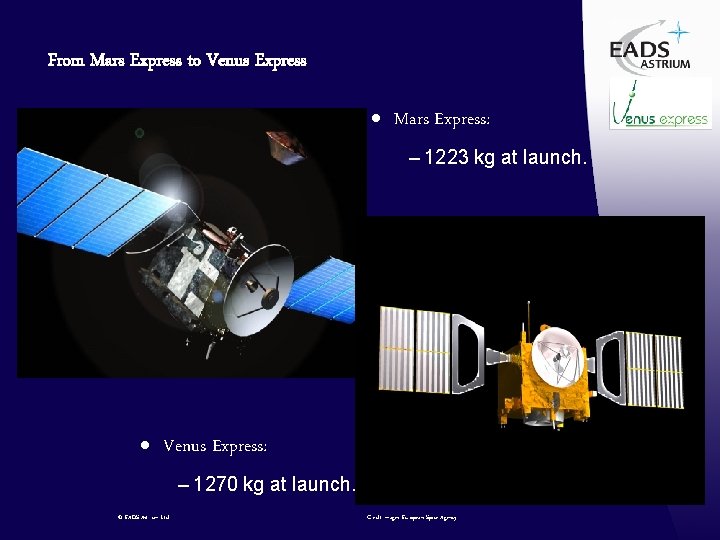
From Mars Express to Venus Express · Mars Express: – 1223 kg at launch. · Venus Express: – 1270 kg at launch. © EADS Astrium Ltd Credit images: European Space Agency
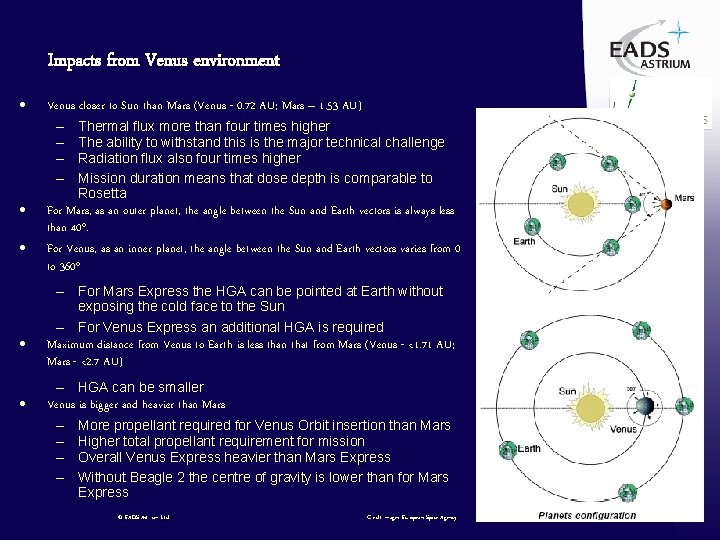
Impacts from Venus environment · Venus closer to Sun than Mars (Venus - 0. 72 AU; Mars – 1. 53 AU) – – · · Thermal flux more than four times higher The ability to withstand this is the major technical challenge Radiation flux also four times higher Mission duration means that dose depth is comparable to Rosetta For Mars, as an outer planet, the angle between the Sun and Earth vectors is always less than 40°. For Venus, as an inner planet, the angle between the Sun and Earth vectors varies from 0 to 360° – For Mars Express the HGA can be pointed at Earth without exposing the cold face to the Sun – For Venus Express an additional HGA is required Maximum distance from Venus to Earth is less than that from Mars (Venus - <1. 71 AU; Mars - <2. 7 AU) – HGA can be smaller Venus is bigger and heavier than Mars – – More propellant required for Venus Orbit insertion than Mars Higher total propellant requirement for mission Overall Venus Express heavier than Mars Express Without Beagle 2 the centre of gravity is lower than for Mars Express © EADS Astrium Ltd Credit images: European Space Agency
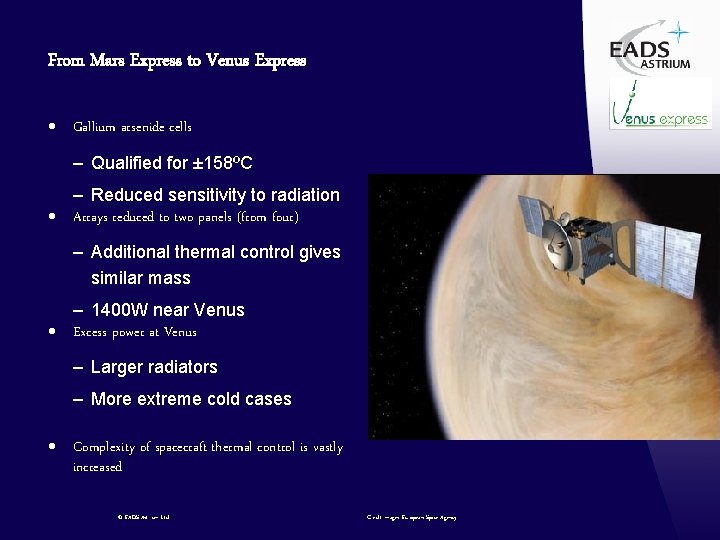
From Mars Express to Venus Express · Gallium arsenide cells – Qualified for ± 158ºC – Reduced sensitivity to radiation · Arrays reduced to two panels (from four) – Additional thermal control gives similar mass – 1400 W near Venus · Excess power at Venus – Larger radiators – More extreme cold cases · Complexity of spacecraft thermal control is vastly increased © EADS Astrium Ltd Credit images: European Space Agency
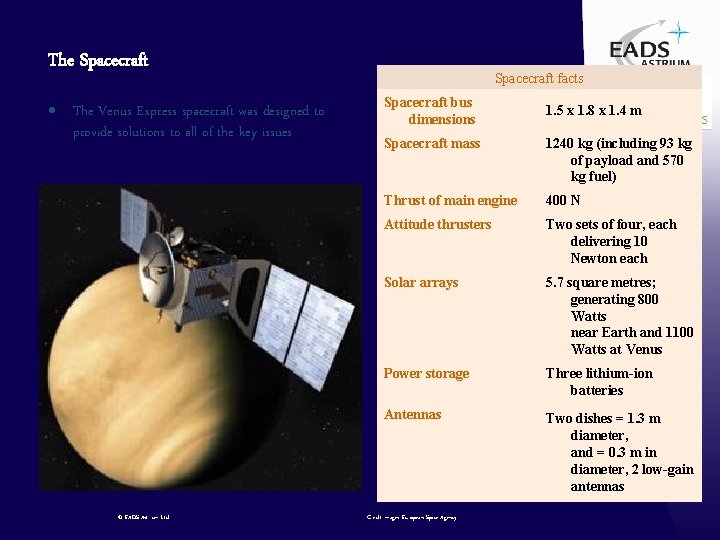
The Spacecraft · The Venus Express spacecraft was designed to provide solutions to all of the key issues © EADS Astrium Ltd Spacecraft facts Spacecraft bus dimensions 1. 5 x 1. 8 x 1. 4 m Spacecraft mass 1240 kg (including 93 kg of payload and 570 kg fuel) Thrust of main engine 400 N Attitude thrusters Two sets of four, each delivering 10 Newton each Solar arrays 5. 7 square metres; generating 800 Watts near Earth and 1100 Watts at Venus Power storage Three lithium-ion batteries Antennas Two dishes = 1. 3 m diameter, and = 0. 3 m in diameter, 2 low-gain antennas Credit images: European Space Agency
The Spacecraft · Structure – The spacecraft body is termed a ‘bus’, it is a honeycomb aluminium box (1. 5 m wide). With its solar arrays extended, it measures ~ 8 m across – The scientific instruments mounted in the bus are concentrated on three sides. · Thermal Control – The spacecraft coating, called ‘multi-layer insulation’ or MLI, is composed of 23 layers. – The MLI is gold instead of black, which provides more capability to reflect the radiation. In general, previous spacecraft have been designed to keep warm while Venus Express is modified to stay cool. · Power – At Venus, the Sun appears twice as powerful as on Earth, so solar radiation to power the spacecraft is plentiful. – When the spacecraft is in shadow (eclipse) or when its power demand exceeds the capacity of the solar arrays, electrical power is supplied by three lithium-ion batteries that are charged by the solar-generated power. © EADS Astrium Ltd Credit images: European Space Agency
The Spacecraft · Navigation and Attitude Control – Venus Express is a three-axis stabilised spacecraft. Through three different systems on board, the spacecraft can acquire data about its position in space, attitude (orientation) and change of velocity. – These on-board systems provide data necessary to re-orient the spacecraft and the solar arrays. – The actual spacecraft re-orientation manoeuvre or trajectory correction is performed by means of so-called ‘reaction wheels’ or by firing the thrusters. · Data Storage – The Venus Express on-board computer is responsible for supervising and managing the overall spacecraft functioning, for handling all data acquired by instruments and sensors and for sending commands through the whole spacecraft. – Part of the computer is the Solid State Mass Memory, which has a capacity of 12 gigabits. All scientific data collected by the instruments are stored here until they can be downloaded to Earth during the appropriate orbital phase © EADS Astrium Ltd Credit images: European Space Agency
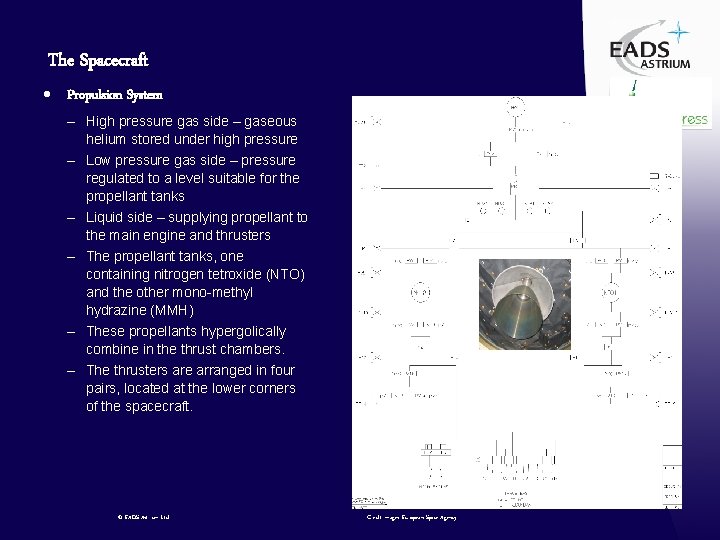
The Spacecraft · Propulsion System – High pressure gas side – gaseous helium stored under high pressure – Low pressure gas side – pressure regulated to a level suitable for the propellant tanks – Liquid side – supplying propellant to the main engine and thrusters – The propellant tanks, one containing nitrogen tetroxide (NTO) and the other mono-methyl hydrazine (MMH) – These propellants hypergolically combine in the thrust chambers. – The thrusters are arranged in four pairs, located at the lower corners of the spacecraft. © EADS Astrium Ltd Credit images: European Space Agency
© EADS Astrium Ltd Credit images: European Space Agency
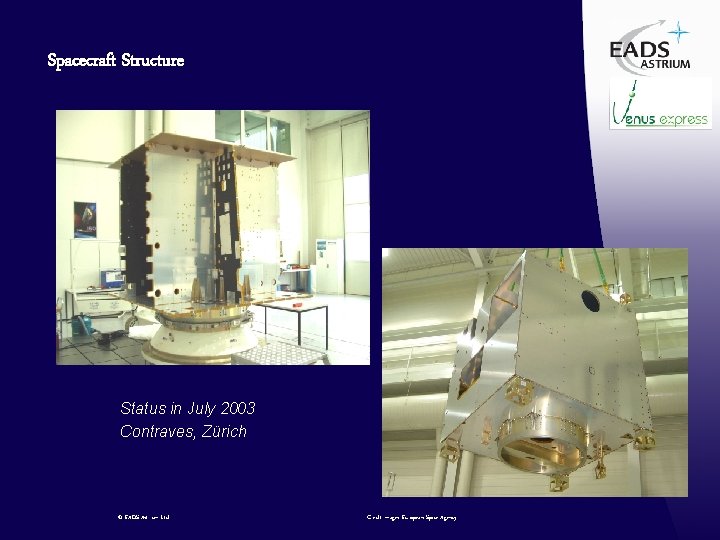
Spacecraft Structure Status in July 2003 Contraves, Zürich © EADS Astrium Ltd Credit images: European Space Agency
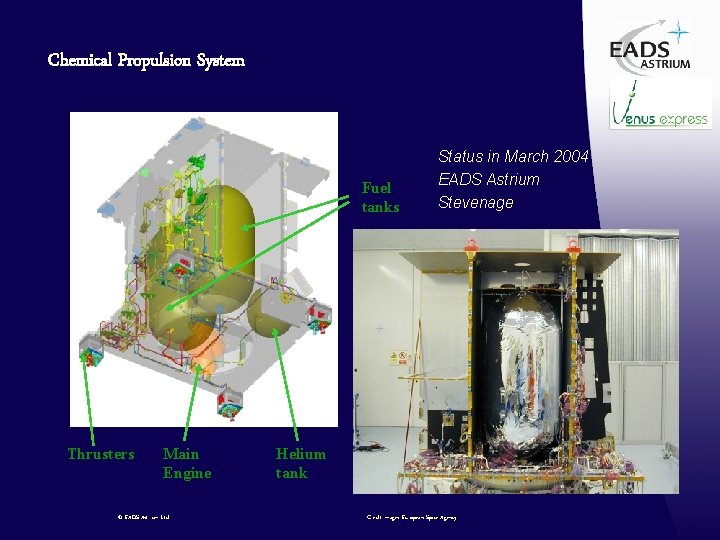
Chemical Propulsion System Fuel tanks Thrusters Main Engine © EADS Astrium Ltd Status in March 2004 EADS Astrium Stevenage Helium tank Credit images: European Space Agency
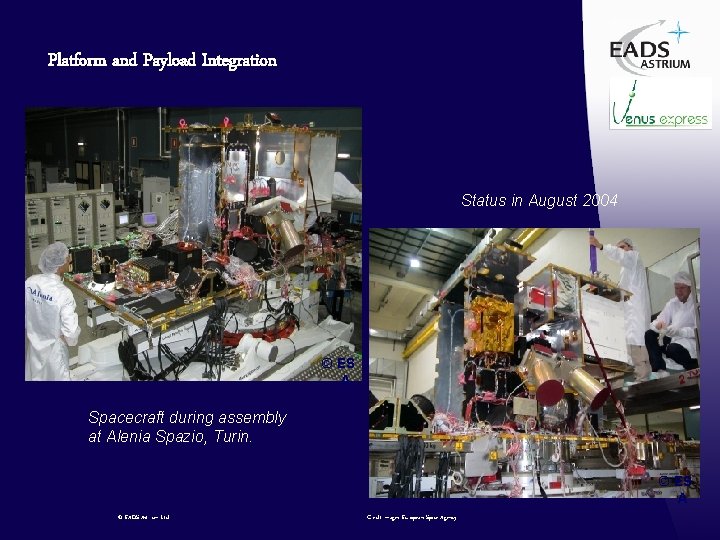
Platform and Payload Integration Status in August 2004 © ES A Spacecraft during assembly at Alenia Spazio, Turin. © ES A © EADS Astrium Ltd Credit images: European Space Agency
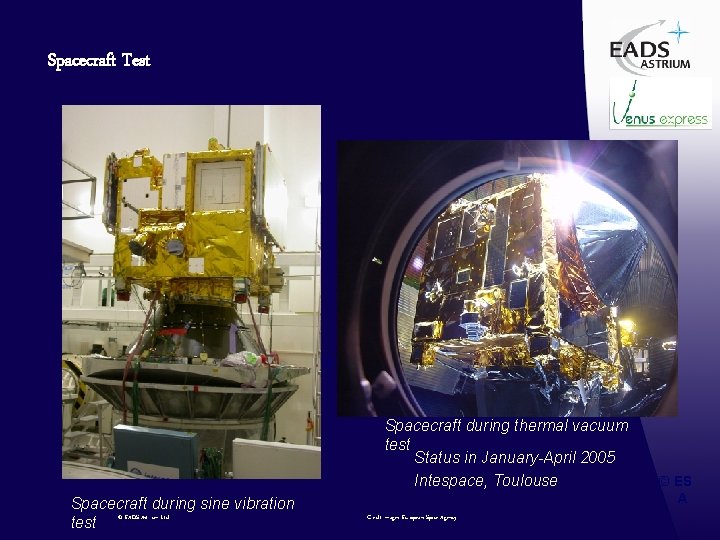
Spacecraft Test © ES A Spacecraft during thermal vacuum test Status in January-April 2005 Intespace, Toulouse Spacecraft during sine vibration © EADS Astrium Ltd test Credit images: European Space Agency © ES A
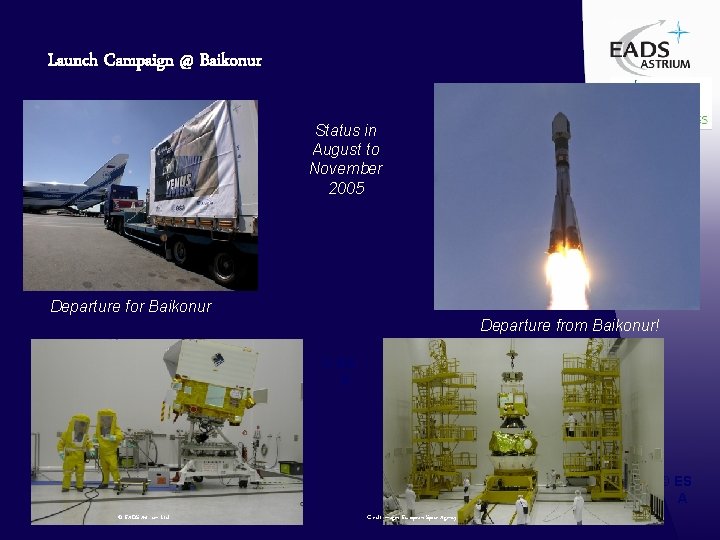
Launch Campaign @ Baikonur Status in August to November 2005 Departure for Baikonur Departure from Baikonur! © ES A © EADS Astrium Ltd Credit images: European Space Agency
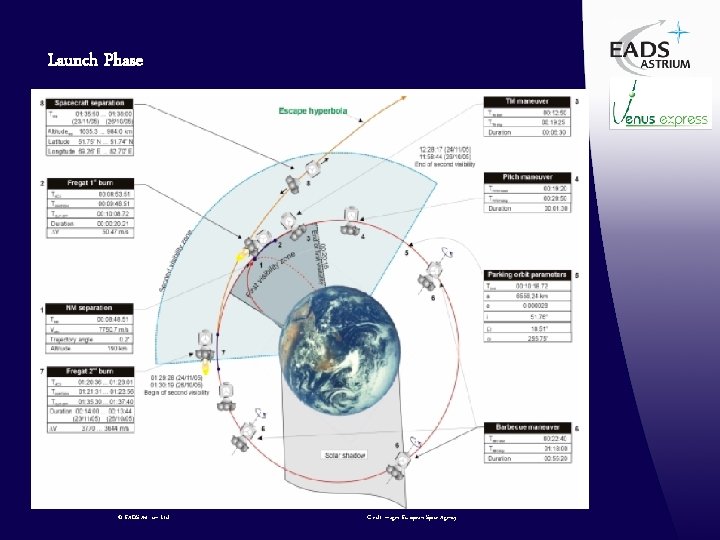
Launch Phase © EADS Astrium Ltd Credit images: European Space Agency
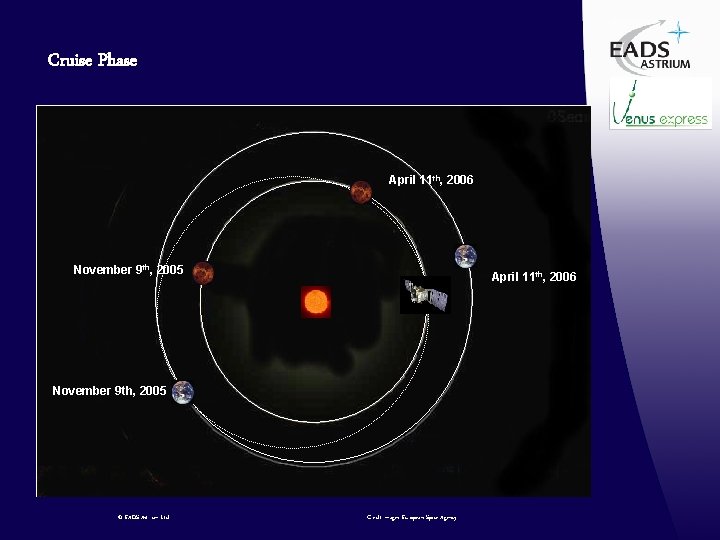
Cruise Phase April 11 th, 2006 November 9 th, 2005 © EADS Astrium Ltd Credit images: European Space Agency
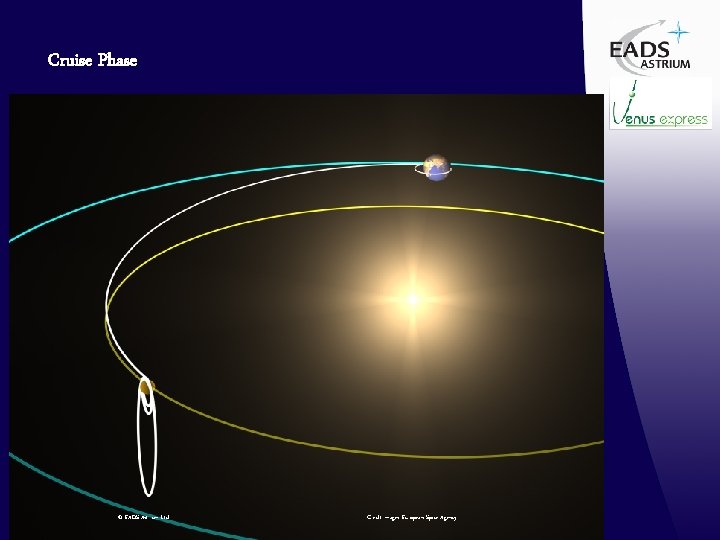
Cruise Phase © EADS Astrium Ltd Credit images: European Space Agency
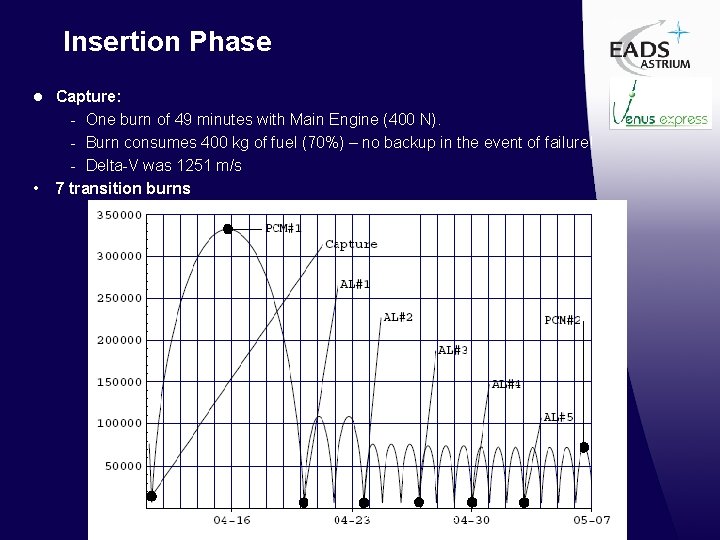
Insertion Phase l • Capture: - One burn of 49 minutes with Main Engine (400 N). - Burn consumes 400 kg of fuel (70%) – no backup in the event of failure! - Delta-V was 1251 m/s 7 transition burns © EADS Astrium Ltd Credit images: European Space Agency
Launch Animation © EADS Astrium Ltd Credit images: European Space Agency
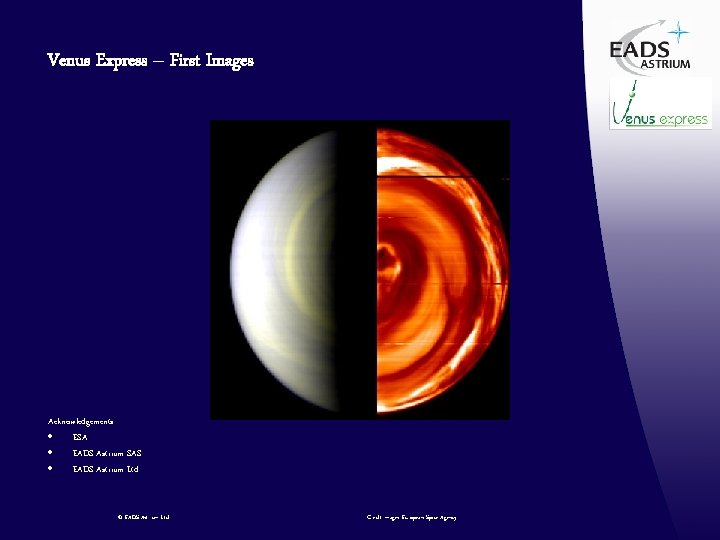
Venus Express – First Images Acknowledgements · ESA · EADS Astrium SAS · EADS Astrium Ltd © EADS Astrium Ltd Credit images: European Space Agency
- Slides: 37