
Venus 1 Venus basic data Semimajor axis Eccentricity
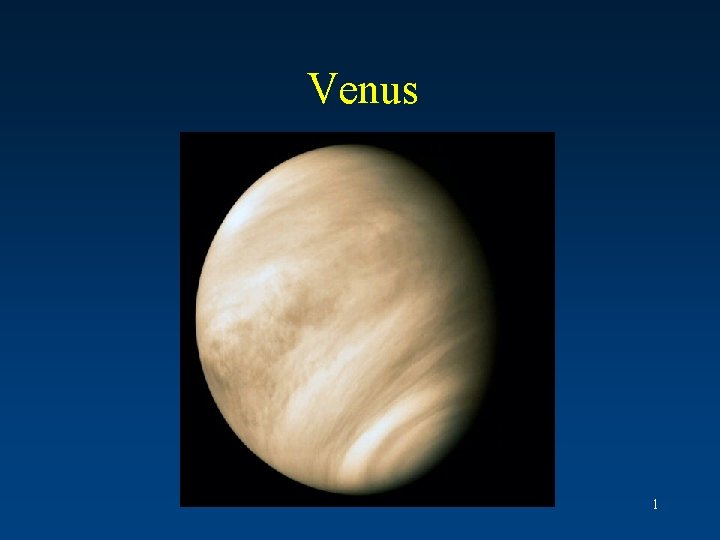
Venus 1
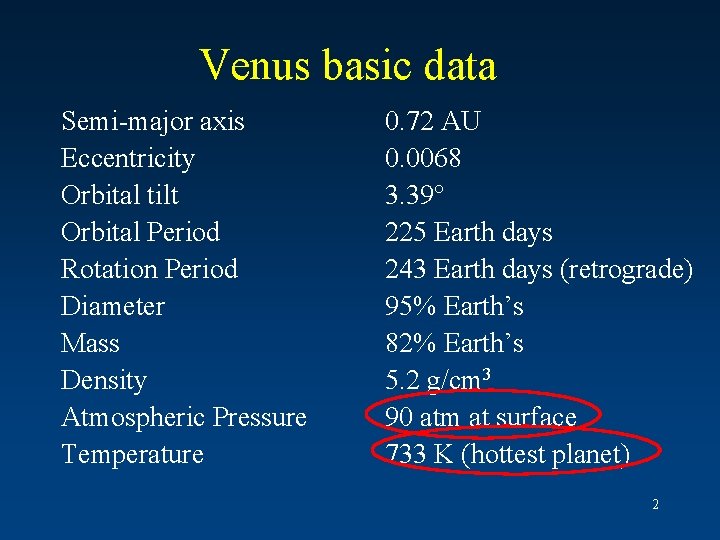
Venus basic data Semi-major axis Eccentricity Orbital tilt Orbital Period Rotation Period Diameter Mass Density Atmospheric Pressure Temperature 0. 72 AU 0. 0068 3. 39° 225 Earth days 243 Earth days (retrograde) 95% Earth’s 82% Earth’s 5. 2 g/cm 3 90 atm at surface 733 K (hottest planet) 2

• Atmosphere so thick, can’t see surface, at visible, UV or most IR wavelengths Visible UV • Strong upper level winds of up to 350 km/h • Convection: hot air from equatorial regions to poles, cools, returns to equator. Keeps T very constant. Convection and winds give V-shape appearance. • Yet at surface winds are only < 5 km/h due to intense pressure. IR 3
Missions to Venus Soviet Venera 4 -18 (1967 - 1983) Mariner 2, 5 and 10 (1962, 1967 and 1974) Pioneer Venus (1978) Magellan (1989) Venus Express (ESA, launched 9 Nov 2005), in orbit since May 2006. Ended in 2014. 4
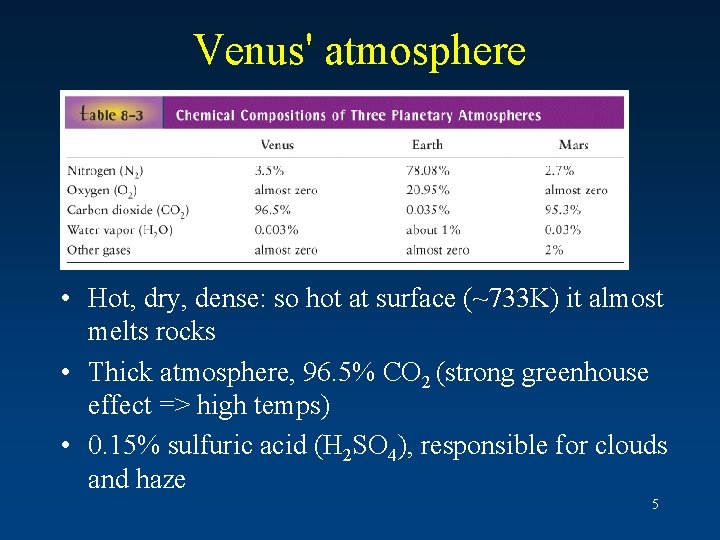
Venus' atmosphere • Hot, dry, dense: so hot at surface (~733 K) it almost melts rocks • Thick atmosphere, 96. 5% CO 2 (strong greenhouse effect => high temps) • 0. 15% sulfuric acid (H 2 SO 4), responsible for clouds and haze 5
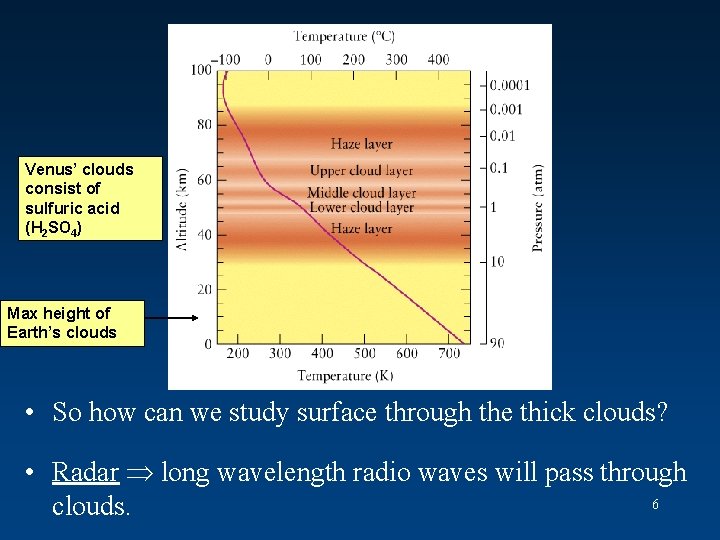
Venus’ clouds consist of sulfuric acid (H 2 SO 4) Max height of Earth’s clouds • So how can we study surface through the thick clouds? • Radar long wavelength radio waves will pass through 6 clouds.
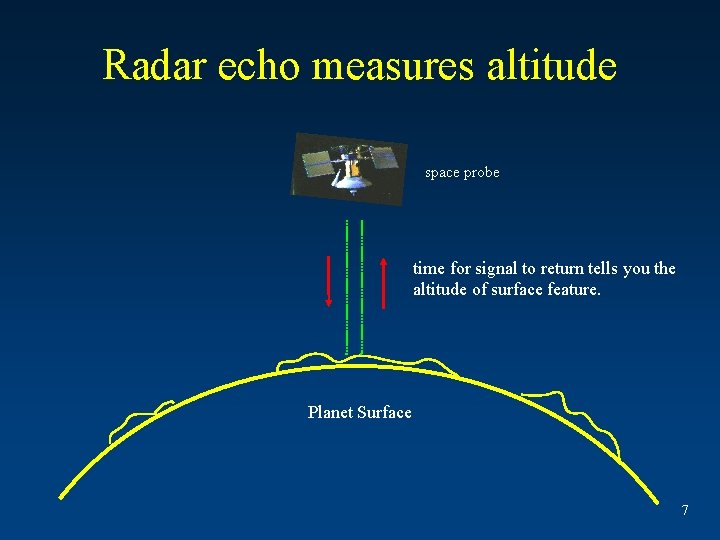
Radar echo measures altitude space probe time for signal to return tells you the altitude of surface feature. Planet Surface 7
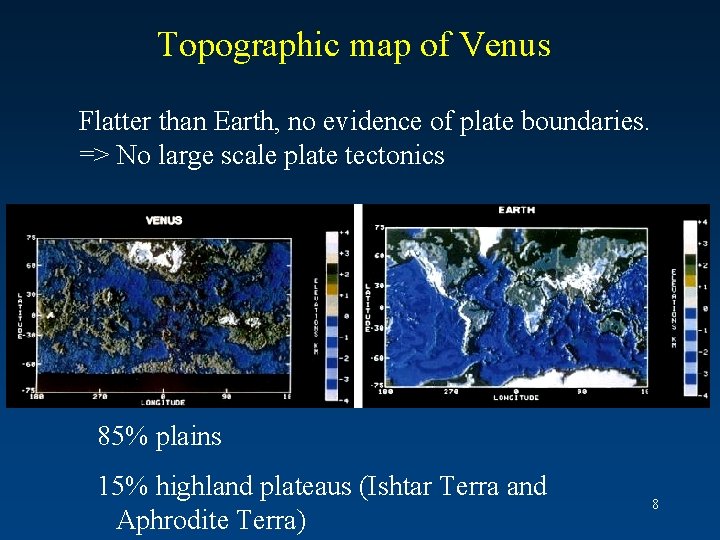
Topographic map of Venus Flatter than Earth, no evidence of plate boundaries. => No large scale plate tectonics 85% plains 15% highland plateaus (Ishtar Terra and Aphrodite Terra) 8
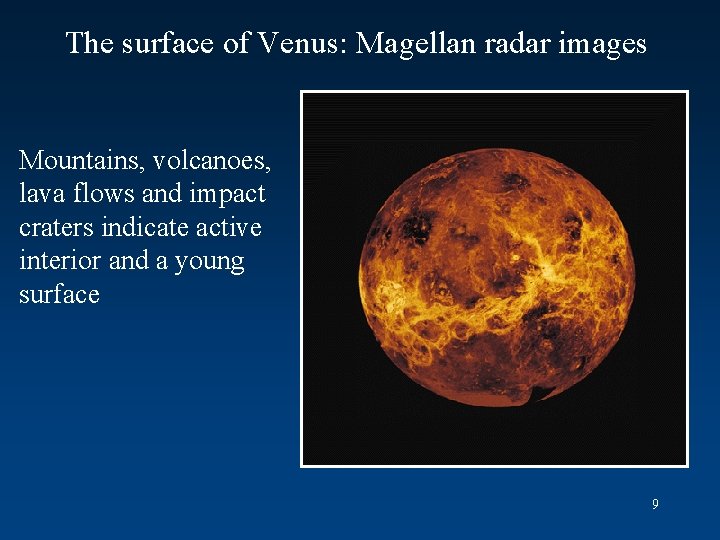
The surface of Venus: Magellan radar images Mountains, volcanoes, lava flows and impact craters indicate active interior and a young surface 9
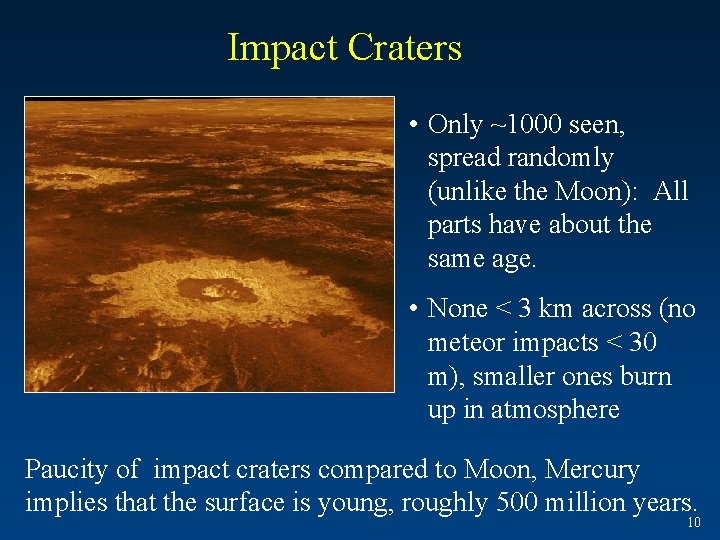
Impact Craters • Only ~1000 seen, spread randomly (unlike the Moon): All parts have about the same age. • None < 3 km across (no meteor impacts < 30 m), smaller ones burn up in atmosphere Paucity of impact craters compared to Moon, Mercury implies that the surface is young, roughly 500 million years. 10
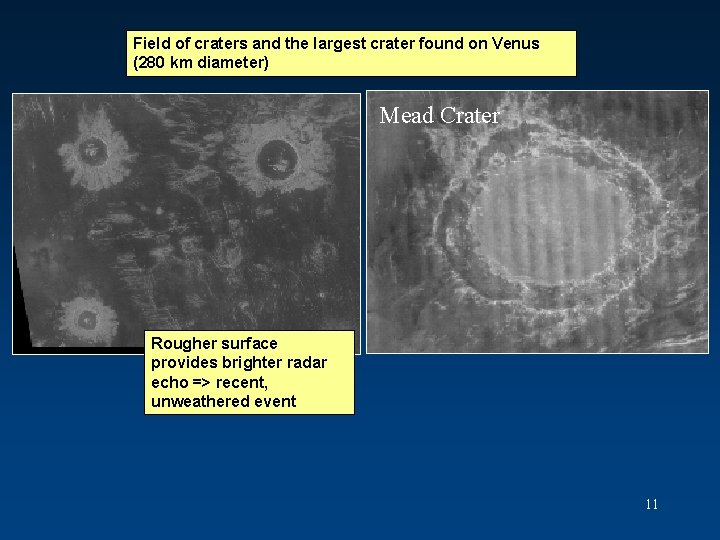
Field of craters and the largest crater found on Venus (280 km diameter) Mead Crater Rougher surface provides brighter radar echo => recent, unweathered event 11
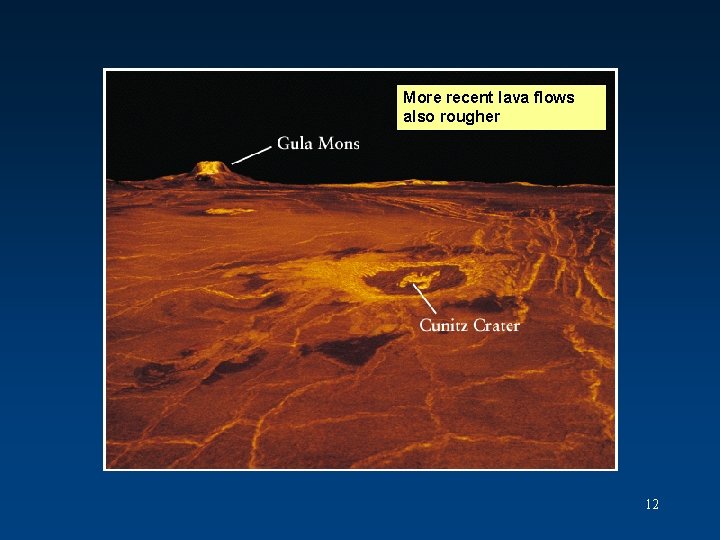
More recent lava flows also rougher 12
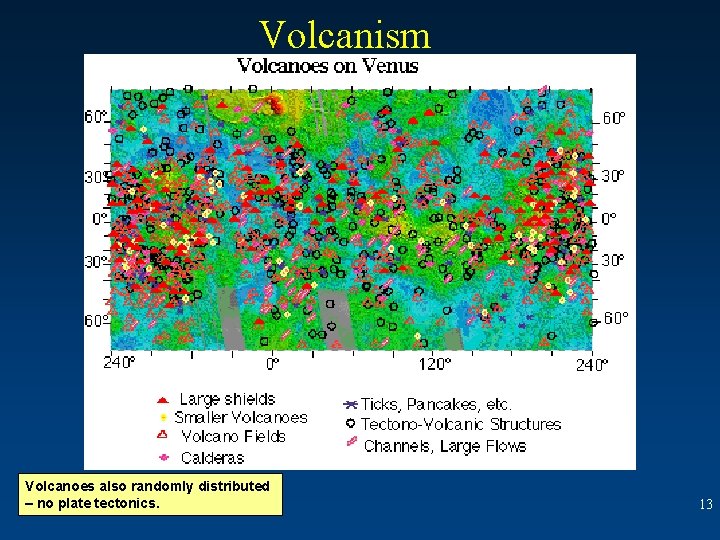
Volcanism Volcanoes also randomly distributed – no plate tectonics. 13

Shield volcano elevation map from Magellan radar data. About 100 km across. Sif Mons, and a ~ 5 km long lava flow. Estimate lava flowed within 10 million years. 14
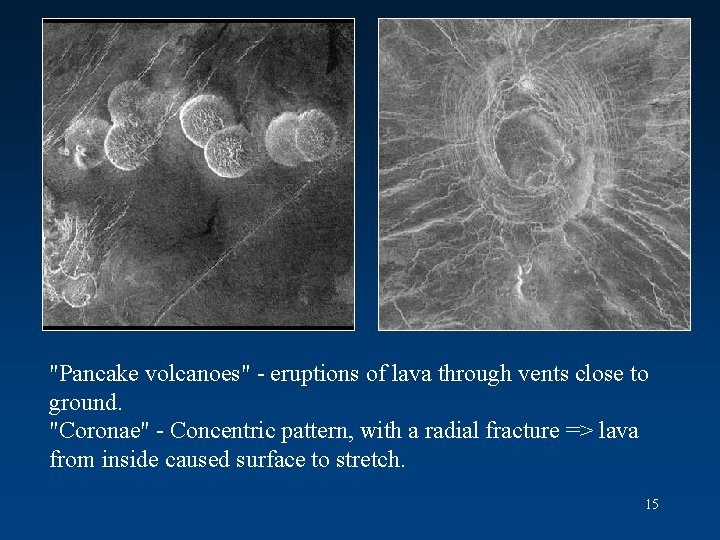
"Pancake volcanoes" - eruptions of lava through vents close to ground. "Coronae" - Concentric pattern, with a radial fracture => lava from inside caused surface to stretch. 15
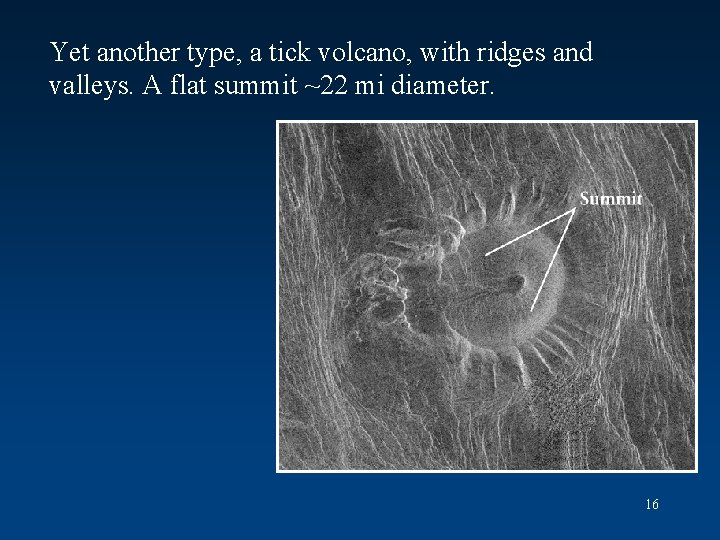
Yet another type, a tick volcano, with ridges and valleys. A flat summit ~22 mi diameter. 16
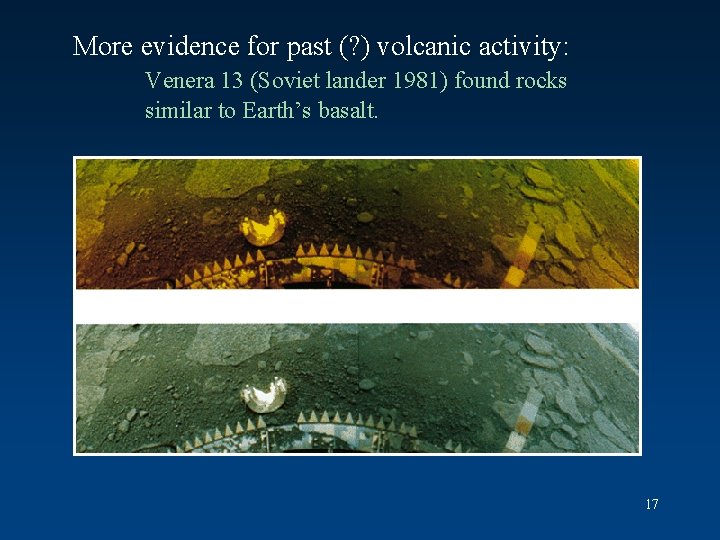
More evidence for past (? ) volcanic activity: Venera 13 (Soviet lander 1981) found rocks similar to Earth’s basalt. 17
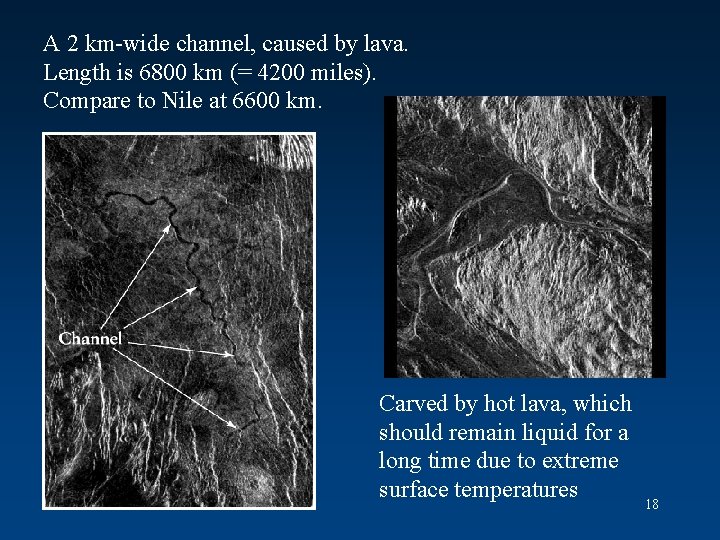
A 2 km-wide channel, caused by lava. Length is 6800 km (= 4200 miles). Compare to Nile at 6600 km. Carved by hot lava, which should remain liquid for a long time due to extreme surface temperatures 18
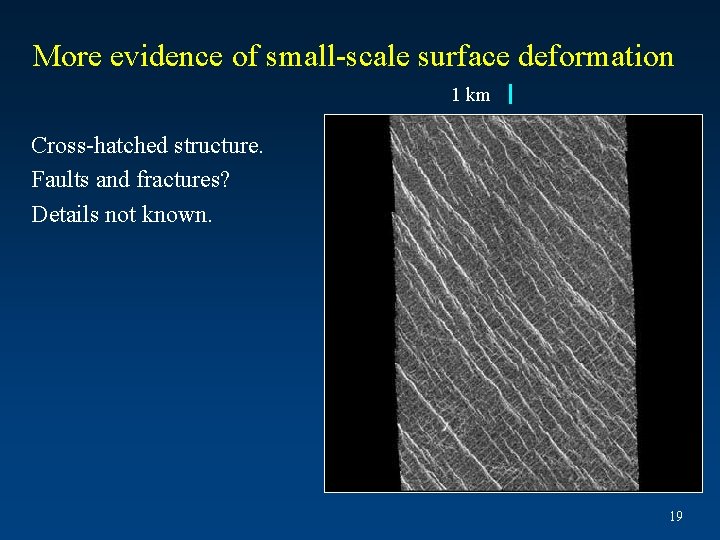
More evidence of small-scale surface deformation 1 km Cross-hatched structure. Faults and fractures? Details not known. 19
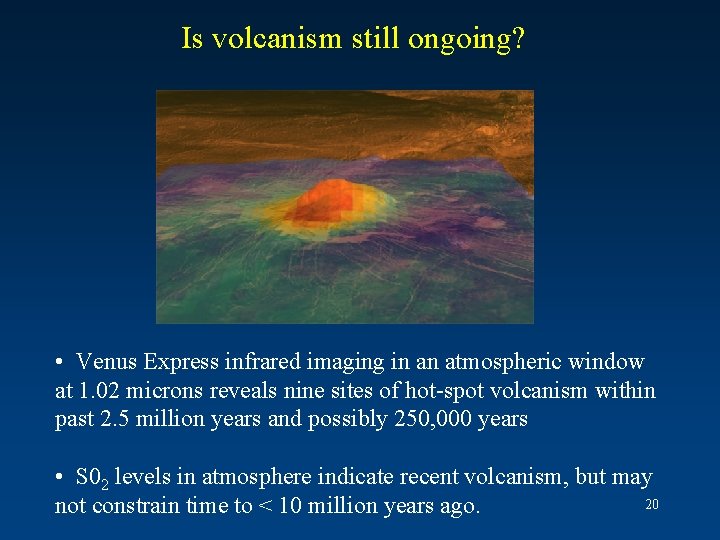
Is volcanism still ongoing? • Venus Express infrared imaging in an atmospheric window at 1. 02 microns reveals nine sites of hot-spot volcanism within past 2. 5 million years and possibly 250, 000 years • S 02 levels in atmosphere indicate recent volcanism, but may 20 not constrain time to < 10 million years ago.
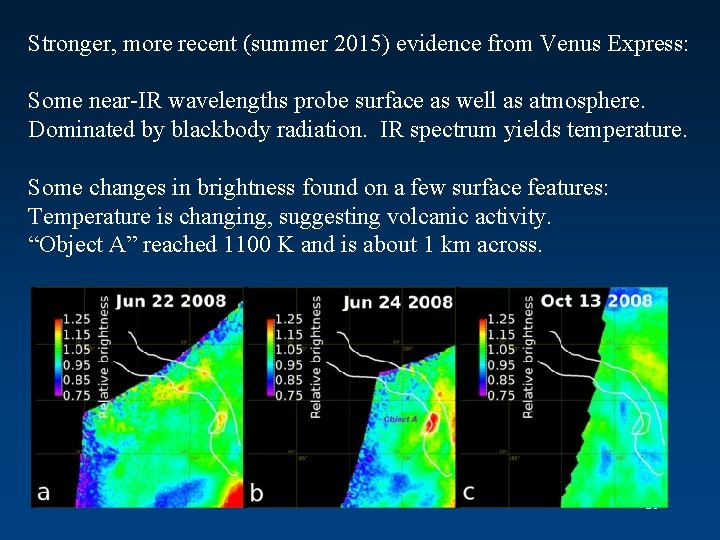
Stronger, more recent (summer 2015) evidence from Venus Express: Some near-IR wavelengths probe surface as well as atmosphere. Dominated by blackbody radiation. IR spectrum yields temperature. Some changes in brightness found on a few surface features: Temperature is changing, suggesting volcanic activity. “Object A” reached 1100 K and is about 1 km across. 21
Volcanism summary • No volcanoes in chains => no plate tectonics • Much evidence for localized upwelling and fracturing • Volcanoes may still be active • Surface is young: roughly 500 million years. All parts have about same age. If volcanoes active, only small fraction of surface affected. 22
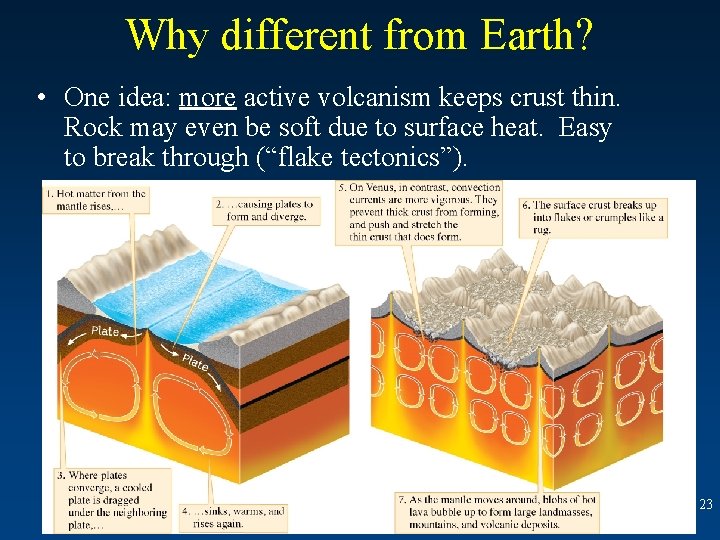
Why different from Earth? • One idea: more active volcanism keeps crust thin. Rock may even be soft due to surface heat. Easy to break through (“flake tectonics”). 23
• Second idea: the surface undergoes uniform upheaval about every ½ billion years. Heat builds up under thick, dead lithosphere until catastrophic surface meltdown. Seismometers would be very nice to have on Venus… 24
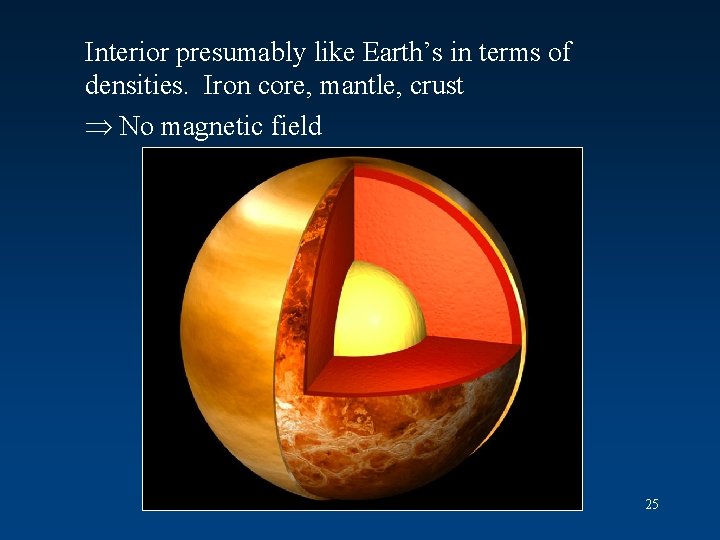
Interior presumably like Earth’s in terms of densities. Iron core, mantle, crust No magnetic field 25
Climate History of Venus • Like Earth, started with outgassing from volcanoes (mostly H 2 O, CO 2, SO 2) and perhaps additional water from cometary impacts. • Young Sun only 70% as luminous as now, so Venus’ early atmosphere would have been cooler. Probably liquid water? At least some water would have been gaseous. CO 2 dissolved in water and rocks. • Water vapor is greenhouse gas, so T would rise. Plus 26 aging Sun got brighter.
• Hotter Sun + water vapor increases atmospheric temperature. • Water could no longer be liquid as Sun got hotter (~ few 100 million years). Oceans start to evaporate, adding more H 2 O and CO 2 (and SO 2) to atmosphere. • Stronger Greenhouse effect => further evaporation => stronger Greenhouse effect, etc. Eventually, CO 2 even baked out of rocks into atmosphere. Temperature stops rising when all CO 2 removed. Runaway Greenhouse Effect! 27
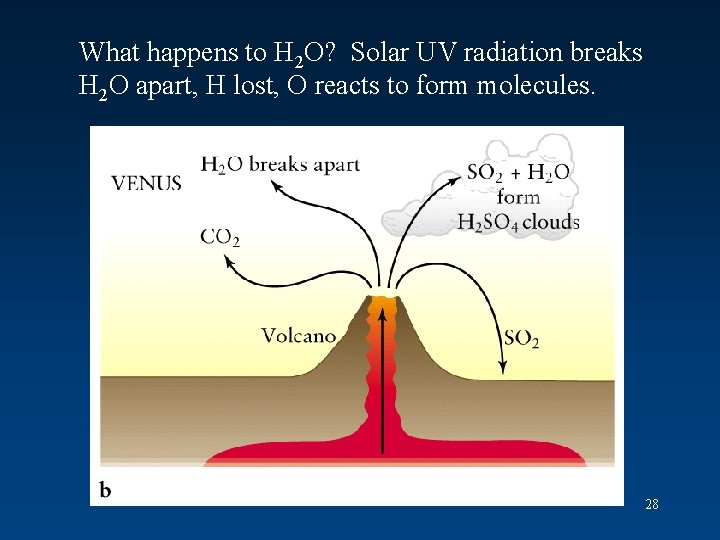
What happens to H 2 O? Solar UV radiation breaks H 2 O apart, H lost, O reacts to form molecules. 28
Comparison of Venus and Earth • Both display volcanism and geological activity, BUT Venus has: – Slow rotational period – No plate tectonics – No magnetic field – No satellite – No water – High surface temperature and dense atmosphere • Was Runaway Greenhouse Effect inevitable at this distance from Sun? 29

30
Venus fly-over 31
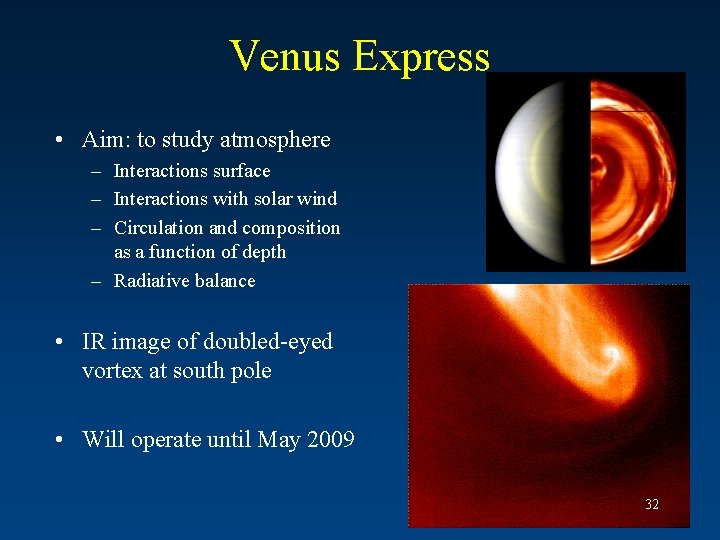
Venus Express • Aim: to study atmosphere – Interactions surface – Interactions with solar wind – Circulation and composition as a function of depth – Radiative balance • IR image of doubled-eyed vortex at south pole • Will operate until May 2009 32
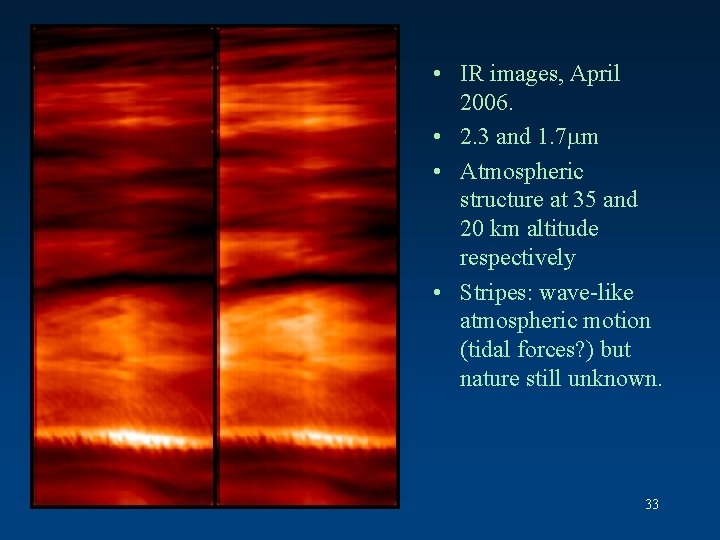
• IR images, April 2006. • 2. 3 and 1. 7 m • Atmospheric structure at 35 and 20 km altitude respectively • Stripes: wave-like atmospheric motion (tidal forces? ) but nature still unknown. 33
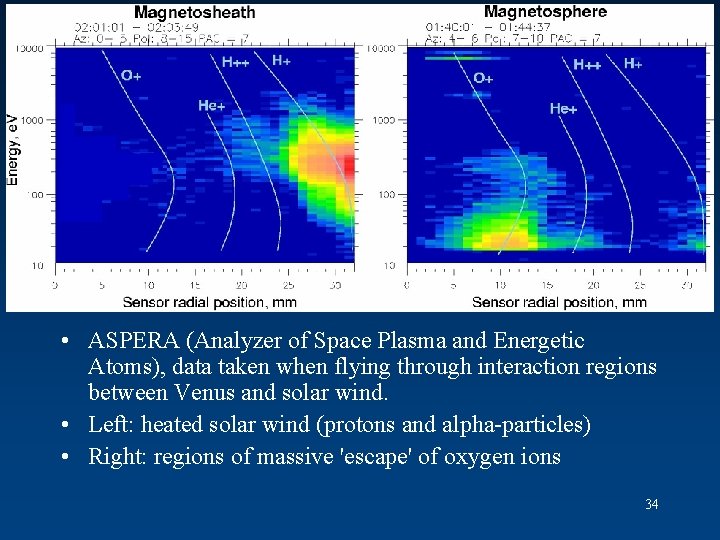
• ASPERA (Analyzer of Space Plasma and Energetic Atoms), data taken when flying through interaction regions between Venus and solar wind. • Left: heated solar wind (protons and alpha-particles) • Right: regions of massive 'escape' of oxygen ions 34
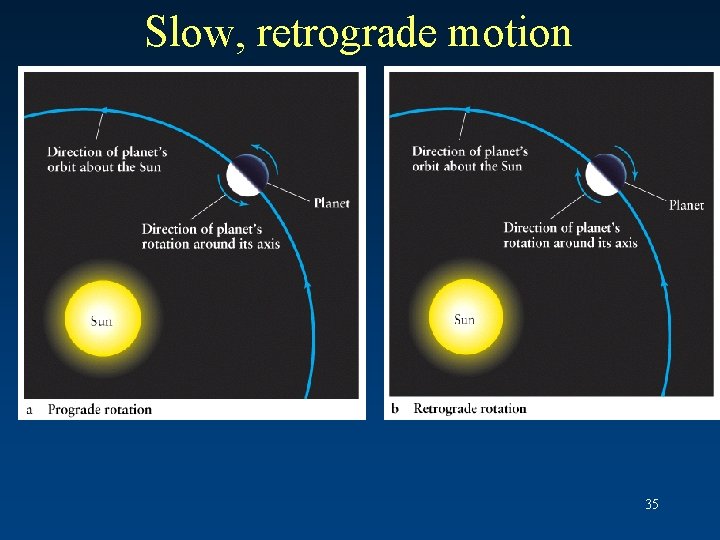
Slow, retrograde motion 35
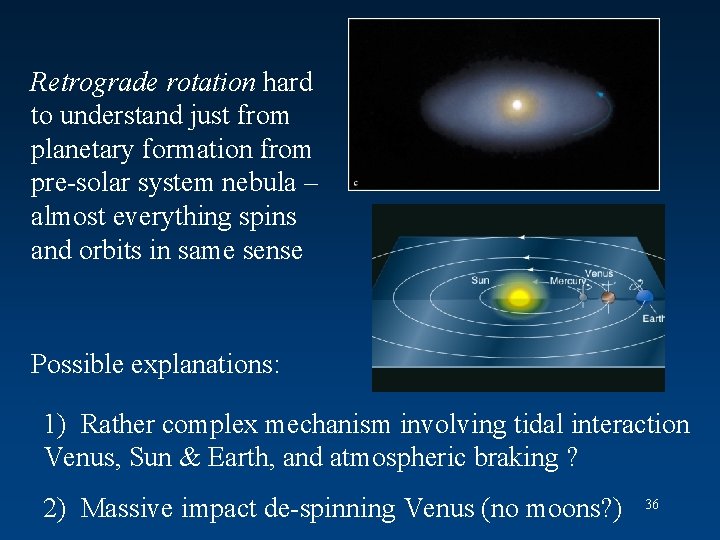
Retrograde rotation hard to understand just from planetary formation from pre-solar system nebula – almost everything spins and orbits in same sense Possible explanations: 1) Rather complex mechanism involving tidal interaction Venus, Sun & Earth, and atmospheric braking ? 2) Massive impact de-spinning Venus (no moons? ) 36
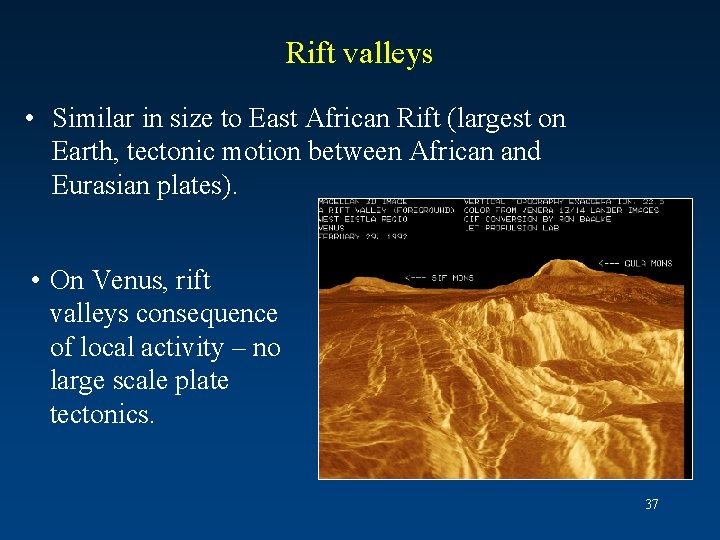
Rift valleys • Similar in size to East African Rift (largest on Earth, tectonic motion between African and Eurasian plates). • On Venus, rift valleys consequence of local activity – no large scale plate tectonics. 37
- Slides: 37